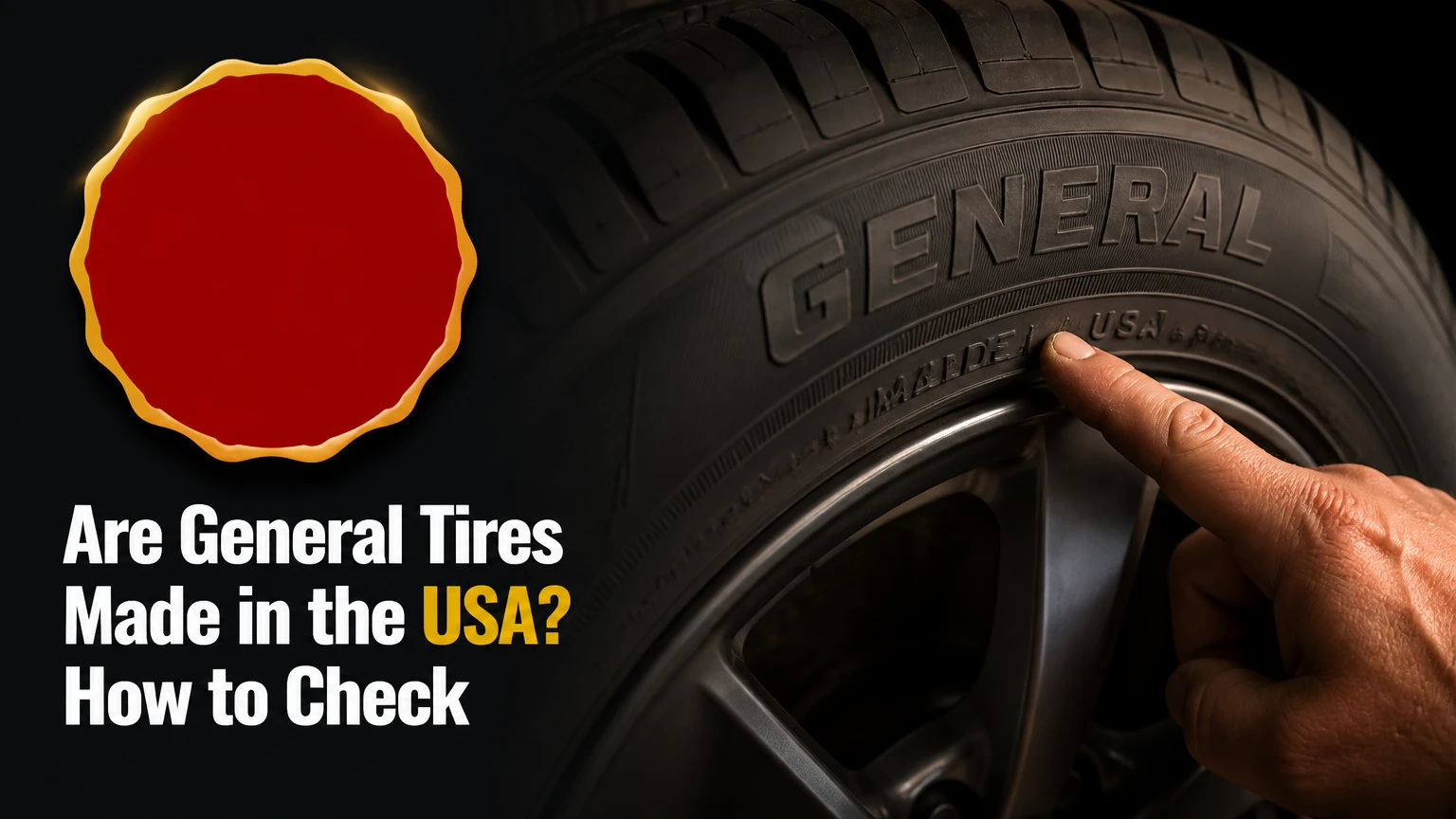
General Tire is an American heritage brand owned by Germany’s Continental AG, and some General tires are manufactured in the United States, including at the Mt. Vernon, Illinois plant. General Tire is not exclusively American-made, however. The country of origin depends on the exact model, tire size, construction, and production plant, so inspect the sidewall before purchase.
Key Facts at a Glance
- General Tire is an American-founded brand that Continental AG has owned since 1987.
- General tires come from a global manufacturing network, not one country.
- Mt. Vernon, Illinois is a major U.S. General Tire manufacturing location.
- The DOT Tire Identification Number identifies the manufacturing plant and production date.
- A model name, such as Grabber or AltiMAX, does not guarantee one country of origin.
- The final four DOT digits identify the production week and year, such as 3523 for week 35 of 2023.
Are General Tires Made in the USA?
Yes, some General tires are made in the USA, but General Tire is not an all-American-made tire brand. Continental’s U.S. production includes General-branded tires made at Mt. Vernon, Illinois, while other General products are manufactured in countries such as Mexico, Brazil, Portugal, Thailand, Indonesia, and other locations in Continental’s international network.
The key distinction is between brand origin and manufacturing origin. General Tire began in the United States in 1915, but Continental AG owns the brand and makes tires according to regional demand, factory capability, available molds, and vehicle fitment requirements. A tire sold by an American retailer can therefore be American-made, Mexican-made, or imported from another Continental facility.
A retailer’s product page may list a country inconsistently because inventory changes. The same model family can also have different origins across sizes, speed ratings, load ranges, or production dates. The sidewall of the actual tire is more reliable than a generic brand statement.
Who Owns General Tire?
Continental AG owns General Tire. Continental acquired General Tire in 1987, bringing the American brand into a German-based tire and automotive technology group.
Ownership does not mean every General tire is made in Germany. Continental operates production facilities in multiple countries and assigns products according to equipment and market requirements. General remains a distinct consumer brand, while its engineering, distribution, warranties, and manufacturing resources connect to Continental’s wider organization.
Where Are General Tires Manufactured?
General tires are manufactured in the United States and at overseas Continental facilities. The country attached to a specific tire can differ by product line, size, and date, so country lists describe the network rather than a permanent origin for every General tire.
Mt. Vernon, Illinois is the U.S. location most relevant to current General replacement tires. The plant has produced passenger, light-truck, SUV, and commercial products, although exact product allocation changes over time. Historic references may also mention Bryan, Ohio, but a historical factory association does not prove that a newly purchased tire came from Bryan.
Common overseas locations appearing in General and Continental manufacturing information include Mexico, Brazil, Portugal, Thailand, and Indonesia. Venezuela also appears in some older or regional plant-code references. The presence of a country in a plant-code directory does not mean every General model is currently produced there.
| Manufacturing location | Country | What the location means for buyers |
|---|---|---|
| Mt. Vernon, Illinois | United States | Major U.S. production site for selected General and Continental tires |
| Mexico | Mexico | Common North American source for selected passenger and truck applications |
| Camaçari | Brazil | South American production location associated with Continental operations |
| Porto | Portugal | European Continental manufacturing location |
| Bangkok | Thailand | Asian production location appearing in tire plant references |
| Bekasi | Indonesia | Asian production location for selected tire production |
| Valencia | Venezuela | Older or regional plant reference that requires current-code confirmation |
Manufacturing allocation is not a quality ranking. A tire made in Portugal is not automatically better than one made in Illinois, and a U.S.-made tire is not automatically the correct tire for a particular vehicle. The engineering specification, certification, size, load index, speed rating, condition, and fitment matter more than the flag on the sidewall.
How Can You Check a General Tire’s Country of Origin?
Check the complete DOT marking on the tire sidewall, then identify the plant code immediately after “DOT” and look for a separate country-of-origin statement. The full DOT string also contains the tire’s manufacturing date, which is essential when comparing old warehouse stock with fresh production.
Use this process:
- Find the DOT marking. Look near the bead, rim, or lower sidewall. One side of a tire may show a shortened DOT string, while the opposite side carries the complete Tire Identification Number.
- Record every character. Photograph the marking before installation. Do not rely on memory because molded characters can be difficult to read.
- Identify the plant code. The first characters after “DOT” identify the factory. Plant identifiers may contain two or three characters depending on the code and regulatory format.
- Check the date code. The final four digits use a week-year format. “3523” means the 35th production week of 2023.
- Look for “Made in” text. A molded statement such as “Made in USA” gives the most direct country confirmation.
- Verify uncertain codes. Use the current NHTSA tire identification resources or ask the manufacturer, because plant assignments and code directories can change.
- Compare all four tires. A replacement set can contain different production dates or origins, particularly when a retailer completes an order from several warehouses.
The U.S. Department of Transportation’s tire-identification regulation, 49 CFR §574.5, states that “the TIN consists of 13 symbols.” Older tires and older references can use different formatting, so a two-character plant code should not be treated as proof that the remaining sidewall characters are irrelevant.
What Do General Tire Plant Codes Mean?
Plant codes connect a tire to a manufacturing facility, but code lists require context and should not replace the actual country marking. Commonly cited examples include A3 for Mt. Vernon, Illinois, 6B and 3C for Mt. Vernon references, A9 for Bryan, Ohio references, AF for Porto, Portugal, CP for Camaçari, Brazil, 6A and 9A for Bangkok, Thailand, and A8 for Bekasi, Indonesia.
| Example plant code | Associated location | Country | Verification caution |
|---|---|---|---|
| A3 | Mt. Vernon, Illinois | United States | Confirm against current NHTSA or manufacturer data |
| 6B | Mt. Vernon, Illinois reference | United States | Code directories may identify legacy formats |
| 3C | Mt. Vernon, Illinois reference | United States | Inspect the complete DOT string |
| AF | Porto | Portugal | Confirms plant association, not tire model quality |
| CP | Camaçari | Brazil | Regional production information may change |
| A8 | Bekasi | Indonesia | Use the full code and country statement where available |
The most dependable buying practice is simple: ask the seller for a photograph of the actual sidewall. A catalog listing that says “General Grabber A/TX” identifies the product, not necessarily the factory that made the individual tire.
Which General Tire Lines Are Commonly Made in the USA?
General’s Grabber, AltiMAX, and G-MAX families can have mixed origins, although U.S. production is particularly relevant to selected truck, SUV, and high-volume replacement applications. No family name guarantees American manufacture across every size.
| General line | Typical vehicle use | Typical specification or feature | Origin expectation |
|---|---|---|---|
| AltiMAX RT45 | Sedans, coupes, minivans | All-season touring, up to 75,000-mile limited warranty on selected sizes | Mixed U.S., Mexico, and other plants |
| AltiMAX 365AW | Cars and crossovers | All-weather design with 3-Peak Mountain Snowflake marking | Mixed, verify each tire |
| Grabber A/TX | Pickups, SUVs, Jeeps | All-terrain tread, selected sizes with severe-snow rating | U.S. production common in selected applications |
| Grabber X3 | Off-road trucks and SUVs | Mud-terrain tread, 3-Peak rating on applicable sizes | Mixed, verify sidewall |
| G-MAX AS-05 | Performance sedans | Ultra-high-performance all-season tire | Often imported, but size-specific |
| G-MAX RS | Performance cars | Summer ultra-high-performance tire | Often imported, depending on size and market |
Are AltiMAX Tires Made in the USA?
Some AltiMAX tires may be made in the United States, but AltiMAX is not uniformly American-made. RT45, RT43, and other AltiMAX products can have different origins by tire size, and a buyer should inspect the exact stock being offered.
Touring tires are produced in large volumes for many regional markets. That makes production allocation especially sensitive to demand and warehouse inventory. A 205/55R16 tire for a compact sedan may come from a different facility than a 225/65R17 tire for a crossover, even when both carry an AltiMAX name.
Are Grabber Tires Made in America?
Selected Grabber tires are commonly made at U.S. facilities, including Mt. Vernon, Illinois, but a Grabber label alone cannot establish U.S. origin. Grabber tires are offered in many diameters, load ranges, and constructions, which increases the chance of mixed manufacturing sources.
The A/TX suits drivers who need highway manners with gravel, dirt-road, and light-trail capability. The X3 favors deeper off-road use and accepts more road noise, tread weight, and pavement wear. Country of manufacture should be a final verification step, not a substitute for choosing the correct casing and tread.
What Do General Tires Cost?
Typical U.S. retail pricing ranges from about $100-$180 per tire for common AltiMAX sizes, $160-$340 for G-MAX performance sizes, and $170-$620 for large Grabber truck and off-road sizes. Installation, disposal, taxes, wheel balancing, alignment, and optional road-hazard coverage can add $80-$200 per set.
Prices vary sharply with diameter, load range, run-flat construction, seasonal demand, and retailer promotions. A 15-inch touring tire and a 35-inch mud-terrain tire are not meaningful price comparisons, even when both carry the General name.
| Product example | Typical price per tire | Typical mileage or use | Main extra cost to budget |
|---|---|---|---|
| AltiMAX RT45, 15-17 inch | $100-$180 | Up to 75,000-mile warranty on selected sizes | $20-$40 installation |
| AltiMAX 365AW | $115-$210 | All-weather commuting | $20-$40 installation |
| G-MAX AS-05 | $160-$300 | Performance all-season driving | $25-$45 installation |
| Grabber A/TX, 16-20 inch | $170-$360 | Highway, gravel, light trails | $25-$50 installation |
| Grabber X3, large truck sizes | $250-$620 | Mud and technical off-road terrain | $30-$60 installation |
Warranty mileage is not a guaranteed service life. General’s limited warranty terms depend on the exact size and product, and correct inflation, rotation, alignment, vehicle condition, and remaining tread determine whether a claim is valid.
Are General Tires Good for Snow and Winter Driving?
General tires range from ordinary all-season designs to severe-snow-rated all-weather and all-terrain products. A tire qualifies for severe-snow service when it carries the Three-Peak Mountain Snowflake symbol, but the symbol does not make every General tire a dedicated winter tire.
The G-MAX AS-05 is an all-season performance tire, not a dedicated snow tire. The Grabber A/TX and AltiMAX 365AW can carry the Three-Peak Mountain Snowflake marking in applicable sizes, while exact certification must be checked on the sidewall and product specification.
| Tire type | Snow designation | Best conditions | Limitation |
|---|---|---|---|
| AltiMAX RT45 | M+S or all-season labeling, size-dependent | Rain, mild winter, dry commuting | Not a dedicated deep-snow tire |
| AltiMAX 365AW | 3PMSF on applicable sizes | Cold weather, slush, moderate snow | Less specialized than a winter tire |
| Grabber A/TX | 3PMSF on applicable sizes | Snow, gravel, mixed truck use | More noise and rolling resistance |
| G-MAX AS-05 | All-season performance | Dry roads, rain, mild cold | Not intended for severe winter conditions |
| Dedicated winter tire | 3PMSF | Ice, packed snow, sustained cold | Seasonal changeover and storage required |
Temperature matters as much as tread appearance. A winter compound remains flexible in colder conditions, whereas an all-season performance compound can lose traction as temperatures fall even when the tread still looks substantial.
How Does General Compare With Other Brands?
General generally occupies the value-to-midrange position below Continental’s premium passenger branding and below the highest-priced Michelin, Bridgestone, and Goodyear offerings. General can reduce purchase cost, but buyers should compare independent test results, warranty terms, wet braking, noise, and the exact tire category rather than comparing brand names alone.
Continental’s relationship with General does not mean a General tire is simply a cheaper Continental model. The products can use different compounds, tread patterns, casings, warranties, and target markets. A General touring tire may be a sensible commuter purchase, while a premium grand-touring tire may provide quieter operation or more refined wet handling.
| Decision factor | General Tire | Premium alternative | Practical consequence |
|---|---|---|---|
| Typical touring price | $100-$180 per tire | $150-$260 per tire | General usually lowers initial cost |
| Touring warranty | Up to 75,000 miles on selected RT45 sizes | Often 70,000-90,000 miles | Read model-specific exclusions |
| Severe-snow options | AltiMAX 365AW, selected Grabber sizes | Broad winter and all-weather range | Verify 3PMSF on the exact size |
| Off-road range | Grabber A/TX and X3 | Varies by premium competitor | General offers strong category coverage |
| Performance range | G-MAX AS-05 and RS | Larger premium UHP selection | Premium tires may improve steering precision |
| Manufacturing origin | U.S. and international | Also globally manufactured | Brand nationality does not settle origin |
General is often a rational choice when the vehicle is a daily commuter and the buyer values initial price, warranty mileage, and broad availability. A premium tire becomes easier to justify when braking distance, cabin quietness, high-speed control, or severe-weather performance carries more weight than purchase price.
Which General Tire Should You Choose?
Choose the General model by vehicle type, climate, road surface, and driving priority, then verify the country of origin only after confirming the tire’s size and rating. A U.S.-made tire in the wrong category is a worse purchase than an imported tire with the correct wet, snow, or load performance.
Daily Commuter
Choose the AltiMAX RT45 for ordinary sedan, coupe, and minivan use when long treadwear and low purchase cost matter most. Confirm the vehicle’s original size, load index, speed rating, and the warranty applicable to that exact size.
The RT45 is not the right answer for sustained mountain snow or aggressive driving. Drivers in areas with frequent snow should consider the AltiMAX 365AW or a dedicated winter tire instead.
Pickup and SUV Driver
Choose the Grabber A/TX when the vehicle spends most of its time on pavement but regularly travels gravel roads, construction access roads, campsites, or moderate trails. The tread gives more loose-surface control than a highway tire while retaining reasonable road behavior.
Choose the Grabber X3 only when off-road traction outweighs highway quietness, fuel economy, and tread life. Mud-terrain tread can become an expensive compromise for a truck that spends 90% of its miles commuting.
Performance Sedan Driver
Choose the G-MAX AS-05 for an affordable performance all-season tire that can handle rain and spirited road driving. Choose the G-MAX RS only when warm-weather grip and steering response matter more than cold-weather versatility.
Neither model should be selected solely because the sidewall says General or because the tire was made in a particular country. The vehicle’s brake system, suspension geometry, alignment, and intended speed determine whether the performance category is appropriate.
What Problems Can Mislead Buyers?
The most common General tire buying mistakes involve assuming the model name proves origin, ignoring tire age, overlooking a mismatched rating, and treating uneven wear as a tire defect. These errors can waste money because a manufacturing-country preference cannot correct incorrect fitment or poor vehicle maintenance.
- Assuming every Grabber is U.S.-made. Check the actual DOT string and country statement.
- Rejecting a tire because the code looks unfamiliar. Verify the code before concluding that the tire is imported or counterfeit.
- Ignoring the production date. Tire age matters even when tread is unused. NHTSA recommends replacing tires when they are six years old, while some manufacturers recommend earlier replacement; follow the tire maker and vehicle guidance.
- Buying an unapproved size. A tire can fit the wheel but still have an unsuitable load index, speed rating, diameter, or clearance.
- Skipping alignment checks. Cupping, feathering, and shoulder wear can create noise within a few thousand miles.
- Treating all-season as winter-rated. Look for the Three-Peak Mountain Snowflake symbol, not merely the M+S marking.
Why Does a New Tire Become Noisy?
Uneven wear usually causes a new General tire to become noisy, especially when misalignment, worn suspension parts, incorrect inflation, or poor rotation intervals create alternating high and low tread blocks. A roaring sound that changes with road speed but not engine speed often indicates tire or wheel-related noise.
Rotate tires at the vehicle manufacturer’s recommended interval, commonly every 5,000-8,000 miles when no interval is specified. Check cold pressure monthly with a gauge, because the door-jamb label, not the maximum pressure molded into the sidewall, provides the correct vehicle setting.
An alignment is especially important after replacing worn tires or hitting a pothole. If cupping has already removed substantial tread, correcting the alignment prevents further damage but cannot restore the worn rubber.
How Old Is Too Old for a New General Tire?
A tire with four unused years is not automatically unsafe, but buyers should request a fresher tire when the price is presented as current inventory. The last four DOT digits provide the production week and year, allowing a buyer to compare stock age before installation.
A practical purchasing rule is to seek tires less than two years old when comparable inventory is available, particularly for low-mileage vehicles. For tires already in service, inspect for cracks, bulges, vibration, pressure loss, and tread damage, then follow the manufacturer’s age recommendation rather than relying on appearance alone.
How Should You Buy a U.S.-Made General Tire?
Buy by exact tire specification first, request the DOT and country marking second, and accept or reject the tire before mounting. This three-stage process prevents a retailer from substituting a different size or shipping a tire whose origin does not meet your requirement.
Use this checklist:
- Write down the vehicle’s approved size, load index, and speed rating.
- Select the General model appropriate for pavement, snow, towing, or off-road use.
- Ask whether the seller can provide the current sidewall country marking.
- Request the four-digit date code before installation.
- Confirm that all four tires have compatible specifications.
- Inspect bead, sidewall, and tread for damage during installation.
- Save the invoice and photograph the DOT marking for warranty records.
- Recheck inflation after the vehicle has sat overnight.
Retailers may not guarantee a country of origin because warehouse inventory changes. If American manufacture is a firm requirement, purchase only when the seller confirms the actual tire’s marking, not when a search filter or generic product description implies U.S. production.
Frequently Asked Questions
Is General Tire an American company?
General Tire is an American-founded tire brand, established in 1915, but Continental AG has owned it since 1987. The brand’s historical nationality and the factory country on an individual tire are separate facts. General tires sold in the United States can be manufactured domestically or imported from Continental facilities abroad.
Are General tires made by Continental?
Continental AG owns General Tire and supplies the corporate manufacturing and distribution network behind the brand. The relationship does not mean every General tire uses the same construction as a Continental-branded tire. General products have their own model specifications, compounds, tread designs, and warranty terms.
Are General tires made in Mexico?
Some General tires are made in Mexico, although the exact origin depends on model, size, production date, and factory allocation. A Mexican-made General tire is not defective because of its origin. Verify the actual tire’s DOT plant code and “Made in” marking when country matters.
Does a DOT code prove a tire is safe?
A DOT code identifies regulatory registration, the manufacturing plant, and the production date; it does not by itself certify that the tire is suitable for every vehicle or condition. Correct size, load index, speed rating, inflation, condition, and vehicle maintenance still determine safe use.
Are General tires cheaper than Michelin tires?
General tires commonly cost less than comparable Michelin tires, with typical General touring prices around $100-$180 per tire and premium touring prices often higher. The final value depends on treadwear, wet braking, ride noise, warranty coverage, local pricing, and whether the tire suits the vehicle’s climate.
Should you buy a General tire made outside the USA?
Yes, if the tire has the correct specification, current production date, proper certification, and suitable performance for your driving conditions. Manufacturing country is a legitimate purchasing preference, but it is not a reliable standalone measure of safety, durability, or ride quality.
The Bottom Line
Are General tires made in the USA? Some are, especially selected products from the Mt. Vernon, Illinois manufacturing operation, but General Tire has a global supply chain and does not make every tire domestically. Check the actual sidewall’s DOT plant code, four-digit date code, and country-of-origin marking before buying. Choose the tire’s size, load rating, weather capability, and intended use first, then use manufacturing origin as the final decision factor.