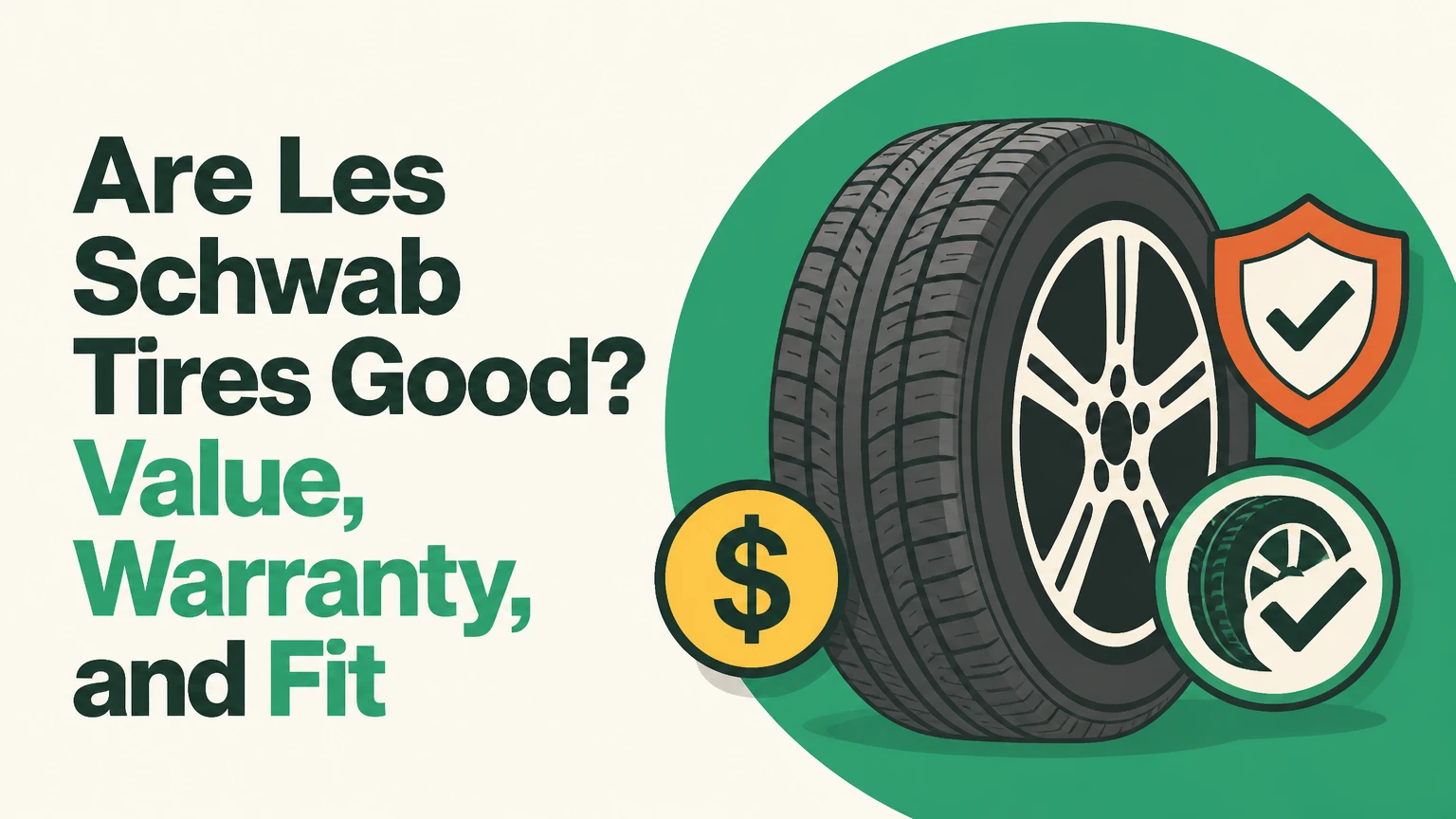
Les Schwab tires can be good, especially for drivers who value professional installation, convenient maintenance, and road-hazard support more than the lowest purchase price. The retailer’s house brands, including Mazama, Caldera, and Dean, offer useful options, but tire quality still depends on the specific model, vehicle, climate, load, and driving habits.
Key Facts at a Glance
- Les Schwab’s strongest differentiator is its bundled service, including installation, rotations, balancing, air checks, and flat repairs under stated conditions.
- Mazama, Caldera, and Dean are Les Schwab house brands produced by contract manufacturers to specifications set by Les Schwab.
- Typical prices range from approximately $120-$150 for budget tires to about $259 per tire for a premium crossover-size house-brand tire.
- A treadwear warranty is a mileage promise with conditions, not a guarantee that a tire will physically last that many miles.
- Les Schwab’s road-hazard and service value is highest near its Western U.S. store network.
- Michelin, Continental, Goodyear, and other major brands may be available when a vehicle requires a specialized tire or independently tested model.
Are Les Schwab Tires Good Overall?
Les Schwab tires are a reasonable choice for everyday commuting, SUVs, light trucks, and buyers who want a single retailer to handle tire maintenance. The purchase is often more expensive at checkout than an online tire order, but the included service can reduce ownership friction and sometimes narrow the total-cost gap.
Les Schwab’s retail operation received strong recognition for installation quality and sales service in Consumer Reports’ 2026 retailer ratings, according to Les Schwab’s published announcement. That result evaluates the retailer experience, not every Mazama, Caldera, Dean, Michelin, or Goodyear tire sold in every location.
The distinction matters. A helpful salesperson cannot compensate for the wrong load index, an unsuitable winter rating, or a tire whose tread design conflicts with your driving conditions. Tire quality is therefore a product-level question, while Les Schwab’s greatest advantage is a retailer-level service system.
What does Les Schwab do especially well?
Les Schwab performs best when the buyer needs ongoing local support. A driver can typically return to a participating store for pressure checks, rotations, balancing, puncture evaluation, and other covered services instead of arranging each task independently.
Les Schwab also simplifies tire selection by matching the vehicle, original-equipment size, regional weather, annual mileage, and hauling needs. That process is valuable for buyers who know their vehicle but do not know how load index, speed rating, tread compound, and 3PMSF certification affect performance.
The main limitation is geographic. Les Schwab has more than 610 locations, but the network is concentrated in the Western United States. A warranty that is convenient in Oregon, Washington, Idaho, Montana, or California is less convenient if a puncture occurs during a cross-country trip.
How Does the Les Schwab Tire Model Work?
Les Schwab combines tire sales with an installation and maintenance package, while its private-label products are designed or specified for the retailer and manufactured by outside factories. The customer usually pays a higher retail price in exchange for service access, warranty administration, and local support.
The exact package varies by tire, vehicle, store, and current policy. Ask for a written out-the-door quote rather than assuming every advertised benefit applies identically to every purchase.
What is included with a typical purchase?
A typical Les Schwab installation package may include mounting, wheel balancing, valve-stem replacement, tire disposal, pressure setting, and tire installation. Lifetime or ongoing services can include rotations, rebalancing, flat repairs, and air checks, subject to the applicable warranty terms.
| Service or benefit | Typical coverage | Practical condition to verify |
|---|---|---|
| Mounting and installation | Included with many purchases | Confirm for carry-in tires and specialty wheels |
| Dynamic wheel balancing | Included with qualifying purchases | Rebalancing may require inspection or appointment |
| Valve stems | New stems commonly included | TPMS sensors are separate components |
| Tire disposal | Commonly included | Confirm fees for unusual or oversized tires |
| Rotations | Often free during tire life | Correct interval and recordkeeping may apply |
| Flat repair | Often free when safely repairable | Sidewall and shoulder damage usually cannot be repaired |
| Air checks | Commonly free at stores | Correct pressure comes from the vehicle placard |
| Road-hazard replacement | Policy-dependent | Read exclusions, tread limits, and geographic terms |
Les Schwab’s service package is valuable only when the owner uses it. A driver who never rotates tires, checks pressure, or returns for inspections has paid for benefits that may not reduce costs.
Are Les Schwab house-brand tires made by Les Schwab?
Les Schwab house-brand tires are generally manufactured by third-party factories under specifications established for Les Schwab. Les Schwab’s brand pages identify products such as Mazama, Caldera, and Dean, but the private-label structure means the brand name alone does not reveal the exact factory, compound, carcass design, or independent test performance.
That does not make a tire unsafe or automatically inferior. Many retailers use private-label manufacturing, and a tire must still meet applicable U.S. Federal Motor Vehicle Safety Standards. It does mean buyers should judge the individual model by size, rating, warranty, intended use, reviews, and fitment rather than assuming a house brand equals Michelin or Continental technology.
Which Les Schwab Tire Brands and Models Fit Different Drivers?
Mazama generally occupies the retailer’s higher-positioned house-brand range, Caldera targets value-oriented passenger applications, and Dean includes practical truck and all-terrain choices. The correct selection depends more on use case and tire specification than on the brand tier printed on the sidewall.
| Tire line or example | Intended vehicle or use | Published or typical warranty | Best match |
|---|---|---|---|
| Mazama Reputation 2 | Cars, crossovers, all-season highway use | Up to 80,000 miles | Daily commuting and long highway mileage |
| Caldera Confidence All Season | Passenger cars and small crossovers | About 50,000 miles | Budget-conscious normal-weather driving |
| Mazama Open Range A/T Plus | Pickups, SUVs, dirt, gravel, mixed terrain | About 60,000-65,000 miles | Drivers combining pavement and trails |
| Mazama Open Range HTS | Highway pickup and SUV applications | Up to 80,000 miles | Highway driving and moderate towing |
| Dean Back Country A/T 2 | Light trucks and SUVs | Model-specific | Lower-cost all-terrain use |
| Michelin, Continental, Goodyear | Broad passenger, touring, winter, and performance categories | Model-specific | Buyers seeking established model-level testing |
Is Mazama a premium tire?
Mazama is positioned as a premium house-brand line within Les Schwab, but the label does not prove that every Mazama model equals a premium-brand competitor. A Mazama tire may offer a strong warranty, quiet highway behavior, and good value when the bundled service matters, while a Michelin or Continental model may provide more published independent testing or a more specialized performance profile.
The Mazama Reputation 2, for example, is marketed for all-season passenger and crossover use with an up-to-80,000-mile treadwear warranty in applicable sizes. That specification supports long-mileage commuting, but it does not make the tire a winter tire, a track tire, or a substitute for a severe-snow-rated design.
Is Caldera good for budget buyers?
Caldera can suit a budget buyer who wants a lower initial price while retaining access to Les Schwab’s service network. A typical Caldera Confidence All Season price may fall near $120-$150 per tire, although size, promotions, taxes, installation, and vehicle requirements change the final quote.
Budget tires have trade-offs. They may provide adequate dry-road commuting and wet-weather performance for ordinary driving, yet they may have less independent test coverage, less precise steering, shorter warranties, or weaker cold-weather behavior than a well-regarded premium model.
Are Les Schwab all-terrain tires good for trucks?
Les Schwab all-terrain tires can work well for pickups and SUVs that divide their time between paved roads, gravel, construction access roads, and moderate trails. The Mazama Open Range A/T Plus includes versions with the Three-Peak Mountain Snowflake, or 3PMSF, severe-snow certification, while the Dean Back Country A/T 2 targets a more value-oriented all-terrain buyer.
All-terrain tread cannot erase load, traction, or braking limits. Check the tire’s load range, load index, speed rating, rim width, and actual 3PMSF marking before towing, carrying a camper, or driving in mountain snow.
How Much Do Les Schwab Tires Cost?
A typical Les Schwab tire purchase may cost about $120-$259 per tire before the final vehicle-specific total is known. A four-tire package with installation and a possible four-wheel alignment commonly reaches approximately $940-$1,050 for a premium crossover application, but size and required services can move the price substantially.
| Purchase level | Typical price per tire | Typical four-tire subtotal | Common application |
|---|---|---|---|
| Budget all-season | $120-$150 | $480-$600 | Compact car or basic commuter |
| Midrange house brand | $150-$210 | $600-$840 | Sedan, crossover, or light SUV |
| Premium house brand | About $259 | About $1,036 | Larger crossover or premium touring size |
| Mainstream premium brand | $180-$350 | $720-$1,400 | Michelin, Continental, or Goodyear fitments |
| Alignment when required | About $100-$200 typical | Add to package | Uneven wear, pull, or steering correction |
These figures are planning ranges, not a universal price list. Wheel size, run-flat construction, specialty load ratings, taxes, shop supplies, alignment requirements, and promotions affect the invoice.
Is Les Schwab more expensive than Costco or online tire sellers?
Les Schwab is often more expensive at checkout than an online seller or warehouse club when comparing only the tire itself. The comparison changes when installation, disposal, rotations, balancing, flat repairs, road-hazard coverage, and travel distance are included.
Costco may offer competitive premium-brand pricing and warehouse-club benefits, while Discount Tire often has a broad inventory and strong nationwide support. Online retailers can provide the widest model selection, but the customer must coordinate shipping, installation, warranty claims, and maintenance with separate businesses.
| Buying channel | Typical strength | Typical limitation | Best fit |
|---|---|---|---|
| Les Schwab | Local installation and bundled maintenance | Western U.S. concentration | Owners near a store who value service |
| Costco | Premium-brand pricing and warehouse benefits | Membership and appointment availability | Costco members buying mainstream brands |
| Discount Tire | Broad inventory and multi-state support | Service terms vary by market | Travelers needing larger network access |
| Online retailer | Model selection and frequent price competition | Separate installer and warranty process | Informed buyers comparing exact models |
| Dealership | Vehicle-specific fitment and records | Frequently higher labor pricing | Lease, warranty, or specialty vehicle needs |
What Does the Les Schwab Warranty Cover?
Les Schwab warranty benefits may include treadwear protection, road-hazard assistance, free rotations, balancing, air checks, and repairable flat fixes, but coverage depends on the tire, purchase record, maintenance history, and written terms. Unrepairable damage is not automatically covered in every circumstance.
The advertised 60-day satisfaction guarantee can allow an exchange when the buyer dislikes the ride, handling, or noise, provided the tire meets conditions such as less than 2/32 inch of tread wear. Confirm whether the replacement is equal, higher, or lower in price and whether labor or prorating applies.
What commonly voids or reduces tire coverage?
The most common problems are improper inflation, missed rotations, overloaded vehicles, misalignment, racing or commercial misuse, irregular wear, and failure to keep service records. Road-hazard coverage usually distinguishes a repairable puncture from damage caused by a curb, collision, vandalism, underinflation, or a damaged wheel.
Keep the invoice, but also ensure the purchase is attached to the correct phone number or digital customer profile. A store can often retrieve records electronically, yet accurate account information reduces delays when a tire needs inspection or replacement.
Does a treadwear warranty mean the tire will last that mileage?
A treadwear warranty does not guarantee that a tire will reach its stated mileage. The warranty normally provides a prorated credit when the tire wears out before the published mileage, and the credit can depend on uniform rotation, inflation, alignment, the original tread depth, and the remaining usable tread.
A tire rated for 80,000 miles may wear faster on a heavy crossover, an aggressively driven pickup, or a vehicle with poor alignment. Tire wear is a maintenance outcome, not a number printed on the sidewall.
Are Les Schwab Tires Good in Snow, Rain, and Heat?
Les Schwab offers suitable all-season, all-terrain, and severe-snow-rated products, but no Les Schwab tire is automatically appropriate for every climate. Rain performance depends on tread design and condition, while snow performance depends on rubber compound, siping, temperature, and the 3PMSF certification where severe winter conditions justify it.
A normal all-season tire can be adequate in mild rain and occasional light snow. Drivers facing repeated ice, packed snow, or temperatures below roughly 45°F should compare a dedicated winter tire or a severe-snow-rated all-weather tire rather than relying on a long treadwear warranty.
Expert rule: never use the warranty mileage as a weather-performance proxy. A long-lasting tire can still brake poorly on ice if its compound is not designed for low temperatures.
Are Les Schwab Tires Good for Towing and Work Trucks?
Les Schwab offers highway-terrain and all-terrain tires that can suit light towing and work-truck use when the tire’s load rating matches the vehicle and trailer demands. The Mazama Open Range HTS favors highway stability, while an A/T tire offers more loose-surface traction at the cost of additional noise and rolling resistance.
Before purchase, compare the driver-door tire placard, the owner’s manual, axle ratings, trailer tongue weight, and the tire sidewall load index. A tire with an attractive 80,000-mile warranty can still be the wrong choice if its load capacity is insufficient.
Choose a highway-terrain design for mostly paved towing. Choose an all-terrain design when gravel, mud, construction sites, or trail access are regular parts of the route.
What Are the Main Problems With Les Schwab Tires?
The main drawbacks are higher initial pricing, limited independent testing for some house-brand models, regional service concentration, and possible confusion about what the warranty actually covers. These disadvantages matter more to long-distance travelers, performance drivers, and buyers who prioritize exact model comparisons over retailer convenience.
Expert mistakes to avoid
- Comparing only the tire price. Request an out-the-door quote that lists mounting, balancing, disposal, alignment, taxes, warranty terms, and future maintenance.
- Treating every Mazama model as equivalent. Compare the exact model, size, load index, speed rating, 3PMSF status, and warranty.
- Ignoring pressure after installation. Use the vehicle placard, not the maximum pressure molded into the sidewall.
- Assuming free service is nationwide. Confirm where a road-hazard claim can be processed before a major trip.
- Accepting an alignment without evidence. Ask for before-and-after readings when uneven wear, steering pull, or a recent impact suggests alignment damage.
A particularly counterintuitive point is that free lifetime balancing does not correct a bent wheel, worn suspension component, or separated tire belt. Rebalancing can temporarily mask a mechanical problem while irregular wear continues.
Which Alternatives Should You Compare?
Compare Les Schwab with Costco, Discount Tire, online retailers, dealerships, and independent tire shops using the same exact tire size and service scope. The best alternative depends on whether your priority is premium-brand testing, lowest installed cost, nationwide support, or a nearby shop that knows your vehicle.
When is Costco a better choice?
Costco may be better for members who want Michelin, Bridgestone, or other mainstream brands at competitive installed pricing and who can obtain appointments conveniently. Costco’s tire center can be less attractive when appointment availability is poor or when the nearest warehouse is far from home.
When is Discount Tire a better choice?
Discount Tire may be better for drivers who travel across multiple states and want a larger service footprint. Its inventory and protection-plan terms vary, so compare the written policy with Les Schwab’s road-hazard coverage instead of assuming either retailer is universally superior.
When is an online retailer a better choice?
An online retailer may be better for an informed buyer seeking a specific tire, uncommon size, run-flat design, winter model, or performance compound. The buyer must separately confirm the installer’s disposal fee, TPMS handling, alignment policy, warranty process, and ability to service replacement claims.
Who Should Buy Les Schwab Tires?
Les Schwab is strongest for drivers near a store who want convenient maintenance, clear staff guidance, and a bundled ownership experience. Les Schwab is less compelling for buyers who travel far outside the Western network, need a niche performance tire, or can confidently manage installation and warranty claims through separate providers.
| Driver situation | Les Schwab fit | Better buying emphasis | Recommended direction |
|---|---|---|---|
| Daily commuter near a store | Strong | Quiet ride and mileage | Compare Mazama Reputation 2 with touring competitors |
| Budget compact-car owner | Moderate to strong | Installed price | Price Caldera against online and warehouse options |
| Pickup used on pavement | Strong | Load rating and stability | Compare Open Range HTS with highway-terrain brands |
| Frequent mountain-snow driver | Conditional | 3PMSF or winter compound | Verify severe-snow certification or buy winter tires |
| Cross-country traveler | Conditional | Nationwide claim access | Compare Discount Tire or a national dealer network |
| Performance-car owner | Weak to conditional | Independent testing and handling | Shop exact Michelin, Continental, Bridgestone, or equivalent models |
| EV owner | Conditional | Weight, efficiency, noise, EV fitment | Confirm load index, acoustic design, and EV approval |
Les Schwab is not the automatic best choice for a track car, a high-performance sports sedan, or a driver who needs a specialized winter tire with extensive independent test data. The service package cannot replace a tire engineered for the vehicle’s actual operating envelope.
How Should You Buy Tires at Les Schwab?
Use the vehicle placard and owner’s manual first, then request an itemized quote for at least two exact tire models. Compare the complete package, including tire price, installation, alignment, protection, maintenance, replacement terms, and store access.
Follow these steps:
- Record the required size and ratings. Write down tire size, load index, speed rating, and any run-flat or original-equipment requirement.
- Describe the real use case. State annual mileage, highway percentage, snow exposure, gravel use, towing weight, and acceptable road noise.
- Request two or three exact models. Ask for a budget, midrange, and premium option in the same required size.
- Demand an out-the-door quote. Confirm every fee and whether rotations, balancing, flat repairs, and road-hazard replacement are included.
- Ask about fitment limitations. Verify wheel compatibility, TPMS service, vehicle alignment, and whether all four tires must be replaced together.
- Schedule maintenance. Check pressure monthly and rotate at the interval stated by the retailer or vehicle manufacturer, commonly 5,000-8,000 miles.
- Inspect the result. Confirm cold pressure, torque, valve-stem condition, and that the vehicle does not pull or vibrate after installation.
You will know the purchase is properly matched when the tire meets the placard ratings, the invoice states the warranty terms, the vehicle tracks straight, and the quote remains competitive after included services are counted.
Frequently Asked Questions
Are Les Schwab tires made in the USA?
Les Schwab house-brand tires are manufactured through outside production partners, and the country of manufacture can vary by model and size. Check the tire sidewall and retailer documentation for the specific origin. Country of manufacture alone does not establish safety or performance quality.
How long do Les Schwab tires usually last?
Les Schwab tire warranties commonly range from about 50,000 to 80,000 miles for applicable passenger and highway models, while actual service life varies with pressure, alignment, rotation, load, climate, and driving style. Replace tires at the legal or manufacturer wear limit, with 2/32 inch commonly used as the minimum tread threshold.
Can Les Schwab repair a nail in a tire?
Les Schwab can often repair a puncture in the tread’s repairable area when the tire has not been driven severely underinflated and the damage meets industry repair limits. Shoulder and sidewall punctures generally require replacement because those areas flex too much for a safe permanent repair.
Do Les Schwab tires include alignment?
A tire purchase does not automatically mean every alignment is included. Some packages or promotions may bundle alignment, but the quote should identify alignment separately, including whether the shop measured the vehicle and whether adjustment is possible on the affected axle.
Are Les Schwab tires good for an electric vehicle?
Les Schwab can supply suitable EV tires when the exact size, load index, speed rating, noise profile, and vehicle requirements are matched. EVs place greater demands on tire load capacity and tread wear because of battery weight and instant torque, so choose the model rather than the retailer name alone.
Can I use Les Schwab’s warranty outside its normal region?
Warranty access outside the Western Les Schwab network may be limited or require additional coordination. Before a long trip, ask how an out-of-area inspection, road-hazard replacement, or prorated claim would be handled and keep the invoice and digital account information available.
The Bottom Line
Are Les Schwab tires good? Yes, for many commuters, families, SUV owners, and light-truck drivers who live near Les Schwab and will use the included maintenance. The retailer’s strongest value is service continuity, not proof that every house-brand tire beats every Michelin, Continental, Goodyear, Costco, or online alternative.
Choose the exact tire by vehicle rating, weather, terrain, load, noise tolerance, and independent evidence where available. Then compare the complete installed price and warranty terms. Les Schwab is a strong service-centered purchase, but it is not automatically the lowest-cost or highest-performing choice for every driver.