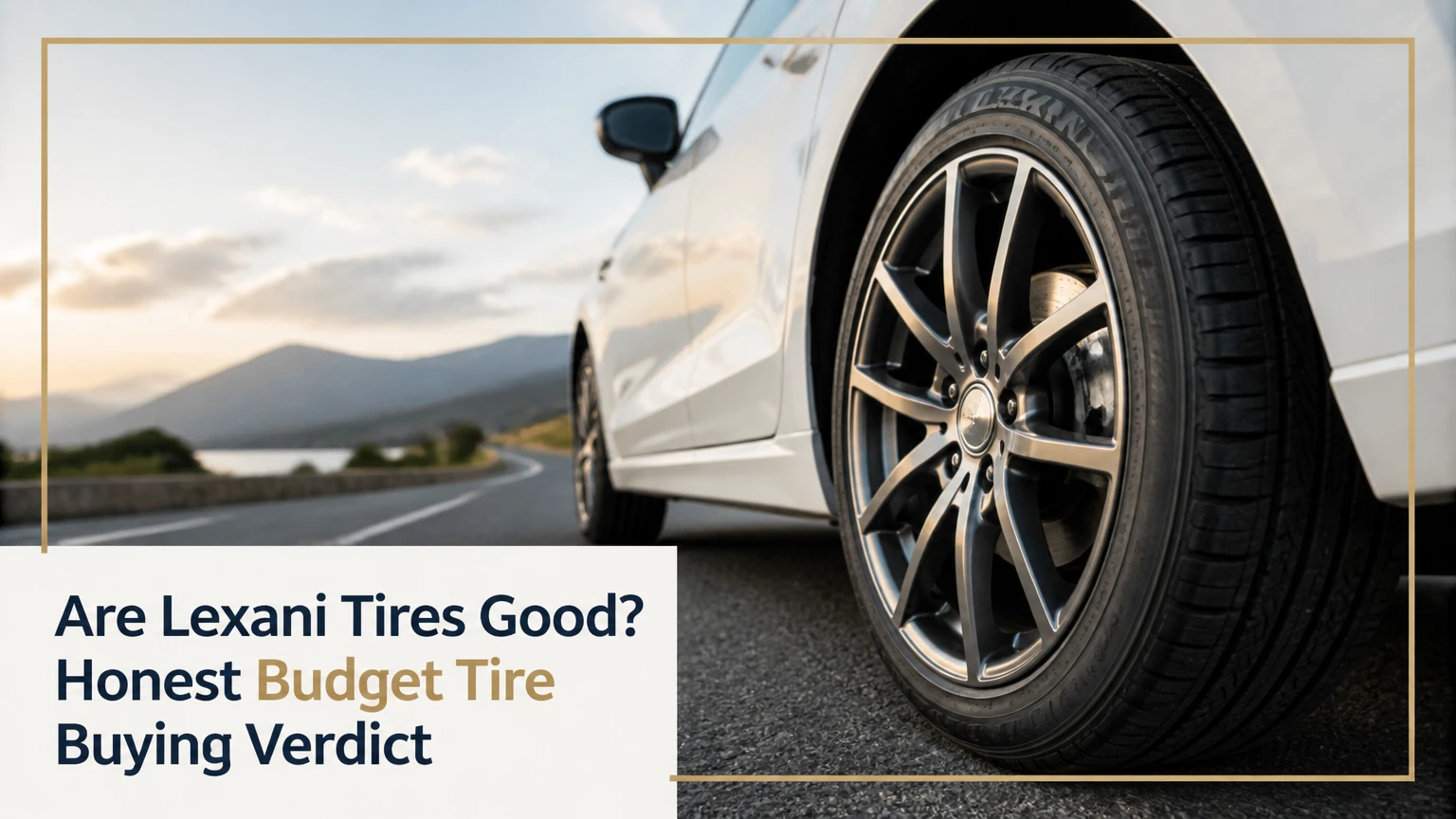
Lexani tires are acceptable budget tires for normal city and highway commuting when the exact model has the correct size, load index, speed rating, and recent DOT date. Lexani tires usually prioritize low purchase cost, large-wheel fitments, and aggressive styling over premium wet braking, winter traction, quietness, and long-term tread life.
Key Facts at a Glance
- Lexani is a value-oriented tire brand with passenger, UHP, SUV, and all-terrain models.
- Lexani tires can provide satisfactory dry-road traction for ordinary commuting at approximately $80-$330 per tire before installation.
- Lexani tires are not a universal substitute for Michelin, Continental, Bridgestone, or other premium tires.
- A 55,000-mile limited warranty on one model does not guarantee 55,000 miles of service on every vehicle.
- All-season Lexani tires should not be treated as dedicated snow tires unless the sidewall carries the 3-Peak Mountain Snowflake symbol.
- Correct inflation, alignment, rotation, load capacity, and tire age often matter more than the brand name alone.
Are Lexani Tires Good for Daily Driving?
Lexani tires are good enough for many budget-conscious daily drivers who mainly use dry roads, urban streets, and moderate-speed highways. Lexani tires become a weaker choice when the vehicle regularly encounters heavy rain, ice, mountain snow, high cornering loads, long annual mileage, or repeated high-speed driving.
The practical verdict is “adequate value,” rather than “premium performance.” A driver replacing worn, inexpensive original-equipment tires may find a Lexani set comfortable and responsive enough. A driver moving down from a high-quality Michelin or Continental tire will probably notice weaker wet braking, more tread noise, less consistent steering, or faster wear.
NHTSA describes tires as “the only thing between your vehicle and the road.” That principle makes tire selection a safety decision, not merely a styling or price decision. A low price is sensible only when the tire’s speed rating, load capacity, weather capability, and condition match the vehicle and route.
Who Makes Lexani Tires?
Lexani began as a private-label tire associated with the Nexen Tire supply chain, while later brand and manufacturing information has been associated with Sentury Tire and production in China, Thailand, and the United States. Supply arrangements can change, so the manufacturer and plant should be confirmed from the tire sidewall, DOT identification, and current product documentation.
The brand should not be judged from country of manufacture alone. Tire quality depends on the specific design, compound, factory controls, certification, age, inspection, and application. A consumer should verify the full model name rather than assuming every Lexani product shares identical engineering.
The DOT code identifies the production week and year. For example, a code ending in 3524 indicates production during the 35th week of 2024. A retailer offering an unusually cheap tire with an old DOT date may provide less value than a newer tire costing slightly more.
What Are Lexani Tires Designed to Do?
Lexani tires are designed to give passenger cars, SUVs, and custom vehicles affordable replacement rubber in sizes that often emphasize large wheels and low-profile sidewalls. Common design priorities include visual tread appeal, steering response, broad size availability, and acceptable dry-road behavior.
Low-profile construction uses a shorter sidewall between the wheel rim and tread. The shorter sidewall can reduce steering flex, but it also transmits more impact into the cabin and wheel. Large wheels further increase replacement cost because 20-, 22-, and 24-inch tire sizes use more specialized dimensions and often carry lower sidewall protection.
How Do the Construction Features Affect Driving?
Lexani’s low-profile and performance-oriented models may use reinforced casing materials, steel belts, silica-containing compounds, circumferential grooves, and asymmetric or directional tread layouts. Those features can support cornering stability and water evacuation, but they do not prove that a tire will match a premium competitor in braking or mileage.
| Design feature | Likely benefit | Main trade-off | Driver consequence |
|---|---|---|---|
| Short sidewall | Faster steering response | Less impact cushioning | Harsher ride on potholes |
| Reinforced casing | Better load and cornering support | Higher stiffness | More road impact and wheel risk |
| Circumferential grooves | Water evacuation | Less rubber in groove area | Hydroplaning resistance varies by model |
| Asymmetric tread | Different dry and wet zones | Correct mounting required | Inside and outside sides matter |
| Silica-containing compound | Compound flexibility and wet grip support | Formula varies by model | Marketing term alone proves little |
| Large tread blocks | Dry-road steering feel | Can increase heel-and-toe wear | Rotation becomes more important |
Tread design is only one part of performance. Tire Rack testing and independent tire tests generally measure braking, handling, noise, and hydroplaning separately because one tread cannot maximize every attribute simultaneously.
Which Lexani Models Fit Different Uses?
Lexani models target different applications, so model-level specifications matter more than the Lexani name. The following categories summarize commonly marketed product families, but buyers should confirm current specifications because sizes, warranties, and availability can change.
| Lexani model or family | Intended vehicle/use | Typical design emphasis | Important limitation |
|---|---|---|---|
| LX-Twenty | Sedan, coupe, custom street car | UHP all-season styling and dry response | Wet and winter performance vary by size |
| LX-UHP-107 | Performance sedan or coupe | Low-profile UHP fitments and high speed ratings | Short sidewalls can ride harshly |
| LX-407 | SUV, crossover, luxury street fitment | Large diameter and directional groove design | Not a substitute for off-road tires |
| Terrain Beast AT | Pickup, SUV, light trail use | All-terrain blocks and sidewall styling | Noise and wet-road behavior may exceed touring tires |
| LX-307 | Passenger and crossover applications | Budget all-season coverage | Confirm exact warranty and UTQG data |
A model with a W speed rating can carry a rating of up to 168 mph under specified test conditions, but that number does not mean the tire should be driven at that speed. Vehicle condition, inflation, temperature, load, road surface, and local law still control safe operation.
The sidewall also displays the load index. A tire marked 101 can carry 1, Emmanuel? Need avoid typo. Load index 101 corresponds to 1,ура? 825 lb. Use no weird. A 101 load index corresponds to 1,819 pounds under the applicable standard. The number must meet or exceed the vehicle placard requirement, and an XL tire does not automatically make an incorrectly sized fitment safe.
How Do Lexani Tires Perform in Dry, Wet, and Winter Conditions?
Lexani tires generally provide their strongest value on dry pavement at ordinary road speeds. Wet braking, cold-weather grip, and snow traction are less predictable because they vary substantially by tread pattern, compound, tire age, tread depth, and vehicle application.
| Driving condition | Typical Lexani result | Main variable | Better choice when performance matters |
|---|---|---|---|
| Dry city roads | Acceptable traction | Model and inflation | Lexani can meet budget needs |
| Dry highway | Stable when correctly rated | Balance and alignment | Touring premium tire for lower noise |
| Heavy rain | Adequate when new, less confidence near wear | Groove depth and compound | Michelin, Continental, or Bridgestone |
| Light snow | Limited all-season capability | Temperature and tread pattern | Severe-snow-rated all-weather tire |
| Packed snow or ice | Poor choice for most models | Ice temperature and tread compound | Dedicated winter tire |
| Track or repeated hard driving | Not the intended use | Heat cycling and casing control | Track-approved performance tire |
How Do Lexani Tires Perform in Rain?
Lexani tires can resist standing-water loss when their grooves are deep and the tire is correctly inflated, but hydroplaning resistance is not the same as short wet stopping distance. As tread wears, water channels lose effective depth, and a budget tire may provide less wet-weather margin than a premium touring model.
Use the vehicle placard pressure, measured cold, rather than adding air to compensate for a low-profile appearance. Replace tires before legal minimum tread if wet performance has materially declined. Many tire professionals use 4/32 inch as a practical wet-weather replacement threshold, especially for drivers who face frequent rain.
Alignment errors create another hidden risk. Excessive toe can scrub tread rapidly, producing a noisy, irregular surface even when the center tread appears healthy.
Are Lexani Tires Suitable for Winter?
Lexani all-season tires are not dedicated winter tires, and no universal 45°F cutoff applies to every Lexani model. Rubber compounds become less flexible as temperatures fall, but winter capability must be judged from the model’s certification, tread design, and local conditions.
Look for the 3-Peak Mountain Snowflake symbol, also called the Three-Peak Mountain Snowflake, if the vehicle regularly drives through significant snow. The M+S marking alone does not establish severe-snow performance. Drivers in northern Canada, the upper Midwest, New England, or mountain regions should consider dedicated winter tires or certified all-weather tires instead.
How Much Do Lexani Tires Cost?
Lexani tires typically cost about $80-$330 each before mounting, balancing, disposal fees, taxes, and alignment. A 17-inch passenger tire may fall near the lower part of that range, while a specialized 22- or 24-inch SUV fitment can approach the upper end.
| Purchase scenario | Typical tire price | Typical installation total | Value concern |
|---|---|---|---|
| 17-inch sedan set | $80-$120 each | $430-$650 for four | Lowest entry cost |
| 20-inch UHP set | $130-$220 each | $650-$1,050 for four | Short sidewalls raise damage risk |
| 22-inch SUV set | $190-$290 each | $900-$1,450 for four | Size limits local availability |
| 24-inch custom set | $250-$330 each | $1,150-$1,700 for four | Replacement lead time can be longer |
Installation pricing is a typical United States range, not a guaranteed quote. Road-force balancing, valve stems, TPMS service, alignment, and disposal can add $80-$250 to the transaction.
A tire’s purchase price should be compared with expected usable miles. A $100 tire lasting 30,000 miles costs about 0.33 cents per mile before installation. A $160 tire lasting 55,000 miles costs about 0.29 cents per mile. Warranty mileage is not the same as guaranteed mileage, so the calculation requires realistic wear expectations.
How Long Do Lexani Tires Usually Last?
Lexani tires commonly provide roughly 25,000-45,000 real-world miles, although a particular model may advertise a limited warranty up to 55,000 miles. High horsepower, aggressive alignment, oversized wheels, low pressure, poor rotation practices, heavy loads, and hot pavement can reduce usable life substantially.
Limited treadwear warranties usually require documented rotations, matching tires, proper inflation, and replacement before a specified age or wear limit. The warranty may reimburse only a prorated portion of the original purchase price, and it generally excludes punctures, curb damage, racing, improper fitment, and irregular wear caused by the vehicle.
Does a 55,000-Mile Warranty Mean 55,000 Miles?
A 55,000-mile treadwear warranty means the manufacturer has published a limited coverage promise under stated conditions, not that every driver will receive 55,000 miles. The vehicle, axle configuration, climate, maintenance records, and remaining tread determine the actual outcome.
Rotate tires approximately every 5,000-7,500 miles, or follow the vehicle manufacturer’s schedule when it is more specific. Check pressure monthly and before long trips. AWD vehicles require close circumference matching because a worn or mismatched tire can stress the drivetrain.
What Are the Main Drawbacks?
The main Lexani drawbacks are inconsistent model-level performance, faster wear on powerful vehicles, increased road noise from aggressive patterns, limited winter traction, and reduced impact protection from large low-profile fitments. Those disadvantages matter more to high-mileage commuters and wet-climate drivers than to low-mileage custom-car owners.
Why Do Some Lexani Tires Become Noisy?
Tire noise often comes from heel-and-toe wear, cupping, uneven inflation, worn shocks, or incorrect alignment rather than a defective tread design alone. Aggressive all-terrain and directional patterns can also produce a normal hum that becomes more noticeable above 60 mph.
Inspect the tread by hand with the vehicle safely parked. A feathered edge, repeating high-low blocks, or scalloped depressions points toward alignment, balance, suspension, or rotation problems. Noise that begins suddenly, especially with vibration, deserves immediate inspection.
What Does Pulling or Sidewall Damage Mean?
A vehicle pulling to one side can result from road crown, unequal pressure, alignment, a tire conicity issue, or internal damage. A bulge, exposed cord, deep cut, or inner-sidewall crack means the tire should be replaced rather than repaired.
Check pressures first, then inspect the tire and obtain an alignment measurement. If the problem follows the tire when front tires are exchanged by a qualified technician, the tire may have an internal issue. Do not continue highway driving on a tire suspected of separation.
How Should You Install and Maintain Them?
Correct fitment and maintenance determine whether Lexani tires deliver their intended performance. A professional installation should verify size, load index, speed rating, wheel width, clearance, bead seating, valve condition, TPMS operation, balance, and lug-nut torque.
- Confirm the vehicle specification. Read the driver-door placard for original size, cold pressure, load requirement, and speed rating.
- Check wheel clearance. Turn the steering from lock to lock and inspect inner fenders, struts, brake components, and suspension travel.
- Install compatible TPMS hardware. Replace damaged seals and program sensors according to the vehicle system.
- Balance the assembly. Road-force balancing is valuable for large wheels and low-profile tires because small radial-force variations are easier to feel.
- Set cold pressure. Use the placard value, not the maximum pressure molded into the sidewall.
- Torque the wheel correctly. Follow the vehicle maker’s torque specification and recheck after approximately 50-100 miles when the installer recommends it.
- Rotate and inspect. Use a 5,000-7,500-mile interval, checking tread depth, pressure, cracks, and irregular wear.
- Drive conservatively at first. A short, gentle bedding period helps the driver identify vibration, pulling, or installation problems before a long trip.
A common expert rule is to diagnose vibration before replacing tires. Road-force variation, a bent wheel, and worn suspension can make a new tire appear defective and can destroy its tread within a few thousand miles.
How Do Lexani Tires Compare With Alternatives?
Lexani is usually the lower-price option, while Nexen often occupies a stronger mid-range position and Michelin, Continental, and Bridgestone typically offer broader premium testing, wet-weather refinement, and dealer support. The right comparison is model against model in the correct size, not brand against brand in isolation.
| Brand or category | Typical price position | Strongest use | Main advantage over Lexani | Main trade-off |
|---|---|---|---|---|
| Lexani | $80-$330 per tire | Budget street and custom fitments | Low purchase price and appearance | Less predictable wet and wear performance |
| Nexen | $110-$220 per tire | Daily commuting and crossover use | More established mid-range touring choices | Usually costs more |
| Michelin | $160-$350 per tire | Long-mileage, wet-road, highway use | Refinement, braking, dealer support | Highest purchase price |
| Continental | $140-$300 per tire | Wet handling and touring | Strong wet-weather alternatives | Size availability varies |
| Bridgestone | $140-$320 per tire | Touring and winter applications | Broad product range and support | Premium pricing |
| Dedicated winter tire | $120-$280 per tire | Snow, ice, sustained cold | Cold-weather traction | Requires seasonal changeover |
Is Lexani Better Than Nexen?
Nexen is usually the safer mid-range choice when the price difference is manageable and the driver values more consistent touring behavior, wet-road confidence, or dealer availability. Lexani can still make financial sense for a low-mileage vehicle where dry-road commuting and custom sizing matter most.
Is Lexani Better Than Michelin?
Michelin is generally the stronger choice for drivers who keep tires for many miles, drive extensively in rain, carry passengers at highway speeds, or want lower cabin noise. Lexani wins mainly on initial purchase price and selected large-wheel styling applications.
Who Should Buy Lexani Tires?
Lexani tires suit low-mileage commuters, budget replacements, custom show vehicles, and drivers whose roads are mostly dry and well maintained. Lexani tires are a poor match for track use, severe winter, frequent towing at maximum load, high annual mileage, or drivers who prioritize the shortest wet stopping distance.
| Driver profile | Lexani decision | Better specification or alternative | Reason |
|---|---|---|---|
| City commuter, 8,000 miles yearly | Reasonable purchase | Correct all-season size | Low annual wear and lower cost |
| Custom SUV, occasional cruising | Strong fitment candidate | XL or LT rating as required | Appearance and size availability |
| Highway commuter, 25,000 miles yearly | Conditional | Premium touring tire | Wear and wet-road value matter |
| Snow-belt driver | Usually avoid | 3PMSF all-weather or winter tire | Cold and snow traction |
| Sports-car or track driver | Avoid | Max-performance or track tire | Heat and steering loads exceed intent |
| Heavy towing owner | Conditional to unsuitable | Load-rated LT tire | Capacity and casing requirements |
What Should You Check Before Buying?
Check the exact model’s UTQG information, DOT production date, load index, speed symbol, XL or LT designation, warranty terms, retailer return policy, and independent test results where available. Confirm that the tire matches the vehicle placard and wheel dimensions before paying for installation.
Use this purchase checklist:
- Compare four-tire installed prices, not tire-only prices.
- Reject tires with visible cracking, plugs in unsafe locations, or an unexpectedly old DOT date.
- Confirm whether the seller supplies four matching tires from similar production dates.
- Ask whether balancing, TPMS service, disposal, and alignment are included.
- Check whether the warranty requires registration or rotation receipts.
- Avoid a lower load index merely because the nominal size fits.
- Verify the 3PMSF symbol if snow traction is important.
- Read return terms for vibration, noise, and fitment complaints.
The most counterintuitive risk is not always the rubber. A large wheel with an unsuitable offset, incorrect load rating, or poor alignment can make a properly manufactured tire unsafe and short-lived.
Frequently Asked Questions
Are Lexani Tires Safe on the Highway?
Lexani tires can be safe on the highway when they are correctly sized, properly inflated, undamaged, within their service life, and used below the vehicle’s requirements. Highway safety declines with underinflation, overloaded vehicles, worn tread, old rubber, severe vibration, or speeds beyond the tire’s rating.
Are Lexani Tires Noisy?
Some Lexani tires are noisier than premium touring tires, particularly aggressive all-terrain and directional patterns. Noise can also indicate cupping, feathering, worn shocks, poor alignment, or imbalance. A new, even tread pattern should produce a consistent sound, not a sudden roar or vibration.
Can Lexani Tires Be Used on a Luxury Car?
Lexani tires can fit a luxury car if the exact tire meets the manufacturer’s size, load, speed, and clearance requirements. Luxury-car owners who expect quietness, polished steering, strong wet braking, or high mileage may receive better overall value from a premium touring tire.
Are Used Lexani Tires Worth Buying?
Used Lexani tires are worth considering only when the DOT age, tread depth, repair history, sidewalls, bead area, and wear pattern are professionally inspected. Avoid tires with uneven wear, exposed cords, sidewall bulges, deep cracking, unknown storage history, or less than 4/32 inch tread for frequent wet driving.
When Should Lexani Tires Be Replaced?
Replace Lexani tires when tread reaches the legal wear indicators, when wet performance has declined materially, or when the tire has damage, bulges, exposed cords, persistent vibration, or severe cracking. Many professionals recommend replacing at 4/32 inch for wet climates, even though legal limits may be lower.
Are Lexani Tires a Good Value?
Lexani tires are a good value when the purchase goal is affordable, correctly rated transportation for ordinary dry-road driving and the expected annual mileage is modest. Lexani tires are a weaker value when installation, rapid wear, wet-weather risk, winter tires, or frequent replacements erase the initial savings.
The Bottom Line
Are Lexani tires good? Lexani tires are a defensible budget choice for correctly matched commuter and custom applications, especially when the buyer prioritizes low upfront cost and large-wheel styling. Lexani tires are not the best choice for severe winter, track driving, heavy-duty use, or drivers seeking premium wet braking, quietness, and long-term mileage.