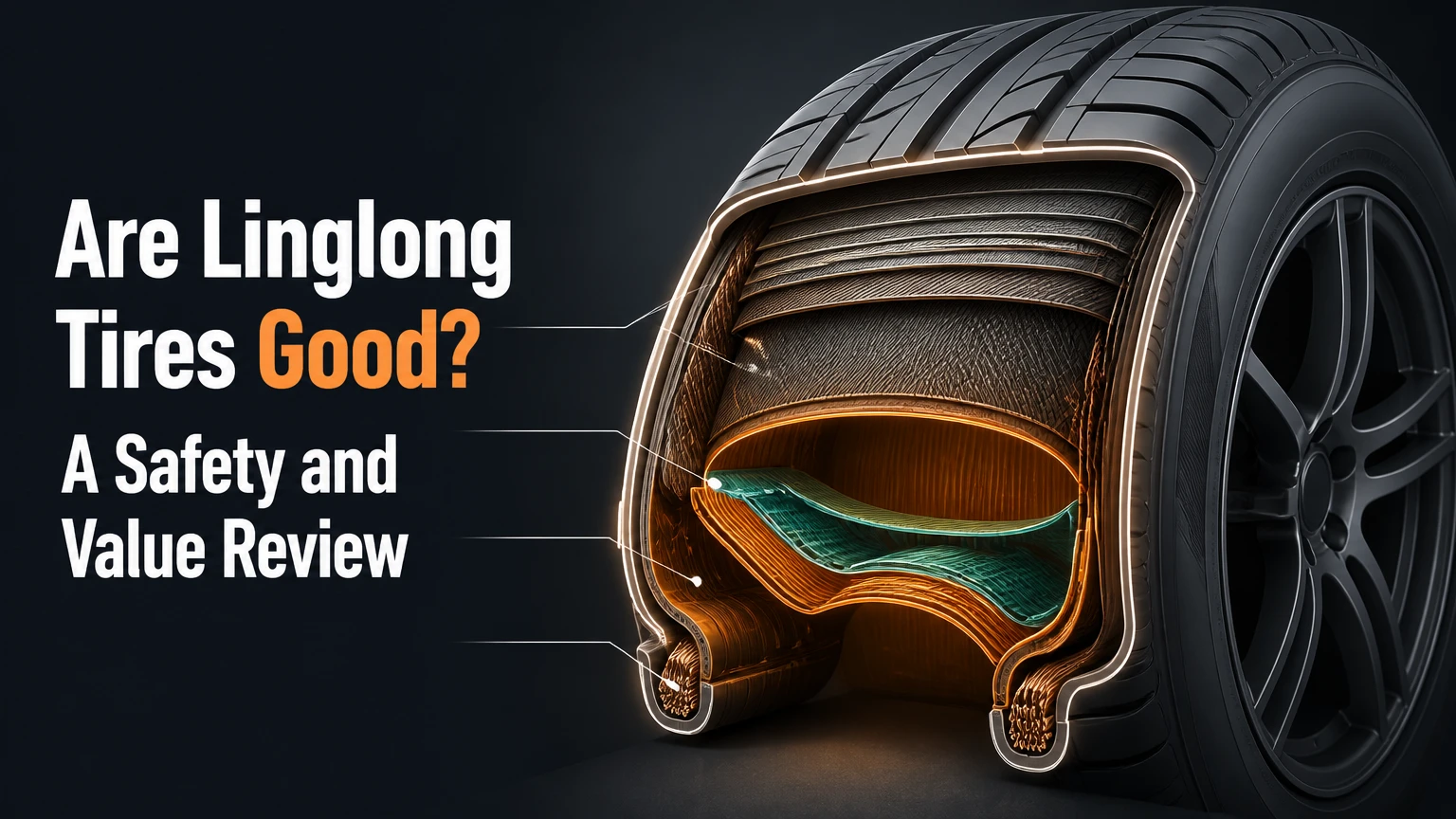
Linglong tires can be acceptable budget tires when the exact model, size, certification, age, and driving conditions match the vehicle. They may deliver competitive wet-braking results in some independent tests, but Linglong should not be treated as uniformly equivalent to Michelin or Continental because tread life, rolling resistance, handling, and winter performance vary substantially by model.
Key Facts at a Glance
- Linglong is a Chinese tire manufacturer with passenger-car, SUV, truck, commercial, and specialty tire lines.
- A short wet-braking distance does not prove strong hydroplaning resistance, tread life, or high-speed handling.
- Linglong Sport Master, Comfort Master, Green-Max, and CrossWind products target different driving conditions.
- Typical budget pricing may save approximately $30-$100 per tire before mounting, balancing, taxes, and disposal fees.
- Tire age, load index, speed rating, alignment, inflation, and local certification matter more than country of manufacture alone.
- A low purchase price can lose its advantage if the tire wears quickly or increases fuel consumption.
Are Linglong Tires Good for Your Driving?
Linglong tires are best viewed as conditionally good budget tires, not as a universally good or bad brand. A low-mileage urban driver with a properly sized, recent, certified Linglong tire may receive adequate value, while a high-mileage highway driver, winter commuter, or performance driver should usually spend more on a tire with stronger independent evidence for durability and control.
The relevant question is not whether Linglong is Chinese. Major tire quality depends on compound design, casing construction, factory controls, market certification, product age, and the specific tire test. A premium tire can outperform a budget tire in several categories, yet a budget model can occasionally match or beat it in one metric such as straight-line wet braking.
The supplied AI Overview gives strong claims about a 2026 Auto Bild and ADAC-related comparison involving Linglong Sport Master. Those claims should be checked against the original test, tire size, vehicle, temperature, surface, braking speed, and complete ranking before being generalized to every Linglong product. A result from one Sport Master test cannot validate Comfort Master, Green-Max, CrossWind, or an unbranded tire sold under a similar name.
What Is Linglong?
Linglong Tire is a large Chinese tire manufacturer headquartered in China. The company’s official product materials cover passenger-car tires, truck and bus tires, light-truck products, off-road tires, and other specialty categories.
Linglong sells through different regional distributors, so model availability, warranties, labeling, and legal requirements vary by country. A tire listed in Southeast Asia, Europe, Africa, or North America may have different markings, retailer support, and market approval.
Country of origin is therefore a weak standalone quality signal. The stronger buying signals are the exact model, independent test data, the manufacturer’s warranty, the tire’s date code, and whether the tire carries the required local markings.
Which Linglong Models Fit Which Drivers?
The Linglong model family determines the likely compromise. Sport-oriented products prioritize grip and steering response, touring products emphasize noise and comfort, and all-terrain or mud-terrain products trade smooth-road efficiency for construction and off-road traction.
| Linglong product family | Intended use | Typical strength | Main verification concern |
|---|---|---|---|
| Sport Master | Passenger cars, summer or performance applications | Wet and dry braking focus | Tread life, lane-change stability, heat behavior |
| Comfort Master | Daily commuting and touring | Lower cabin noise and softer ride | Rolling resistance, steering precision |
| Green-Max HP010 | Passenger-car highway and urban use | Broad size availability and low price | Independent mileage and wet-grip evidence |
| GREEN-Max All Season | Mild climates and mixed seasons | M+S-oriented utility | Snow performance and 3PMSF status |
| CrossWind UHP | Budget ultra-high-performance fitments | Aggressive tread appearance and grip | High-speed consistency and casing quality |
| CrossWind M/T | Work trucks and loose terrain | Deep tread and off-road traction | Wet pavement, noise, fuel use, road manners |
Product names can conceal important differences. Check the complete sidewall designation, including size, load index, speed symbol, XL marking, and seasonal rating. A 225/50R17 98V XL tire is not interchangeable in performance or load capacity with a 225/50R17 94V tire simply because both share the same nominal size.
How Do Linglong Tires Perform in Rain?
Linglong tires may stop effectively on wet asphalt in some controlled tests, but wet braking and hydroplaning resistance measure different behaviors. Wet braking evaluates stopping distance on a wet surface; hydroplaning resistance concerns the speed at which a tire loses contact over standing water.
This distinction matters during heavy rain. Broad grooves, tread depth, compound temperature, vehicle speed, water depth, and tire pressure influence hydroplaning. A tire can perform well in a straight-line braking test on a thin, consistent water film and still feel less secure in a deep puddle.
The AI Overview’s claim that Sport Master achieved leading wet-braking results should be treated as model-specific evidence. It does not establish a universal Linglong result, and it does not remove the need to slow down in standing water.
For wet-weather buyers, check the tire label and independent tests for:
- Wet-grip grade or wet-braking ranking.
- Hydroplaning measurements, if published.
- Tread depth and groove design.
- Emergency lane-change behavior.
- Performance after partial wear, not only when new.
A new Linglong tire with correct inflation can be reasonable in ordinary rain. Drivers who regularly face tropical downpours, deep road ruts, flooding, or fast rural highways need stronger evidence than a single wet-braking number.
How Long Do Linglong Tires Last?
Linglong tread life has no single brand-wide mileage figure. A typical budget passenger tire may last about 20,000-40,000 miles under moderate use, but aggressive driving, poor alignment, underinflation, heavy loads, hot pavement, and front-wheel-drive torque can reduce that range substantially.
The AI Overview presents approximately 16,000 miles for Sport Master versus 35,000-36,000 miles for premium alternatives. Treat those figures as test-specific estimates rather than a guaranteed service life. Independent wear projections depend on the test route and cannot predict every driver’s result.
| Driving pattern | Typical annual distance | Inspection interval | Replacement risk |
|---|---|---|---|
| Short urban commuting | 5,000-8,000 miles | Every 5,000 miles | Aging before tread exhaustion |
| Mixed personal driving | 10,000-15,000 miles | Every 5,000-6,000 miles | 2-4 years, condition dependent |
| Highway road trips | 15,000-25,000 miles | Every 4,000-5,000 miles | Accelerated shoulder and center wear |
| Delivery or fleet service | 20,000-40,000 miles | Every 3,000-5,000 miles | Rapid wear and uneven loading |
Do not rely on tread depth alone. Replace a tire when it reaches the legal wear indicator, develops cracks or bulges, suffers a puncture in an unsafe area, or becomes too old according to local guidance and manufacturer recommendations.
What Do Linglong Tires Cost to Own?
Linglong tires usually cost less to buy, but the lowest invoice is not necessarily the lowest operating cost. A realistic comparison must include mounting, balancing, disposal, rotations, fuel use, and the number of sets required over the ownership period.
| Cost item for four tires | Linglong budget set | Midrange set | Premium set |
|---|---|---|---|
| Tire purchase price | $200-$400 | $360-$600 | $520-$900 |
| Mounting and balancing | $80-$160 | $80-$160 | $80-$160 |
| Road-hazard or warranty add-on | $0-$120 | $40-$160 | $60-$200 |
| Typical installed total | $280-$680 | $480-$920 | $660-$1,260 |
| Possible replacement period | 1.5-3 years | 2-4 years | 3-5 years |
These are typical retail ranges, not quoted prices. Size, country, taxes, vehicle type, and seasonal demand can move the total significantly.
For example, a driver covering 20,000 miles annually may consume a short-lived budget tire much faster than a driver covering 7,000 miles. A second installation within the same period can erase the original saving. Rolling resistance can also affect fuel use, although the exact effect depends on vehicle weight, speed, temperature, pressure, and route.
How Do Linglong Tires Compare With Alternatives?
Linglong is usually strongest on purchase price and weakest where long-term durability, dealer support, and independently documented all-round performance matter. Midrange brands such as Hankook, Falken, Nexen, and Kumho often occupy the more useful compromise zone for drivers who want lower cost without selecting the cheapest available tire.
| Decision factor | Linglong | Nexen or Kumho | Hankook or Falken | Michelin or Continental |
|---|---|---|---|---|
| Typical tire price | $50-$100 | $80-$140 | $100-$170 | $130-$220 |
| Expected evidence depth | Model dependent | Moderate | Moderate to strong | Strong across more categories |
| Highway refinement | Model dependent | Moderate | Moderate to high | High |
| Long-mileage confidence | Limited on some models | Moderate | Moderate to high | High |
| Dealer and warranty support | Retailer dependent | Regional | Regional to strong | Strong |
| Best buyer profile | Tight initial budget | Value-focused daily driver | Balanced commuter and traveler | Maximum consistency and refinement |
A comparison must use matching categories. Comparing a Linglong summer performance tire with a Michelin all-season touring tire produces a misleading conclusion because the compounds and intended conditions differ.
When Is a Midrange Tire Better Value?
A midrange tire is often better value when the vehicle travels more than about 12,000 miles annually, carries passengers or cargo frequently, or spends substantial time on high-speed roads. The higher initial price can buy more predictable wear, stronger warranty support, and better performance after thousands of miles.
A midrange product also makes sense when the size is unusual and the vehicle manufacturer specifies a high load index or a reinforced casing. The cheapest available tire may meet the dimensional requirement while offering little independent evidence for the vehicle’s actual weight and speed profile.
Are Linglong Tires Safe?
Linglong tires can be safe when the tire is legal for the market, correctly fitted, undamaged, properly inflated, and appropriate for the vehicle’s load and speed requirements. Safety cannot be inferred from the brand name or from one braking result.
Before installation, verify the following:
- The tire size matches the vehicle placard or approved fitment.
- The load index is equal to or higher than the vehicle requirement.
- The speed symbol meets the vehicle requirement.
- The tire has the required DOT, E-mark, or local certification.
- The date code indicates acceptable age and storage history.
- No sidewall bulges, cracks, exposed cords, bead damage, or irregular deformation exists.
- All four tires have compatible seasonal and performance characteristics.
- The installer torques wheel nuts to the vehicle specification.
The Tire and Rubber Association of Canada and the U.S. National Highway Traffic Safety Administration both emphasize correct inflation, inspection, and replacement of damaged or worn tires. Those maintenance principles apply equally to premium and budget products.
A tire with adequate tread can still be unsafe if its pressure is wrong, its casing is damaged, or its load rating is insufficient.
Do Linglong Tires Work in Winter?
Linglong tires are suitable for winter only when the exact model carries an appropriate winter designation and its tested performance matches local conditions. An M+S marking does not equal the Three-Peak Mountain Snowflake, or 3PMSF, severe-snow rating.
| Road condition | Minimum useful tire feature | Linglong buying check | Safer decision |
|---|---|---|---|
| Warm rain, 45°F and above | Wet-grip design | Confirm model and wet label | Model-specific purchase |
| Light occasional snow | M+S or all-season design | Check local legal requirements | Moderate-climate use |
| Frequent packed snow | 3PMSF all-weather or winter tire | Confirm mountain-snowflake symbol | Use a dedicated winter option |
| Ice and freezing rain | Studless winter compound | Seek independent ice tests | Avoid generic budget all-season |
| Mud, gravel, and work sites | Strong casing and open tread | Check load index and sidewall | Match tire to truck duty |
Rubber compounds harden as temperatures fall. A summer performance tire, regardless of price, is a poor choice for repeated freezing conditions. Drivers in Canada, northern U.S. states, mountain regions, and similar climates should prioritize winter testing over low purchase price.
Who Should Buy Linglong Tires?
Linglong tires can suit low-mileage city drivers, older vehicles with modest annual use, and fleet operators who control speed, loads, inspections, and replacement schedules. They are a weaker choice for drivers who value quiet highway travel, long tread life, snow control, or rapid steering response.
| Driver situation | Recommendation | Reason |
|---|---|---|
| 6,000-mile urban driver | Consider a recent touring model | Low annual wear can preserve upfront savings |
| 15,000-mile mixed driver | Compare midrange first | Wear and fuel differences matter more |
| 25,000-mile highway driver | Usually avoid the cheapest model | Replacement frequency raises ownership cost |
| Performance enthusiast | Avoid budget UHP selection | Heat stability and steering evidence may be limited |
| Winter-region commuter | Choose tested winter tires | M+S alone does not establish snow safety |
| Local delivery van | Consider only with load checks | Fleet inspection controls can reduce risk |
Linglong is not a sensible shortcut for a vehicle that regularly carries maximum payload, travels at sustained high speed, or operates in severe weather without close maintenance supervision.
How Should You Maintain Linglong Tires?
Maintain Linglong tires at the vehicle manufacturer’s cold inflation pressure, rotate them according to the vehicle manual, and inspect tread and sidewalls at least monthly. Correct pressure is the most immediate control because underinflation increases heat, shoulder wear, rolling resistance, and casing stress.
Use this practical schedule:
| Maintenance task | Recommended interval | Measurement or action | Failure sign |
|---|---|---|---|
| Cold-pressure check | Monthly and before trips | Use a calibrated gauge | Pressure differs by 2-3 psi or more |
| Tread inspection | Monthly | Check grooves and wear bars | 2/32 inch legal limit in many U.S. states |
| Rotation | 5,000-7,500 miles | Follow vehicle pattern | Front tires wear faster |
| Alignment check | After impact or uneven wear | Measure camber and toe | Feathering or outer-edge loss |
| TPMS verification | At every service | Compare sensor with gauge | Warning light or mismatched readings |
| Professional inspection | Twice yearly | Check casing, bead, and balance | Bulge, vibration, or pull |
Do not rotate a tire to conceal an alignment problem. Rotation can redistribute wear, but it cannot repair excessive toe, bent suspension components, worn bushings, or a damaged wheel.
What Causes Rapid Edge Wear?
Rapid outer-edge wear usually comes from underinflation, excessive toe or camber, hard cornering, overloaded axles, or suspension wear. Soft compounds can make the pattern appear sooner, but the compound alone is rarely a complete diagnosis.
Measure pressure cold, inspect both shoulders, and obtain an alignment printout if the wear is uneven. A tire shop should also check wheel balance and suspension joints when the vehicle vibrates or pulls.
Why Did Fuel Economy Drop?
A fuel-economy decline can result from low pressure, higher rolling resistance, colder weather, heavier cargo, aggressive acceleration, or a change from an efficient touring tire to a softer or more heavily patterned product. Do not attribute the entire change to Linglong without controlling the other variables.
Check pressure against the door-placard value, not the maximum pressure molded into the sidewall. Compare fuel consumption over at least three full tanks under similar routes and temperatures.
What Should You Check Before Buying?
Check the exact tire before paying, because online listings can combine several sizes, seasons, and model generations under one product page. A lower price is less useful if the tire arrives old, lacks local certification, or has no usable warranty.
Use this checklist:
- Photograph the full model name and sidewall markings.
- Confirm the size, load index, speed symbol, and XL status.
- Decode the four-digit production date, such as 2525 for week 25 of 2025.
- Ask whether the price includes mounting, balancing, valves, taxes, and disposal.
- Confirm the retailer’s treadwear, road-hazard, and workmanship policies.
- Request the EU label or equivalent local efficiency and wet-grip information.
- Search independent tests for the exact model and size.
- Compare the installed price with Nexen, Kumho, Hankook, Falken, and regional equivalents.
- Confirm that all four tires share the same seasonal category.
- Inspect the tire immediately after fitting and retain the invoice.
Avoid a mixed set of unknown ages or models on the same axle. If replacing only two tires, the installer should follow the vehicle manufacturer’s placement guidance, which commonly places the newer pair on the rear axle for wet stability.
What Are the Most Common Linglong Buying Mistakes?
The most expensive mistake is treating a low purchase price as a five-year cost calculation. Installation fees, premature replacement, fuel use, and lost time can make a $250 set less economical than a $450 set that lasts materially longer.
Other frequent errors include:
- Confusing wet braking with all-weather performance. A tire can stop well on wet asphalt yet hydroplane sooner in deep water.
- Ignoring the date code. Discount tires may have spent extended periods in storage.
- Fitting the wrong load index. SUV and van applications often need more capacity than a visually identical passenger tire.
- Skipping alignment after uneven wear. A new set will repeat the same damage.
- Using M+S as proof of winter capability. Severe-snow performance requires the 3PMSF symbol and relevant testing.
- Comparing only tread depth. Compound aging, casing damage, noise, and fuel consumption also affect value.
A practitioner rule is simple: drivers who cover more than 1,000 miles per month should calculate cost per 10,000 miles before choosing the cheapest set. High annual mileage magnifies every weakness in wear and rolling resistance.
The Bottom Line: Should You Buy Linglong Tires?
Linglong tires can be a defensible budget purchase for low-mileage urban driving when the exact model has suitable wet-grip evidence, correct certification, a recent date code, and professional installation. Linglong tires are less convincing for frequent highway travel, severe winter conditions, heavy commercial loads, and performance driving because durability, heat control, and independent all-round evidence may not match established midrange or premium alternatives.
The safest decision is model-specific. Compare the installed price, expected service life, wet performance, winter designation, speed and load ratings, warranty, and retailer support. If a midrange Hankook, Falken, Nexen, Kumho, or comparable tire costs only modestly more, that additional purchase price may provide better total value.
Frequently Asked Questions
Are Linglong tires made in China?
Linglong is a Chinese tire manufacturer, although its manufacturing and distribution footprint includes facilities and sales channels in multiple regions. The country shown on the sidewall is less informative than the exact model, certification, production date, warranty, and independent test record.
Do Linglong tires have a mileage warranty?
Warranty terms vary by country, retailer, product line, and distributor. Do not assume that every Linglong model includes a comparable mileage warranty to Michelin, Continental, or another premium brand. Request the written policy before purchase and check exclusions for alignment, inflation, rotation, punctures, and commercial use.
Are Linglong tires noisy?
Some Linglong touring products are designed around comfort and reduced road noise, but noise depends on tread pattern, pavement, vehicle insulation, inflation, and wear. A tire that is quiet when new may become louder as tread blocks feather or cup, so customer reviews should be separated by model and vehicle.
Can Linglong tires be used on an SUV?
Linglong tires can be used on an SUV only when the exact size, load index, speed rating, construction, and seasonal designation meet the vehicle manufacturer’s requirements. Passenger-car tires should not replace a required light-truck or reinforced SUV specification merely because the diameter and width appear to match.
How can you tell whether Linglong tires are worn out?
Check the molded tread-wear indicators, measure tread depth across the inner, center, and outer sections, and inspect for cracks, bulges, exposed cords, vibration, or irregular wear. In many U.S. jurisdictions, 2/32 inch is the legal replacement threshold, while wet-weather traction often declines well before that point.
Are Linglong tires worth the money?
Linglong tires are worth considering when the installed price is substantially lower, annual mileage is modest, weather is moderate, and the model passes the vehicle’s fitment and certification checks. Drivers who accumulate high mileage or demand stronger winter, touring, or performance consistency should compare the full ownership cost with a midrange tire before deciding.