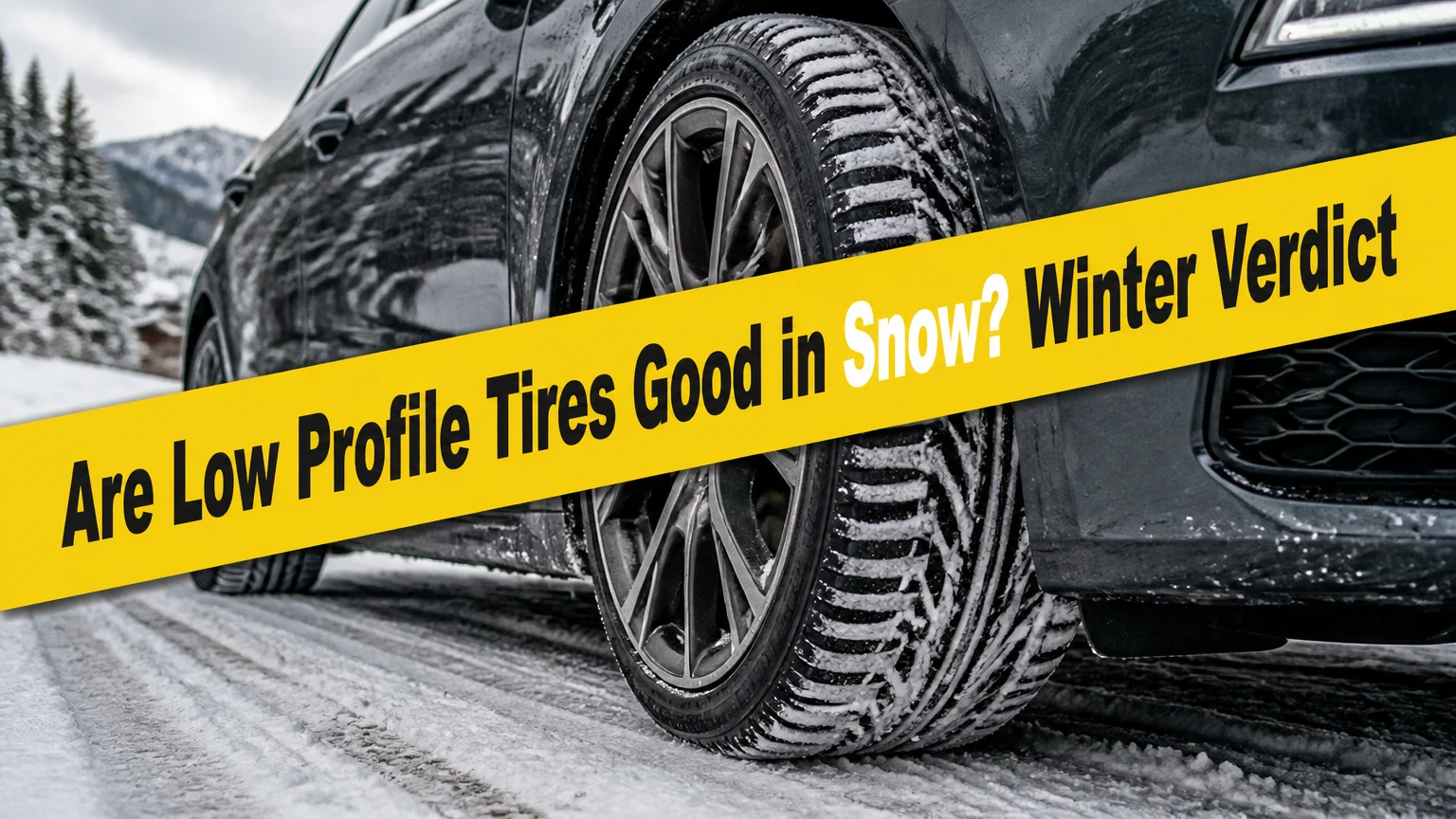
Low-profile tires are generally a poor choice for snow when compared with properly fitted, taller winter tires. The main disadvantages are usually the tire compound, tread design, limited sidewall protection, and reduced ability to absorb rough winter surfaces, not aspect ratio alone. A low-profile tire with a 3PMSF winter compound can work, but downsized winter tires are usually safer and more practical.
Key Facts at a Glance
- A low-profile tire commonly has an aspect ratio of 50 or lower, although manufacturers and retailers do not use one universal cutoff.
- A summer tire can lose substantial cold-weather grip below approximately 7°C (45°F), regardless of whether the tire has a wide or narrow tread.
- The Three-Peak Mountain Snowflake, or 3PMSF, symbol identifies a tire that meets a standardized severe-snow traction test; it does not guarantee strong ice braking.
- A narrower tire is not automatically better in every snow condition because tread design, compound, vehicle weight, and snow depth also determine traction.
- Downsizing from a large wheel to a smaller approved wheel can provide more sidewall, lower replacement cost, and better pothole protection.
- All four tires should match in type and winter capability, especially on all-wheel-drive vehicles.
Are Low Profile Tires Good in Snow?
Low-profile tires are usually inferior to standard-profile winter tires in snow, ice, and damaged winter pavement. A 35-series summer tire may become hard in cold weather, while its short sidewall offers little protection from potholes; a 45-series 3PMSF winter tire can perform much better because its compound and tread are designed for low temperatures.
The important comparison is not simply “low profile versus regular.” Tire category matters first. A low-profile performance winter tire can outperform a tall all-season tire on packed snow, while neither may match a dedicated Nordic winter tire on ice.
Low-profile tires remain useful on cleared, dry roads when the driver values steering response and high-speed stability. They become a poor compromise when the route includes unplowed snow, frozen ruts, frequent potholes, or temperatures consistently below freezing.
What Counts as a Low-Profile Tire?
A low-profile tire has a short sidewall relative to its tread width. The aspect ratio on the sidewall expresses sidewall height as a percentage of section width, so a 245/40R18 tire has a nominal sidewall height of 98 millimeters.
The tire code breaks down as follows:
- 245: nominal section width in millimeters
- 40: aspect ratio
- R: radial construction
- 18: wheel diameter in inches
The term usually describes 50-series, 45-series, 40-series, 35-series, and 30-series tires. A 30-series tire has a shorter sidewall than a 45-series tire when both share the same width.
| Example tire size | Nominal width | Aspect ratio | Approximate sidewall height |
|---|---|---|---|
| 215/60R16 | 215 mm | 60 | 129 mm |
| 225/50R17 | 225 mm | 50 | 113 mm |
| 235/40R19 | 235 mm | 40 | 94 mm |
| 275/35R21 | 275 mm | 35 | 96 mm |
| 305/30R22 | 305 mm | 30 | 92 mm |
Aspect ratio alone does not determine winter performance. A 235/40R19 3PMSF tire may have better snow traction than a 215/60R16 all-season tire because the winter tire uses a softer compound, deeper grooves, and more biting edges.
Why Do Low-Profile Tires Struggle in Winter?
Low-profile tires often struggle because performance wheels are paired with summer or ultra-high-performance all-season tires, and those tires sacrifice cold-weather flexibility for dry-road response. The short sidewall also transmits impacts more sharply and provides less protection when snow hides potholes.
Does the Contact Patch Make a Wide Tire Float?
A wide tire can be harder to control in deep, loose snow, but the simple “snowshoe effect” explanation is incomplete. Tire pressure, vehicle weight, tread void, snow depth, and speed determine how much pressure the tire applies and whether the tread can evacuate snow.
A wider tire spreads the vehicle’s load over a larger footprint. That can reduce penetration into loose snow, allowing the tread to ride on a soft layer instead of reaching a firmer surface. However, a narrow tire does not automatically create traction because a poorly designed all-season tread can still slide.
Wide tires can perform acceptably on shallow, compacted snow when the tire has a severe-snow compound and enough open tread. The disadvantage becomes more apparent in deep snow, slush, and narrow ruts, where the sidewalls and shoulders have less room to conform.
How Does Sidewall Height Affect Winter Control?
Sidewall height affects impact absorption, steering response, and the tire’s ability to conform to uneven surfaces. A taller sidewall usually gives a winter tire more vertical compliance, while a low-profile tire transmits sharp impacts directly to the wheel and suspension.
The sidewall does not create snow traction by flexing like a tread block. Tread compound, siping, void ratio, and contact pressure generate most of the usable grip. Excessive sidewall flex can actually reduce steering precision and increase heat, particularly at highway speeds.
The practical winter consequence is different. A taller sidewall helps the wheel follow frozen ruts and cushions impacts from potholes hidden under slush. A 35-series tire may remain perfectly controllable on smooth pavement but suffer a bent rim after one abrupt pothole strike.
Does Cold Temperature Harden Low-Profile Rubber?
Cold temperature hardens summer tire compounds, but the problem is the compound category rather than the tire’s profile. Tire manufacturers formulate summer tires for warm pavement, all-season tires for broader temperature ranges, and winter tires for flexibility in cold conditions.
The commonly cited 7°C (45°F) threshold is a useful maintenance rule, not a universal instant-failure point. A summer tire does not suddenly lose all grip at 6°C, and an all-season tire does not become a winter tire at 5°C. Rain, pavement temperature, tread wear, and compound chemistry also matter.
Which Tire Types Work Best in Snow?
Dedicated winter tires with a 3PMSF marking generally provide the best non-studded snow performance, regardless of whether the size is low profile. Studded winter tires can improve traction on glare ice where local law permits them, but they may produce more noise and less dry-road refinement.
| Tire category | Cold-weather compound | Snow capability | Ice capability | Typical low-profile suitability |
|---|---|---|---|---|
| Summer performance | Hardens in cold conditions | Unsafe in accumulation | Very poor | Avoid below warm-weather conditions |
| UHP all-season | Flexible across moderate temperatures | Light snow to moderate snow | Limited | Acceptable only in mild climates |
| 3PMSF performance winter | Remains flexible below freezing | Good to very good | Good, model-dependent | Usable when downsizing is impossible |
| Studded winter | Specialized cold-weather compound | Very good | Highest on permitted ice surfaces | Available in selected sizes |
| Nordic friction winter | Very soft cold-weather compound | Very good | Excellent without studs on many surfaces | Often limited in ultra-low profiles |
The 3PMSF symbol is more meaningful than an aggressive-looking tread pattern. The symbol indicates that the tire passed a standardized snow-traction requirement under specified test conditions. It does not rank the tire against every other winter tire, certify ice performance, or guarantee safe driving at any speed.
Are Low-Profile All-Season Tires Good Enough?
Low-profile all-season tires are adequate for occasional light snow in regions where roads are cleared quickly and temperatures often remain above freezing. They are a weak choice for regular mountain travel, repeated freeze-thaw cycles, packed snow, or prolonged subfreezing weather.
Check the sidewall for the M+S marking and 3PMSF symbol. M+S means mud and snow tread geometry, but it is not equivalent to severe-snow certification. A 3PMSF all-weather tire is generally more winter capable than an M+S ultra-high-performance all-season tire.
How Do Low-Profile Tires Compare With Downsized Winter Tires?
Downsized winter tires usually offer the best balance of snow traction, wheel protection, cost, and predictable handling. The smaller wheel diameter allows a taller sidewall while maintaining a similar overall tire diameter, but the replacement size must be approved for the vehicle.
| Factor | 235/40R19 performance setup | 215/55R17 winter setup | Practical effect |
|---|---|---|---|
| Wheel diameter | 19 inches | 17 inches | More sidewall with the 17-inch wheel |
| Sidewall height | 94 mm | 118 mm | Approximately 24 mm more impact cushion |
| Typical tire price | $180-$350 | $130-$240 | Lower cost varies by brand and load rating |
| Wheel damage exposure | High | Lower | Taller sidewall absorbs more impact |
| Steering response | Quick | Softer | Winter setup prioritizes compliance |
| Snow-oriented availability | Limited | Broad | More 3PMSF choices in 17-inch sizes |
The example is illustrative, not a universal replacement. Tire diameter, load index, brake clearance, wheel offset, speedometer calibration, and manufacturer-approved sizes must be checked before purchase.
What Are the Advantages of Keeping Low-Profile Winter Tires?
Low-profile winter tires preserve the original wheel appearance, steering response, and vehicle ride height. They can suit a sports sedan that spends most of winter on treated highways and has no smaller wheel option clearing its brakes.
Performance winter tires also retain stronger dry-cold handling than many soft Nordic designs. That matters for drivers who frequently encounter cold, dry pavement rather than deep snow.
The limitations are significant. Replacement tires may cost more, sidewalls may be more vulnerable to pothole impacts, and the tire may offer less flotation in deep snow. Low-profile winter tires are a compromise for fitment or handling priorities, not a shortcut to summer-tire behavior in winter.
Should You Downsize Wheels for Winter?
Downsize wheels when the manufacturer approves the smaller diameter, the wheel clears the brake calipers, and the replacement tire preserves an appropriate overall diameter and load rating. A separate winter wheel set also reduces seasonal mounting costs and protects expensive summer wheels.
Use the vehicle placard, owner’s manual, manufacturer fitment data, or a reputable tire-and-wheel database. Do not select a smaller wheel based only on the tire’s diameter calculation.
Before ordering, verify:
- The tire size appears in the vehicle’s approved fitments.
- The load index meets or exceeds the original specification.
- The speed rating matches the vehicle requirement and winter use.
- The wheel clears brake calipers by a safe physical margin.
- Wheel offset and width suit the suspension and fenders.
- TPMS sensors are compatible and programmable.
- The replacement tire has the correct 3PMSF marking.
- The front and rear rolling diameters suit the drivetrain.
A 1% to 3% overall-diameter difference is commonly targeted in replacement planning, but the vehicle manufacturer’s approved range controls. All-wheel-drive systems can be sensitive to tire circumference differences, so four matching tires are the safest approach.
Are Low-Profile Tires Safe on Ice?
Low-profile tires are not inherently unsafe on ice, but summer and performance all-season versions provide limited ice traction. Dedicated winter tires use rubber and tread features that remain more compliant, yet even the best winter tire cannot provide normal pavement grip on polished ice.
Ice braking depends heavily on compound temperature, tread contact, vehicle speed, and anti-lock brake calibration. AWD helps a vehicle accelerate, but AWD does not shorten braking distance or make cornering physics disappear.
Studded tires can offer the strongest grip on hard ice where studs are legal and conditions justify them. Studs are less attractive on bare pavement because they add noise, can reduce dry-road smoothness, and may be restricted seasonally by local regulations.
How Much Do Winter Low-Profile Tires Cost?
A typical low-profile winter tire costs approximately $180-$450 per tire, while a complete winter wheel-and-tire package commonly costs $1,000-$3,000 or more. Actual pricing depends on wheel diameter, tire brand, load rating, speed rating, run-flat construction, and regional availability.
| Winter setup | Typical tire cost | Wheel cost | Typical complete package | Expected service life |
|---|---|---|---|---|
| 17-inch standard winter | $130-$240 each | $400-$900 set | $900-$1,900 | 3-5 seasons |
| 18-inch performance winter | $170-$330 each | $500-$1,200 set | $1,200-$2,500 | 3-4 seasons |
| 19-inch low-profile winter | $220-$400 each | $700-$1,500 set | $1,600-$3,000 | 2-4 seasons |
| 20-22-inch low-profile winter | $280-$550 each | $900-$2,000 set | $2,000-$4,200 | 2-4 seasons |
These are typical retail ranges, not guaranteed quotes. Tread depth, alignment, inflation, storage, rotation, and seasonal mileage determine actual lifespan. A tire with adequate tread can still age out or lose cold-weather performance before the grooves disappear.
How Should You Maintain Low-Profile Tires in Winter?
Check cold inflation pressure at least monthly and whenever temperatures change sharply. Inflate to the vehicle door-placard specification, not the maximum pressure molded into the tire sidewall, because cold air contraction can trigger TPMS warnings and reduce handling stability.
Inspect the tires for bulges, cuts, bead damage, and uneven wear after pothole impacts. A low-profile tire can sustain internal belt or sidewall damage without immediately losing pressure.
Use this winter maintenance routine:
- Measure pressure before driving, with tires cold.
- Inspect tread depth and wear across the full width.
- Rotate according to the vehicle or tire manufacturer schedule.
- Recheck alignment after a severe pothole strike.
- Store unused tires cool, dry, and away from sunlight.
- Keep four tires from the same winter category on the vehicle.
- Replace a damaged tire rather than repairing a sidewall injury.
Winter tires usually become less effective as tread wears, even when they remain legally usable. Deep grooves and numerous sipes lose their intended snow performance as the tread approaches the manufacturer’s winter-wear guidance.
What Problems Occur in Snow and Slush?
Low-profile tires commonly produce three winter complaints: poor acceleration in deep snow, a floating sensation in slush, and wheel damage after pothole impacts. Each symptom requires a different response.
| Symptom | Likely cause | Immediate response | Permanent correction |
|---|---|---|---|
| Slush wandering | Speed too high or tread cannot evacuate slush | Reduce speed smoothly | Use a winter-oriented tread and replace worn tires |
| Wheel spin on snow | Summer compound or shallow tread | Reduce throttle input | Install 3PMSF winter tires |
| TPMS warning | Cold pressure loss | Check pressure cold | Adjust to placard specification |
| Bent rim or sidewall bulge | Pothole impact | Stop and inspect | Replace damaged tire and assess wheel alignment |
| ABS activation during light braking | Low available traction | Increase following distance | Use dedicated winter tires |
| AWD warning or driveline vibration | Unequal tire circumference | Stop aggressive driving | Install four matching tires and verify diameter |
Do not lower tire pressure substantially to create a larger footprint. That strategy can overheat the tire, destabilize steering, unseat the bead in extreme cases, and remove the limited impact protection around a low-profile wheel.
Which Winter Setup Fits Your Driving?
The best setup depends on snow depth, pavement temperature, pothole exposure, and whether the vehicle has an approved smaller wheel.
Daily Commuter in a Snowy City
Choose downsized 3PMSF winter tires on 16-, 17-, or 18-inch wheels when approved. The taller sidewall protects wheels from urban potholes, and the broader size availability usually lowers replacement cost.
Sports Car on Cleared Roads
Choose a performance winter tire in the original low-profile size if brake clearance prevents downsizing or dry-road handling is a major priority. Avoid driving through deep accumulation, and do not treat a performance winter tire as an ice tire.
Mountain Driver
Choose a dedicated winter tire with a severe-snow rating and a tread designed for repeated snow and ice exposure. Studded tires may be appropriate where permitted, especially on steep, icy roads.
AWD SUV With Large Wheels
Choose an SUV-rated winter tire with the correct load index on all four corners. AWD improves launch traction, but large low-profile tires still face snow-depth, ice-braking, and pothole limitations.
Mild Climate With Occasional Snow
A 3PMSF all-weather tire may be sufficient if temperatures, snowfall, and driving distances remain moderate. A summer tire remains unsuitable for cold winter conditions even when the roads appear clear.
What Are the Most Common Buying Mistakes?
The most damaging mistake is buying a tire by appearance rather than by category, certification, and climate. Aggressive grooves on an M+S all-season tire do not establish the same winter performance as a 3PMSF tire.
Other frequent errors include:
- Installing only two winter tires on a vehicle. Mixed traction can create unstable handling, especially during braking or cornering.
- Assuming a larger wheel improves winter safety. Larger wheels usually reduce sidewall height and winter tire availability.
- Ignoring load index. Heavy SUVs, EVs, and performance sedans may require higher load capacity than a similar-looking tire provides.
- Using summer tires because the car has AWD. AWD controls acceleration, not braking or lateral grip.
- Selecting a size without checking brake clearance. Large performance brakes can eliminate otherwise attractive downsizing options.
- Delaying replacement after a pothole impact. A hidden sidewall injury can worsen at highway speed.
- Using a tire with insufficient tread for the season. Winter traction declines before the legal minimum is reached.
A practitioner rule of thumb is to prioritize compound, 3PMSF status, and tread condition before width or aspect ratio. Profile becomes the next decision when potholes, wheel protection, and fitment are significant.
The Bottom Line
Are low profile tires good in snow? Usually no, especially when the tires are summer or ultra-high-performance all-season models. A properly selected 3PMSF low-profile winter tire can perform safely on many maintained roads, but a downsized winter package normally delivers better deep-snow control, pothole protection, availability, and value.
Choose four matching winter tires, maintain placard pressure, verify load and speed ratings, and confirm wheel clearance before changing sizes. Low-profile tires are acceptable when fitment or dry-road handling requires them, not because their short sidewalls provide a winter advantage.
FAQ
Do narrower tires always perform better in snow?
Narrower tires do not always perform better because compound and tread design can outweigh width. A narrow worn all-season tire may stop worse than a wider 3PMSF winter tire. Narrow sizing tends to help in deeper, loose snow when the tire can penetrate the surface, while wider winter tires can work well on packed snow and cleared pavement.
Is a 40-series tire too low for winter?
A 40-series tire is not automatically too low for winter, but it provides less pothole protection than a 50- or 55-series tire. The tire can be suitable if a 3PMSF winter model exists in the approved size, the roads are maintained, and the driver accepts higher wheel-damage risk.
Can I use winter tires only on the drive wheels?
Use four winter tires rather than installing winter tires only on the drive axle. Two winter tires can create a major grip imbalance, causing the front or rear of the vehicle to lose control during braking or cornering. Vehicle manufacturers and tire organizations generally recommend matching winter tires on all four positions.
Are run-flat low-profile tires good in snow?
Run-flat construction does not determine snow traction. A run-flat summer tire remains poor in winter, while a 3PMSF run-flat winter tire can provide appropriate cold-weather grip. Run-flat sidewalls may feel especially firm, and replacement choices can be limited, so verify the exact tire model and vehicle requirements.
Should electric vehicles use special low-profile winter tires?
Electric vehicles need winter tires with sufficient load capacity and, in some cases, EV-specific noise, rolling-resistance, or torque characteristics. Low-profile EV tires can work in snow when they have an appropriate 3PMSF rating, but heavy vehicle weight increases pothole loads and can accelerate tread wear.
Title tag: Are Low Profile Tires Good in Snow? Winter Verdict
Meta description: Compare 3PMSF, all-season, and downsized winter tires, with $130-$550 typical prices. Choose the safest setup for your roads and vehicle.


