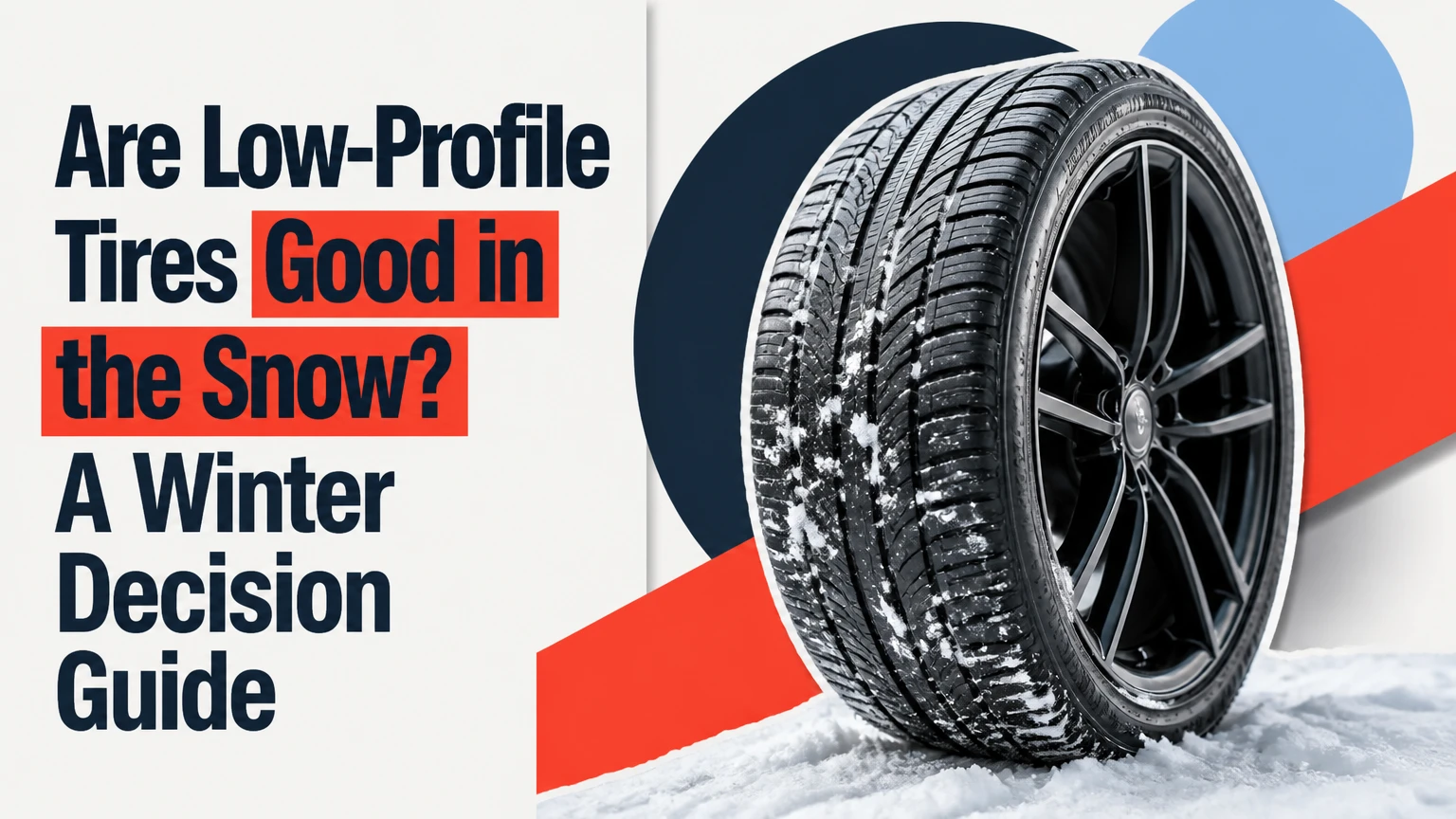
Low-profile tires are generally a poor choice for frequent snow and ice, especially when they are wide, stiff, and fitted with performance-focused all-season compounds. A low-profile tire with a winter-rated compound can work acceptably in light snow, but a narrower, taller tire with the 3PMSF symbol usually delivers better winter traction, ride compliance, and wheel protection.
Key facts at a glance
Low-profile tires usually have a short sidewall, commonly an aspect ratio of 50 or lower.
A 245/40R19 tire has a 245 mm nominal section width and a sidewall height of about 98 mm.
The Three-Peak Mountain Snowflake, or 3PMSF, identifies a tire tested against a severe-snow performance threshold.
The M+S marking alone does not prove strong snow or ice braking performance.
All-wheel drive improves acceleration and hill climbing, but it does not shorten braking distance on ice.
A winter tire package with smaller wheels commonly costs about $1,000-$1,800, depending on vehicle and tire size.
Are Low-Profile Tires Good in the Snow?
Low-profile tires are not usually good in snow because their short, rigid sidewalls provide less compliance over ruts, frozen ridges, and potholes, while many low-profile models use wide performance tread and cold-sensitive compounds. The profile itself is not the only cause of poor traction. Tire width, rubber compound, siping, tread depth, vehicle weight, and snow depth determine the actual result.
A low-profile tire can be competent in winter if it carries a 3PMSF rating, has adequate tread depth, and is used on cleared roads. It remains a compromise, however, because a 35-series or 40-series tire leaves little sidewall to absorb impacts. That matters when snow hides potholes or ice creates abrupt edges across the lane.
The most important distinction is between a low-profile summer or all-season tire and a low-profile winter tire. The first may lose substantial flexibility near freezing. The second uses a cold-weather compound and winter tread features, so it can outperform a taller all-season tire in some conditions.
What Counts as a Low-Profile Tire?
A low-profile tire has a short sidewall relative to its section width. The aspect ratio is the sidewall height expressed as a percentage of the tire’s nominal width, and many tire professionals informally classify aspect ratios of 50 or less as low profile.
For example, the sidewall on a 245/40R19 tire is approximately:
245 mm × 0.40 = 98 mm
The tire code means:
| Code | Meaning | Example value |
|---|---|---|
| 245 | Nominal section width | 245 mm |
| 40 | Aspect ratio | 40% |
| R | Construction | Radial |
| 19 | Wheel diameter | 19 inches |
Aspect ratio does not reveal tread compound or snow capability. A 245/40R19 3PMSF winter tire and a 245/40R19 summer tire share the same profile but behave very differently below 45°F (7°C).
How Does Low-Profile Design Affect Winter Traction?
Low-profile design affects winter traction through sidewall stiffness, contact-patch geometry, and wheel protection. The short sidewall reduces deflection during cornering, but that same reduction in flex can make the tire less able to conform to broken ice, compacted snow, and uneven winter pavement.
Tire width also affects the pressure applied to the road. For the same vehicle load, a wider contact patch tends to distribute load across more area, which can reduce localized pressure in loose snow. The familiar snowshoe comparison is directionally useful, but it is incomplete because modern tire construction, tread voids, inflation pressure, and vehicle weight also change the outcome.
A narrow tire is not automatically superior in every winter situation. On wet pavement, a wider tire with an excellent winter compound may resist hydroplaning and brake better than a narrow tire with worn or inferior tread. On deep, loose snow, the narrower option often has a practical advantage because it is less likely to float or high-center.
Does Tire Width Matter More Than Profile?
Tire width often matters more than sidewall height in deep snow, but compound and tread design matter more than either dimension on ice. Drivers should compare the complete tire specification rather than assume that every low-profile tire fails or every narrow tire succeeds.
| Winter condition | Low-profile wide tire risk | Taller or narrower tire advantage | Most important specification |
|---|---|---|---|
| 1-2 inches of fresh snow | Reduced steering feel | Easier snow penetration | 3PMSF compound |
| 3-6 inches of loose snow | Higher flotation and high-centering risk | Greater forward bite | Tread void ratio and width |
| Packed snow at intersections | Stiff response over ridges | More sidewall compliance | Siping and cold flexibility |
| Glazed ice | Long braking if compound is hard | No size can overcome poor rubber | Winter compound and studs where legal |
| Wet slush at 35°F | Wide tread may hydroplane sooner | Narrower section can clear slush | Tread channels and speed control |
| Hidden potholes | Greater wheel and sidewall exposure | Taller sidewall absorbs impact | Sidewall height and wheel diameter |
Why Does Sidewall Flex Matter?
Sidewall flex allows a tire to follow uneven pavement instead of bouncing across it. A taller sidewall generally absorbs more vertical movement, while a short performance sidewall transmits more of the impact to the wheel and suspension.
That does not mean flexible sidewalls always improve steering precision. Low-profile construction can maintain a sharper steering response on dry roads, and some performance winter tires deliberately use reinforced structures to preserve handling. The winter trade-off is harsher impact response and less protection when frozen debris interrupts the contact patch.
Which Tire Type Works Best for Winter Driving?
Dedicated winter tires provide the strongest snow and ice performance, 3PMSF all-weather tires provide the best year-round compromise, and ordinary M+S all-season tires are suitable only for mild winter conditions when the vehicle can remain off severe snow and ice.
| Tire category | Cold-weather compound | Typical marking | Snow and ice use | Typical price per tire |
|---|---|---|---|---|
| Summer performance | No winter flexibility | None or summer designation | Avoid below 45°F | $180-$450 |
| M+S all-season | Moderate, often cold-sensitive | M+S | Light snow and wet roads | $150-$350 |
| UHP all-season | Improved silica blend | M+S, sometimes 3PMSF | Occasional light snow | $200-$450 |
| All-weather | Winter-capable year-round blend | 3PMSF | Regular light and moderate snow | $170-$350 |
| Dedicated winter | Soft cold-weather compound | 3PMSF | Frequent snow, ice, and cold | $220-$500 |
Prices are typical replacement-market ranges for passenger vehicles and larger wheels. Luxury, electric, run-flat, and high-load applications can exceed them.
How Do M+S, 3PMSF, and Winter Tires Differ?
M+S means Mud and Snow, but manufacturers can apply the marking based on tread geometry without meeting the severe-snow test associated with 3PMSF. The 3PMSF symbol indicates that the tire passed a standardized snow-traction performance test, although it does not guarantee short braking distances on glare ice.
A dedicated winter tire usually goes beyond the 3PMSF threshold with deeper siping, a softer compound, and tread structures designed for temperatures below approximately 45°F. An all-weather tire also carries 3PMSF, but it sacrifices some extreme-cold and ice performance to remain usable through summer.
Consumer Reports has repeatedly found that winter tires improve snow and ice control compared with all-season tires, while tire manufacturers including Michelin and Bridgestone advise drivers to use four matching winter tires rather than mixing seasonal categories. The symbol is a screening tool, not a complete buying decision.
When Can Low-Profile Tires Be Acceptable in Snow?
Low-profile tires can be acceptable when snowfall is infrequent, roads are cleared quickly, the tires carry 3PMSF, and the driver accepts reduced wheel protection. They are a reasonable compromise for a performance sedan that spends most winter miles on treated highways, but they are a poor fit for unplowed rural roads or steep icy streets.
A low-profile winter tire is more defensible when all of the following conditions apply:
- The tire has the 3PMSF symbol and at least 6/32 inch of usable tread.
- The vehicle manufacturer approves the size, load index, and speed rating.
- The wheel has enough clearance from brake calipers and suspension components.
- The driver avoids unnecessary travel during deep snowfall.
- The tire is replaced if a sidewall bubble or structural damage appears.
A low-profile M+S tire is a different case. It may manage cold rain and occasional slush, but its hardening behavior and limited sipe density can make braking unpredictable on packed snow.
Should You Downsize for Winter?
Downsizing the winter wheel diameter is usually the best solution when the vehicle manufacturer approves a smaller fitment. A smaller wheel allows a taller sidewall, often permits a narrower winter tire, reduces replacement-wheel cost, and gives the tire more vertical compliance over potholes.
Minus sizing does not mean choosing any smaller tire. The replacement package must preserve safe load capacity, outer diameter, brake clearance, wheel offset, TPMS compatibility, and vehicle-system calibration.
| Winter package | Common example | Typical set cost | Main benefit | Main limitation |
|---|---|---|---|---|
| OEM 19-inch performance | 245/40R19 3PMSF | $900-$1,600 | Retains factory appearance | High wheel damage exposure |
| Minus-one package | 235/45R18 3PMSF | $1,000-$1,700 | More sidewall and lower cost | Requires approved 18-inch clearance |
| Minus-two package | 225/55R17 3PMSF | $1,000-$1,800 | Strong impact protection | May not clear large brakes |
| All-weather on existing wheels | Factory-approved size | $700-$1,400 | No seasonal wheel storage | Less ice grip than winter tires |
The exact diameter must remain close to the original rolling circumference. A tire shop should verify the manufacturer’s fitment chart rather than rely on a generic online calculator.
What Specifications Must Match?
The winter tire must meet or exceed the original tire’s load index and required speed rating. Drivers should also confirm the vehicle’s axle load, wheel width range, run-flat requirement, directional tread orientation, and TPMS sensor type.
A lower speed rating may be allowed for winter tires in some jurisdictions, but the driver must follow the vehicle manufacturer’s instructions and place a visible speed-warning label inside the vehicle when required. Electric vehicles deserve extra scrutiny because high curb weight and instant torque increase load and wear demands.
Can AWD Compensate for Low-Profile Tires?
All-wheel drive cannot compensate for inadequate winter tires because AWD helps transmit engine torque during acceleration but does not create additional tire grip during braking or cornering. The National Highway Traffic Safety Administration states, “Four-wheel drive and all-wheel drive vehicles do not stop any better than two-wheel drive vehicles.”
AWD can help a vehicle pull away from a snowy intersection, climb a driveway, and reduce wheelspin. The same vehicle still depends on four contact patches for braking, and a hard all-season compound can slide on ice regardless of how many axles receive power.
Everyday handling also exposes the limitation. If a corner contains compacted snow, AWD may accelerate the vehicle into the turn successfully, but unsuitable tires can then understeer or lock under braking. Four matching winter tires remain the correct foundation.
What Does a Winter Setup Cost?
A complete winter setup typically costs $700-$1,800 for four tires and wheels, while mounting winter tires on existing wheels commonly costs $120-$250 per season over repeated swaps. Premium run-flat tires, large 20-inch applications, sensors, and storage can raise the first-year total above $2,000.
Typical cost components include:
| Component | Typical quantity | Typical price | Replacement interval |
|---|---|---|---|
| 17-inch 3PMSF winter tires | 4 | $650-$1,100 | 3-5 winters |
| Basic winter wheels | 4 | $350-$700 | 5-10 years |
| TPMS sensors | 4 | $120-$240 | 5-10 years |
| Mounting and balancing | 1 service | $100-$180 | Each seasonal swap |
| Tire storage | 1 season | $60-$150 | Each season |
| Wheel alignment check | 1 service | $90-$150 | After impact or uneven wear |
Dedicated winter tires often last 15,000-20,000 winter miles, but tread depth, storage temperature, ultraviolet exposure, and summer use determine the actual lifespan. Driving a soft winter compound through warm summer pavement accelerates wear and reduces handling precision.
How Should You Prepare and Maintain Them?
Prepare low-profile winter tires by checking approved fitment, installing four matching tires, setting cold inflation pressure to the door-placard value, and inspecting tread and sidewalls before the first storm. The maintenance priority is preserving pressure and finding impact damage early.
Follow this seasonal procedure:
- Confirm the approved size. Compare the owner’s manual, door placard, and wheel manufacturer data. Verify load index, speed rating, diameter, width, offset, and brake clearance.
- Inspect tread and age. Measure all four tires with a tread gauge. Replace tires with a bubble, exposed cord, severe cracking, or insufficient tread.
- Install the complete set. Do not place winter tires only on the drive axle. Mixed traction can create unstable braking and cornering.
- Set cold pressure. Inflate to the placard specification, not the maximum molded on the sidewall. Cold temperatures can reduce pressure by about 1 psi for every 10°F drop.
- Reset and test TPMS. Follow the vehicle procedure, then verify that the warning light turns off after the system relearns.
- Retorque the wheels. Use the manufacturer’s torque specification after installation and recheck it after roughly 25-50 miles if the wheel maker recommends it.
The installation checkpoint is simple: the vehicle should track straight, show no TPMS warning, and produce no vibration between approximately 50 and 70 mph. A vibration that begins immediately after snowfall may come from frozen snow inside a wheel, but persistent vibration requires balancing and inspection.
Why Is the Steering Wheel Vibrating?
Steering-wheel vibration after a snowstorm most often comes from compacted snow or ice frozen inside a wheel, but imbalance, a bent rim, separated tire belts, and missing wheel weights are also possible causes. Clear the wheel with a plastic tool or warm water, never with a metal object or open flame.
If vibration disappears after cleaning, inspect the inner barrel before driving at highway speed. If vibration remains, a technician should check radial force variation, wheel runout, balance, and suspension components.
What Does a Sidewall Bubble Mean?
A sidewall bubble means the tire’s internal cords have been damaged, usually after an impact, and the tire must be replaced immediately. Inflation cannot repair the structural failure, and a bubble can progress to a sudden blowout.
Low-profile tires develop this failure more readily because the short sidewall provides less impact absorption. Do not plug, patch, glue, or continue driving on a bulged tire, even if pressure appears normal.
Which Setup Fits Your Driving Situation?
Drivers who regularly encounter snow should choose a 3PMSF winter package with the tallest approved sidewall, while drivers in mixed climates may prefer 3PMSF all-weather tires. The correct setup depends on snow frequency, ice exposure, road clearance, wheel budget, and summer driving priorities.
Daily Commuter in a Snowy Region
Choose four dedicated winter tires, preferably on approved smaller wheels. This setup gives the best braking and traction when temperatures remain below 45°F for long periods, and it protects expensive 19-inch wheels from salt and pothole damage.
Performance Sedan in a Mild Climate
A 3PMSF performance winter tire in the original low-profile size can work when roads are plowed and the car is not used in deep snow. The driver should accept greater impact risk and avoid interpreting the tire’s high speed rating as permission to drive quickly on ice.
Luxury SUV With Large Brakes
Use an OEM-approved performance winter tire if brake calipers prevent minus sizing. Sport utility vehicles often carry more weight, so load index and reinforced construction matter as much as the snow symbol.
Budget Commuter With Occasional Snow
Select a 3PMSF all-weather tire if seasonal storage and wheel swaps are impractical. It will usually produce more dry-road noise and less peak ice grip than a dedicated winter tire, but it is safer in snow than a conventional M+S all-season tire.
Electric Vehicle Owner
Choose a tire with sufficient load capacity and an EV-compatible noise and rolling-resistance profile, but do not trade away winter certification for efficiency alone. EV weight increases impact loads, while instant torque can overwhelm marginal traction during acceleration.
What Common Winter-Tire Mistakes Should You Avoid?
The most damaging winter-tire mistakes are relying on AWD for braking, lowering pressure to enlarge the contact patch, mixing tire types, and ignoring fitment limits during minus sizing. Each error either reduces control or increases the chance of tire and wheel failure.
- Lowering pressure below the placard value: This increases sidewall flex, heat, shoulder wear, and pinch-flat risk. Use the specified cold pressure.
- Installing only two winter tires: The vehicle may have inconsistent front-to-rear grip, which can produce sudden oversteer or understeer.
- Treating M+S as a severe-snow rating: Look for the 3PMSF symbol when regular snow is expected.
- Driving winter tires through summer: Warm pavement rapidly wears the soft compound and reduces dry handling.
- Ignoring tread depth: A tire may still be legal but lose snow-clearing ability as grooves become shallow. Many practitioners replace winter tires near 5/32 or 6/32 inch for snow use.
- Keeping a damaged tire because it holds air: Structural damage can remain dangerous without an immediate pressure loss.
One counterintuitive rule matters: a narrower tire does not automatically brake better on ice. Ice braking is dominated by rubber flexibility, tread edges, temperature, and speed. Width becomes more influential when the vehicle enters loose or deep snow.
FAQ
Are 40-series tires dangerous in winter?
A 40-series tire is not automatically dangerous in winter, but its short sidewall increases pothole and rim damage risk. A 3PMSF 40-series winter tire can provide useful snow traction on cleared roads, while a 40-series summer tire should not be used in freezing conditions.
Are wider tires worse on ice?
Wider tires are not universally worse on ice because tread compound and sipe design dominate friction on a smooth frozen surface. Wider tires become more problematic in loose snow when their contact patch floats, especially if the tire is also hard, worn, or overpowered by the vehicle.
How much tread depth is safe for snow?
At least 6/32 inch is a practical replacement threshold for drivers who need dependable snow traction, although local legal limits may be lower. New winter tires commonly start around 10/32-12/32 inch, and performance declines as grooves lose the depth needed to carry snow.
Should winter tires be narrower than summer tires?
Winter tires should be narrower only when the vehicle manufacturer approves the size and the narrower fitment preserves load capacity and brake clearance. A narrower approved tire can improve performance in deep snow, but an undersized tire can overload the casing and compromise handling.
Can I use low-profile winter tires on an SUV?
Low-profile winter tires can be used on an SUV when the tire size, load index, speed rating, wheel width, and brake clearance match the manufacturer’s approved fitment. SUV weight and high center of gravity make tire selection especially important on packed snow and ice.
When should I replace low-profile tires after a pothole?
Replace a low-profile tire immediately after a pothole impact if it has a sidewall bubble, cut, exposed cord, air loss, or abnormal vibration. A technician should inspect the wheel and alignment too, because a bent rim can mask or cause continuing tire damage.
The Bottom Line
Are low-profile tires good in the snow? Usually not, especially when the tires are wide, worn, M+S-only, or designed for summer performance. The strongest winter decision is four matching 3PMSF tires, ideally in the tallest approved sidewall and a narrower winter fitment when the vehicle allows it. AWD helps you move, but winter rubber helps you stop.