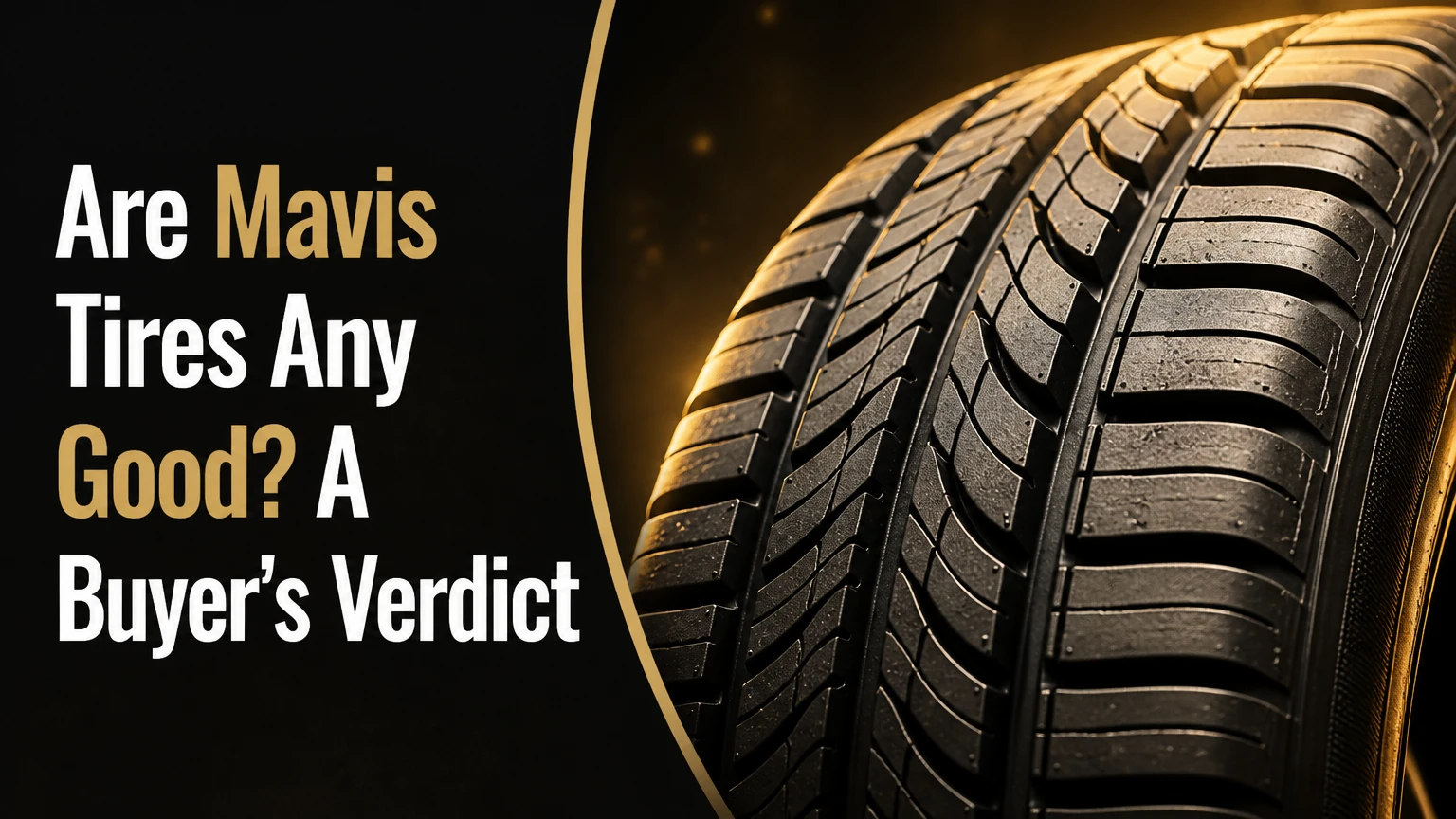
Mavis tires can be a good purchase when you select a reputable model at a competitive installed price, but Mavis is a retailer rather than a single tire brand. Tire quality depends on the manufacturer, model, size, age, and performance category; installation quality depends heavily on the individual location. The lowest price is worthwhile only when the tire specifications and completed installation are correct.
Key Facts at a Glance
- Mavis Discount Tire sells premium, mid-range, value, and private-label tire brands; it does not represent one universal “Mavis” tire design.
- A typical four-tire purchase costs about $400-$1,200 installed for a passenger car, depending on size, brand, taxes, fees, and services.
- A tire’s wet grip, snow traction, noise, tread life, and warranty come from the specific tire model, not from the retailer.
- Mavis installation normally includes mounting, balancing, and installation, but valve stems, TPMS service, disposal, alignment, and road-hazard coverage may cost extra.
- A booked appointment does not guarantee a fixed completion time because shop capacity, walk-ins, staffing, and unexpected repairs affect the schedule.
- Consumer Reports evaluates tire retailers separately from tire models, so a retailer satisfaction score cannot prove that a particular tire is unsafe or poor quality.
Are Mavis Tires Any Good for Your Car?
Mavis is a reasonable tire retailer for drivers who compare models carefully and confirm the final invoice before authorizing work. Mavis is a poor choice for anyone who treats the retailer name as a tire-quality guarantee, assumes every online price includes installation, or needs a precisely timed same-day appointment.
The key distinction is between the tire and the service. A Michelin CrossClimate2 purchased through Mavis remains a Michelin tire with Michelin’s specifications and warranty. A budget private-label tire purchased through Mavis remains a value-oriented tire whose compromises may include greater road noise, weaker wet braking, shorter practical life, or less predictable winter performance.
Mavis location quality varies. National chains provide broad inventory and standardized procedures, but staffing, equipment maintenance, scheduling discipline, and management differ by shop. Reviews should therefore be assessed at the exact location, not treated as proof of every Mavis branch.
What does Mavis actually sell?
Mavis sells tires from major manufacturers and lower-priced brands across several performance tiers. The available catalog changes by location, tire size, vehicle, promotions, and inventory, so a model visible online may not be stocked at the nearest shop.
| Tire tier | Examples commonly encountered | Typical price per tire | Best use |
|---|---|---|---|
| Premium | Michelin, Continental, Bridgestone, Goodyear, Pirelli | $150-$300+ | Long-distance driving, wet roads, refined ride |
| Upper value | Cooper, General, Kumho | $100-$190 | Commuting with balanced cost and performance |
| Entry value | Uniroyal and comparable value brands | $70-$140 | Older vehicles and constrained budgets |
| Private label | Location-dependent house or lesser-known brands | $55-$130 | Basic transportation with low initial cost |
Brand names in this table are examples, not a guarantee of current Mavis inventory. Always verify the exact model, size, load index, speed rating, warranty, and manufacturing date.
How Does Buying Tires at Mavis Work?
Mavis’s online process usually begins with vehicle identification, tire selection, local inventory, and appointment booking, followed by in-store payment and installation. The online price is useful for comparison, but the shop invoice is the amount that determines the real cost.
A normal purchase follows this sequence:
- Enter the vehicle information. Use year, make, model, trim, tire size, or license plate. Confirm the result against the driver’s door-jamb placard because a vehicle database can display multiple approved sizes.
- Compare tire models. Check all-season, touring, performance, all-weather, and winter categories rather than sorting only by price.
- Review the complete cart. Look for mounting, balancing, disposal, taxes, valve service, TPMS service, alignment recommendations, and road-hazard coverage.
- Reserve a local appointment. Treat the time as a target arrival window, not a guaranteed hand-back time.
- Inspect the vehicle before work begins. Photograph wheel damage, note existing warning lights, and record the odometer.
- Approve only documented additional work. Request measurements or photographs for brake, alignment, and suspension recommendations.
- Verify the installation. Confirm tire pressure, torque, wheel direction, valve operation, and TPMS status before leaving.
A standard four-tire installation often takes 60-120 minutes under normal shop conditions. A busy location, missing inventory, seized lug nuts, TPMS problems, alignment work, or a staffing shortage can extend the visit to two or three hours.
Which Tire Specifications Matter Most?
The correct tire specification is more important than a small promotional discount. Tire size, load index, speed rating, seasonal category, and vehicle fitment determine whether the selected model is appropriate.
| Specification | Example | What it controls | Buyer’s rule |
|---|---|---|---|
| Size | 225/65R17 | Width, sidewall ratio, wheel diameter | Match the placard unless a qualified professional approves an alternative |
| Load index | 102, 1,874 pounds | Maximum load per tire at specified pressure | Never choose below the vehicle requirement |
| Speed rating | H, 130 mph; V, 149 mph | Tested speed capability under conditions | Match or exceed the original rating |
| Treadwear grade | 600 UTQG | Relative wear estimate within a test system | Compare models from the same manufacturer, not across brands as a mileage promise |
| Traction grade | AA, A, B | Wet-traction classification | Prefer AA or A for wet-road priorities |
| Temperature grade | A, B, C | Resistance to heat generation | Avoid C-rated tires for normal passenger use |
The Uniform Tire Quality Grading system can help compare models, but treadwear grades are not guaranteed mileage. Driving speed, inflation, alignment, climate, vehicle weight, pavement, and rotation frequency can change actual life substantially.
Are budget Mavis tires safe?
Budget tires can be safe when they meet the vehicle’s required specifications, carry the correct certification markings, and remain appropriate for the climate and driving conditions. Budget construction does not automatically mean unsafe, but low-priced tires often provide less wet-weather margin and lower refinement than premium alternatives.
For a driver who travels 8,000 miles annually in a mild climate, a value tire may be rational. For a driver covering 25,000 highway miles, carrying heavy loads, or commuting through snow, the cheapest model can become a false economy because braking, traction, and replacement intervals matter more than purchase price.
How Much Do Mavis Tires Cost Installed?
A typical Mavis four-tire purchase costs approximately $400-$1,200 installed for common passenger vehicles, while large SUV, truck, run-flat, and specialty tires can exceed $1,400. The final amount depends on tire size, brand, local taxes, installation charges, disposal, valve service, TPMS work, alignment, and optional protection plans.
| Vehicle and tire setup | Typical tire price | Typical installed total | Main cost variable |
|---|---|---|---|
| Compact sedan, value all-season | $65-$120 each | $350-$600 | Fees and local tax |
| Midsize sedan, mid-range all-season | $110-$190 each | $550-$900 | Brand warranty and tire size |
| Crossover, premium all-season | $160-$280 each | $800-$1,300 | 18-20 inch fitment |
| Pickup or SUV, all-terrain | $170-$325 each | $900-$1,500+ | Heavy-duty casing and wheel size |
These are typical market ranges, not a quote. Promotions can reduce the tire subtotal while leaving installation, disposal, tax, or protection charges unchanged.
Ask for these numbers before arriving:
- Tire price for each model and quantity
- Mounting and balancing charge
- Valve stem or TPMS service charge
- Tire disposal fee
- Sales tax and shop supplies
- Alignment price and diagnostic basis
- Road-hazard plan price and exclusions
- Rotation and balancing terms
- Manufacturer rebate conditions
- Total installed price after every discount
A price-match policy can be useful, but terms change and may require an identical tire, local competitor documentation, or a specific time window. Compare the complete installed total rather than comparing a tire-only advertisement with a fully installed quote.
Is Mavis Installation Reliable?
Mavis installation reliability is location-dependent, so a favorable tire price should not be mistaken for a guaranteed service experience. The main risks reported by customers across large tire chains include delayed completion, inaccurate time estimates, communication problems, uneven balancing, and recommendations for additional work that the customer cannot independently verify.
Consumer Reports has published retailer satisfaction research that distinguishes tire retailers from tire products. Such surveys can reveal customer-experience patterns, but they do not establish that every Mavis location performs poorly or that a specific Mavis-sold tire is defective. Claims that Mavis is universally ranked last by every major survey should be treated cautiously unless the current survey methodology and year are identified.
The practical solution is location screening. Read the newest reviews for the exact store, filter for tire installation, and look for repeated descriptions of the same failure. One complaint about a delayed appointment is weaker evidence than multiple recent complaints about incorrect balancing or missing invoice items.
How should you screen a Mavis location?
Call the shop before booking and ask four operational questions:
- Is the exact tire model and size physically available?
- What is the complete installed total, including disposal and valve service?
- How long is the current wait for a four-tire installation?
- Does the shop check and document wheel torque and tire pressure?
A professional answer does not guarantee flawless work, but evasive pricing or refusal to discuss wait times is a useful warning. Book earlier in the day when possible, because delays from earlier jobs accumulate as the schedule progresses.
Does Mavis Upsell Unnecessary Repairs?
Mavis may recommend brakes, alignment, suspension repairs, or maintenance during a tire visit, but a recommendation is not proof that the work is necessary. Customers should request measured evidence, photographs, or a written diagnosis before approving unrelated repairs.
A brake recommendation should identify pad thickness in millimeters, rotor condition, and the manufacturer’s or shop’s replacement threshold. An alignment recommendation should identify measured camber, caster, and toe before adjustment, plus the target range after adjustment.
| Recommendation | Evidence to request | Reasonable decision point | Immediate concern |
|---|---|---|---|
| Brake pads | Inner and outer pad measurements | Compare thickness with shop threshold | Metal-to-metal contact or hydraulic leak |
| Brake rotors | Thickness, scoring, runout, heat damage | Compare measured thickness with discard specification | Cracks, severe grooves, or pulsation |
| Alignment | Before-and-after printout | Uneven wear, pulling, or out-of-range toe | Steering instability or rapid edge wear |
| Suspension | Damaged component and symptom | Leakage, looseness, or failed bushing | Broken spring or unsafe joint play |
| Tire protection | Written coverage and exclusions | Compare deductible and replacement terms | Coverage that excludes common punctures |
An independent inspection is often cheaper than approving a large repair package under time pressure. The exception is an obvious safety defect, such as a visibly broken suspension component or brake fluid leak, where continued driving should stop.
What Does Mavis Installation Usually Include?
Basic installation commonly includes mounting the tires on the wheels, balancing each assembly, reinstalling the wheels, and inflating the tires. Valve stems, TPMS sensor service, disposal, alignment, rotations, and road-hazard protection may be separate line items or included only in a promotion.
Before payment, inspect the invoice for the exact tire model and quantity. The invoice should also show whether the shop performed an alignment, replaced valve components, reset or relearned TPMS sensors, and charged for optional coverage.
Tire pressure should be set to the vehicle placard specification, not the maximum pressure printed on the tire sidewall. The sidewall maximum is a component limit; the door placard is the vehicle manufacturer’s operating recommendation for normal loading.
Wheel torque matters because over-tightening can damage studs and under-tightening can allow wheel movement. Ask whether the shop uses a calibrated torque wrench after the impact tool, then recheck symptoms immediately if the steering wheel vibrates.
Can You Buy Mavis Tires and Use Another Installer?
Whether another installer will fit tires purchased through Mavis depends on Mavis’s current fulfillment terms, the product listing, and the local store. Some retailers restrict shipment, pickup, or promotional installation to their own locations, while an independent shop may install customer-supplied tires for a separate fee.
Before paying, ask whether the tires can be shipped to your chosen installer and whether the manufacturer warranty remains valid. Manufacturer defect warranties generally follow the tire’s eligibility rules, but workmanship claims usually belong to the installer that performed the work.
Buying online and using an independent installer can improve scheduling control, but it may remove the convenience of one retailer handling delivery, installation, rotation, and warranty administration. Compare the combined online tire price, shipping, mounting, balancing, disposal, and future service.
How Does Mavis Compare With Alternatives?
Mavis is strongest when local pricing and inventory beat competitors, while other retailers may offer more predictable scheduling, simpler protection policies, or stronger rotation support. The best alternative depends on the total installed price and the service capability of the exact location.
| Retailer type | Typical strength | Typical limitation | Best fit |
|---|---|---|---|
| Mavis | Promotions and broad brand selection | Variable location experience | Price-focused buyers who can screen a shop |
| Discount Tire | Tire-focused service and rotation support | Coverage varies by market | Drivers prioritizing tire service |
| Costco | Member pricing and warehouse value | Limited appointment capacity in busy periods | Members buying supported tire models |
| Local independent shop | Direct communication and continuity | Smaller inventory and fewer promotions | Drivers wanting a known technician |
| Online retailer plus installer | Broad model selection and transparent comparison | Separate parties handle warranty and installation | Buyers comfortable coordinating vendors |
Discount Tire, Costco, and independent shops are not automatically better in every city. A highly reviewed Mavis location can outperform a poorly managed competitor, while a low-rated branch can make a premium tire purchase frustrating.
Is Mavis cheaper than Discount Tire or Costco?
Mavis can be cheaper on the initial quote, but the winner changes after rebates, disposal, installation, road-hazard coverage, membership fees, and included rotations are counted. Compare identical tire models and the same service package within the same week.
For example, a $620 Mavis quote may become $700 after TPMS service and protection, while a $660 competitor quote may include rotations and a longer workmanship policy. The lower tire price alone does not establish lower ownership cost.
What Problems Can Occur After Mavis Installation?
The most useful post-installation checks are a low-speed brake test, a highway vibration check, a TPMS inspection, and a visual review of the sidewalls and wheels. Report defects promptly because documentation and timing strengthen a workmanship claim.
| Symptom | Likely causes | First response | Stop-driving condition |
|---|---|---|---|
| Steering shake at 55-70 mph | Balance error, bent wheel, tire defect | Return for balance check and road-force diagnosis | Severe shake or loss of control |
| TPMS warning | Incorrect pressure, sensor relearn failure, leak | Check cold pressure and request leak test | Pressure falls repeatedly |
| Vehicle pulls | Unequal pressure, alignment, tire conicity | Equalize pressure and request inspection | Pull worsens during braking |
| Slow pressure loss | Bead leak, valve issue, puncture | Soap-test valve and bead, then repair | Visible sidewall damage |
| New road noise | Tread design, defective tire, loose component | Compare tire model and inspect mounting | Grinding, humming with play, or bearing symptoms |
A vibration is not always a balancing mistake. A bent wheel, worn suspension part, or defective tire can produce the same symptom, so a competent shop should diagnose rather than simply repeat a balance.
What should you do if the TPMS light stays on?
Check all four tires and the spare, if equipped, with a reliable gauge when cold. Inflate to the door-placard pressure, drive the vehicle according to the owner’s manual relearn procedure, and return to the installer if the light remains on or pressure declines.
Do not use the tire sidewall maximum as the target pressure. A tire that loses pressure overnight requires a leak inspection, not repeated inflation alone.
Are Mavis House-Brand Tires Worth Buying?
A Mavis house-brand or lesser-known value tire can be worthwhile for low-mileage drivers who prioritize purchase price and drive in mild conditions. The same tire is a weaker choice for frequent rain, snow, towing, high annual mileage, or drivers who value quietness and short stopping distances.
Before choosing an unfamiliar model, check:
- Manufacturer and country of origin
- UTQG treadwear, traction, and temperature grades
- Mileage warranty and exclusions
- Severe Snow Service symbol, if winter traction matters
- Independent test results from organizations such as Consumer Reports or Tire Rack
- Retailer return and road-hazard terms
- DOT date code and storage history
A tire with a high treadwear number can still feel poor in rain or snow. Harder compounds may resist wear while sacrificing cold-weather grip, especially as temperatures fall below typical all-season operating conditions.
When Should You Avoid Mavis?
Avoid Mavis when the local branch cannot provide a written installed price, has repeated recent complaints about incorrect work, lacks the tire you need, or cannot complete the job within your safety and travel constraints. Avoid a particular tire model when independent testing, warranty terms, or seasonal performance do not match your driving.
Mavis is also a poor fit when you require specialized service, such as complex run-flat replacement, TPMS sensor programming, performance alignment, or commercial truck tire support, unless the exact location confirms the equipment and training.
A local specialist may cost more but reduce coordination risk. That premium can be reasonable when the vehicle is new, modified, leased, used for business, or difficult to replace.
How Can You Get a Better Mavis Tire Installation?
Use Mavis’s online pricing as a starting point, then control the transaction at the shop. Confirm specifications, photograph the vehicle, reject undocumented repairs, and perform a post-installation check before leaving.
Use this practical checklist:
- Compare at least two identical tire models at three retailers.
- Verify size, load index, speed rating, and seasonal category.
- Check the DOT date code when the tires arrive or are installed.
- Request the complete installed price in writing.
- Ask whether TPMS service, disposal, and valve stems are included.
- Photograph wheel faces and existing damage.
- Request measurement evidence for brakes and alignment.
- Confirm placard pressure and wheel torque.
- Drive at city speeds before entering the highway.
- Return immediately for vibration, pressure loss, or warning lights.
Expert rule of thumb: a tire installation should produce no new warning light, steering pull, vibration, or unusual noise. If one appears immediately afterward, treat the timing as diagnostic evidence, not as normal tire break-in.
Frequently Asked Questions
Does Mavis sell real name-brand tires?
Yes. Mavis commonly sells established brands such as Michelin, Goodyear, Bridgestone, Continental, Pirelli, Cooper, General, Kumho, and Uniroyal, although inventory varies by location and vehicle. Verify the exact model and size because a familiar brand name does not make every product line equivalent.
How long do Mavis tires last?
Mavis tires can last about 30,000-80,000 miles when the selected model, alignment, pressure, rotation schedule, climate, and driving habits support that result. The mileage warranty is not a promise of actual life. Uneven wear or underinflation can shorten service life substantially.
Does Mavis offer free tire rotation?
Rotation terms vary by store, tire purchase, promotion, and protection package. Ask for the offer in writing and confirm the required interval, usually around 5,000-8,000 miles, plus any exclusions. Free rotation has value only if the customer can conveniently return to the same service network.
Should I buy all-season or all-weather tires at Mavis?
Choose all-season tires for moderate climates with occasional light snow and choose all-weather tires when regular winter traction matters but dedicated winter tires are impractical. Look for the three-peak mountain snowflake symbol on all-weather tires, because the symbol indicates a tested severe-snow performance threshold.
How can I tell whether a new tire is too old?
Read the four-digit DOT date code on the sidewall. The first two digits identify the production week and the last two identify the year, so 2424 means the 24th week of 2024. Tire age guidance varies by manufacturer, but NHTSA reports that tire makers commonly recommend replacement around six to ten years, regardless of remaining tread.
The Bottom Line
Are Mavis tires any good? The answer is yes for carefully selected models and no as a blanket judgment about every tire or location. Mavis can deliver strong value when the tire matches your vehicle, the installed total is genuinely competitive, and the local shop documents its work.
Choose the tire by model and specification, not by the Mavis name. Screen the exact location, verify every fee, inspect the installation, and obtain evidence before approving brake or alignment work. A premium tire cannot compensate for incorrect pressure or poor balancing, and a low price cannot justify a tire that lacks the traction your climate requires.