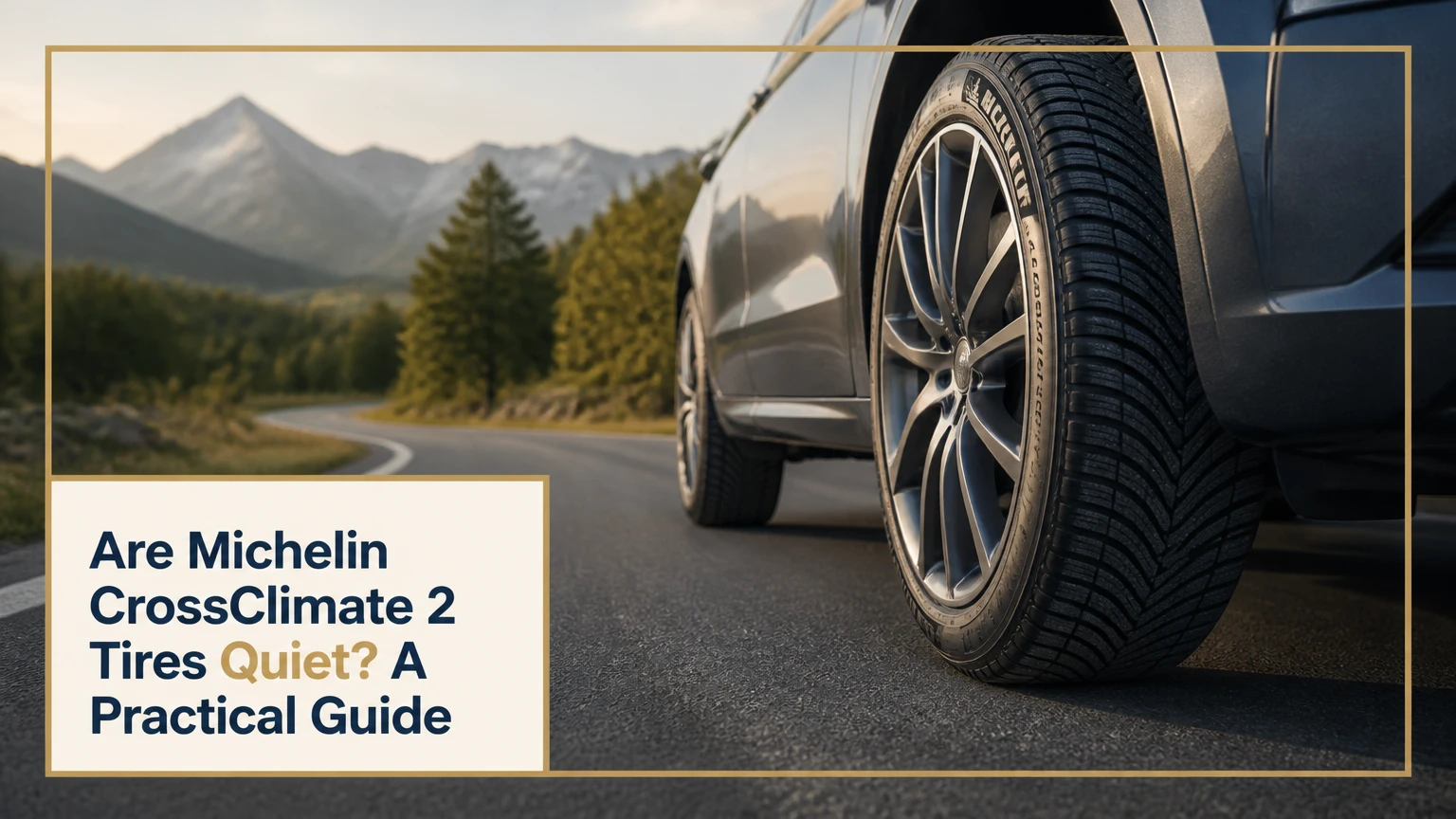
Michelin CrossClimate 2 tires are generally quiet for an all-weather tire, but they are not the quietest option in every vehicle or on every road. Most drivers hear mild tread hiss on smooth asphalt and a deeper hum on coarse or grooved concrete, while uneven wear can create substantially louder noise than the original tread design.
Key Facts at a Glance
- Michelin CrossClimate 2 tires usually produce a controlled, moderate sound level for a directional all-weather tire.
- Smooth asphalt is typically the quietest surface; coarse asphalt and grooved concrete can create a noticeable hum.
- The 3PMSF severe-snow rating requires winter capability that ordinary touring all-season tires do not provide.
- CrossClimate 2 noise depends on tire size, vehicle insulation, inflation pressure, alignment, tread wear, and road surface.
- A rhythmic “wub-wub” or roar usually indicates cupping, heel-and-toe wear, imbalance, or a mechanical issue rather than normal tread sound.
- Michelin’s published warranty and UTQG details can vary by market and size, so buyers should verify the exact product specification.
Are Michelin CrossClimate 2 Tires Quiet on Highways?
Michelin CrossClimate 2 tires are quiet enough for normal highway conversation, podcasts, and radio listening, particularly on clean, smooth asphalt. At 70 mph or higher, the directional tread can produce a low-pitched hum, and grooved concrete can make that sound more prominent because the grooves interact with the tire’s repeating tread geometry.
The practical verdict is favorable. CrossClimate 2 tires are quieter than most dedicated winter tires and many aggressive all-terrain tires, but a premium grand-touring tire with smaller, less open tread blocks can sound quieter on dry pavement. The trade-off is that CrossClimate 2 provides stronger cold-weather and light-snow capability than those comfort-focused alternatives.
Cabin design changes the result. A luxury sedan with laminated glass may make the tire seem nearly silent, while a compact crossover with thin floor insulation can transmit tread frequencies clearly. Large wheels also tend to reduce sidewall cushioning, so a 20-inch fitment may sound and feel harsher than a 17-inch fitment on the same vehicle.
Why Does the Tread Pattern Affect Noise?
The Michelin CrossClimate 2 tread affects noise through block impacts, air movement, and resonance inside the tread grooves. Its pronounced V-shaped directional pattern creates large drainage channels and strong snow-biting edges, but those open features can move more air and generate more audible frequencies than a conventional symmetric touring tread.
Michelin identifies “Piano Acoustic Tuning” as part of the CrossClimate 2 design. The principle is passive frequency management: tread blocks use different lengths and sequences so that impacts do not repeat in one perfectly dominant rhythm. That approach can reduce a sharp whine, but it cannot eliminate every sound created by pavement texture.
Tire noise is also a vehicle-system issue. The tire excites the road, suspension, wheel, and cabin floor; the passenger compartment then amplifies or suppresses particular frequencies. The Tire Rack’s testing of all-weather and winter tire categories demonstrates why subjective noise impressions differ between vehicles and surfaces, even when drivers use the same tire model.
What does a 69-72 dB reading mean?
A 69-72 dB figure should not be treated as a universal cabin-noise specification for every CrossClimate 2 size. European tire-label noise values are external pass-by measurements, not a direct measurement of what the driver hears inside a particular vehicle, and the value can change with tire width, load index, and construction.
Decibels are logarithmic. A small numerical difference can represent a meaningful change in acoustic energy, but perceived loudness also depends on frequency. A deep hum may feel intrusive even when a meter records a modest average level, whereas a higher, softer hiss may measure similarly but seem less objectionable.
For that reason, independent test numbers are useful for comparing tires under identical conditions, not for promising a specific cabin result. The most reliable buyer evidence combines a controlled test, owner reports from the same vehicle, and an inspection of the tire’s exact size and load rating.
Which CrossClimate 2 Version Is Quietest?
The standard passenger CrossClimate 2 is usually the best choice for minimum noise, provided its load and speed ratings match the vehicle. CrossClimate 2 SUV versions use related tread technology but may have stronger construction, while Agilis CrossClimate is a commercial-van product with different durability priorities and should not be judged as an equivalent passenger tire.
| Version | Typical application | Construction consideration | Likely noise character |
|---|---|---|---|
| CrossClimate 2 | Sedans, wagons, minivans | Passenger-focused casing in sizes from about 16-20 inches | Lowest noise among the three when correctly fitted |
| CrossClimate 2 SUV | Crossovers and SUVs | Higher load requirements and reinforced fitments in some sizes | Similar tread hiss, more impact transmission on stiff setups |
| Agilis CrossClimate | Delivery vans and commercial vehicles | Heavy-duty casing, sidewall protection, fleet durability | More pronounced impact and tread noise than passenger versions |
| Original-equipment fitment | Specific factory vehicle applications | Vehicle-tuned compound, casing, or acoustic treatment may differ | Noise can differ from the aftermarket equivalent |
Vehicle fitment matters more than the label “SUV.” A compact crossover on 17-inch wheels may be quieter than a sedan on low-profile 20-inch tires because the crossover has more sidewall and softer suspension tuning. The correct comparison uses identical wheel diameter, tire width, load rating, and vehicle.
How Does Noise Change as CrossClimate 2 Tires Wear?
CrossClimate 2 tires often become more audible as tread depth decreases, but the largest noise increase usually comes from irregular wear rather than ordinary tread loss. Heel-and-toe wear, cupping, feathering, and shoulder wear create repeating impact patterns that can turn a mild hum into a pronounced roar.
Directional tires have a limited rotation pattern. Most vehicles can move CrossClimate 2 tires from front to rear on the same side, but side-to-side rotation is unavailable unless the tire is dismounted and remounted, which is not a routine rotation method. Front-wheel-drive vehicles place especially high demands on the front tires during acceleration, steering, and braking.
Michelin and tire-service professionals commonly recommend following the vehicle manufacturer’s rotation interval, often about 5,000-8,000 miles rather than waiting for audible noise. The exact interval depends on the vehicle, drivetrain, alignment, and wear pattern. Rotation cannot repair existing cupping; it only reduces the chance of worsening an uneven pattern.
What does irregular tire noise sound like?
| Sound heard while driving | Most likely source | First inspection |
|---|---|---|
| Even hiss above 30 mph | Normal tread and air noise | Compare smooth and coarse pavement |
| Low hum at 60-75 mph | Tread resonance or concrete grooves | Change road surface and check tread depth |
| Rhythmic “wub-wub” | Cupping or severe irregular wear | Run a hand across tread blocks |
| Sharp steering-related whine | Wheel bearing or drivetrain issue | Check whether sound changes during turns |
| Vibration with droning | Balance, bent wheel, or tire uniformity | Inspect wheel balance and radial runout |
| One-sided roar | Feathering, alignment, or suspension wear | Check toe setting and tire shoulders |
A hand inspection can reveal more than a visual glance. Run a palm lightly across the tread in both directions with the vehicle parked and secured; alternating high and low blocks suggest cupping or heel-and-toe wear. Do not place hands near a moving wheel, and have a technician inspect any tire with bulges, cords, cracks, or structural damage.
How Can Owners Prevent Increasing Tire Noise?
Owners can preserve the original noise character by maintaining placard pressure, rotating on schedule, and correcting alignment or suspension faults before they create irregular wear. Tire pressure should match the driver-door placard, not the maximum pressure molded into the sidewall, because both underinflation and overinflation can worsen ride and wear.
Use this maintenance sequence:
- Check pressure monthly and before long trips. Measure cold tires with a reliable gauge, then adjust all four tires to the vehicle manufacturer’s specified pressure.
- Inspect tread every 5,000 miles. Look for shoulder wear, scalloping, feathered edges, nails, and differences between axle positions.
- Rotate according to the vehicle schedule. Keep each directional tire on the same side unless a qualified technician dismounts and reverses it correctly.
- Measure alignment after impact or abnormal wear. A pothole strike, curb contact, or steering pull can alter toe and create feathering.
- Check suspension components. Worn dampers, bushings, or wheel bearings can produce cupping and noise even when inflation is correct.
- Replace tires as a set when appropriate. Mixing a new directional tire with a heavily worn tire can produce handling and acoustic differences.
The expert rule is simple: a tire that becomes loud quickly deserves an inspection, not an assumption that all aggressive tread is naturally noisy. Normal tread hum develops gradually; a sudden change points toward pressure, damage, balance, alignment, or a mechanical fault.
How Do CrossClimate 2 Tires Compare With Touring Tires?
Michelin CrossClimate 2 tires usually lose a small amount of pavement quietness and fuel efficiency to a highway touring tire, but they add certified severe-snow capability and stronger cold-weather traction. The touring tire wins for dry-road refinement in warm climates, while CrossClimate 2 wins when one tire must cover rain, cold, and occasional snow.
| Tire category | Representative example | Snow certification | Noise tendency | Best operating priority |
|---|---|---|---|---|
| All-weather | Michelin CrossClimate 2 | 3PMSF | Moderate, with possible concrete hum | Four-season traction |
| Highway touring all-season | Michelin Defender 2 | M+S or all-season marking, not generally 3PMSF | Low on smooth asphalt | Quiet mileage and fuel economy |
| All-weather competitor | Bridgestone WeatherPeak | 3PMSF | Moderate to low, vehicle dependent | Snow traction with comfort |
| Dedicated winter | Michelin X-Ice Snow | 3PMSF | More audible on dry roads | Ice, packed snow, and severe cold |
| Performance all-season | Michelin Pilot Sport All Season 4 | Usually not a winter substitute | Variable, often firmer and louder | Dry handling and steering response |
Is the Defender 2 quieter than the CrossClimate 2?
The Michelin Defender 2 is generally the quieter and more efficient choice on dry highways because its touring tread and casing prioritize low rolling resistance, long wear, and ride comfort. The CrossClimate 2 is the better choice when the driver regularly encounters snow, freezing temperatures, or mountain-road weather.
The comparison is not a universal decibel contest. A Defender 2 in a large, stiff SUV fitment may sound louder than a CrossClimate 2 in a smaller tire size, and pavement can reverse a driver’s impression within the same trip. Treat category characteristics as a starting point, then verify vehicle-specific reviews.
Is WeatherPeak quieter than CrossClimate 2?
Bridgestone WeatherPeak can provide a similarly comfortable all-weather experience and may sound quieter on some coarse surfaces, but no consistent winner applies across every vehicle and size. CrossClimate 2 often has a more distinctive tread hum, while WeatherPeak’s sound may be perceived as softer or less directional.
Both tires carry the Three-Peak Mountain Snowflake symbol in applicable specifications, so neither is a substitute for a dedicated winter tire in frequent ice or deep-snow conditions. Compare wet braking, snow testing, warranty terms, price, and local availability rather than choosing on noise alone.
Does Snow Capability Require More Noise?
Severe-snow capability does not require an intolerably loud tire, but the tread features that help in snow can increase sound compared with a closed touring tread. The 3PMSF symbol means the tire passed a standardized snow-traction performance test, not that it matches a dedicated winter tire on ice or every deep-snow surface.
CrossClimate 2 uses directional grooves, pronounced shoulder geometry, and a rubber compound intended to remain functional in lower temperatures than many conventional all-season tires. Those features improve water evacuation and snow engagement, but they also increase tread void and edge interaction with pavement.
The practical boundary is important. CrossClimate 2 is well suited to drivers who face intermittent snow, cold rain, and plowed roads. Drivers in mountain regions, northern Canada, or places with persistent ice should still consider dedicated winter tires, which use a more cold-flexible compound and dense sipe network.
What Is the Ownership Cost?
Typical US retail pricing for Michelin CrossClimate 2 tires falls around $180-$350 per tire, depending on size, load rating, retailer, and seasonal promotions. A complete set commonly costs approximately $720-$1,400 before mounting, balancing, disposal fees, taxes, and alignment.
| Fitment example | Typical tire price | Typical installed set | Cost variable |
|---|---|---|---|
| 16-inch passenger size | $160-$210 | $760-$1,000 | Regional labor and rebates |
| 17-inch crossover size | $190-$240 | $880-$1,150 | Load rating and wheel diameter |
| 18-inch SUV size | $220-$290 | $1,020-$1,350 | XL construction and availability |
| 20-inch truck or SUV size | $280-$380 | $1,280-$1,750 | Large casing and premium fitment |
Michelin warranty mileage is specification- and market-dependent. Many US passenger CrossClimate 2 fitments carry a 60,000-mile limited treadwear warranty, but the exact warranty document controls, and commercial Agilis products may have different terms. UTQG ratings also vary by size and construction; a single rating such as 640 AA should never be assumed for every CrossClimate 2 tire.
Tread life depends on alignment, rotation, vehicle weight, driving style, climate, and starting tread depth. A driver who prioritizes quietness should budget for rotation and alignment, because replacing a prematurely cupped tire costs more than preventing the wear.
Do EVs Make CrossClimate 2 Noise More Noticeable?
Electric vehicles can make CrossClimate 2 tread noise more noticeable because the powertrain produces less masking sound at urban and suburban speeds. EV weight, instant torque, and aerodynamic sealing can also expose casing and tread frequencies that a gasoline vehicle’s engine would partly conceal.
The trade-off is not automatically negative. CrossClimate 2 traction can suit EV owners who need cold-weather grip, but the tire may reduce energy efficiency compared with a low-rolling-resistance EV-specific tire. The actual range effect varies with temperature, speed, tire pressure, wheel size, and vehicle software, so a fixed 3-5% penalty is not a dependable universal rule.
EV owners should compare the exact tire’s load index and manufacturer approval. An under-rated tire can create heat, handling, and wear problems, while an oversized or unusually heavy fitment can affect both range and ride comfort.
Which Road Surfaces Make Them Loudest?
Grooved concrete and coarse chip-seal asphalt usually make CrossClimate 2 tires sound louder than smooth asphalt. Surface texture changes the frequency and force of tread impacts, so the same tire can move from a faint hiss to a low hum within a few hundred feet.
A useful road test separates normal pattern noise from a defect. Drive the same speed on smooth asphalt, coarse asphalt, and concrete, then note whether the sound changes with the surface. If the noise changes dramatically with pavement, the tread-road interaction is probably normal; if the sound remains identical and rises with vehicle speed or turning load, inspect the tire, wheel, bearing, and suspension.
Wind noise can be misidentified as tire noise. Compare the sound with the transmission in neutral only where safe and legal, and never use unsafe driving maneuvers as a diagnostic test. A technician can isolate rotating assemblies more reliably.
What Are the Best Alternatives for a Quieter Ride?
The best quieter alternative depends on whether the driver can give up 3PMSF snow capability. Michelin Defender 2 is the clearest comfort-first alternative, Bridgestone WeatherPeak preserves all-weather positioning, and a dedicated winter tire provides stronger cold-weather traction at the cost of more dry-road noise and seasonal changeovers.
| Driver situation | Preferred tire category | Example choice | Main sacrifice |
|---|---|---|---|
| Florida or southern Arizona highway use | Touring all-season | Michelin Defender 2 | No severe-snow certification |
| Northeast mixed weather | All-weather | Michelin CrossClimate 2 | More tread hum than touring tires |
| Frequent ice and unplowed snow | Dedicated winter | Michelin X-Ice Snow | Storage, mounting, and dry-road noise |
| EV range priority | Low-rolling-resistance EV tire | Michelin e.Primacy where approved | Reduced snow capability |
| Commercial van delivery use | Commercial all-weather | Michelin Agilis CrossClimate | More casing and impact noise |
CrossClimate 2 is a poor fit for a driver who never sees freezing temperatures and values maximum fuel economy, soft ride, or absolute highway silence. A touring tire will usually make more sense in that situation. CrossClimate 2 is also not the ideal sole tire for repeated icy mountain travel, where a dedicated winter setup has a larger safety margin.
Can a Noisy CrossClimate 2 Be Fixed?
A noisy CrossClimate 2 can often be corrected when the source is pressure, balance, alignment, or irregular wear, but normal tread resonance cannot be repaired without changing the tire category. The first step is identifying whether the sound is even across the tread or rhythmic and localized.
Use this diagnostic order:
- Verify cold inflation pressure against the door placard.
- Inspect tread depth and run a hand over every tire.
- Check wheel balance and radial or lateral runout.
- Measure alignment, especially toe and camber.
- Inspect dampers, bushings, bearings, and wheel fasteners.
- Confirm directional arrows point toward forward rotation.
- Replace a tire with structural damage or severe irregular wear.
Incorrect installation deserves immediate attention. A directional tire mounted backward may reduce wet-weather evacuation and create abnormal behavior, although it will not necessarily become “extremely loud” in every vehicle. The arrow marked “ROTATION” must point in the direction the tire travels when moving forward.
Frequently Asked Questions
Are CrossClimate 2 tires louder than regular all-season tires?
CrossClimate 2 tires can be louder than a conventional highway touring all-season tire because the directional tread has larger voids and more tread edges. The difference is usually modest on smooth asphalt but more apparent on coarse pavement or grooved concrete. The reward is stronger cold-weather and snow performance.
Do CrossClimate 2 tires affect gas mileage?
CrossClimate 2 tires may reduce fuel economy compared with low-rolling-resistance touring tires because their compound, casing, and tread prioritize grip across more temperatures and surfaces. A precise loss cannot be promised; vehicle weight, speed, pressure, wheel size, temperature, and alignment often matter more than a nominal tire-category estimate.
How often should CrossClimate 2 tires be rotated?
Rotate CrossClimate 2 tires at the vehicle manufacturer’s interval, commonly around 5,000-8,000 miles. Because CrossClimate 2 is directional, routine rotation normally moves each tire front-to-rear on the same side. Inspect tread at every rotation, since catching feathering early is easier than correcting established cupping.
Are CrossClimate 2 tires good for hot climates?
CrossClimate 2 tires work in hot climates, but they are not usually the most efficient or quiet choice for a snow-free region. Drivers in Florida, coastal California, or southern Arizona may get better fuel economy and highway refinement from a touring all-season tire such as Michelin Defender 2.
Should I buy CrossClimate 2 tires for occasional snow?
CrossClimate 2 tires are a strong choice for occasional snow when the vehicle needs one year-round tire and roads are generally plowed. The 3PMSF mark confirms severe-snow testing, but drivers facing frequent ice, deep snow, or remote winter travel should use dedicated winter tires for additional cold-weather margin.
Why are my new CrossClimate 2 tires vibrating?
New CrossClimate 2 tires that vibrate may have a balance problem, wheel damage, mounting error, tire uniformity issue, or incorrect pressure. A small amount of tread sound is normal, but steering-wheel vibration, seat vibration, or speed-specific shaking should prompt a tire shop inspection rather than a break-in assumption.
The Bottom Line
Michelin CrossClimate 2 tires are generally quiet for their category, especially when compared with dedicated winter and aggressive all-terrain tires. Their main acoustic weakness is a possible low-frequency hum on grooved concrete or coarse asphalt, and uneven wear can make that hum substantially louder.
The answer to “are Michelin CrossClimate 2 tires quiet” is therefore yes for most drivers, with conditions. Choose them for balanced rain, cold, and snow performance; choose a touring tire for the quietest warm-weather highway ride; and investigate any sudden rhythmic roar instead of treating it as normal.


