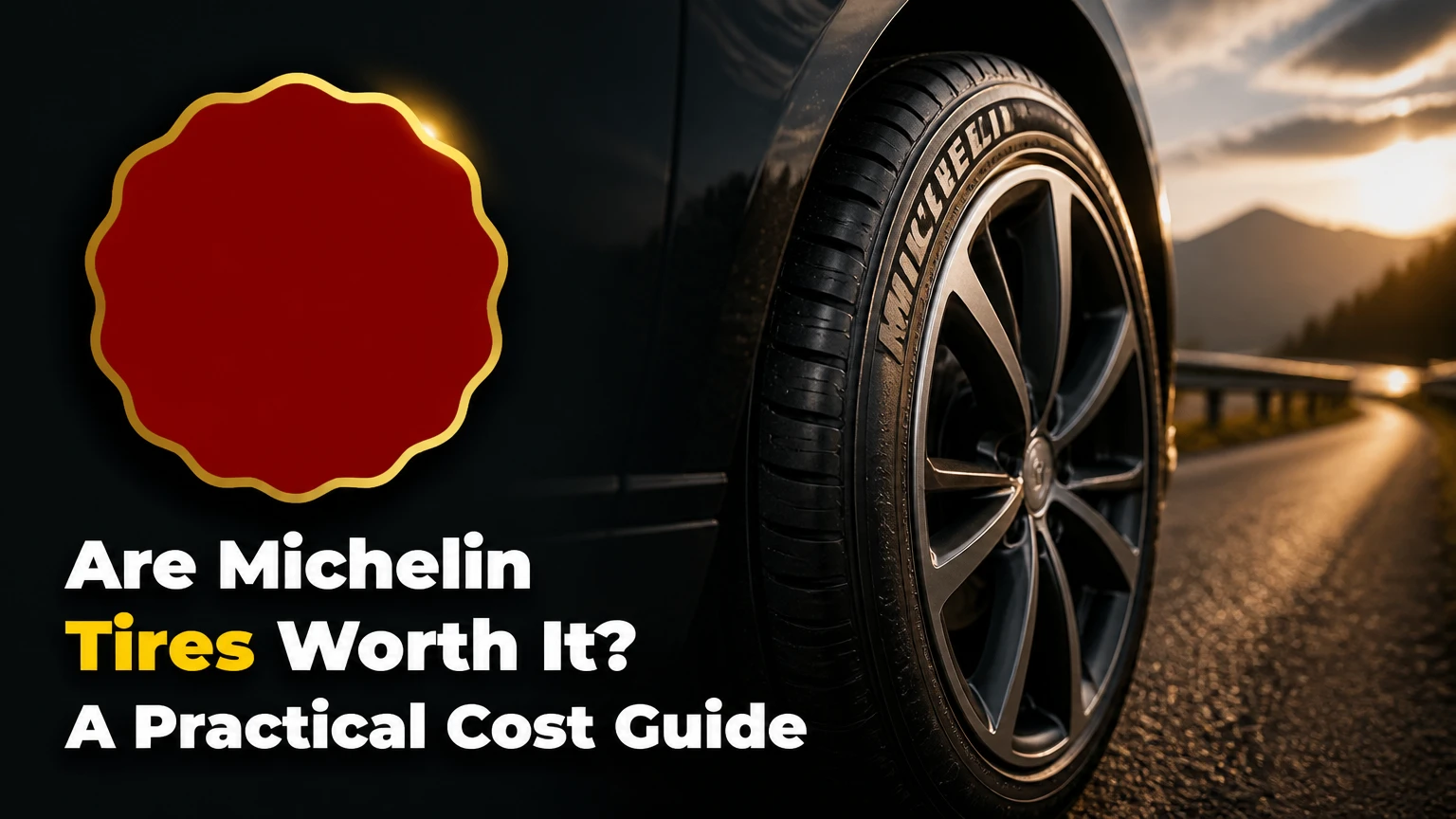
Michelin tires are worth the premium for many drivers who keep a vehicle for several years, drive substantial highway mileage, or place high value on wet-road braking, ride comfort, and predictable handling. Michelin tires are not automatically the best purchase for low-mileage drivers, short-term leases, severe winter conditions, or buyers whose budget cannot support the initial cost.
Key Facts at a Glance
Michelin’s typical premium-touring and commuter tires carry limited treadwear warranties ranging from approximately 55,000 to 80,000 miles, depending on the exact model and size.
Michelin’s ten-year recommendation concerns maximum chronological age from manufacture, not a promise that every tire remains safe for ten years.
A Michelin tire costing $220 and lasting 70,000 miles costs about $0.0031 per expected mile before installation.
Michelin’s Pilot Sport performance tires generally trade tread life for steering response, dry grip, and wet handling.
CrossClimate tires carry the Three-Peak Mountain Snowflake symbol, but a dedicated winter tire remains the stronger choice for frequent ice and deep-snow driving.
Correct inflation, rotation, alignment, load rating, and tire age can matter more than the brand name.
Are Michelin Tires Worth It for Your Driving?
Michelin tires are usually worth buying when their longer usable life and stronger wet-weather performance offset the higher purchase price. The value is highest for drivers covering about 12,000-20,000 miles annually, retaining a vehicle beyond the next tire replacement, and buying a model suited to their climate.
Michelin tires are less compelling when the vehicle will be sold within months, annual mileage is below roughly 6,000 miles, or the buyer must use a credit balance to afford them. A cheaper tire with strong independent test results can be financially wiser if it meets the vehicle’s original load index, speed rating, size, and seasonal requirements.
The brand also does not remove the need for maintenance. An underinflated Michelin tire can wear rapidly, while an alignment defect can create noise and irregular wear before the treadwear warranty becomes relevant.
What Does the Premium Actually Buy?
The Michelin premium usually buys a more carefully balanced combination of wet grip, steering consistency, rolling resistance, noise control, and tread durability. No single Michelin model maximizes all of those properties, because a soft performance compound and a long-wearing touring compound require different engineering compromises.
Michelin identifies technologies such as MaxTouch Construction, which distributes forces across the contact patch, and EverGrip features, which maintain water evacuation as selected tread patterns wear. Those technologies describe design intent, not a guaranteed mileage or stopping-distance result for every vehicle.
Tire performance also depends on the vehicle’s suspension geometry, wheel alignment, road surface, temperature, tire pressure, and driver inputs. A Defender on a compact sedan and a Pilot Sport on a high-performance coupe are both Michelin products, but their priorities are fundamentally different.
How Much Do Michelin Tires Cost per Mile?
Michelin tires commonly cost about $150-$450 per tire in mainstream passenger-car sizes, with installation, balancing, disposal fees, taxes, and optional road-hazard coverage adding approximately $100-$250 per set. Cost per mile is more useful than purchase price alone, but expected mileage must come from the exact tire model rather than the brand average.
| Example tire purchase | Set price before installation | Expected usable life | Approximate cost per mile |
|---|---|---|---|
| Budget touring set | $520 | 45,000 miles | $0.0116 |
| Mid-tier touring set | $680 | 55,000 miles | $0.0124 |
| Michelin touring set | $900 | 70,000 miles | $0.0129 |
| Michelin performance set | $1,300 | 35,000 miles | $0.0371 |
The table shows why a premium tire does not always produce a lower per-mile cost. The $900 Michelin example costs slightly more per expected mile than the $520 budget set, although it may offer better wet braking, lower noise, or a more consistent end-of-life feel.
A more expensive tire becomes financially attractive when the price gap is smaller than its additional service life. For example, replacing a $700 set every 45,000 miles costs about $1,400 across 90,000 miles. A $900 set lasting 70,000 miles costs about $1,157 over the same distance, before installation differences.
Those figures are planning examples, not laboratory results. Temperature, alignment, tire rotation, road texture, vehicle weight, and acceleration can change actual mileage substantially.
How Long Do Michelin Tires Last?
Michelin tires commonly last 50,000-80,000 miles in touring applications, while high-performance models may last about 25,000-45,000 miles. The exact treadwear warranty, vehicle fitment, driving conditions, and replacement threshold matter more than the Michelin name.
| Michelin family | Typical use | Typical warranty range | Typical street price per tire |
|---|---|---|---|
| Defender | Commuting and all-season touring | 70,000-80,000 miles | $150-$240 |
| Primacy | Quiet touring and luxury sedans | 55,000-70,000 miles | $160-$260 |
| CrossClimate | All-weather use | 50,000-70,000 miles | $180-$280 |
| Pilot Sport | Performance and sports cars | 20,000-45,000 miles | $220-$450 |
| LTX or Latitude | SUVs, pickups, and light towing | 55,000-80,000 miles | $200-$350 |
Michelin’s limited treadwear warranty is not the same as a guaranteed replacement at the stated mileage. Warranty claims normally require proof of purchase, documented rotation, acceptable remaining tread, and compliance with the manufacturer’s conditions. Pro-rated credit may apply rather than a free replacement.
Michelin recommends replacing tires at ten years from the date of manufacture, even if tread remains, and recommends professional inspection after five years. The National Highway Traffic Safety Administration also advises checking tire age and condition rather than relying only on tread depth. Heat, ultraviolet exposure, ozone, storage, and long periods of underinflation accelerate aging.
The DOT code on the sidewall identifies the week and year of manufacture. A code ending in “2324,” for example, indicates production during the 23rd week of 2024.
Are Michelin Tires Safer in Rain?
Michelin tires can provide excellent wet-road braking and hydroplaning resistance, but the advantage varies by model, tire age, temperature, and comparison tire. Wet safety comes primarily from tread design, rubber compound, contact pressure, and the tire’s ability to retain grip as water depth and speed increase.
Independent comparison tests often place premium Michelin models near the top for wet handling, although Continental, Goodyear, Bridgestone, and Pirelli frequently match or exceed Michelin in particular categories. A claimed stopping-distance advantage, such as twelve feet, cannot be generalized without specifying vehicle, speed, tire size, temperature, water depth, and test surface.
Michelin’s EverGrip branding refers to tread features intended to preserve evacuation performance as the tire wears. In practical terms, drivers should still replace a tire at the legal or manufacturer-recommended wear limit because a worn groove cannot create the same water reserve as new tread.
A useful practitioner rule is to prioritize independent wet-braking results over brand reputation. If two tires cost the same, choose the one with stronger wet braking and hydroplaning results for the climate where the vehicle actually operates.
Do Michelin Tires Improve Fuel Economy?
Low-rolling-resistance Michelin tires can reduce energy losses at the road and may improve fuel economy, but an “up to 8%” gain is not a reliable expectation for every vehicle. Real-world improvement is commonly smaller because speed, temperature, tire pressure, traffic, payload, and driving style dominate fuel consumption.
The U.S. Environmental Protection Agency explains that rolling resistance affects vehicle efficiency, while tire manufacturers tune it alongside wet grip, tread life, and noise. Lower rolling resistance can also produce compromises, including reduced steering feel or different braking behavior, depending on the model.
Correct inflation frequently produces a larger and more dependable benefit than changing from one premium brand to another. Use the pressure on the driver-door placard, not the maximum pressure molded into the sidewall. The placard pressure is the vehicle manufacturer’s cold inflation specification for the approved tire setup.
Electric vehicles make rolling resistance more noticeable because tire losses directly affect range. EV-specific Michelin models may use reinforced construction, acoustic foam, and compounds designed for high vehicle weight, but the correct load rating and alignment remain more important than the brand badge.
Which Michelin Tire Should You Choose?
The best Michelin tire depends on climate, vehicle type, driving speed, annual mileage, and whether comfort, winter traction, or handling has the highest priority. Michelin’s product families are not interchangeable upgrades, because a performance tire can wear faster and an all-weather tire can ride differently from a touring tire.
| Driving situation | Michelin family to investigate | Main strength | Main limitation |
|---|---|---|---|
| 15,000 highway miles annually | Defender | Long treadwear and low noise | Less responsive than a performance tire |
| Luxury sedan commuting | Primacy | Ride comfort and cabin refinement | Higher price and moderate winter ability |
| Rain with occasional snow | CrossClimate | All-weather traction and 3PMSF rating | More tread noise than many touring tires |
| Aggressive street driving | Pilot Sport | Steering response and dry grip | Shorter tread life and higher cost |
| SUV or light pickup use | LTX or Latitude | Load support and highway durability | Not a substitute for a severe-duty commercial tire |
Is CrossClimate Good Enough for Snow?
Michelin CrossClimate tires are appropriate for drivers who encounter light or moderate snow but do not need maximum ice and deep-snow traction. The 3PMSF symbol confirms that the tire meets a standardized severe-snow performance threshold, but it does not make the tire equivalent to a dedicated winter tire.
Dedicated winter tires use compounds that remain flexible at lower temperatures and tread designs optimized for packed snow and ice. Drivers in areas with frequent temperatures below about 45 degrees Fahrenheit, repeated snowstorms, or steep icy roads should compare a winter set rather than treating an all-weather tire as a universal solution.
Are Pilot Sport Tires Worth the Price?
Michelin Pilot Sport tires are worth the price for drivers who can use their dry grip, wet handling, steering precision, and high-speed stability. They are poor value for basic commuting when long tread life, low noise, and low replacement cost matter more than cornering response.
Pilot Sport models differ substantially. Pilot Sport 4S is a summer performance tire, while Pilot Sport All Season 4 adds colder-weather versatility but does not equal a winter tire on ice. Performance tires also require correct alignment because aggressive shoulder wear can destroy their usable life quickly.
Michelin vs Continental, Bridgestone, and Other Alternatives
Michelin is a strong premium choice, but no brand wins every tire category. Continental often competes closely in wet braking and steering feel, Bridgestone has a strong winter reputation through Blizzak, and Goodyear, Pirelli, Hankook, and Falken can provide better value for specific vehicles and budgets.
| Brand or line | Strong fit | Typical price position | Where it may beat Michelin |
|---|---|---|---|
| Continental PureContact or ExtremeContact | Touring and wet-road performance | 5%-15% lower | Steering response or wet-test result |
| Bridgestone Turanza or Blizzak | Touring or winter driving | Similar to Michelin | Ice and snow performance with Blizzak |
| Goodyear Assurance or Eagle | Commuting and performance | 5%-15% lower | Local promotions and broad availability |
| Hankook Kinergy or Ventus | Budget-conscious replacement | 15%-30% lower | Lower purchase cost with competent performance |
| Falken Azenis or Wildpeak | Performance or truck use | 10%-25% lower | Value and selected SUV applications |
The statement that Continental delivers “90% of Michelin’s performance for 80% of the cost” is too broad to treat as a fact. Tire tests compare specific models, not entire brands, and results can reverse between wet braking, dry handling, noise, rolling resistance, and wear.
A reliable alternative must match the original tire’s size, load index, speed rating, construction type, and seasonal category. A cheaper tire that cannot support the vehicle’s axle load is not an economical substitute.
What Should You Check Before Buying Michelin Tires?
Verify the exact tire specification before comparing prices. The brand and model name alone do not identify the full product, because one Michelin tire may have different load ratings, speed ratings, run-flat construction, acoustic foam, or original-equipment tuning for different vehicles.
Use this buying checklist:
- Read the door placard. Record the approved size and cold inflation pressure.
- Match the load index. Never install a tire with a lower load capacity than the vehicle requires.
- Match the speed rating. A lower rating can change handling and may violate vehicle requirements.
- Check OE markings. BMW star, Mercedes MO, Porsche N, and Tesla-specific markings can indicate tuned fitments.
- Compare the DOT date. Request a newer production date when inventory has been stored for an extended period.
- Price the complete job. Include mounting, balancing, valve stems, disposal, alignment, taxes, and road-hazard coverage.
- Confirm warranty terms. Read the local Michelin warranty and seller conditions before relying on mileage credit.
- Check drivetrain rules. Many AWD vehicles require closely matched tread depths across all four positions.
Replacing only two tires can create handling differences between axles. On some AWD systems, a small circumference mismatch can increase driveline stress, so the vehicle manufacturer’s replacement guidance takes priority over a general two-tire rule.
How Should Michelin Tires Be Maintained?
Michelin tires require monthly pressure checks, rotation at the vehicle manufacturer’s interval, alignment after impact or irregular wear, and professional inspection as the tires age. Maintenance determines whether the tire reaches its expected mileage and retains its wet-weather behavior.
| Maintenance action | Practical interval | Warning sign requiring earlier action |
|---|---|---|
| Check cold pressure | Every month | Pressure loss exceeding 2 psi monthly |
| Rotate tires | About 5,000-8,000 miles | Front-to-rear tread difference |
| Inspect tread and sidewalls | Monthly | Bulge, cut, exposed cord, or cracking |
| Check alignment | After pothole impact or pull | Feathering, steering offset, uneven shoulder wear |
| Professional age inspection | Annually after five years | Ozone cracks or repeated pressure loss |
Center tread wear usually indicates chronic overinflation, while shoulder wear commonly indicates underinflation or excessive cornering loads. Cupping or scalloped wear can indicate worn shocks, wheel imbalance, or suspension play rather than a defective tire.
Fine surface weather checking does not have a universal safe-depth rule. Cracks that reach the carcass, appear between tread blocks, accompany a bulge, or expose cords require immediate professional evaluation and often replacement. Tire dressing containing petroleum distillates can accelerate deterioration, so water-based products are the safer choice.
Michelin’s guidance is direct: “No tire, regardless of its tread depth, lasts forever.” That principle matters because deep tread cannot compensate for structural aging or impact damage.
When Are Michelin Tires a Bad Buy?
Michelin tires are a poor purchase when the buyer selects a premium model that does not match the vehicle or driving environment. Paying for Pilot Sport grip on a slow urban commuter wastes money, while choosing a long-wearing Defender for a car that requires dedicated winter traction creates a safety mismatch.
Michelin may also be a bad buy in four specific situations:
- A short ownership period: A seller may not recover the premium through resale value.
- Very low annual mileage: Aging may end the tire’s service life before tread wear creates financial value.
- Severe winter driving: A 3PMSF all-weather tire may not provide enough ice traction.
- Damaged suspension or alignment: Mechanical wear can destroy any tread-life advantage.
A tire should not be selected solely by warranty mileage. A 70,000-mile warranty has limited value if the vehicle’s alignment, rotation pattern, road surfaces, or driving style make that mileage unrealistic.
What About Leased Vehicles?
Leased-vehicle drivers should compare the tire’s remaining tread at turn-in with the lease company’s return threshold. A premium Michelin set may be worthwhile when the lease requires substantial tread and the driver will cover 30,000 or more miles, but it is usually unnecessary when the vehicle will be returned soon and compliant mid-tier tires cost substantially less.
Are Michelin Tires Worth It for Trucks and SUVs?
Michelin LTX and Latitude products can be worth the premium for highway-oriented SUVs, family pickups, and light towing when quiet operation, wet-road stability, and long tread life matter. They are not automatically ideal for rock crawling, commercial hauling, deep mud, or repeated operation near maximum payload.
Confirm the tire’s load range, maximum load, sidewall construction, and fitment for the truck’s axle ratings. A tire with excellent tread life can still be unsuitable if its load capacity or terrain design does not match the work.
FAQ
Do Michelin Tires Really Last Longer Than Cheaper Tires?
Michelin touring tires often last longer than many budget alternatives, but the comparison must use equivalent models and warranty categories. A typical 70,000-mile Michelin touring tire may outlast a 45,000-mile budget tire, yet some mid-tier Continental, Hankook, or Falken products can approach Michelin’s usable life under the same maintenance and road conditions.
Are Michelin Tires Quiet?
Many Michelin touring tires are quiet when properly inflated and evenly worn. Road noise depends on tread pattern, pavement texture, vehicle insulation, wheel size, and suspension condition, so a Michelin tire cannot guarantee a silent cabin. Cupping and heel-toe wear can make any tire hum at highway speed.
Can I Mix Michelin Tires With Another Brand?
Mixing brands is sometimes possible, but matching size, load index, speed rating, construction, and seasonal category is essential. The same axle should normally use a matching pair, and AWD vehicles may require four closely matched tires. Follow the vehicle manufacturer’s instructions before combining different tread patterns.
How Do I Know Whether a Michelin Tire Is Too Old?
Inspect the DOT date, sidewalls, tread grooves, and inner shoulders, then have a tire professional evaluate tires that are five years old or more. Replace Michelin tires at ten years from manufacture under Michelin’s general recommendation, or sooner if cracking, bulges, impact damage, repeated pressure loss, or unusual vibration appears.
Are Michelin Tires Better for Electric Vehicles?
Michelin EV-oriented tires can support higher vehicle weight, reduce rolling resistance, and manage noise from a quieter powertrain. They are not automatically better for every electric vehicle. The correct load index, alignment, pressure, and low rolling resistance specification matter more than choosing the most expensive model.
The Bottom Line
Are Michelin tires worth it? Michelin tires are worth the premium when a driver wants long-wearing touring performance, strong wet-weather confidence, low cabin noise, or a carefully engineered fit for a vehicle kept over several years. Michelin tires are not worth paying for when low annual mileage, severe winter conditions, short ownership, or financial constraints point toward another properly tested option. Choose the exact tire by climate, vehicle specification, expected miles, and cost per usable mile, not by the brand name alone.