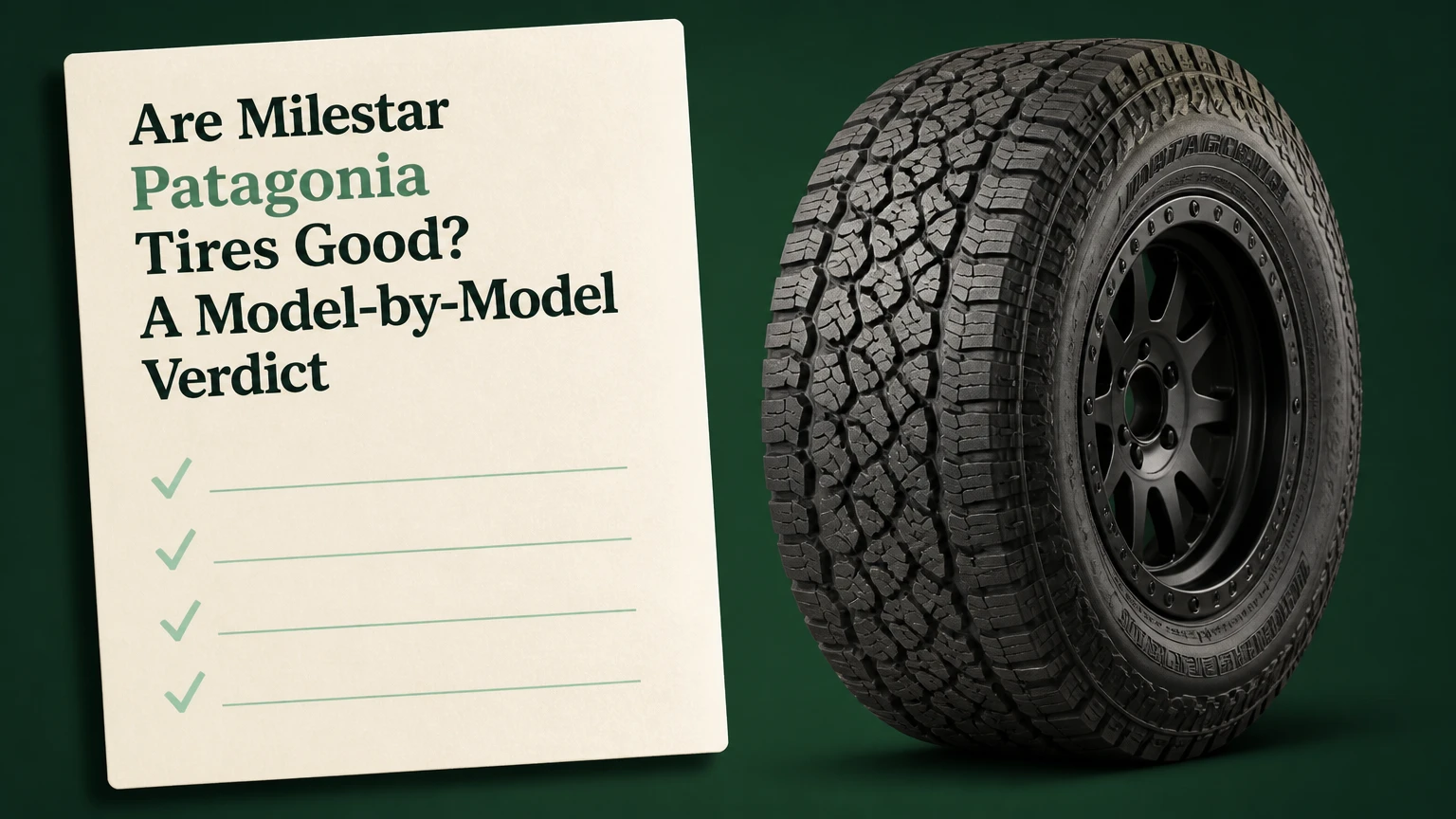
Milestar Patagonia tires are good value-oriented tires when their model matches the vehicle’s actual use. The A/T Pro and H/T are the strongest choices for pavement and mixed driving, the X/T suits drivers who regularly combine highways with technical trails, and the M/T-02 works best for serious mud and rock use. They do not consistently match premium tires in wet braking, refinement, balancing, or long-term consistency.
Key Facts at a Glance
- Milestar Patagonia is a light-truck, SUV, Jeep, van, and overlanding tire family sold by Tireco Inc.
- Patagonia quality varies substantially by model: an A/T Pro is designed for a different job than an M/T-02.
- Typical retail pricing is about $130-$380 per tire, with oversized mud tires reaching the upper end.
- The A/T Pro, X/T, and some other models carry mileage warranties, while mud-terrain warranties commonly exclude treadwear mileage.
- M+S means mud and snow classification; 3PMSF indicates a tire passed a standardized severe-snow traction test.
- Correct load rating, wheel fitment, alignment, rotation, and pressure affect safety more than the Patagonia name alone.
Are Milestar Patagonia Tires Good Overall?
Milestar Patagonia tires are good budget and mid-budget off-road tires, but they are not a universal substitute for BFGoodrich, Falken, Toyo, Goodyear, or Michelin. Their strongest value appears when a driver needs deep tread, aggressive sidewalls, and trail capability at a lower purchase price, while their weaknesses become more visible during wet-road braking, high-speed travel, balancing, and heavily loaded use.
The lineup is broad enough that “Patagonia quality” cannot be judged from one review. A Patagonia H/T is a highway tire, whereas the M/T-02 is a mud tire with substantially different noise, handling, and wear behavior. The X/T occupies a hybrid position, and the A/T Pro targets drivers who spend most of their time on pavement.
Tireco’s official product pages describe features such as open shoulders, siping, stone ejectors, and reinforced construction. Independent reviews, including MotorTrend’s earlier evaluation of the Patagonia M/T, generally support the tire’s off-road value, but user experiences vary with alignment, vehicle weight, wheel size, driving speed, and maintenance.
Verdict: Patagonia tires are a sensible purchase for budget-conscious off-road drivers, especially when trail traction matters more than maximum highway refinement. They are a weaker choice for a vehicle that sees almost exclusively wet pavement, icy roads, or long-distance interstate travel.
What Makes Patagonia Tires Different?
Patagonia tires use different tread architectures to balance road contact with off-road void space. A tighter center tread can reduce the constant noise associated with a mud tire, while larger shoulder voids clear mud and expose additional biting edges when the tire enters loose terrain.
The center-crown concept is useful, but it does not make an aggressive tire behave like a touring tire. Large tread blocks still create impact noise, and a heavy LT construction can transmit more vibration through the steering system. Stone ejectors and open grooves help reduce rock retention, although they cannot prevent every puncture or gravel chip.
Flexible sidewalls also help a tire conform to rocks at reduced trail pressure. The benefit depends on tire construction, load range, wheel diameter, vehicle weight, and the driver’s pressure choice. A light Jeep on a 33-inch tire cannot use the same pressure as a loaded diesel pickup on a 35-inch tire.
How Do Tread Design and Sidewalls Affect Performance?
Patagonia tread design affects traction through three connected variables: block shape, void ratio, and sipe arrangement. Large voids help evacuate mud and gravel, sipes create additional edges on wet or snowy surfaces, and reinforced sidewalls improve resistance to cuts when the tire contacts rocks.
The trade-off is predictable. More void space usually means less continuous rubber on pavement, while stiffer LT carcasses often improve load capacity at the cost of ride comfort. A buyer should therefore evaluate the tire by terrain and load requirements, not by tread aggressiveness alone.
Which Patagonia Model Should You Buy?
The best Patagonia model depends on the percentage of pavement, the type of off-road surface, winter conditions, and the vehicle’s required load capacity. The A/T Pro is the most balanced daily-use option, the X/T favors technical overlanding, the M/T-02 favors severe mud and rock, and the H/T is the pavement-focused choice.
| Model | Primary use | Typical strengths | Main compromise | Stated warranty or rating |
|---|---|---|---|---|
| Patagonia H/T | Highway, towing, paved commuting | Lower noise, ribbed highway tread, wet-road siping | Limited mud and rock traction | All-season design; verify size-specific coverage |
| Patagonia A/T Pro | Daily driving, snow, mild trails | Balanced road manners, severe-snow rating on applicable sizes, deep tread | Less mud grip than X/T or M/T-02 | Up to 55,000 miles, size-dependent |
| Patagonia A/T R | Work trucks, vans, gravel, light trails | Open shoulders, cut-and-chip resistance, commercial utility | Less aggressive winter and trail performance | Up to 50,000 miles, application-dependent |
| Patagonia X/T | Mixed highway and technical trail use | Hybrid tread, stronger off-road bias, available heavy-duty sizes | More noise and rolling resistance than A/T tires | Often listed with 40,000-mile coverage, verify exact size |
| Patagonia M/T-02 | Mud, rock crawling, severe trails | Large voids, aggressive lugs, off-road bite | Noise, wear, wet braking, no normal mileage warranty | M+S classification; no standard treadwear mileage warranty |
Patagonia A/T Pro: Best Daily Driver
The Patagonia A/T Pro is the strongest general-purpose choice for drivers who spend roughly 70%-90% of their time on pavement and still use forest roads, gravel, snow-covered routes, or moderate trails. Its all-terrain tread provides more road stability and lower noise than a mud tire, while its severe-snow certification on applicable sizes gives it a measurable advantage over an M+S-only tire.
A stated 55,000-mile warranty is useful, but it is not a prediction that every set will reach 55,000 miles. Tire warranties normally require regular rotation, acceptable alignment, legal use, matching tire sizes, and sufficient remaining tread. A heavy truck, aggressive acceleration, poor toe alignment, or frequent towing can shorten actual life considerably.
Choose the A/T Pro if: pavement dominates and winter snow is a regular concern.
Skip it if: deep mud, sharp rocks, or maximum sidewall protection are routine.
Patagonia X/T: Best Mixed-Terrain Compromise
The Patagonia X/T suits a driver who wants more trail traction than a conventional all-terrain tire but still commutes on highways. Its hybrid tread uses larger voids and more aggressive shoulder geometry than the A/T Pro, making it better suited to loose dirt, rocks, ruts, and occasional mud.
The X/T usually produces more tread noise and steering sensitivity than the A/T Pro. A claimed or listed 40,000-mile warranty is also lower than the A/T Pro’s maximum coverage, which matches its more aggressive tread and harsher operating environment. Buyers should check whether their selected size carries 3PMSF certification, because ratings can vary by model and size.
Choose the X/T if: the vehicle regularly alternates between pavement and technical trails.
Skip it if: quiet highway travel and maximum wet braking matter more than trail bite.
Patagonia M/T-02: Best for Mud and Rock
The Patagonia M/T-02 is appropriate for drivers who deliberately accept highway compromises to gain mud-clearing and rock-crawling traction. Its open tread removes soft material more effectively than an A/T tire, and its large shoulder lugs provide additional edges when the tire is placed against uneven terrain.
Mud-terrain tires often wear faster and become less pleasant on pavement as the tread loses block height. The M/T-02 also lacks the normal mileage warranty offered on several all-terrain models, a standard limitation for many mud tires because terrain, wheelspin, and low-pressure use produce highly variable wear.
The M/T-02 is not automatically safer because it has deeper or more aggressive tread. On wet asphalt, a dedicated highway or all-terrain design may stop more predictably. Its advantage appears off-road, not during emergency braking on a rainy freeway.
Choose the M/T-02 if: mud, ledges, rocks, and trail access determine the purchase.
Skip it if: the vehicle drives 15,000 highway miles annually and rarely leaves pavement.
Patagonia A/T R: Best for Utility Vehicles
The Patagonia A/T R targets work trucks, vans, and overland vehicles that encounter gravel, construction sites, dirt roads, and moderate trails. Its cut-and-chip-oriented compound and open shoulder design can be useful in commercial environments where a highway tire would suffer repeated stone damage.
The A/T R is less specialized for severe snow than a 3PMSF-rated tire and less capable in deep mud than the X/T or M/T-02. A listed warranty of up to 50,000 miles is attractive for a budget commercial tire, but fleet operators should inspect the exact load range and warranty conditions before purchase.
Choose the A/T R if: utility, gravel durability, and price outweigh maximum snow performance.
Skip it if: severe winter traction or technical rock performance is the primary requirement.
Patagonia H/T: Best for Pavement and Towing
The Patagonia H/T is the logical choice when a truck or SUV spends nearly all its time on paved roads. Highway-oriented ribs and siping generally provide better ride comfort, lower noise, and more predictable wet-road behavior than the open blocks used on M/T and X/T tires.
The H/T cannot reproduce the loose-surface traction of an all-terrain tire. Drivers who tow on paved roads may prefer its stability and lower heat buildup, but correct load index, inflation, axle ratings, and trailer setup remain decisive. The tire must never be used to exceed the vehicle’s gross axle weight rating.
Choose the H/T if: pavement, towing, and quiet long-distance travel dominate.
Skip it if: regular mud, deep sand, or rocky trails are part of the normal route.
How Do Patagonia Tires Compare With Premium Alternatives?
Patagonia tires usually win on purchase price and deliver credible off-road traction, while premium alternatives often win on wet braking consistency, balance quality, casing uniformity, road comfort, and predictable tread life. The practical gap is smaller on a recreational trail vehicle and more important on a family SUV that travels at highway speeds in heavy rain.
| Buying priority | Patagonia advantage | Common premium alternative | Why the alternative may be better |
|---|---|---|---|
| Lowest purchase price | Often $130-$380 per tire | Falken Wildpeak, Toyo Open Country | Higher upfront cost can buy quieter road behavior |
| Serious mud use | M/T-02 tread voids and price | BFGoodrich Mud-Terrain KM3 | More established casing and dealer support |
| Mixed pavement and trails | X/T and A/T Pro options | Falken Wildpeak A/T4W, Toyo Open Country A/T III | Often stronger wet-road refinement and winter reputation |
| Highway commuting | H/T value | Michelin Defender LTX, Goodyear Wrangler Steadfast HT | Better touring comfort and road manners |
| Winter snow | Applicable 3PMSF A/T sizes | Dedicated winter tire, such as Bridgestone Blizzak | Dedicated winter compounds perform better on ice and severe cold |
| Commercial gravel use | A/T R price and cut resistance | Cooper Discoverer Work Series | Alternative may offer broader fleet support |
A lower price does not necessarily mean unsafe construction. It does mean the buyer should inspect the DOT date, dealer reputation, load range, test data, and return policy more carefully. A tire that saves $300 initially can become expensive if it requires early replacement or repeated balancing.
Are Milestar Patagonia Tires Good for Highway and Rain?
Patagonia all-terrain and highway tires can perform adequately on wet pavement when new and correctly inflated, but aggressive models generally give up braking refinement and hydroplaning resistance compared with road-focused tires. The M/T-02 is the least suitable Patagonia choice for frequent rain-heavy highway driving, especially after substantial tread wear.
Sipes and grooves evacuate water, but tread design alone does not determine wet grip. Rubber compound, contact pressure, tread depth, temperature, alignment, and vehicle suspension all matter. A worn tire with flattened center blocks can lose wet traction even when its side grooves remain visibly deep.
The most practical ranking for pavement is H/T first, A/T Pro second, A/T R or X/T depending on size and use, and M/T-02 last. Drivers in regions with frequent rain should also compare independent wet-braking tests rather than relying only on M+S or 3PMSF markings.
What Do M+S and 3PMSF Actually Mean?
M+S means the tread meets a classification for mud and snow geometry; it does not prove winter stopping performance on ice. The 3-Peak Mountain Snowflake symbol, or 3PMSF, means the tire passed a standardized snow-traction test and is a stronger indicator for severe-snow service.
Neither mark makes a tire a dedicated ice tire. A Patagonia A/T Pro with 3PMSF certification can be a reasonable one-tire compromise for moderate snow, while a winter tire remains preferable for repeated freezing temperatures, polished ice, and severe winter braking.
How Much Do Patagonia Tires Cost?
Typical Patagonia retail pricing ranges from $130-$380 per tire, or approximately $650-$1,500 for four tires before mounting, balancing, taxes, disposal fees, and alignment. The largest variables are tire diameter, load range, wheel size, seller, shipping, and whether the tire is a flotation or oversized fitment.
| Example purchase | Typical tire price | Four-tire estimate | Likely added service cost |
|---|---|---|---|
| 31-inch A/T or H/T | $130-$190 | $520-$760 | $100-$220 mounting and balancing |
| 33-inch A/T or X/T | $170-$250 | $680-$1,000 | $120-$260, with alignment often extra |
| 35-inch LT X/T or M/T | $220-$330 | $880-$1,320 | $150-$300 for heavy-duty service |
| 37-40-inch M/T-02 | $300-$380+ | $1,200-$1,520+ | $200-$400, plus fitment modifications |
An oversized tire can create costs beyond the tire invoice. Lift requirements, fender trimming, altered gearing, speedometer correction, spare-tire relocation, and increased fuel consumption may exceed the initial savings over a premium stock-size tire.
How Long Do Patagonia Tires Last?
Patagonia all-terrain tires commonly have stated treadwear coverage from 40,000 to 55,000 miles, depending on model and size, while actual service life is often lower or higher based on use. A realistic planning range is 35,000-55,000 miles for maintained A/T tires and substantially less for heavily abused M/T tires.
Mileage warranties are conditional. Rotation history, alignment records, uniform tread depth, correct inflation, and the date or mileage of the claim can affect eligibility. Mud, rock, wheelspin, low-pressure trail use, towing, and lifted suspension geometry can make a warranty estimate irrelevant.
Uneven wear is a frequent ownership problem. Toe misalignment creates feathering, worn shocks promote cupping, and incorrect pressure concentrates wear in the center or shoulders. Rotate typical street-driven sets every 5,000-7,500 miles, or more often when aggressive lugs begin feathering; follow the tire maker and vehicle manufacturer when their schedules differ.
What Pressure Should You Run?
Use the vehicle door placard as the starting point for road pressure, not the maximum PSI molded into the tire sidewall. Trail pressure must be selected for tire size, wheel bead security, vehicle weight, terrain, and load, then tested conservatively because a generic 12-18 PSI recommendation is unsafe for every vehicle.
A typical light SUV on a 33-inch LT tire may begin trail testing around 18-22 PSI, while a carefully configured rock-crawling vehicle may use 12-15 PSI. The correct value keeps the bead seated, protects the rim, controls sidewall heat, and produces a stable footprint without excessive bulging.
The chalk test can reveal obvious overinflation or underinflation, but it is not a complete engineering measurement. A better process records cold pressure, axle load, tread temperature, wear pattern, steering feel, and sidewall deflection, then changes pressure in small increments.
How Should You Set Up New Patagonia Tires?
- Confirm fitment before mounting. Match the tire’s load index, load range, speed rating, diameter, section width, and wheel diameter to the vehicle. Check full-lock clearance and suspension compression, not only static parking clearance.
- Balance the assembly accurately. Large LT tires may need a road-force balance or a specialist familiar with off-road wheels. Recheck balance if vibration appears after mud packs inside the wheel.
- Set cold road pressure. Begin with the vehicle placard pressure unless a qualified tire professional calculates a different pressure for the new tire’s load capacity.
- Rotate on schedule. Use a 5-tire rotation when the spare matches the other tires and the vehicle manufacturer permits it. Mark each position and record tread depth.
- Inspect after every trail trip. Remove lodged rocks, check for sidewall cuts, examine missing tread blocks, and verify that the valve stems and TPMS sensors remain secure.
One practitioner rule matters more than a dramatic tread pattern: never air down without carrying a reliable compressor, an accurate low-pressure gauge, and a plan for reinflating before returning to pavement.
Why Do Patagonia Tires Vibrate, Cup, or Wear Unevenly?
Patagonia tires may vibrate because of wheel imbalance, radial force variation, mud packed inside the wheel, bent wheels, tire runout, worn steering components, or an installation problem. Cupping usually points to a combination of suspension wear, imbalance, alignment error, or insufficient rotation rather than a single defect in the tread design.
Large mud-terrain blocks amplify small mechanical problems. A normal passenger-car balance procedure may not solve a heavy off-road assembly with significant radial variation, so a road-force balance can provide better diagnosis. Internal balancing media may help some applications, but it should not conceal a bent wheel, damaged tire, or loose bearing.
Stop driving and seek inspection when a tire develops a sudden bulge, exposed cord, severe pull, repeated pressure loss, or a new high-speed wobble. A tire shop should inspect the casing and suspension before simply adding weights.
How Can You Reduce Chunking and Sidewall Damage?
Reduce chunking by avoiding prolonged wheelspin on sharp rock, using an appropriate trail pressure, maintaining moderate throttle, and inspecting the tread after each difficult route. Excessive pressure can make tread blocks strike edges harshly, while excessive deflation can expose the rim and sidewall to impact damage.
Stone damage also has a vehicle-side consequence. Open shoulder lugs can eject gravel into rocker panels, fender liners, and paint, especially on vehicles without mud flaps. Wider offset tires increase that risk and may require protective film or redesigned splash guards.
Who Should Buy Milestar Patagonia Tires?
Milestar Patagonia tires make the most sense for owners who prioritize off-road capability per dollar and accept more maintenance than a highway tire requires. The correct model changes by use case.
- Daily commuter in moderate snow: Choose the A/T Pro in a verified 3PMSF size.
- Weekend overlander: Choose the X/T when technical trails outweigh quiet-road priorities.
- Rock crawler or mud user: Choose the M/T-02 with a matching full-size spare.
- Work van or gravel-road contractor: Consider the A/T R after confirming commercial load requirements.
- Highway tow vehicle: Choose the H/T or compare it with a premium highway LT tire.
- Frequent ice driver: Buy a dedicated winter tire instead of treating any Patagonia model as an ice solution.
Patagonia tires are a poor match for a luxury SUV owner seeking near-silent operation, a driver who demands the shortest wet-road stopping distance, or a vehicle that cannot accommodate increased tire weight and section width.
What Alternatives Should You Consider?
Compare the Patagonia model with a tire serving the same category, not merely another tire with an aggressive appearance. A Falken Wildpeak A/T, Toyo Open Country A/T, or BFGoodrich All-Terrain may justify its higher price through road manners and casing consistency, while a dedicated winter tire addresses cold-weather grip more effectively than an all-terrain compromise.
Before choosing, request the exact tire size and load range, check the production date, verify the warranty for that size, and compare installed pricing. Reviews from a Jeep cannot be transferred directly to a loaded dually, van, or half-ton pickup because axle loads and alignment behavior differ.
Frequently Asked Questions
Are Milestar Patagonia tires made in the United States?
Milestar is a Tireco Inc. brand, but manufacturing location varies by tire and production period. Check the DOT identification code molded into the sidewall and confirm the current country of manufacture with the retailer before buying, especially when comparing inventory from different sellers.
Are Patagonia tires louder than factory tires?
Patagonia H/T and many A/T models can remain reasonably quiet, but X/T and M/T-02 tires are typically louder than original-equipment highway tires. Noise usually increases as tread blocks wear, feather, or cup. A rotation schedule and correct alignment can prevent abnormal roar without eliminating the tire’s basic tread noise.
Can I use Patagonia tires for towing?
Patagonia tires can be used for towing when the selected load index, load range, inflation pressure, wheel rating, and axle capacity meet the vehicle and trailer requirements. A highway-oriented H/T usually provides more stable paved-road behavior than an M/T-02, while an overloaded tire remains unsafe regardless of model.
Are Milestar Patagonia tires good in deep snow?
Applicable 3PMSF-rated Patagonia A/T tires can provide useful traction in moderate deep snow, while M+S-only models offer a weaker winter qualification. Deep snow performance does not equal ice performance; dedicated winter tires remain the better choice for frequent freezing conditions and polished surfaces.
Do Patagonia tires need frequent rotation?
Patagonia tires benefit from rotation about every 5,000-7,500 miles on normal roads, with shorter intervals when feathering or cupping begins. Off-road use, towing, aggressive alignment settings, and heavy vehicles can require more frequent inspection. Record tread depth at every rotation to detect uneven wear early.
Should I buy Patagonia tires for a lifted truck?
Buy them for a lifted truck only after confirming suspension clearance, steering clearance, wheel backspacing, load capacity, gearing effects, and spare-tire fitment. A lift does not automatically make an oversized tire safe. The combination can also change braking, handling, fuel consumption, and speedometer accuracy.
The Bottom Line
Are Milestar Patagonia tires good? Yes, when the purchase is based on terrain, load, and driving conditions rather than price alone. The A/T Pro is the most balanced choice for daily use and moderate snow, the X/T is the stronger mixed-terrain option, the M/T-02 is for serious trails, the A/T R suits utility vehicles, and the H/T fits pavement-heavy trucks.
Milestar Patagonia tires provide credible off-road value at a lower entry price, but buyers should budget for careful fitment, frequent inspections, correct pressure, balancing, and possible compromises in wet braking, noise, and tread life. For mostly paved driving, compare premium highway or all-terrain tires; for severe ice, choose a dedicated winter tire.