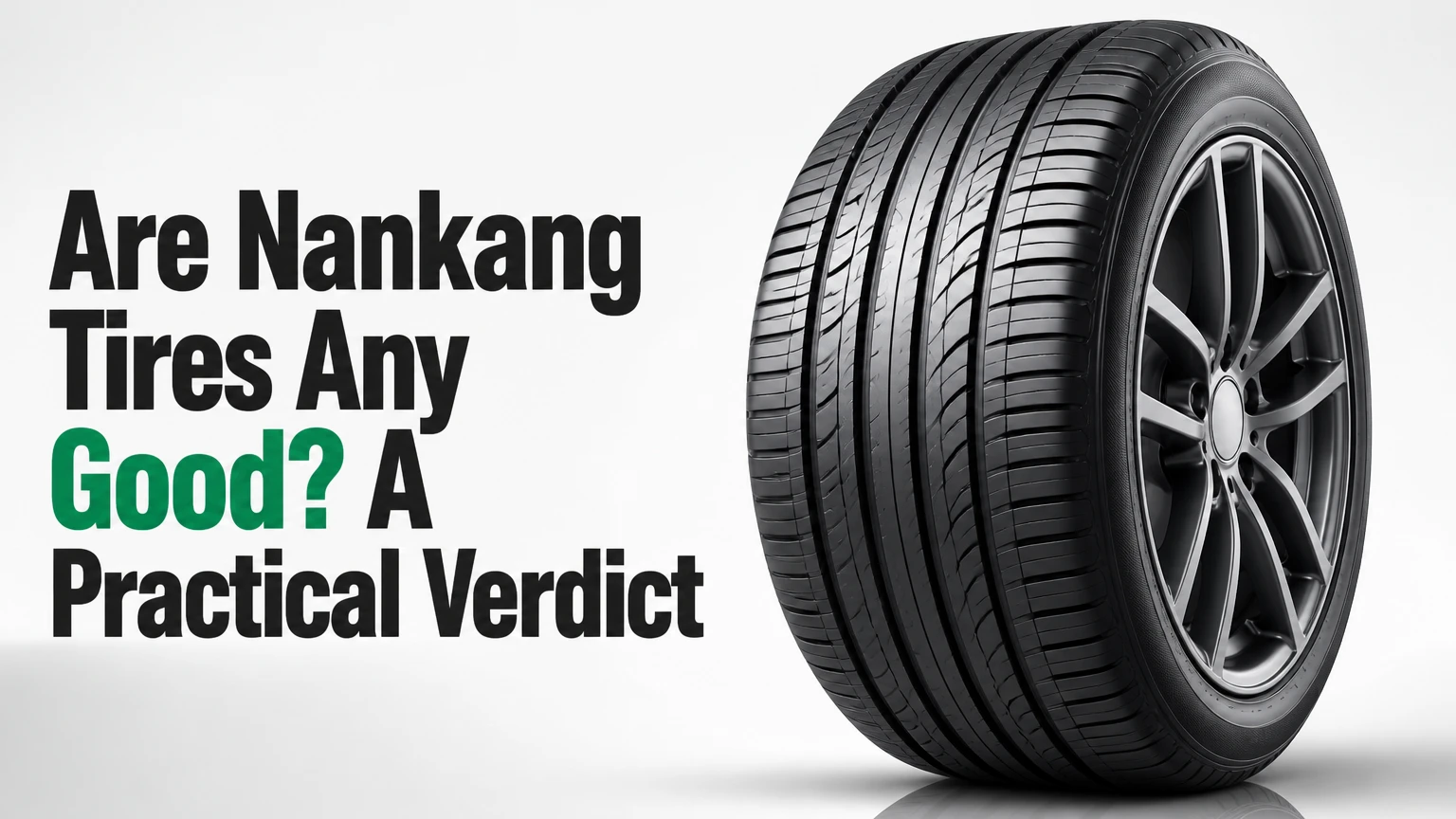
Nankang tires are a legitimate value-performance brand, and the best models can be good purchases when price, unusual fitments, dry grip, or track use matter more than premium refinement. Nankang street tires generally trail Michelin, Continental, and comparable mid-range products in wet braking, noise control, and consistency, while the AR-1 and CR-S offer unusually strong dry-track performance for their price.
Key Facts
Nankang Rubber Tire Corp. is a Taiwanese tire manufacturer with roots dating to 1959.
Nankang is generally positioned above anonymous low-cost imports and below premium brands in refinement and testing consistency.
Street models can suit budget-conscious drivers, but the exact model, tire age, load rating, and retailer warranty matter.
AR-1 and CR-S are competition-oriented tires, not sensible replacements for normal all-season road tires.
The AT-5 Conqueror carries a 3-Peak Mountain Snowflake designation in applicable sizes, but it is not equivalent to a dedicated winter tire.
A Nankang tire can be safe and useful without matching a premium tire’s wet-weather margin or service life.
What Kind of Tire Brand Is Nankang?
Nankang is a Taiwanese tire manufacturer best understood as a value-performance supplier rather than a single uniform quality tier. The company produces passenger-car, SUV, light-truck, all-terrain, high-performance, and motorsport tires, so a Nankang AR-1 and a touring-oriented SP-9 should not be judged by the same standards.
Nankang Rubber Tire Corp. identifies Taiwan as its home market, while retailer and industry profiles commonly place the company’s modern establishment in 1959. Manufacturing location can vary by product and market, so buyers should read the sidewall and inspect the DOT or regional production markings instead of assuming every tire is made in Taiwan.
The important distinction is between brand legitimacy and model performance. Nankang is not an anonymous tire label, but that fact does not guarantee that every model delivers the same wet grip, casing quality, or tread life. Product testing, independent reviews, vehicle setup, and tire age remain more useful than the logo alone.
The U.S. National Highway Traffic Safety Administration describes tires as “the only thing between you and the road.” That principle makes correct size, load capacity, inflation, and condition more important than saving the final few dollars at checkout.
Are Nankang Tires Any Good for Normal Driving?
Nankang street tires are usually adequate to good for commuting when the driver accepts more road noise and less wet-weather reserve than a premium alternative. Nankang tires make the most sense on older vehicles, modified cars with difficult fitments, and drivers who maintain modest speeds and replace tires before severe wear begins.
A budget street tire does not need to feel dangerous to be inferior. Differences often appear during emergency braking, standing-water transitions, cold mornings, highway lane changes, and the final third of tread life. Premium tires tend to preserve steering response and wet traction more effectively as they age.
Nankang’s value becomes stronger when the price difference is substantial. A $105 tire that fits an uncommon 17-inch wheel may be a rational purchase if the comparable premium option costs $190, provided the tire has an appropriate speed rating, a recent production date, and a credible warranty.
The purchase becomes harder to justify when the price gap is only $20-$30 per tire. At that point, a well-reviewed Kumho, Hankook, General, Falken, or comparable mid-range tire may provide better overall value through quieter operation and more predictable wet performance.
How Do Nankang Street Models Differ?
Nankang street models differ mainly by vehicle type, tread design, climate target, load rating, and intended performance. The following categories are more useful than treating NS-20, NS-25, and AS-2+ as interchangeable products.
| Nankang model or family | Primary category | Typical use | Main advantage | Main limitation |
|---|---|---|---|---|
| NS-20 | Summer performance | Sport compacts and modified cars | Affordable low-profile sizing | Limited cold-weather flexibility |
| NS-25 | UHP street tire | Daily-driven sedans and coupes | Broad fitment and low purchase price | Noise and wet performance vary by size |
| AS-2+ | Performance street tire | Drivers wanting sharper response | Asymmetric tread and silica-focused compound | Not a substitute for a dedicated winter tire |
| SP-9 Cross Sport | SUV touring | Crossovers and family SUVs | Smooth ride at a low price | Less precise steering under hard cornering |
| AT-5 Conqueror | All-terrain | Pickups, Jeeps, and light trucks | Aggressive tread with severe-snow marking in applicable sizes | Added weight and poorer highway efficiency |
| AR-1 | Semi-slick competition | Track days and time attack | Very high dry grip per dollar | Poor standing-water behavior and short life |
| CR-S | Competition track tire | Track days and club racing | Stronger all-round track pace than a basic street tire | Loud, expensive to run, and unsuitable for winter |
Product names and specifications can change by region. Confirm the local technical data sheet rather than relying on an old retailer listing.
How Do Nankang Tires Perform in Rain and Snow?
Nankang street tires can perform acceptably in ordinary rain, but drivers should expect less wet-braking margin than leading premium tires, especially at highway speed or near the wear bars. Nankang AR-1 and CR-S competition tires are a separate case: their limited tread void makes standing water a serious hydroplaning risk.
Silica-rich compounds and circumferential grooves can improve wet traction, but they do not erase the effects of tread depth, temperature, alignment, inflation, and vehicle weight. A new tire with four deep grooves may displace water well, while the same model at 3/32 inch can feel substantially less secure.
A 3PMSF marking means the tire passed a standardized severe-snow traction test. It does not mean the tire has the braking, cornering, or ice performance of a dedicated winter tire. The Nankang AT-5 can be useful for a truck that sees occasional snow, but a front-wheel-drive sedan in a snowy region needs a winter-oriented design.
| Driving condition | Suitable Nankang category | What to expect | Better alternative when risk is high |
|---|---|---|---|
| Light rain at urban speed | NS-25, AS-2+, SP-9 | Generally usable with correct inflation | Premium grand-touring tire |
| Heavy rain at 65 mph | Street models only, with caution | Reduced margin as tread wears | Michelin, Continental, or equivalent wet-focused tire |
| Standing water | Avoid AR-1 and CR-S | High hydroplaning potential | Full-tread street tire |
| Packed snow | AT-5 in marked sizes, cautiously | Useful traction, limited ice control | Dedicated winter tire |
| Glare ice | No Nankang all-terrain substitute | Poor braking regardless of tread appearance | Studless winter tire |
| Dry track surface | AR-1 or CR-S | Very high grip after proper preparation | R-compound or racing tire at higher cost |
Expert insight: a severe-snow rating answers one narrow test question. It does not certify year-round snow safety, and it cannot compensate for a heavy all-terrain casing on ice.
How Long Do Nankang Tires Last?
Nankang street tires typically last about 30,000-50,000 miles under moderate driving and correct maintenance, while aggressive performance tires may last closer to 20,000-35,000 miles. AR-1 and CR-S track tires can consume usable performance in roughly 3-8 track days, depending on car weight, alignment, temperatures, driving style, and circuit surface.
Those figures are practical ranges, not guarantees. A front-wheel-drive car with excessive toe, low tire pressure, or frequent hard cornering can destroy a front pair in less than 15,000 miles. A lightly driven rear-wheel-drive sedan with regular rotation may exceed the lower end of the street-tire range.
UTQG treadwear numbers require careful interpretation. A 500 rating does not mean a tire will last exactly twice as long as one rated 250, because manufacturers submit their own tires for comparison and the result is not a universal mileage forecast.
| Use case | Typical usable life | Main life-shortening factor | Maintenance rule |
|---|---|---|---|
| Compact-car commuting | 30,000-45,000 miles | Underinflation and front-axle wear | Check pressure monthly |
| SUV touring | 35,000-50,000 miles | Vehicle weight and alignment | Rotate every 5,000-7,500 miles |
| Spirited summer driving | 20,000-35,000 miles | Heat and shoulder wear | Inspect shoulders monthly |
| Occasional autocross | 10,000-25,000 road miles | Repeated heat cycles | Measure tread across the tire |
| AR-1 or CR-S track use | 3-8 track days | Overheating and abrasion | Record hot pressures and temperatures |
Replace any tire with exposed cords, a sidewall bulge, deep cracking, repeated air loss, or tread at or below the legal limit in the relevant jurisdiction. Tire age also matters. NHTSA recommends inspecting older tires carefully, and many manufacturers advise replacement around six years from service or ten years from manufacture, subject to their specific guidance.
How Much Do Nankang Tires Cost?
Typical Nankang purchase prices range from about $90-$150 for many passenger and crossover sizes, $160-$220 for common all-terrain light-truck sizes, and $200-$300 or more for competition sizes. Installation, balancing, valve stems, disposal fees, taxes, and alignment can add $100-$250 per vehicle.
Prices vary sharply by wheel diameter and availability. A rare stretched or low-profile fitment may cost more than a common 16-inch tire despite belonging to the same product family. Competition tires also have different replacement economics because their short life can outweigh a low initial price.
| Example category | Typical single-tire price | Typical vehicle set | Likely added fitting cost | Ownership note |
|---|---|---|---|---|
| NS-20 or NS-25, 17-inch | $95-$125 | $380-$500 | $100-$180 | Budget entry cost |
| SP-9, 18-inch crossover size | $125-$165 | $500-$660 | $120-$200 | Check mileage warranty |
| AT-5, LT 17-inch size | $170-$230 | $680-$920 | $150-$250 | Heavy casing may reduce MPG |
| AR-1, 17-inch track size | $210-$280 | $840-$1,120 | $100-$180 | No normal touring lifespan |
| CR-S, 18-inch track size | $250-$350 | $1,000-$1,400 | $100-$180 | Cost depends on track pace |
A claimed mileage warranty is only meaningful when the specific size and market include that warranty. Confirm the written terms, approved rotation pattern, required maintenance records, and prorated replacement conditions before treating warranty coverage as part of the value calculation.
How Do Nankang Tires Compare With Michelin, Continental, and Kumho?
Nankang usually wins on purchase price and unusual fitment availability, while Michelin and Continental usually win on wet braking, acoustic refinement, steering consistency, and broad independent-test performance. Kumho and Hankook often occupy the middle ground, costing more than Nankang while narrowing the gap to premium tires.
No universal percentage describes the difference because tire tests use different vehicles, sizes, temperatures, and surfaces. A claim that one tire stops exactly 10-15 percent farther in every rain condition is not reliable without a named test, vehicle, and measurement protocol.
| Decision factor | Nankang | Kumho or Hankook | Michelin or Continental |
|---|---|---|---|
| Purchase price, common size | $90-$165 | $115-$190 | $150-$260 |
| Rare modified fitment | Often strong availability | Moderate availability | Limited availability |
| Dry grip per dollar | Strong in performance models | Moderate to strong | Strong, at higher cost |
| Wet-weather reserve | Model-dependent, usually lower | Generally more consistent | Usually highest |
| Cabin noise | Moderate to high on aggressive tread | Moderate | Usually lowest |
| Long-term refinement | Acceptable | Good | Very good |
| Track-specific value | AR-1 and CR-S are strong | Fewer direct equivalents | More expensive track choices |
| Warranty transparency | Varies by market and model | Often clearer | Usually broad and established |
Nankang is therefore not a direct substitute for every Michelin or Continental product. A driver choosing tires for a luxury sedan, frequent motorway travel, or repeated heavy rain should assign more value to refinement and emergency stopping distance than to the lowest invoice.
Which Tire Should Each Driver Choose?
Choose Nankang for a modified street car
Nankang is a sensible candidate when the vehicle needs a wide, low-profile, or uncommon size and the owner prioritizes dry appearance and affordability. Confirm that the tire’s load index meets the vehicle requirement, because a visually correct stretched fitment can still create unsafe sidewall loading or rim protection problems.
Choose a mid-range rival for daily commuting
Kumho, Hankook, Falken, General, or a similar mid-range brand is often the stronger choice when the price difference is less than $30 per tire. The additional cost may buy lower noise, more stable wet behavior, and a clearer mileage warranty without reaching premium pricing.
Choose premium tires for luxury or high-mileage use
Michelin or Continental makes more sense for a quiet luxury vehicle, frequent wet-weather driving, long road trips, and drivers who keep tires until late tread life. Premium tires are expensive at purchase, but reduced noise and stronger worn-tread behavior can justify the difference.
Choose AR-1 or CR-S for track driving
AR-1 and CR-S are appropriate when the driver understands tire temperatures, hot pressures, camber, and the risk of rapid wear. They are poor choices for a daily car that regularly encounters rain, cold pavement, standing water, or long highway commutes.
What Are the Main Problems With Nankang Tires?
The most common Nankang complaints involve road noise, inconsistent wet performance between models, uneven wear, and limited refinement rather than immediate structural failure. Many complaints attributed to the brand actually result from poor alignment, incorrect pressure, worn suspension components, old inventory, or an unsuitable tire category.
Aggressive tread blocks can produce a repeating hum as they wear. Cupping creates alternating high and low spots that feel scalloped under a hand and may sound like a wheel bearing. Rotation every 5,000-7,500 miles helps, but it cannot correct an alignment problem or a damaged damper.
Check these failure modes before blaming the tire:
- Inner-edge wear: measure toe and camber, then inspect suspension bushings.
- Scalloped tread: check wheel balance, shocks, rotation history, and inflation.
- Wet grip loss: measure remaining tread and inspect for hardening or age cracks.
- Vibration after installation: request road-force balancing and verify wheel runout.
- Rapid shoulder wear: increase inspection frequency and confirm the vehicle’s specified pressure.
- Persistent air loss: inspect the valve, bead seal, wheel, and sidewall for damage.
Expert insight: treadwear across the full width is more informative than a brand reputation. Measure inside, center, and outside grooves; a 2/32-inch difference across one tire identifies a setup problem that a new replacement alone will not solve.
How Should You Break In Nankang AR-1 or CR-S Tires?
Nankang AR-1 and CR-S tires should receive a controlled scrub-in session before sustained maximum attack, followed by a complete cooldown. A practical track-day sequence is 3-4 moderate laps at roughly 50-60 percent pace, a gradual return to speed, and pressure adjustments based on measured hot readings rather than a generic street setting.
Use the manufacturer’s current technical guidance first, because compound, size, ambient temperature, and vehicle weight change the correct procedure.
Step 1: Inspect and set a baseline
Verify tire direction, wheel torque, cold pressure, tread condition, and clearance before leaving the paddock. Record ambient temperature and cold pressure in all four tires.
Step 2: Build heat gradually
Drive 3-4 laps without sliding, locking brakes, or attacking curbs. The objective is even carcass temperature, not a qualifying lap.
Step 3: Cool the tires completely
Allow a full cooldown before the next hard session. A 24-hour cooldown is commonly used when a driver is heat-cycling a fresh set for durability, while a normal track-day session may use a shorter between-session cooldown.
Step 4: Measure hot pressure immediately
Check pressure as soon as the car returns. Track-day practitioners commonly target approximately 32-35 psi hot for some Nankang competition applications, but the correct number depends on the vehicle and tire size.
Step 5: Inspect the tread
Look for tearing, grain, chunking, melted rubber, or excessive shoulder rollover. Adjust pressure, camber, driving style, or session length before continuing.
Expert insight: a stiff sidewall does not mean a street pressure is automatically correct on track. Excess pressure can reduce the contact patch and make the tread feel greasy, while too little pressure can overheat the shoulder and damage the carcass.
What Should You Check Before Buying Nankang Tires?
Check the exact model, size, load index, speed rating, season designation, manufacturing date, warranty, and retailer return policy before paying. The same Nankang model may have different ratings or warranty terms by country, so a product page from another market is not sufficient evidence.
Use this purchase checklist:
- Match the vehicle placard’s size and minimum load index.
- Confirm the speed rating meets the vehicle manufacturer’s requirement.
- Read the sidewall for the DOT production week and year.
- Prefer recent inventory, especially for performance or specialty tires.
- Verify whether the tire is summer, all-season, all-terrain, or competition-only.
- Ask whether the retailer covers road-hazard damage.
- Price mounting, balancing, disposal, and alignment separately.
- Confirm that all four tires share the same model and comparable tread depth.
- Avoid mixing a semi-slick axle with ordinary street tires on a road car.
- Recheck pressure after installation and torque wheels to vehicle specification.
A tire can be technically legal yet unsuitable for the vehicle. Fitment, load capacity, weather, and driving pattern must be evaluated together.
Which Nankang Tire Is Best for Each Situation?
The best Nankang tire depends on the road surface and the driver’s priority, not on the brand name alone. NS-25 or AS-2+ can suit budget street performance, SP-9 can suit relaxed crossover use, AT-5 can suit mixed pavement and light off-road driving, and AR-1 or CR-S can suit dry track work.
| Driver situation | Recommended direction | Why it fits | Avoid when |
|---|---|---|---|
| Civic or Camry commuter | NS-25 or comparable street model | Low cost and broad sizing | Frequent mountain snow or long wet-road travel |
| Lowered or modified coupe | NS-20 or size-specific performance model | Unusual fitment availability | Load index or clearance is compromised |
| Family crossover | SP-9 Cross Sport | Comfortable, affordable touring design | Driver expects sporty cornering |
| Pickup with occasional trails | AT-5 Conqueror | Aggressive tread and marked snow capability | Fuel economy and quiet highway travel dominate |
| Miata, BRZ, or track BMW | AR-1 or CR-S | High dry grip for track budget | The car is driven daily in heavy rain |
| Luxury sedan | Premium touring tire | Better acoustic and wet-weather refinement | Budget is the overriding constraint |
Nankang is least attractive for drivers who want one tire to excel at quiet highway travel, emergency wet braking, snow, long tread life, and sharp handling simultaneously. No inexpensive model can deliver all of those traits without trade-offs.
Are Nankang Tires Any Good? The Bottom Line
Nankang tires are good when the selected model matches the job: street models offer credible budget transportation, AT-5 provides a value-oriented all-terrain option, and AR-1 or CR-S delivers serious dry-track grip at a relatively accessible price. Nankang is not the best choice when premium wet braking, low noise, late-life consistency, or luxury-car refinement matter most.
Buy Nankang confidently for a suitable fitment after checking ratings, age, warranty, and independent model feedback. Choose a mid-range or premium competitor when the price gap is modest or the vehicle regularly faces demanding rain, snow, highway mileage, or high-consequence emergency braking.
Frequently Asked Questions
Are Nankang tires made in China?
Nankang is a Taiwanese tire company, but production location can vary by model and market. The sidewall and production markings identify the tire’s origin and certification information. Buyers should verify the exact product rather than assuming every Nankang tire is manufactured in Taiwan or treating country of origin as a complete quality assessment.
Are Nankang tires noisy?
Some Nankang tires are noticeably noisy, particularly aggressive directional or all-terrain designs as tread blocks wear unevenly. Correct rotation, alignment, inflation, balance, and suspension condition reduce avoidable noise. A rhythmic hum accompanied by scalloped tread usually indicates cupping rather than a simple characteristic of the rubber compound.
Do Nankang tires have a mileage warranty?
Mileage warranties vary by model, country, size, and retailer. Some street products are advertised with limited treadwear coverage, while many competition tires have no normal mileage warranty. Confirm the written terms and required maintenance records before assigning a warranty value to a Nankang purchase.
Can I use Nankang AR-1 tires on the street?
Nankang AR-1 tires may be road-legal in some sizes and jurisdictions, but road legality does not make them suitable for ordinary street use. Their limited water evacuation, high noise, rapid wear, cold-weather limitations, and track-focused construction make a full-tread street tire safer for commuting and wet highways.
Are Nankang tires better than Westlake or Linglong?
Nankang often has a stronger enthusiast and motorsport reputation than many ultra-budget alternatives, especially through the AR-1 and CR-S. The comparison still depends on the exact models. A well-tested Westlake or Linglong touring tire may be adequate, while a poor Nankang fitment can be unsuitable for a particular vehicle.
Should I buy Nankang tires for winter driving?
Buy a dedicated winter tire for frequent snow, ice, or temperatures consistently below about 45°F. The Nankang AT-5’s 3PMSF marking can help a truck in mixed conditions, but an all-terrain tire does not provide the same cold-weather compound and ice performance as a dedicated winter design.


