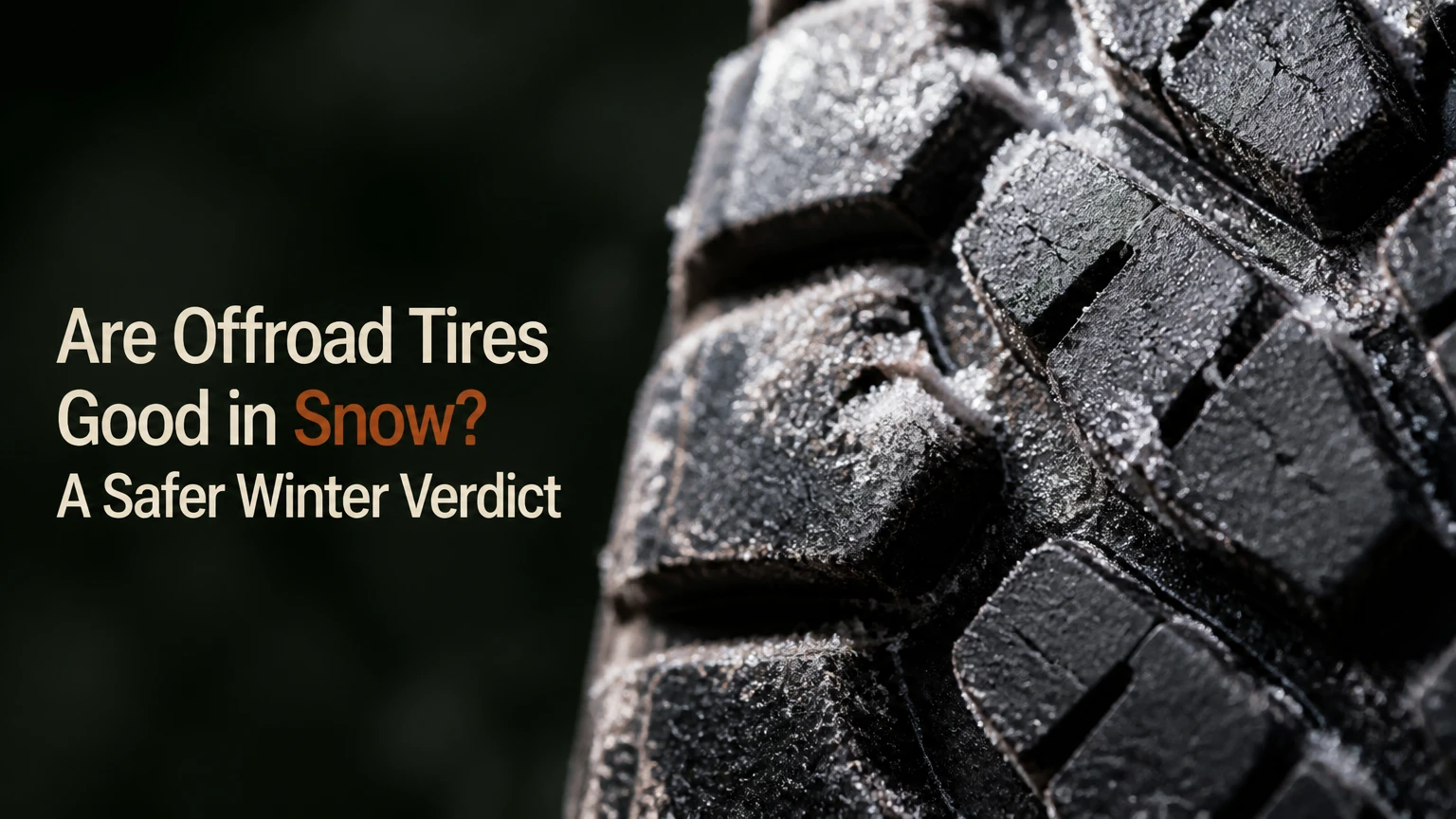
Off-road tires are conditionally useful in snow, but they are not automatically good winter tires. Aggressive mud-terrain tires can move through deep, loose snow, while dedicated winter tires usually stop and steer better on packed snow, ice, and cold pavement. For mixed driving, a 3PMSF-rated all-terrain tire is the most practical compromise.
Key Facts at a Glance
- Dedicated winter tires generally provide shorter braking and stronger cornering on packed snow and ice than all-terrain or mud-terrain tires.
- Mud-terrain tires can outperform highway-oriented tires in deep, unplowed snow when their voids remain open and the vehicle maintains momentum.
- The 3PMSF symbol confirms a tire passed a standardized severe-snow acceleration test, but it does not certify ice braking or cornering.
- The M+S marking is a manufacturer-declared tread designation, not proof that a tire uses a cold-weather compound or passed a snow test.
- Four-wheel drive improves acceleration and forward motion, but tire grip still determines braking and steering.
- A tire with less than approximately 4/32 inch of tread has limited winter reserve, even if the sidewall carries a winter-related marking.
Are Offroad Tires Good in Snow?
Off-road tires are good in deep, loose snow only when their tread design, compound, pressure, and vehicle use match the conditions. Large voids and open shoulders can clear snow and maintain forward traction, but the same tire may perform poorly on polished ice, compacted intersections, wet pavement, and emergency braking.
The phrase “off-road tire” covers several designs. A mild all-terrain tire may have interlocking blocks and substantial siping, whereas a mud-terrain tire may use large, rigid blocks with fewer road-focused edges. Their winter behavior can differ as much as their mud performance.
The most important distinction is snow type. Fresh powder offers deformable material for tread blocks to bite into. Packed snow and ice offer far less mechanical keying, so rubber flexibility, siping, contact pressure, and speed become more important than visual tread aggression.
A practical verdict follows: use a dedicated winter tire for regular winter highway travel, choose a 3PMSF all-terrain tire for mixed road and trail use, and treat a mud-terrain tire as a specialized off-road tool rather than a winter safety solution.
How Do Off-Road Tread Patterns Work in Snow?
Off-road tread patterns create traction by combining block edges, void volume, and self-cleaning action. Deep grooves can accept snow and eject it as the tread rotates, while shoulder lugs help the tire claw through ruts and unplowed surfaces.
Snow traction is not the same as ice traction. In loose snow, a tire may benefit from open voids and controlled wheel torque. On compacted snow, the tread must create many small contact edges without allowing the tread blocks to squirm excessively.
Why Deep Snow Favors Open Treads
Deep snow can fill a narrow, highway-oriented tread until the grooves lose their ability to clear material. A wider void ratio gives loose snow somewhere to move, and tall shoulders help maintain propulsion when the tire sinks into a trail or driveway.
That advantage has limits. A very wide tire can float on top of snow instead of cutting down to a firmer layer, while a heavy vehicle can bury the tread until the chassis drags. Tire width, axle load, speed, and snow depth interact.
Why Packed Snow and Ice Expose Weaknesses
Packed snow and ice reward flexible tread blocks with numerous edges. Sipes open under load and create small gripping edges, while a winter compound remains more compliant at low temperatures than many all-season or off-road compounds.
Large unsiped lugs can feel impressive during acceleration but lose grip during braking. A tire that spins forward through a snowy trail may still slide sideways at a bend or lock during a downhill stop.
Does Cold Weather Make Every Off-Road Tire Hard?
Cold weather does not make every off-road tire equally hard, because compound chemistry varies by model and tire category. Many severe-snow-rated all-terrain tires use a compound designed for lower temperatures, while some rugged and mud-terrain tires prioritize heat resistance, cut resistance, and durability.
The often-repeated 45°F or 7°C threshold is associated with the point at which summer-oriented compounds begin losing flexibility, but it is not a universal switch for every tire. Read the manufacturer’s application information rather than treating 45°F as a laboratory cutoff.
Which Off-Road Tire Type Performs Best in Winter?
A 3PMSF all-terrain tire is usually the strongest off-road compromise for mixed winter driving. Mud-terrain tires can be effective in deep, unplowed snow, while rugged-terrain tires occupy a middle position with better road manners than M/T tires but less winter specialization than a true winter tire.
| Tire category | Typical tread depth | Typical winter marking | Deep snow behavior | Packed snow behavior | Typical price per tire |
|---|---|---|---|---|---|
| Highway terrain, H/T | 10/32-12/32 in | M+S, some 3PMSF | Fair | Fair to poor | $140-$260 |
| All-terrain, A/T | 12/32-ีย15/32 in | M+S, many 3PMSF | Good | Fair to good | $170-$330 |
| Rugged terrain, R/T | 15/32-18/32 in | M+S, some 3PMSF | Good | Fair | $220-$400 |
| Mud terrain, M/T | mud-terrain tread, typically 15/32-20/32 in | Usually M+S, fewer 3PMSF models | Good to excellent | Poor to fair | $240-$500 |
| Dedicated winter SUV tire | 11/32-14/32 in | 3PMSF | Good | Excellent relative to off-road types | $180-$360 |
All-Terrain Tires
All-terrain tires offer the broadest useful compromise. Their tighter center tread, staggered blocks, and moderate siping usually produce more predictable road grip than mud tires, while reinforced construction and open shoulders preserve trail capability.
A/T performance varies considerably. A 3PMSF-rated model is a better winter candidate than an M+S-only model, but the symbol does not make it equivalent to a studless winter tire. Drivers who spend most winter miles on cleared roads should still prefer winter tires.
Rugged-Terrain Tires
Rugged-terrain tires combine some all-terrain road continuity with mud-terrain shoulder aggression. They can suit a truck that carries heavy loads, travels gravel roads, and occasionally enters muddy or snowy trails.
Their winter compromise is often noise, mass, and block stiffness. Some R/T models have 3PMSF certification, but their larger blocks may still provide less packed-snow control than a densely siped A/T or winter tire.
Mud-Terrain Tires
Mud-terrain tires are specialized for loose terrain, not maximum winter-road safety. Their large voids can clear deep snow, but sparse siping and rigid tread blocks reduce grip on compacted snow, ice, and cold wet asphalt.
M/T tires also create longer transitions between acceleration and braking grip. A driver may reach an unplowed trail successfully, then discover that the tires cannot stop reliably at a frozen road junction.
What Do M+S and 3PMSF Actually Mean?
M+S means Mud and Snow, but the marking does not prove severe-winter performance. The 3PMSF symbol means the tire passed a regulated snow-traction test, yet it does not guarantee short ice braking, strong cornering, or equal performance to a dedicated winter tire.
M+S Marking
M+S is based primarily on tread geometry and manufacturer designation. The commonly quoted 25% void-to-tread figure comes from older classification language and should not be treated as a universal guarantee of every tire’s winter capability.
An M+S tire may remain usable in light snow, but the marking says little about compound flexibility, siping density, or braking distance. It should not be confused with a dedicated snow-tire certification.
3PMSF Certification
The three-peak mountain snowflake symbol identifies a tire that met a standardized severe-snow traction requirement under the applicable testing system. The test focuses on acceleration traction over medium-packed snow, not the complete range of winter driving tasks.
3PMSF is therefore a valuable filter, not a final answer. It separates qualifying severe-snow products from ordinary M+S tires, but it does not measure ice braking, wet-road handling, tread life, or trail durability.
| Marking | What it indicates | What it does not prove | Buying implication |
|---|---|---|---|
| M+S | Tread geometry designated for mud and snow | Cold compound, ice grip, severe-snow test | Acceptable only for mild conditions |
| 3PMSF | Passed severe-snow acceleration testing | Ice braking, cornering, stopping distance | Preferred for mixed winter use |
| Stud-compatible design | Manufacturer permits approved studs | Studs installed, legal use, dry-road performance | Check local law and break-in rules |
| No winter marking | No stated snow classification | Winter suitability | Treat as a poor default for severe snow |
How Do Off-Road Tires Compare With Winter Tires?
Dedicated winter tires generally win on packed snow, ice, cold pavement, and emergency braking, while off-road tires win on rocks, sharp gravel, mud, and sidewall resistance. A 3PMSF all-terrain tire narrows the gap in loose snow but does not erase the design differences.
| Decision factor | 3PMSF A/T | R/T | M/T | Dedicated winter tire |
|---|---|---|---|---|
| Fresh snow traction | Good at 4-12 in depth | Good at 4-12 in depth | Very good at 6-18 in depth | Good at 2-10 in depth |
| Packed snow braking | Fair to good | Fair | Poor to fair | Very good |
| Ice braking | Fair | Poor to fair | Poor | Good to very good |
| Rock and gravel durability | Very good | Very good | Excellent | Fair |
| Highway noise at 65 mph | 70-74 dB typical | 73-78 dB typical | 76-82 dB typical | 68-73 dB typical |
| Warm-weather life | 35,000-60,000 miles | 35,000-55,000 miles | 25,000-45,000 miles | 15,000-30,000 warm miles |
| Seasonal swapping | Usually unnecessary | Usually unnecessary | Usually unnecessary | Recommended |
| Typical installed set cost | $850-$1,600 | $1,050-$1,900 | $1,150-$2,200 | $900-$1,700 |
The ranges above are typical retail and service ranges, not guarantees. Size, load rating, wheel diameter, market, rebates, alignment, and vehicle weight can change the result substantially.
What About All-Season Tires?
A modern all-season tire may be quieter and more efficient than an aggressive A/T, but an ordinary all-season tire is not automatically a winter tire. An all-weather tire carrying 3PMSF can offer stronger cold-weather performance than a conventional all-season design.
The relevant comparison is the sidewall marking and the manufacturer’s tread design, not the word “all.” A 3PMSF all-weather tire suits a road-focused crossover better than a mud tire, but neither necessarily matches a studless winter tire on ice.
Can Tire Chains Beat Off-Road Tread?
Approved tire chains or traction devices can provide a major traction increase in deep snow and ice, but they cannot correct an incorrect tire size, excessive speed, worn tread, or unsafe clearance. Chains also require vehicle-specific clearance and legal compliance.
Many passenger vehicles restrict chains to particular axles or require low-profile cable devices. Consult the owner’s manual, test-fit before a storm, and keep speed within the chain manufacturer’s limit, often 20-30 mph.
Which Tire Should Different Drivers Choose?
The correct winter tire depends primarily on the percentage of paved winter miles, not the vehicle’s off-road image. A commuter, rural resident, trail user, and commercial truck operator face different traction priorities.
| Driver situation | Winter mileage pattern | Recommended tire | Why it fits | Main compromise |
|---|---|---|---|---|
| Urban commuter | 90% paved roads | Dedicated winter tire | Best packed-snow and ice control | Seasonal storage and swaps |
| Mixed-use truck owner | 60% pavement, 40% gravel | 3PMSF A/T | Winter rating plus trail durability | More noise and fuel use |
| Rural unplowed-road driver | 50% pavement, 50% loose snow | 3PMSF A/T with chains | Balanced flotation and legal backup | Ice performance below winter tire |
| Mud and trail specialist | Under 30% pavement | M/T plus approved winter setup | Deep-snow and terrain clearance | Poor road braking and comfort |
| Mountain passenger vehicle | 80% pavement, frequent passes | Studless or studded winter tire | Predictable cold-road grip | Reduced warm-weather tread life |
Urban and Highway Commuters
Drivers who encounter cleared roads, intersections, bridges, and freezing rain should buy dedicated winter tires. Winter tread compounds and dense siping address the surfaces where off-road lugs are least persuasive.
AWD or 4WD does not change this recommendation. A powered axle can help the vehicle pull away from a stop, but all four tires must generate grip during braking and cornering.
Mixed Road and Trail Drivers
A 3PMSF all-terrain tire is a rational choice when one tire set must handle winter roads, gravel, construction access, and occasional trails. Select a model with continuous center tread, abundant siping, a suitable load rating, and documented severe-snow certification.
Do not choose the most aggressive tread automatically. A quieter, more densely siped A/T may stop better and last longer than a heavy R/T on the same pickup.
Remote and Unplowed-Road Drivers
Remote drivers need a system rather than a tread pattern. A 3PMSF A/T, correctly sized chains, a tire repair kit, a compressor, and recovery equipment provide more resilience than an M+S-only M/T used without a traction plan.
Carry equipment appropriate to the vehicle. A chain that fits a 265/70R17 tire may not fit a 285/70R17 tire, even when both are mounted on similar trucks.
How Should You Prepare Off-Road Tires for Snow?
Prepare off-road tires by checking tread depth, age, pressure, sidewall damage, alignment, and certification before the first storm. Use the vehicle manufacturer’s cold-pressure specification on public roads, and change pressure only for controlled off-road travel with a plan to reinflate.
- Inspect tread depth and condition. Use a gauge across the inner, center, and outer grooves. Replace a winter tire near 4/32 inch for winter reserve, and replace any tire with exposed cords, cracking, bulges, or severe irregular wear.
- Verify the complete sidewall marking. Confirm size, load index, speed rating, maximum load, M+S or 3PMSF status, and production date. A tire older than six years deserves professional inspection, even with usable tread.
- Set cold pressure before driving. Measure all four tires, including the spare, after the vehicle has been parked for at least three hours. Do not copy a tire’s maximum pressure onto the vehicle unless the manufacturer specifies it.
- Test traction gradually. Brake gently in an empty, legal area at low speed, then evaluate steering response. A controlled test reveals more than aggressive acceleration, which can hide poor braking performance.
- Install chains before they are needed. Practice fitting them in daylight, check wheel-well clearance, and follow the owner’s manual for axle placement. Stop after a short distance to retighten them.
- Reinflate after trail travel. Airing down can improve flotation on soft snow, but 15-20 psi is not a universal safe setting. Use the tire maker’s off-road guidance, keep speed low, and return to road pressure before pavement.
Airing down is an off-road technique, not a substitute for winter tires. Lower pressure can increase sidewall flex, heat, bead-unseating risk, steering delay, and pavement damage when speed rises.
What Common Mistakes Reduce Winter Traction?
The most common winter mistakes are choosing tread appearance over certification, driving too fast for ice, relying on 4WD to stop, and running incorrect pressure. Each mistake changes the tire’s contact behavior more than many buyers realize.
- Using M+S as proof of winter performance: Replace the assumption with a 3PMSF check and a review of independent winter tests.
- Installing only two winter-capable tires: Keep matching traction characteristics on all four corners unless the vehicle and tire manufacturer specify another arrangement.
- Running highway pressure after airing down: Reinflate before reaching cleared pavement, because low pressure can destabilize the vehicle at road speed.
- Siping a tire without checking the design: Aftermarket siping can affect tread-block stability, warranties, and structural behavior. Ask the tire manufacturer or a qualified commercial tire specialist first.
- Adding cargo weight as a universal fix: Extra weight over a pickup’s drive axle may improve propulsion but increases stopping distance and does not create grip on ice.
- Ignoring tire age and uneven wear: A five-year-old tire with hardening, cupping, or shoulder wear may perform worse than a newer tire with a less dramatic tread.
One practitioner rule is especially useful: evaluate winter tires by braking and steering first, propulsion second. Drivers usually notice wheelspin immediately, but loss of braking control creates the more serious risk.
How Much Do Winter Tire Options Cost?
A complete winter conversion typically costs $900-$2,200 before storage, depending on vehicle size and whether the owner buys wheels. A 3PMSF A/T set generally costs $850-$1,600 installed, while a separate winter set with steel wheels often costs $1,050-$2,200.
| Expense | Typical low range | Typical high range | Timing |
|---|---|---|---|
| Four 3PMSF A/T tires | $680 | $1,320 | Every 3-6 years |
| Four dedicated winter tires | $720 | $1,440 | Every 3-5 years |
| Mount and balance | $80 | $180 | Per installation |
| Seasonal swap on existing wheels | $60 | $140 | Twice yearly |
| Steel wheel set | $300 | $800 | One-time purchase |
| Tire storage | $60 | $180 | Per season |
| Light-truck chain set | $120 | $500 | Replace when damaged |
Separate wheels reduce repeated demounting and can shorten seasonal service appointments. They also require a compatible TPMS strategy, because some vehicles need sensor relearning after a wheel change.
Ownership cost should include tread lost during warm weather. Running winter tires through summer accelerates wear and reduces hot-weather handling, while running A/T tires year-round avoids swapping costs but accepts weaker ice performance.
When Are Off-Road Tires a Poor Winter Choice?
Off-road tires are a poor winter choice when the vehicle spends most of its time on paved roads below freezing, especially where ice, packed intersections, downhill braking, or freezing rain are common. Mud-terrain tires are particularly weak when their open tread cannot create enough small edges on hard surfaces.
They are also a poor choice when tread depth is low, the tire is aged, the vehicle carries an unsuitable load, or the tire size creates clearance problems for chains. A 3PMSF marking cannot compensate for mechanical defects or unsafe driving speed.
The honest limitation is simple: no off-road tire can guarantee control on glare ice. Studded winter tires may improve ice traction where local law permits them, but even studs have limits on wet pavement, bare roads, and high-speed maneuvers.
FAQ
Are all-terrain tires better than mud tires in snow?
All-terrain tires are usually better than mud-terrain tires on roads covered by packed snow, slush, and ice because A/T designs typically provide more siping and more continuous tread contact. Mud tires can gain an advantage in deep, loose snow, where large voids clear material and maintain forward propulsion.
Is a 3PMSF all-terrain tire enough for mountain winter driving?
A 3PMSF all-terrain tire can be enough for moderate mountain use when the vehicle is properly maintained and the driver carries approved chains. Drivers who regularly cross icy passes or commute on packed roads will usually gain stronger braking and cornering from dedicated winter tires.
Are mud tires dangerous on ice?
Mud tires can be dangerous on ice when their rigid, sparsely siped tread blocks provide few biting edges. Their ability to accelerate through deep snow does not predict their ability to brake or corner on a frozen road, so drivers should reduce speed and consider winter tires or approved traction devices.
Does 4WD replace winter tires?
Four-wheel drive does not replace winter tires. Four-wheel drive can distribute engine torque to multiple wheels and improve acceleration, but it cannot create additional friction during braking or steering. A 4WD vehicle with poor winter tires can still slide through an intersection or fail to turn.
Should I lower tire pressure in deep snow?
Lowering tire pressure can help during controlled off-road travel in soft snow, but the correct pressure depends on tire construction, wheel size, vehicle weight, speed, and bead retention. Follow the tire manufacturer’s off-road range, drive slowly, and reinflate before returning to public pavement.
What tread depth is best for winter driving?
A tire should have substantially more than the legal minimum tread for reliable winter reserve. Many tire professionals use approximately 4/32 inch as a winter replacement threshold, although severe conditions, uneven wear, tire age, and compound hardening can justify replacement sooner.
The Bottom Line
Are offroad tires good in snow? They can be good in deep, loose snow, particularly when the tire has open voids and the vehicle travels unplowed trails. They are usually only moderate on packed snow and poor to fair on ice, where dedicated winter compounds and dense siping matter more than large lugs.
Choose a 3PMSF all-terrain tire for mixed pavement and trail use. Choose dedicated winter tires for regular highway travel, freezing rain, icy mountain roads, and maximum braking control. Treat mud-terrain tires as specialized off-road equipment, and never assume that 4WD, aggressive tread, M+S labeling, or reduced pressure can replace sound winter preparation.