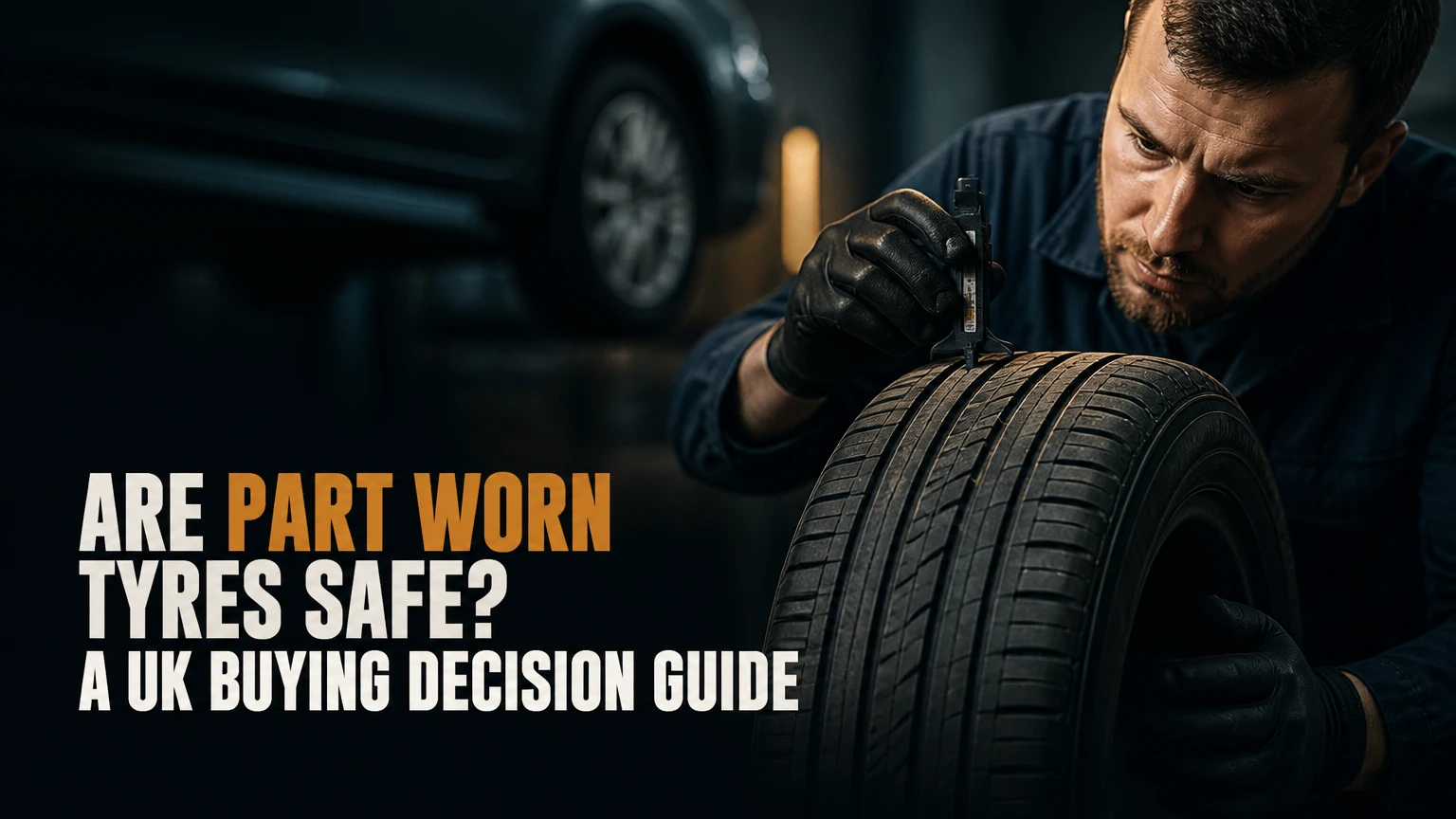
Part-worn tyres are not automatically unsafe, but their unknown history makes them a higher-risk choice than comparable new tyres. A legally marked, professionally inspected part-worn tyre can be driven legally in the UK, yet a new budget or mid-range tyre usually provides more predictable structure, wet grip, usable tread, and value over its service life.
Key facts
UK part-worn tyres must generally have at least 2mm of tread across the required inspection area before sale.
UK cars must have at least 1.6mm of tread across the central three-quarters of the tread and around the full circumference.
A legal part-worn tyre may have only 0.4mm of tread above the legal driving minimum.
A tyre’s remaining tread cannot reveal whether it has been driven flat, overloaded, badly repaired, or internally damaged.
The sidewall must carry a permanent “PART WORN” marking at least 4mm high in the UK.
A new budget tyre often costs more initially but provides substantially more usable tread and a known service history.
What Is a Part-Worn Tyre?
A part-worn tyre is a previously used pneumatic tyre removed from one vehicle and sold for fitting to another vehicle. The tyre may come from a scrapped car, a salvage vehicle, a fleet replacement, or an imported batch, and its brand name does not reveal how it was driven.
Part-worn tyres are different from retreaded tyres. A retread uses an existing casing with a replacement tread bonded to it, while a standard part-worn tyre retains the tread and compound applied during its original manufacture. “Remould” and “retread” usually describe the same broad process, although manufacturers may use different technical terms.
The important safety attribute is history, not simply appearance. A tyre with 4mm of tread may look healthy while carrying damage from a severe pothole, under-inflation, kerbing, overloading, or a puncture repaired incorrectly.
Where Do Part-Worn Tyres Come From?
Part-worn tyres commonly enter the market through salvage dismantlers, vehicle auctions, tyre wholesalers, and imports from European countries. Drivers may replace tyres earlier in some markets because of local climate, fleet policy, winter-tyre practice, or personal preference, but geographic origin does not establish casing condition.
The supply chain normally follows four stages:
- Sourcing: Tyres are removed from used, damaged, written-off, or scrapped vehicles.
- Sorting: Wholesalers group tyres by size, brand, pattern, speed rating, and visible tread.
- Inspection: A retailer should check the casing, tread, bead, inner liner, repairs, and inflation behaviour.
- Distribution and fitting: A compliant retailer marks and fits the tyre to a vehicle with compatible specifications.
The weak point is the history gap between removal and resale. A tyre can pass a basic visual inspection while retaining damage that requires specialist equipment or knowledge to identify.
Are Part-Worn Tyres Legal in the UK?
Part-worn tyres are legal to sell and fit in the UK only when they meet the Motor Vehicle Tyres (Safety) Regulations 1994 and related requirements. The seller must inspect the tyre, inflate it sufficiently for examination, identify specified defects, and permanently mark it “PART WORN” in letters at least 4mm high.
Legal sale is not the same as a recommendation for every vehicle or journey. The tyre must also be suitable for the car’s axle, load, speed, wheel size, construction, and drivetrain, while the vehicle must remain within the 1.6mm legal tread limit during use.
| UK requirement | Practical value | What the buyer should check |
|---|---|---|
| Minimum tread before sale | 2mm | Measure several points, not only the centre groove |
| Minimum tread for driving | 1.6mm | Check the central three-quarters around the circumference |
| Sidewall marking | “PART WORN”, at least 4mm high | Find a permanent moulded or stamped mark |
| Inflation inspection | Tyre inflated for examination | Ask the fitter how the casing was inspected |
| Visible damage | No prohibited cuts, bulges, exposed cords, or dangerous repairs | Inspect both sidewalls and the inner liner |
| Vehicle compatibility | Correct size, load index, speed rating, and construction | Compare with the vehicle handbook or door-plate |
A retailer who omits the required marking or sells a damaged casing is not making the tyre safe by fitting it professionally. Buyers should treat missing markings as a reason to reject the tyre.
What Does the 2mm Rule Really Mean?
The 2mm UK part-worn sale threshold is a legal minimum, not a performance guarantee. A tyre sold at exactly 2mm has only 0.4mm of legal tread remaining before reaching the 1.6mm driving limit, so its useful service life can be short.
Tread depth also varies across the tyre. An apparently acceptable centre groove can conceal shoulder wear caused by incorrect alignment or inflation. Wet-road performance depends on tread pattern, compound condition, temperature, inflation pressure, and water depth, not one measurement alone.
TyreSafe advises motorists to consider replacing tyres before the legal minimum, particularly when wet grip has deteriorated or wear approaches the indicators. The legal threshold answers whether a tyre may be used, not whether it is a sensible purchase.
How Dangerous Can Hidden Tyre Damage Be?
Hidden casing damage is the main safety objection to part-worn tyres because the buyer usually cannot reconstruct the tyre’s previous loads and impacts. A tyre driven while severely under-inflated can suffer internal heat damage even when its outer sidewall later looks normal.
Common failure modes include:
- Run-flat damage: Driving after pressure loss can overheat and weaken the sidewall or inner liner.
- Puncture damage: A nail or screw may have caused secondary belt damage before repair.
- Improper repairs: A plug-only repair, shoulder repair, or overlapping repair may be unsuitable.
- Bead damage: Forceful removal from a wheel can damage the sealing area.
- Exposed cords: Cuts, abrasion, or worn tread can expose reinforcement wires.
- Delamination: Separation between belts, tread, or sidewall layers can develop into a blowout.
- Uneven wear: Alignment or suspension faults may have consumed the usable tread on one edge.
- Age hardening: Rubber loses flexibility through oxidation, heat cycles, sunlight, and storage conditions.
Undercover surveys reported by TyreSafe and tyre retailers have found high levels of non-compliance in selected part-worn outlets, including missing markings and structural defects. Those results are warnings about poor supply chains and sampled sellers; they should not be presented as a failure rate for every part-worn tyre sold nationwide.
What Do Inspection Statistics Actually Prove?
Published audit figures such as 94%-98% illegal or non-compliant tyres and approximately 34% with serious defects describe particular inspections, locations, or campaigns rather than the whole UK market. The figures still matter because a consumer cannot easily identify which retailer follows the required inspection process.
A sound decision therefore uses two questions:
- Was the seller compliant?
- Can the specific tyre’s condition and compatibility be demonstrated?
A premium Michelin or Continental tyre is not exempt from casing damage. Likewise, a budget part-worn tyre is not automatically defective. Brand affects original design and compound, but it cannot substitute for a known history and current inspection.
How Old Is Too Old for a Part-Worn Tyre?
There is no single UK legal age at which every tyre becomes illegal, but many manufacturers recommend professional inspection from around five years after service and replacement by ten years from manufacture, regardless of remaining tread. The date is found in the four-digit DOT production code, where “1222” means week 12 of 2022.
Age is only one variable. Storage, heat, ultraviolet exposure, inflation history, and the tyre’s compound influence condition, so a six-year-old tyre stored correctly is not identical to a six-year-old tyre used on a heavily loaded taxi.
As a practical purchasing rule, avoid part-worn tyres with unclear dates, visible cracking, or more than five or six years of age unless a qualified tyre professional gives a specific reason to accept them. A low price rarely compensates for a short remaining life.
| Sidewall finding | Likely meaning | Buying decision |
|---|---|---|
| DOT 1222 | Manufactured in week 12 of 2022 | Date is identifiable; inspect condition |
| DOT 4818 | Manufactured in week 48 of 2018 | Usually poor value as a part-worn purchase |
| Missing or unreadable date | History cannot be verified | Reject the tyre |
| Fine surface cracking | Rubber ageing or environmental exposure | Reject if cracks reach grooves or cords |
| Deep sidewall cracking | Structural deterioration risk | Do not drive on it |
| Bulge or local deformation | Internal carcass failure | Replace immediately |
Which Used Tyre Types Exist?
Part-worn tyres are usually sold as premium-brand, budget-brand, seasonal, run-flat, or high-performance products. Retreaded tyres form a separate category because the tread has been replaced and the casing has undergone a retreading process.
| Type | Typical identifying feature | Main risk or limitation |
|---|---|---|
| Premium-brand part-worn | Michelin, Continental, Bridgestone, Goodyear branding | Unknown casing history despite high original quality |
| Budget-brand part-worn | Entry-level brand and older tread design | Small initial saving and limited remaining tread |
| Winter part-worn | Sipes, winter compound, M+S or 3PMSF marking | Compound may have aged; unsuitable as an all-season assumption |
| Run-flat part-worn | Reinforced sidewall, SSR, RFT, ROF, or similar marking | Previous pressure-loss driving may cause hidden damage |
| Retread or remould | Replacement tread and “RETREAD” marking | Must meet the correct retread standard and vehicle requirements |
| Performance part-worn | High speed rating and directional or asymmetric pattern | Wear and heat cycles can reduce handling consistency |
Never mix a retread with an ordinary part-worn description. The casing and manufacturing process are different, and the sidewall should identify the retread status.
Are Part-Worn Tyres Good Value?
Part-worn tyres are often cheaper at the checkout but more expensive per millimetre of usable tread. A typical part-worn tyre costing £20-£35 may have 2.5-4mm remaining, whereas a new budget tyre costing £50-£65 may begin with approximately 8mm.
| Metric | Typical part-worn tyre | New budget tyre | Decision effect |
|---|---|---|---|
| Purchase price | £20-£35 | £50-£65 | Part-worn wins upfront |
| Starting tread | 2.5-4mm | 7-9mm | New tyre has greater reserve |
| Tread above 1.6mm | 0.9-2.4mm | 5.4-7.4mm | New tyre lasts longer |
| Typical remaining life | 3,000-6,000 miles | 20,000-30,000 miles | New tyre usually reduces replacement frequency |
| Fitting and balancing | £15-£30 | £15-£30 | Similar additional cost |
| History certainty | Usually incomplete | Fully documented manufacture and specification | New tyre wins predictability |
For example, a £30 part-worn tyre with 1.4mm of usable tread costs about £21 per usable millimetre before fitting. A £60 new tyre with 6.4mm of usable tread costs about £9.40 per usable millimetre. Actual mileage varies with alignment, driving style, vehicle weight, and compound.
The environmental argument has limits. Reusing a serviceable casing can delay disposal, but repeated fitting, premature failure, and transport through a complex supply chain may reduce the benefit. A durable new tyre used until properly worn and recycled can be a more rational long-term choice.
How Should You Inspect a Part-Worn Tyre?
Inspect a part-worn tyre before payment and before fitting, using the vehicle specification as the first filter. A tread gauge, torch, tyre-pressure gauge, and access to the inner liner provide useful checks, although a qualified fitter must make the final safety assessment.
- Confirm the size and specification. Match width, aspect ratio, diameter, load index, and speed rating with the vehicle handbook or door-plate.
- Read the date code. Reject tyres with an unreadable date or visible age cracking.
- Measure tread in multiple locations. Check inner, centre, and outer sections at several points around the circumference.
- Inspect both sidewalls. Reject bulges, cuts, deep scuffs, cracking, exposed cords, and abnormal deformation.
- Examine the tread pattern. Look for shoulder wear, cupping, flat spots, embedded objects, and mismatched directional patterns.
- Inspect the bead and inner liner. Look for abrasion, repair patches, pinched rubber, chalk damage marks, and separation.
- Check repairs. Ask where every repair is located and how it was completed; reject shoulder or sidewall repairs.
- Verify the legal marking. Confirm a permanent “PART WORN” mark at least 4mm high.
- Check inflation behaviour. The fitted tyre should hold pressure and seat evenly on the rim.
- Confirm balance and vehicle placement. The fitter should balance the wheel and normally place the better pair on the rear axle.
You will know the inspection is complete when the tyre’s specification, age, tread measurements, repairs, markings, and pressure behaviour are documented or explained clearly. A seller who refuses to remove the tyre for inner-liner inspection has removed an important safety check.
What Is the Expert Inspection Rule?
The most useful practitioner rule is simple: never buy a used tyre based on brand and tread alone. The inner liner, bead, date code, load rating, repair history, and wear pattern contain information that a casual sidewall inspection misses.
A tyre professional may reject a casing that looks acceptable because of local deformation, suspicious repair marks, or evidence of prolonged under-inflation. That decision is not wasteful; the cost of mounting a risky casing includes labour, balancing, a second replacement, and potentially a loss-of-control event.
Are Part-Worn Tyres Safe on Motorways or in Rain?
Part-worn tyres are a poor choice for frequent motorway driving, heavy rain, high loads, or family transport because those conditions reduce tolerance for unknown casing damage and limited wet-weather tread. A compliant tyre can legally travel on a motorway, but legality does not remove the physical risks of reduced tread and uncertain history.
Water evacuation becomes less effective as grooves wear, while a hardened compound can reduce grip even with legal tread remaining. High speed also increases heat generation and the consequence of a sudden structural failure.
Part-worn tyres are especially unsuitable for:
- Long motorway commutes at sustained high speed.
- Vehicles carrying children, passengers, tools, or heavy luggage.
- Rural routes with potholes and poor surfaces.
- Cars with powerful engines or high performance requirements.
- Winter travel where cold-weather compound flexibility matters.
- AWD vehicles requiring closely matched rolling circumferences.
Can You Replace Only One Tyre?
Replacing one tyre is sometimes possible, but the replacement must match the other tyres closely in size, construction, load index, speed rating, tread pattern, and rolling circumference. The safest practice is generally to replace tyres in axle pairs, then fit the pair with greater remaining tread to the rear unless the vehicle manufacturer specifies another arrangement.
A single part-worn tyre can create handling imbalance when its tread depth differs substantially from the tyre on the same axle. Electronic stability control can respond to differences in wheel speed, while AWD systems may object to larger circumference differences.
| Vehicle situation | Preferred replacement approach | Reason |
|---|---|---|
| Front-wheel drive, one punctured tyre | Match axle pair; check manufacturer guidance | Braking and steering balance |
| Rear-wheel drive, one damaged rear tyre | Replace rear pair when wear differs | Traction and stability |
| AWD or 4WD | Follow manufacturer circumference limit | Protects drivetrain and traction control |
| Directional tyres | Match rotation direction | Preserves water evacuation design |
| Staggered wheel sizes | Use exact axle specification | Front and rear tyres are not interchangeable |
| TPMS-equipped vehicle | Relearn or programme sensor where required | Prevents false warnings |
Never fit a tyre with a lower load index or speed rating than the vehicle requires. “It fits the wheel” is not a sufficient compatibility test.
What Should You Do If Part-Worn Tyres Are Already Fitted?
If part-worn tyres are already fitted, check their pressure, tread, date, markings, and condition at least monthly and before long journeys. Replace a tyre immediately when it develops a bulge, exposed cord, deep cut, repeated pressure loss, severe cracking, or vibration that persists after balancing.
| Symptom | Possible cause | Immediate action |
|---|---|---|
| Sidewall bulge | Broken internal cords | Stop driving and replace |
| Steering vibration | Imbalance, belt shift, or wheel damage | Reduce speed and obtain inspection |
| Repeated pressure loss | Puncture, bead leak, or valve fault | Check promptly; do not keep reinflating indefinitely |
| Cupped tread | Damaged suspension or alignment fault | Inspect suspension and replace affected tyre |
| Pulling under braking | Uneven grip, alignment, or brake issue | Avoid high-speed driving and diagnose |
| Cracking between tread blocks | Rubber ageing | Replace before extended travel |
Check pressures when tyres are cold, using the vehicle manufacturer’s recommended figures rather than the maximum printed on the sidewall. A pressure warning does not identify whether the casing has already been damaged by driving under-inflated.
Can Insurance Be Affected?
A compliant part-worn tyre does not automatically invalidate motor insurance, but an insurer may investigate tyre condition after a collision. Illegal tread, incorrect specification, prohibited repairs, missing markings, or a demonstrable contribution to the accident can create legal and claims complications.
Keep the fitting invoice and specification details. If a tyre fails shortly after fitting, those records help establish what was supplied and by whom.
Who Should and Should Not Buy Part-Worn Tyres?
Daily commuters, family drivers, motorway users, and owners of AWD or high-performance vehicles should normally choose new tyres. A part-worn tyre may be defensible only when the seller is reputable, the tyre is fully compliant, the specification matches exactly, and the buyer accepts a shorter and less certain service life.
| Driver situation | Recommended choice | Why |
|---|---|---|
| Family car used daily | New budget or mid-range tyre | Known history and longer usable tread |
| Motorway commuter | New mid-range or premium tyre | Better reserve for heat, speed, and wet roads |
| Emergency replacement with no funds | Compliant inspected part-worn | Temporary solution, replace when affordable |
| Vehicle being scrapped within weeks | Legal part-worn may be economical | Short distance and limited ownership horizon |
| AWD or 4WD vehicle | Manufacturer-approved matched set | Circumference differences can damage drivetrain |
| Classic or uncommon vehicle | Specialist new or certified retread | Correct specification may be difficult to source |
A part-worn tyre is not a sound way to save money on a full set when a new budget set is affordable. It is also a poor choice for selling a vehicle if the tyres are unsafe, because transferring risk to the next owner does not remove liability.
What Is Safer Than a Part-Worn Tyre?
A new budget tyre is usually the nearest lower-cost alternative, while a new mid-range tyre often improves wet grip, casing consistency, noise, and expected mileage without premium-brand pricing. Certified retreads can be legitimate alternatives for some commercial applications, but they must be correctly marked and approved for the vehicle.
| Alternative | Typical cost per tyre | Known history | Best use |
|---|---|---|---|
| New budget tyre | £50-£65 | Yes, new casing | Cost-sensitive daily driving |
| New mid-range tyre | £70-£110 | Yes, new casing | Regular mixed-road use |
| New premium tyre | £100-£180+ | Yes, new casing | Long mileage or demanding conditions |
| Certified retread | £45-£90 | Tested casing, not new casing | Appropriate commercial or specialist use |
| Temporary spare | £0-£150 if already owned | Known if maintained | Short emergency journey only |
Prices are typical UK retail ranges for common passenger-car sizes and vary by size, brand, season, fitting, and retailer. Compare the complete fitted price, including valve, balancing, disposal, and TPMS service.
Frequently Asked Questions
Are part-worn tyres safe for an MOT?
Part-worn tyres can pass an MOT if they meet the applicable requirements for tread, condition, size, load, speed rating, and damage. An MOT is a point-in-time legal inspection, not a guarantee of future durability, wet grip, or hidden casing integrity. A tyre can pass and still be poor value or unsuitable for heavy use.
Are part-worn tyres illegal?
Part-worn tyres are not illegal in the UK when retailers inspect, mark, and fit them according to the regulations. Driving below 1.6mm tread, using a tyre with prohibited damage, or fitting an incorrect specification is illegal. Rules differ outside the UK, so local legislation applies in Ireland, Europe, Australia, and North America.
How long do part-worn tyres usually last?
A part-worn tyre may provide roughly 3,000-6,000 miles, but remaining tread, tyre age, compound, alignment, inflation, vehicle weight, and driving style determine the result. A tyre sold at 2.5mm has only 0.9mm above the UK driving minimum, so its usable life can be measured in months rather than years.
Is a premium part-worn tyre better than a new budget tyre?
A premium-brand part-worn tyre may have a stronger original design, but the unknown casing history remains. A new budget tyre usually offers more usable tread, a known manufacturing date, and predictable structural condition. For most daily drivers, the new tyre is the safer and financially stronger choice when total service life is considered.
Can part-worn tyres be used on caravans or trailers?
Part-worn tyres can be unsuitable for caravans and trailers because those vehicles may stand unused, carry concentrated loads, and experience age-related deterioration. Check the load index, manufacturing date, sidewall condition, and manufacturer guidance. A new tyre with the correct load rating is normally preferable for infrequently used, heavily loaded equipment.
Should the best tyres go on the front or rear?
The better-matched tyres should generally go on the rear axle, because rear grip helps resist oversteer during braking and cornering on wet roads. Tyre manufacturers and vehicle makers commonly recommend this arrangement, but the vehicle handbook and drivetrain requirements take priority when they specify a different configuration.
The Bottom Line
Are part-worn tyres safe? A compliant, undamaged, correctly specified part-worn tyre can be legal and usable, but its unknown history creates a risk that a new tyre avoids. For a daily car, family vehicle, motorway commute, wet climate, AWD system, or long ownership period, choose a new budget or mid-range tyre whenever possible. A part-worn tyre is best treated as a carefully inspected short-term compromise, not as an equal substitute for new rubber.