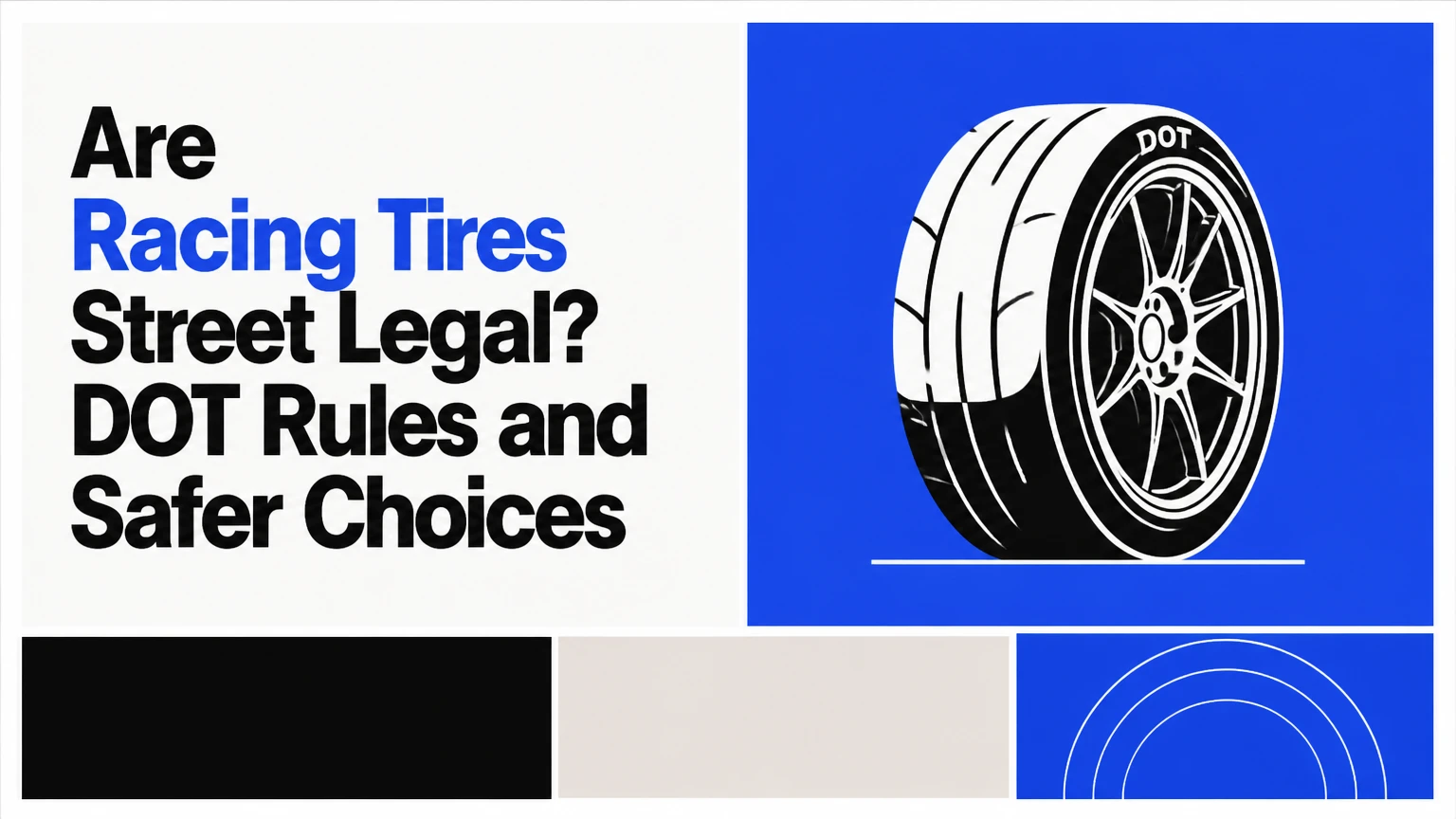
Pure racing slicks are generally not street legal because they lack required tread, road-use labeling, and often the federal certification markings required for highway tires. Some DOT-marked competition tires can be driven legally on public roads in the United States, but legality also depends on state inspection rules, tire size, load rating, speed rating, vehicle fitment, and safe operating conditions.
Key Facts at a Glance
- A DOT symbol indicates that the tire manufacturer certifies compliance with applicable U.S. Federal Motor Vehicle Safety Standards; it does not override state equipment laws.
- A racing slick has no grooves and is designed for dry track pavement, not rainwater evacuation or normal road temperatures.
- A DOT-marked R-compound may be road-legal, but “DOT competition” does not mean suitable for commuting, snow, standing water, or cold storage.
- A 200 treadwear rating is not a universal legal requirement; the rating is a UTQG durability indication, not a nationwide street-use permit.
- Tire pressure, load index, speed rating, tread condition, and correct wheel fitment matter as much as the tire’s marketing category.
- Typical competition-tire life ranges from several track days to roughly 1,000-3,000 road miles, depending on compound, alignment, heat cycles, and driving intensity.
Are Racing Tires Street Legal?
Racing tires are street legal only when the specific tire is certified and equipped for public-road use under the laws governing the vehicle’s location. A non-DOT racing slick is normally track-only, while a DOT-marked competition tire may be legal to drive on the road but still fail a local inspection rule or become unsafe in rain and cold.
The phrase “racing tire” covers several different products. A Formula-style slick, a drag slick, a DOT R-compound, and a 200-treadwear extreme-performance tire do not share the same legal status. The sidewall, manufacturer documentation, vehicle fitment, and local regulations must be checked together.
The practical answer is simple: do not drive a tire on public roads merely because it fits the wheel or appears on a retailer’s racing page. Confirm the DOT marking, service description, size, load index, speed symbol, tread condition, and local inspection requirements before installation.
Does a DOT Marking Make a Racing Tire Legal?
A DOT marking is necessary for many U.S. road tires, but the marking alone is not a blanket legal approval. The National Highway Traffic Safety Administration states that the letters “DOT” certify that the tire complies with applicable Federal Motor Vehicle Safety Standards. The manufacturer, rather than NHTSA, certifies compliance.
Federal compliance is only one layer. States may regulate minimum tread depth, visible cord, tire protrusion, fender coverage, stud use, tire size, and inspection eligibility. A tire can carry DOT marking and still be unsuitable or prohibited under a particular vehicle code, event rule, or insurance condition.
The tire must also be correctly installed. A DOT competition tire with the wrong load index, insufficient speed rating, incorrect direction of rotation, or an incompatible wheel width creates a separate safety and compliance problem.
How Do Racing Tires Differ From Road Tires?
Racing tires produce grip through specialized rubber compounds, stiff carcasses, low tread depth, and operating temperatures that ordinary road tires do not require. Racing slicks maximize dry contact, while road tires trade a small amount of dry-track grip for water evacuation, cold flexibility, durability, noise control, and predictable behavior.
A slick’s uninterrupted tread surface can generate exceptional dry grip because no grooves interrupt the contact patch. That advantage disappears on wet pavement, where water needs channels to escape from between the rubber and road surface.
Race compounds also have narrow temperature windows. A slick may feel vague or slippery when cold, then become extremely adhesive after sustained cornering. The exact window varies by compound and construction, but competition tires commonly require carcass and tread temperatures far above normal commuting conditions.
A rigid carcass limits deformation during braking and cornering. That improves response on a smooth circuit, but it can transmit impacts into the wheel, reduce ride comfort, and make a damaged sidewall harder to identify from the driver’s seat.
What Does the Tread Pattern Tell You?
Tread pattern provides a strong clue about intended use, but it does not independently determine legality. A smooth slick has no wet-weather evacuation channels; a grooved DOT competition tire has some water-management capability; a road tire has deeper, more continuous grooves designed for changing weather and long service.
| Tire category | Typical tread design | Typical operating use | Main road limitation |
|---|---|---|---|
| Non-DOT slick | 0 grooves, smooth tread | Dry circuit, 40-100°C tread range | No reliable standing-water evacuation |
| DOT R-compound | 2-6 large grooves, shallow tread | Dry track and short road transit | Rapid hydroplaning and cold grip loss |
| Extreme-performance summer | Directional or asymmetric grooves, 5-8 mm new tread | Street and occasional track use | Reduced snow and near-freezing performance |
| UHP all-season | Multiple grooves, sipes, 7-9 mm new tread | Year-round road driving | Lower dry-track grip and heat resistance |
The groove count is not a legal test. Manufacturers can meet certification requirements with different tread designs, and some competition products have unusual warnings or restricted service descriptions. Read the exact sidewall and technical data sheet.
Are 200-Treadwear Tires Legal?
Tires with a 200 UTQG treadwear rating are generally street legal when they also carry the required markings and meet the vehicle and jurisdiction’s equipment rules. A 200 rating is not a federal or nationwide threshold for legality, and some legal street tires have higher or lower ratings.
UTQG means Uniform Tire Quality Grading. In the United States, treadwear is a comparative durability grade, while traction and temperature grades describe standardized test performance. The number does not tell you how many miles the tire will last, because vehicle weight, alignment, climate, surface, and driving style alter wear substantially.
Autocross organizations sometimes use treadwear limits to classify cars. That sporting rule is different from a state street-use law. A 100-treadwear DOT tire may be legal on the highway even when an event excludes it, while a non-DOT slick remains unsuitable for public-road use regardless of its intended competition class.
Why Are Track Tires Risky in Rain?
Track tires are risky in rain because shallow grooves and stiff, heat-dependent compounds cannot displace water or generate consistent grip as effectively as road tires. Hydroplaning depends on speed, water depth, inflation pressure, vehicle mass, tread depth, and groove geometry, so no single speed guarantees safety.
A DOT competition tire may be acceptable for light rain at low speed when it has usable grooves, but standing water can overwhelm those channels quickly. A slick offers no designed evacuation path at all. Even a road tire can hydroplane when water depth and speed exceed its drainage capacity.
Rain changes more than braking distance. Steering response becomes nonlinear, painted markings become slippery, and a rear-drive car can lose traction during modest throttle application. Cold rain is especially problematic because it keeps a competition compound below its working range.
Michelin’s motorsport guidance describes wet-weather tire choice as a balance between water evacuation and temperature generation. That principle explains why a road tire can outperform a nominally stickier track tire during a wet commute.
Can You Drive Track Tires to the Circuit?
You can drive some DOT-marked track tires to a circuit, but the trip is a compromise rather than a guarantee of safe all-weather travel. The route should avoid heavy rain, standing water, freezing temperatures, rough roads, and long highway exposure, and the tires must remain within their pressure and load specifications.
Inspect the tires before departure. Confirm at least the minimum legal tread, remove track debris, check for cuts or exposed cord, and set pressures using the tire maker’s guidance rather than copying a slick-track setup. Carry a torque wrench, pressure gauge, inflator, jack, and an emergency spare or transport plan.
A trailer is the safer solution for non-DOT slicks and fragile competition tires. It also prevents a failed tire, bent wheel, or sudden weather change from turning a track day into a roadside recovery.
How Long Do Competition Tires Last?
Competition tires typically last from 3-8 heat cycles for qualifying-style slicks, 4-10 track days for some DOT R-compounds, or approximately 1,000-3,000 road miles when used conservatively. These are typical ranges, not guarantees; alignment, vehicle weight, camber, asphalt abrasiveness, and heat management can cut life dramatically.
A tire can retain visible tread and still lose competitive grip. Repeated heating and cooling harden the compound, while excessive sliding tears the surface and produces “cold” or “hot” graining. Track use therefore requires recording heat cycles and lap behavior, not simply measuring tread depth.
| Tire type | Typical price per tire | Typical usable life | Common replacement trigger |
|---|---|---|---|
| Track slick | $250-$600+ | 3-8 heat cycles | Hardening, cord, severe heat damage |
| DOT R-compound | $220-$550 | 4-10 track days | Heat-cycle loss or below-limit tread |
| 200-treadwear summer | $180-$450 | 5,000-15,000 road miles | Wear bars, irregular wear, heat damage |
| UHP all-season | $150-$350 | 30,000-50,000 road miles | Tread wear, age, cracking, damage |
Price varies with diameter, width, compound, brand, and motorsport demand. A low purchase price does not make a competition tire economical if it needs replacement after one weekend.
What Happens Below the Operating Temperature?
Below the intended temperature range, a racing compound becomes less compliant and produces less friction, which can make the tire feel greasy, numb, or suddenly loose. Some race tires can also crack when folded, mounted, or stored in temperatures around 40°F, or 4°C, and below.
The exact cold limit belongs to the manufacturer. Certain competition tires carry explicit warnings against use or storage below a specified temperature, while others tolerate cooler conditions. Never assume that a DOT marking means winter suitability.
Cold damage may appear as small circumferential or diagonal cracks in the tread and sidewall. The tire should be removed from service if cracks reach cords, grow after warming, or appear alongside bulges, impact marks, or pressure loss.
Practitioner rule: let the tires warm naturally in a controlled environment before mounting them, and do not use a propane heater or open flame to accelerate warming. Localized heating can damage rubber and pressure-sensitive components.
What Must You Check Before Installation?
Before installation, verify the tire’s certification, dimensions, load capacity, speed rating, wheel compatibility, rotation direction, and vehicle pressure requirements. The vehicle door-jamb placard remains the baseline for load and inflation information unless a qualified tire professional or manufacturer provides a documented alternative.
Use this checklist:
- Read the complete sidewall. Find the DOT code, size, load index, speed symbol, maximum pressure, rotation arrow, and competition-use warning.
- Compare the size with the vehicle. Check diameter, section width, wheel width, offset clearance, and suspension clearance at full steering lock.
- Verify capacity. The combined tire load capacity must support the vehicle’s gross axle weight, including passengers, fuel, luggage, and track equipment.
- Check age and storage. Examine the date code, surface cracking, flat spots, and evidence of ultraviolet or chemical exposure.
- Confirm pressure and TPMS. Set cold pressure accurately, and verify that the tire pressure monitoring system can detect the selected valve and sensor arrangement.
- Recheck after fitting. Torque wheel fasteners to the vehicle specification, confirm bead seating, and inspect for leaks.
A competition tire should not be used to compensate for incorrect alignment. Excessive negative camber, toe error, or worn bushings can destroy a shoulder in a single event.
How Do Road Tires Compare With Track Tires?
Road tires are the safer default for public roads because they provide broader temperature performance, deeper water channels, longer wear, and more predictable behavior during ordinary braking. Track tires win on a dry circuit when warmed correctly, but they lose much of that advantage during rain, cold starts, pothole impacts, and long highway trips.
| Decision factor | Slick | DOT R-compound | Extreme summer | UHP all-season |
|---|---|---|---|---|
| Dry-track grip | Highest | Very high | High | Moderate |
| Wet-road suitability | Very low | Low | Moderate-high | High |
| Cold-weather flexibility | Very low | Low | Low-moderate | Moderate-high |
| Typical road life | Not road-rated | 1,000-3,000 miles | 5,000-15,000 miles | 30,000-50,000 miles |
| Ride comfort | Very low | Low | Moderate | Highest |
| Track preparation | Warmers often useful | Warm-up lap needed | Limited setup | Minimal |
| Public-road status | Usually no | Check exact tire and law | Usually yes | Usually yes |
The winner for dry lap time is the slick. The winner for mixed public-road use is the UHP all-season or extreme-performance summer tire, depending on climate.
Which Tire Should Each Driver Choose?
Daily commuter
Choose a UHP all-season tire for changing temperatures, rain, potholes, and high annual mileage. Choose an extreme-performance summer tire only when winter temperatures remain moderate and wet-weather driving is limited.
Racing tires provide no dependable benefit at normal legal road speeds when they remain cold. Their stiff construction, noise, short life, and poor water performance create costs without solving a commuter’s traction problem.
Weekend autocrosser
Choose a 200-treadwear extreme-performance summer tire when the car must be driven to events. Models such as the Yokohama Advan A052, Bridgestone Potenza RE-71RS, and comparable categories offer strong dry response while retaining road equipment and usable grooves.
Check the current event rulebook before purchasing. Class limits can change, and a tire that qualifies for one organization may move the car into a different class elsewhere.
Dedicated track-day driver
Choose a DOT R-compound when legal road transit is unavoidable, or a non-DOT slick with a dedicated wheel set and trailer for maximum dry-track performance. Keep a separate road set because commuting on competition tires consumes heat cycles and exposes them to hazards they were not designed to handle.
What Problems Should You Troubleshoot?
The most common competition-tire problems are cold grip loss, hydroplaning, heat-cycle degradation, uneven wear, impact damage, and vibration from transferred rubber. Each symptom requires a different response, so increasing pressure or adding heat without inspection can make the failure worse.
| Symptom | Likely cause | Immediate action | Do not do |
|---|---|---|---|
| Vibration after a track session | Rubber marbles, flat spot, imbalance | Inspect tread, clean wheel, rebalance | Assume the tire will always recover |
| Sudden wet-road instability | Shallow grooves, excess speed, water depth | Slow smoothly, avoid abrupt inputs | Use cruise control in heavy rain |
| Inner-edge wear | Excessive camber or toe | Measure alignment and rotate if permitted | Continue until cords appear |
| Grip falls after several laps | Overheating or pressure growth | Log hot pressures and reduce sliding | Copy another driver’s pressure |
| Small sidewall cracks | Cold storage or age | Remove and inspect professionally | Mount a cracked tire |
| Steering pull or pressure loss | Bead leak, puncture, bent wheel | Stop and check pressure immediately | Drive on a visibly underinflated tire |
Track “marbles” are chunks of rubber collected from the circuit. They can create temporary vibration and an uneven contact patch, but persistent vibration requires wheel balancing and structural inspection.
Expert insight: hot pressure matters more than a cold number during track work, but the correct target is tire-specific. A pressure that works on a lightweight, front-wheel-drive car can overheat the shoulders of a heavier rear-drive vehicle.
What Do Racing Tires Cost?
Racing tires typically cost $220-$600 or more per tire, while a complete set can range from $700 to $2,400 before mounting, balancing, wheels, transport, and replacement. The total operating cost often exceeds the purchase price because competition tires consume tread and heat cycles quickly.
A realistic track-day budget may include $80-$180 for mounting and balancing, $40-$100 for a professional alignment adjustment, $100-$300 for track fuel, and $100 or more for consumables or event fees. Prices vary by region and vehicle.
| Ownership item | Typical low range | Typical high range | Cost driver |
|---|---|---|---|
| Four DOT competition tires | $880 | $2,200 | Size and compound |
| Four extreme summer tires | $720 | $1,800 | Diameter and brand |
| Mounting and balancing | $80 | $180 | Local labor and wheel size |
| Dedicated track wheels | $600 | $2,000 | Forged versus cast construction |
| Trailer or transport solution | $1,500 | $8,000+ | Used utility trailer versus enclosed setup |
A second wheel set improves safety and economics. It lets the driver preserve road tires for commuting and prevents repeated mounting from damaging beads or TPMS components.
Can Racing Tires Be Used in Every State?
No single answer applies to every state because public-road requirements differ beyond federal tire certification. State inspection programs may assess tread depth, exposed cord, sidewall condition, tire size, fender coverage, and whether the tire is marked for highway service.
The United States has no universal “street legal racing tire” category that automatically settles every state question. A vehicle owner should check the state transportation agency, inspection handbook, and tire manufacturer’s service description. Local law can also differ from track rules and insurer requirements.
For non-U.S. vehicles, DOT marking may not be the relevant approval. European E-marking, United Nations Economic Commission for Europe approvals, Canadian requirements, Australian ADR rules, and local inspection systems use different regulatory frameworks.
Keep the purchase receipt and manufacturer data sheet. Those documents help establish the tire’s intended service if an inspection or insurer asks whether the product is road equipment.
Honest Limitations of Road-Legal Track Tires
Road-legal track tires are not a compromise that delivers race-slick behavior in every condition. Their legal equipment does not give them the rain safety, cold flexibility, comfort, impact resistance, or mileage of a conventional touring tire.
A DOT competition tire can be the right choice for a dry-weather drive to a circuit. It is a poor choice for a family car that faces school runs, winter mornings, standing water, and irregular maintenance. A road-legal label answers a regulatory question, not every safety question.
The same limitation applies to extreme-performance summer tires. They can be excellent on warm, dry pavement and still become unsuitable below freezing or in snow. Climate should therefore influence the choice as much as lap-time ambition.
FAQ
Can I use racing slicks on a registered street car?
A registered vehicle does not make a non-DOT racing slick road legal. Slicks normally lack the tread and highway certification features expected for public-road tires, and they can lose control in rain or cold conditions. Use slicks on a dedicated wheel set and transport the vehicle to the circuit.
Are drag racing tires street legal?
Some drag radials carry DOT marking and are designed for limited street use, while dedicated drag slicks generally are not. A DOT drag radial can still have poor wet braking, low tread life, and manufacturer restrictions. Check the exact sidewall, technical sheet, load rating, and local inspection rules.
Do racing tires need tire warmers?
Tire warmers are useful for some slicks and high-grip competition compounds, but they are not universally required. A tire warmer cannot correct an unsuitable compound, incorrect pressure, wet pavement, or cold ambient conditions. Follow the tire maker’s permitted warmer temperature and heating time.
Can I drive competition tires on the highway?
You can drive a suitable DOT-marked competition tire on the highway only within its design and legal limits. Avoid heavy rain, standing water, freezing temperatures, potholes, and extended high-speed travel, and inspect pressure and tread before every trip.
How can I tell whether a racing tire is DOT approved?
Look for the DOT marking and identification code molded into the sidewall, then match the product to the manufacturer’s technical documentation. Do not rely on a retailer’s “street legal” filter alone. Confirm load index, speed rating, size, direction, and any competition-only warning.
Are racing tires worth it for street driving?
Racing tires are rarely worth their cost for ordinary street driving because they require heat, wear quickly, perform poorly in rain, and provide little benefit at normal road speeds. An extreme-performance summer tire or UHP all-season tire usually offers a safer and less expensive ownership outcome.
The Bottom Line
Are racing tires street legal? Non-DOT racing slicks are generally no, while certain DOT-marked competition tires may be legal under federal and local rules. The right decision depends on the exact tire, vehicle fitment, climate, road conditions, inspection requirements, and whether the car must commute or only run on a circuit.
Use road tires for daily driving, extreme-performance summer tires for warm-weather autocross and spirited use, and DOT R-compounds only when their compromises are acceptable. Reserve true racing slicks for dedicated track wheels and transport.