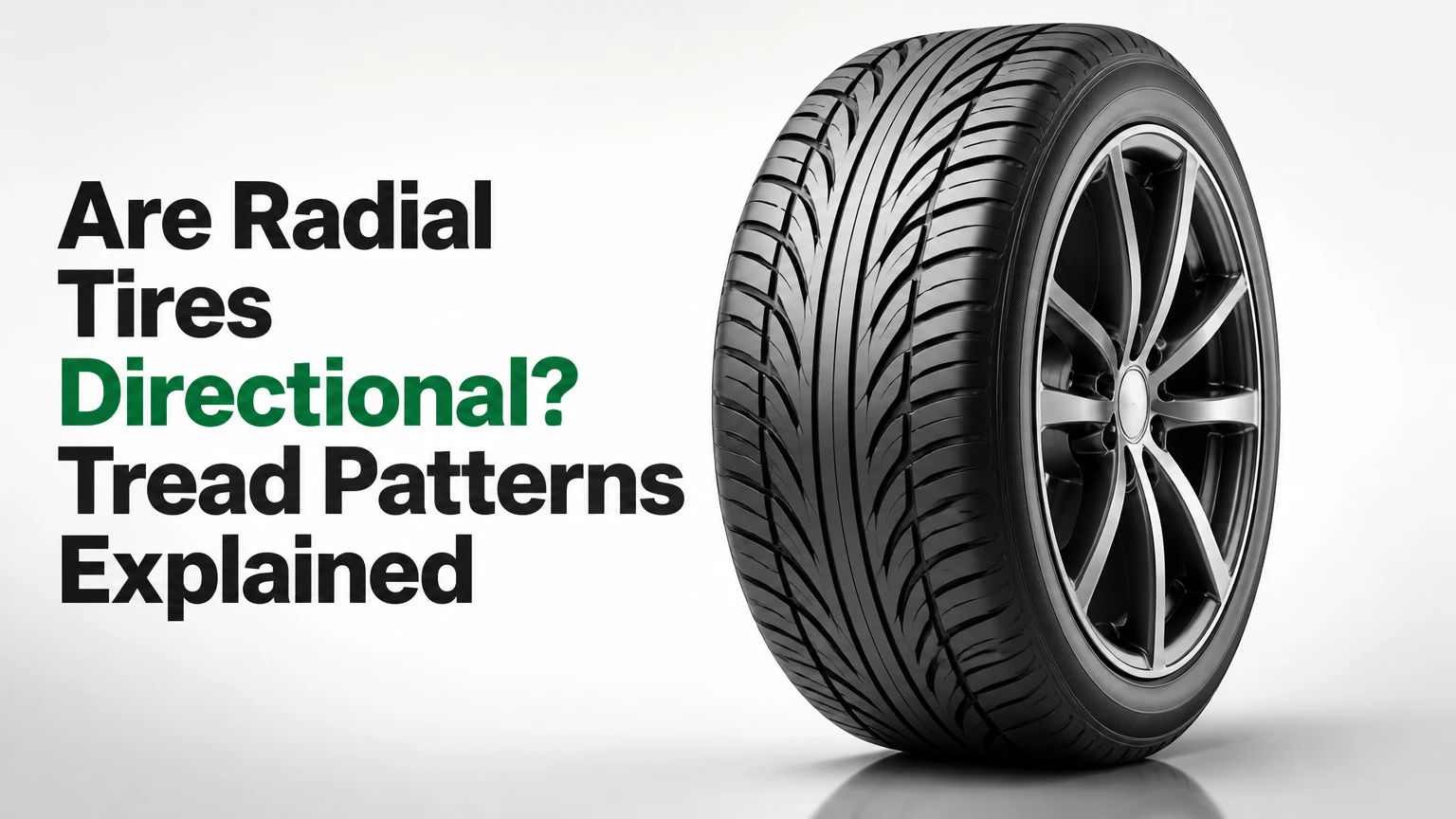
Radial tires are not inherently directional. “Radial” describes the tire’s internal casing construction, while “directional” describes a tread pattern designed to rotate one way. A radial tire may therefore be symmetrical, asymmetrical, or directional, and the sidewall markings determine how it must be mounted and rotated.
Key Facts at a Glance
- The letter R in a size such as 205/55R16 identifies radial construction, not directional tread.
- A directional tire has a specified rolling direction, usually marked by an arrow and the word Rotation or Direction.
- A symmetrical radial tire can usually be mounted in either orientation and rotated through several vehicle-approved patterns.
- An asymmetrical radial tire is side-specific, with Outside and Inside markings, but it is not necessarily directional.
- Directional tires normally rotate from front to rear on the same side unless a tire shop dismounts and remounts them.
- Tire pressure, tread depth, compound, temperature, and road speed affect wet grip more than the word “radial” alone.
Are Radial Tires Directional?
Radial tires are not automatically directional because radial construction and tread direction describe different parts of the tire. Radial construction identifies how the carcass cords run from bead to bead, whereas directional design identifies how the visible tread channels interact with the road while rolling forward.
The distinction matters during installation. A tire can have radial plies and a non-directional symmetrical tread, or radial plies with a one-way chevron tread. Most modern passenger-car tires are radial, but only some carry a required rotation direction.
Tire Rack’s technical guidance summarizes the practical rule: “Directional tires are designed to rotate in one direction only.” That rule concerns the tread pattern, not the casing structure. A tire shop should confirm the manufacturer’s markings before mounting any tire whose tread appearance is difficult to interpret.
What does the R in a tire size mean?
The R in a tire size means radial construction. In 225/45R17, the number 225 is the section width in millimeters, 45 is the aspect ratio, R identifies radial construction, and 17 is the wheel diameter in inches.
| Size marking | Meaning | Example value | Does it prove direction? |
|---|---|---|---|
| 225 | Section width | 225 mm | No |
| 45 | Aspect ratio | 45% of width | No |
| R | Casing construction | Radial | No |
| 17 | Rim diameter | 17 in | No |
| 94W | Load and speed rating | 1,477 lb, 168 mph maximum rating | No |
The size code cannot tell you whether the tread is directional. The sidewall’s rotation instruction and the tire manufacturer’s fitment data provide that information.
How Does Directional Tread Differ From Radial Construction?
Radial construction places the main casing cords approximately perpendicular to the tread centerline, while directional tread uses the outer tread geometry to manage water, snow, noise, and handling. One feature exists inside the tire; the other is visible at the road-contact surface.
A radial tire commonly uses polyester, rayon, or nylon casing cords running from bead to bead. Steel, aramid, or other reinforcing belts sit beneath the tread and help stabilize the contact patch. The casing and belt package influence ride comfort, rolling resistance, durability, and steering response.
Directional tread uses angled grooves and blocks that favor one rolling direction. When the tire rotates correctly, the channels can move water and slush from the center of the contact patch toward the shoulders. The effect depends on tread depth, groove volume, rubber compound, inflation pressure, and speed.
Why are most modern passenger tires radial?
Radial tires became standard on passenger vehicles because their construction supports lower rolling resistance, longer tread life, and better separation between sidewall flex and tread stability than traditional bias-ply designs. The radial design also works efficiently with steel belts and modern computerized tread compounds.
A radial casing is not automatically superior in every application. Bias-ply tires remain useful for some vintage vehicles, low-speed industrial equipment, trailers, and off-road situations where sidewall behavior or impact resistance is prioritized. Vehicle manufacturers specify the correct construction, size, load index, and speed rating for each application.
How Can You Identify a Directional Tire?
You can identify a directional tire by finding a sidewall arrow or a marking such as Rotation or Direction, then confirming that the arrow points toward forward travel at the top of the tire. A V-shaped tread is evidence worth checking, but it is not conclusive by itself.
Use this inspection sequence before installation:
- Read both sidewalls. Look for an arrow, “Rotation,” “Direction,” or a similar one-way instruction.
- Find the brand and model. Search the manufacturer’s fitment diagram or technical specification if the sidewall is unclear.
- Inspect the tread from above. Sweeping chevrons often indicate a directional pattern, but some symmetrical tires also use angled grooves.
- Check for Inside and Outside labels. Those markings identify an asymmetrical tire and control side placement.
- Confirm after mounting. On the vehicle, every rotation arrow must point in the direction of forward travel.
| Sidewall marking | Tire classification indicated | Mounting requirement | Typical rotation limit |
|---|---|---|---|
| Rotation arrow | Directional | Arrow follows forward travel | Same-side front to rear |
| Direction arrow | Directional | Arrow follows forward travel | Same-side front to rear |
| Outside / Inside | Asymmetrical | Outside faces outward | Depends on vehicle position |
| No directional marking | Often symmetrical | Either rotational direction | Vehicle-approved pattern |
| Model-specific instruction | Manufacturer-defined | Follow owner or tire manual | Fitment-specific |
A tire without an obvious arrow is not automatically safe to mount in any position. Some performance tires use subtle molded markings, and an asymmetrical design can be damaged or made unsafe when its inside and outside sides are reversed.
Can you identify direction from a V-shaped tread alone?
A V-shaped tread cannot confirm directional installation because tread blocks may be angled for appearance, noise control, or water management without creating a one-way tire. The sidewall instruction remains the authoritative check.
Look for a continuous, repeating arrow or chevron that converges toward the centerline. Even then, verify the model. Directional and symmetrical patterns can look similar when viewed from one angle, particularly after wear or when the tire has broad shoulder blocks.
What Are the Three Main Radial Tread Types?
The three common radial tread layouts are symmetrical, directional, and asymmetrical. Symmetrical tires usually provide the easiest maintenance, directional tires prioritize one-way water evacuation, and asymmetrical tires divide dry-handling and wet-weather functions between their inner and outer halves.
| Tread type | Sidewall instruction | Main design feature | Common application |
|---|---|---|---|
| Symmetrical | No Inside/Outside or Rotation requirement | Same pattern across both halves | Commuter sedans, compact SUVs |
| Directional | Rotation arrow | Forward-facing chevrons or swept grooves | Wet-road performance, winter tires |
| Asymmetrical | Inside and Outside | Different inner and outer tread zones | Performance sedans, sports cars |
| Directional asymmetrical | Rotation plus Inside/Outside | One-way, side-specific tread | Specialized ultra-high-performance tires |
How do symmetrical radial tires work?
Symmetrical radial tires repeat the same tread design across the inner and outer halves, so they generally tolerate more rotation choices than directional or asymmetrical tires. Their designs commonly emphasize predictable wear, low noise, low rolling resistance, and straightforward replacement.
A symmetrical pattern does not mean poor wet traction. Wide circumferential grooves, silica compounds, siping, and carefully shaped blocks can provide strong rain performance. The pattern simply does not depend on one specified rolling direction.
How do asymmetrical radial tires work?
Asymmetrical radial tires use different tread zones on the same face. The inner section commonly contains more grooves and sipes for water evacuation, while the outer section uses larger, stiffer blocks to support cornering loads.
An asymmetrical tire is not directional unless the sidewall also carries a rotation arrow. A tire marked only Inside and Outside can usually rotate in either rolling direction after it remains on the correct vehicle side, subject to the manufacturer’s instructions.
Are Directional Tires Better in Wet Weather?
Directional tires can provide strong wet-weather performance because their angled grooves help channel water outward, but directional tread is not automatically better than every symmetrical or asymmetrical design. Compound, groove depth, inflation pressure, alignment, and speed determine the actual result.
Hydroplaning begins when a tire cannot maintain enough contact with the road through a water layer. A directional pattern may improve water evacuation at certain speeds and depths, but it cannot overcome bald tread, underinflation, standing water, or excessive speed.
| Wet-road factor | Typical effect | Driver action | Inspection threshold |
|---|---|---|---|
| Tread depth | More groove volume preserves drainage | Replace before legal minimum where appropriate | 4/32 in for rain-focused caution |
| Inflation pressure | Underinflation enlarges heat and wear problems | Set cold pressure to vehicle placard | Check monthly |
| Standing-water speed | Higher speed increases lift risk | Reduce speed before puddles | No universal safe speed |
| Alignment | Toe error creates irregular channels | Correct alignment after abnormal wear | Inspect with tire service |
| Rubber age | Oxidation can reduce flexibility | Follow manufacturer age guidance | Inspect after 5-6 years |
The U.S. Tire Manufacturers Association identifies 2/32 inch as the common legal tread-wear limit in the United States, but replacement before that point can be sensible for drivers who regularly encounter heavy rain. The legal limit is not a guarantee of strong wet traction.
How Are Directional Tires Rotated?
Directional tires are normally rotated front to rear on the same side of the vehicle. A left-front directional tire moves to left-rear, and a right-front tire moves to right-rear, because the tire must keep its arrow aligned with forward travel.
The vehicle owner’s manual controls the schedule and pattern. Many manufacturers specify rotation near every 5,000-8,000 miles, although electric vehicles, performance cars, severe-service vehicles, and aggressive alignment settings may require more frequent inspections.
| Vehicle and tire setup | Usual rotation pattern | Cross-side movement allowed? | Key restriction |
|---|---|---|---|
| Four equal, non-directional tires | Forward cross or rearward cross | Yes | Follow vehicle drivetrain guidance |
| Four equal directional tires | Same-side front to rear | No, without remounting | Preserve arrow direction |
| Asymmetrical tires, equal sizes | Vehicle-approved pattern | Usually yes | Keep Inside and Outside correct |
| Staggered directional tires | Often no routine rotation | No | Front and rear sizes differ |
| Temporary spare installed | No normal rotation | No | Use only within spare limits |
A shop can move a directional tire across the vehicle by removing it from the wheel, turning or remounting it as required, and balancing the assembly again. That service costs more and is not a routine substitute for selecting a suitable rotation pattern.
Can directional tires be rotated side to side?
Directional tires can be moved side to side only after a qualified technician dismounts and remounts them so the tread arrow still points forward. Simply swapping complete wheel-and-tire assemblies left to right reverses the rolling direction and is incorrect.
This limitation becomes important on vehicles with uneven front and rear wear. If a directional tire cannot move to the other side, alignment problems or a worn suspension component may consume tread faster because rotation options cannot distribute the wear as broadly.
What Happens if a Directional Tire Is Installed Backward?
A backward-mounted directional tire has its tread designed to roll opposite the manufacturer’s specified direction. The tire may remain inflated and appear normal, but water evacuation, snow clearing, noise behavior, and handling can differ from the intended design.
Backward installation does not usually cause an immediate blowout by itself. The safety concern is reduced or unpredictable performance, especially during rain, slush, emergency lane changes, and high-speed braking. The correct remedy is to have the tire remounted, not to rely on reduced speed as a permanent fix.
Inspection checkpoint: stand beside each wheel and compare the molded arrow with the vehicle’s forward direction. The arrow should point toward the front of the vehicle at the top of the tire as the wheel rolls forward.
A common mistake is checking only one side. The arrow points in opposite visual directions on the left and right sides when viewed from outside, so compare each tire individually rather than expecting all four arrows to look identical.
What Changes for AWD, 4WD, and Staggered Vehicles?
All-wheel-drive, four-wheel-drive, and staggered vehicles require closer attention to rolling circumference and manufacturer fitment rules. Directional tread adds a rotation constraint, but the larger mechanical concern on many AWD systems is keeping tire diameter and wear closely matched across all four positions.
Subaru, Audi, BMW, Mercedes-Benz, and other manufacturers publish model-specific requirements that can include maximum tread-depth differences or approved replacement procedures. Those limits vary by drivetrain, differential, transfer case, tire size, and vehicle generation, so a generic mileage rule cannot replace the owner’s manual.
| Situation | Main risk | Practical response | Typical service decision |
|---|---|---|---|
| AWD with one damaged tire | Circumference mismatch | Check manufacturer tolerance | Replace one, two, or four as specified |
| Staggered wheel sizes | Front-to-rear movement impossible | Inspect wear each service | Rotate only if the manual permits |
| Directional snow tires | Same-side rotation restriction | Mark tire positions | Plan seasonal inspection |
| Mixed tire models | Different grip and diameter | Avoid mixing on one axle | Match model and size where possible |
| Uneven wear on one axle | Alignment or suspension issue | Measure tread across grooves | Diagnose before replacing tires |
Staggered fitment does not always mean rotation is impossible. Some vehicles permit side-to-side movement with non-directional tires, while directional staggered tires typically have no simple complete-wheel rotation pattern. The tire placard and service manual decide the permitted arrangement.
How Do Radial and Directional Tires Compare?
Radial and directional tires are not competing categories because a tire can be both radial and directional. The useful comparison is between tread layouts placed on radial tires, especially when deciding between symmetrical, asymmetrical, and directional designs.
| Decision factor | Symmetrical radial | Directional radial | Asymmetrical radial |
|---|---|---|---|
| Rolling direction | Either direction | One specified direction | Usually either direction |
| Side placement | No side marking | Arrow required | Inside and Outside required |
| Rotation flexibility | Highest | Same-side front to rear | Moderate, fitment-dependent |
| Wet-water management | Circumferential grooves | Swept or V-shaped grooves | Inner tread drainage zone |
| Cornering support | Balanced general use | Often performance-oriented | Outer blocks emphasize cornering |
| Noise behavior | Usually quiet | Can develop pattern noise | Model-dependent |
| Typical best use | Daily commuting | Heavy rain or winter service | Performance road driving |
Directional tread can be a sensible choice for drivers who prioritize wet-road response and accept limited rotation. A symmetrical tire often suits a commuter vehicle where quiet operation, predictable wear, and lower service complexity matter more.
Are directional tires good for snow and winter driving?
Directional winter tires can work well in snow because their grooves and sipes help clear slush and provide multiple biting edges, but the winter compound and sipe density matter more than the V shape alone. A directional all-season tire is not equivalent to a dedicated severe-snow tire.
Look for the Three-Peak Mountain Snowflake symbol when a tire must meet the severe-snow service designation used in North America. The symbol reflects a standardized snow-traction test threshold, although it does not indicate ice performance, braking distance in every condition, or the tire’s rotation pattern.
What Do Radial and Directional Tires Cost?
Typical passenger-car tire prices range from about $80-$180 per tire for economy models, $120-$280 for mainstream touring or directional products, and $200-$500 or more for premium ultra-high-performance, run-flat, or EV-focused tires. Installation, balancing, disposal, taxes, and alignment are additional costs.
Directional construction alone does not set the price. Brand, size, speed rating, compound, run-flat reinforcement, load index, and vehicle-specific acoustic foam often matter more than tread direction.
| Tire category | Typical price per tire | Typical installed set | Common service interval |
|---|---|---|---|
| Economy symmetrical radial | $80-$140 | $380-$700 | Inspect every 5,000-8,000 miles |
| Mainstream touring radial | $120-$220 | $550-$1,050 | Rotate per vehicle schedule |
| Directional performance radial | $140-$300 | $650-$1,400 | Inspect every 5,000-6,000 miles |
| Premium winter directional | $160-$320 | $750-$1,500 | Seasonal inspection |
| Run-flat or EV-focused tire | $220-$500+ | $1,050-$2,400+ | Check wear and pressure frequently |
These are typical retail ranges, not universal quotes. A 20-inch tire for a luxury SUV can exceed the table, while a sale-priced 16-inch tire can cost less. Directional tires may also cost more over their service life when restricted rotation accelerates shoulder wear.
What Are the Most Common Directional-Tire Mistakes?
The most common errors are reversed mounting, confusing asymmetrical markings with directional arrows, rotating complete wheels across sides, and replacing only one tire on a drivetrain that requires closely matched circumferences.
Mistake 1: Treating the R as a direction symbol
The R in 215/60R17 identifies radial casing construction. It does not mean right side, rotation, or a required wheel position.
Mistake 2: Using the tread shape as the final authority
V-shaped grooves suggest a directional design, but molded sidewall text and the manufacturer’s documentation control the installation. Visual guesses become less reliable after tread wear, repairs, or unusual shoulder designs.
Mistake 3: Reversing Inside and Outside
An asymmetrical tire marked Outside must present that side outward. Mounting the tire backward on the wheel can place the wet-weather and cornering zones on the wrong sides even when no rotation arrow exists.
Mistake 4: Ignoring uneven wear
Cupping, feathering, heel-and-toe wear, and one-sided shoulder wear can indicate incorrect toe, camber, balance, worn dampers, or underinflation. A new directional tire will repeat the problem unless the underlying cause is corrected.
Mistake 5: Mixing tread designs carelessly
Never assume a directional tire can be paired with a symmetrical tire because both are radial. Match tire size, load index, speed rating, axle requirements, and vehicle manufacturer guidance, while keeping the most consistent tires on the same axle.
Which Radial Tread Should You Choose?
Choose a symmetrical radial tire for routine commuting and flexible maintenance, a directional radial tire for a specific wet-road or winter-performance priority, and an asymmetrical radial tire when the vehicle needs a balance of outer-shoulder cornering support and inner-zone water evacuation.
Daily commuter
A symmetrical touring radial usually offers the simplest ownership pattern. It commonly provides lower noise, broad rotation options, and predictable wear for drivers who use equal-size wheels and cover ordinary highway and city mileage.
Performance road driver
An asymmetrical or directional performance radial may provide stronger steering response and wet braking than an economy touring tire. Select by independent wet-braking data, temperature rating, treadwear behavior, and the vehicle maker’s approved size rather than by the V pattern alone.
Snow-belt driver
A dedicated winter tire with the Three-Peak Mountain Snowflake symbol is the stronger choice for sustained cold, snow, and ice. Directional geometry can help slush evacuation, but a winter compound remains flexible at temperatures where many all-season compounds stiffen.
AWD or staggered-fitment owner
Prioritize the vehicle manufacturer’s fitment rules and replacement tolerances. A tire with slightly better theoretical wet performance can create a poor ownership decision if its directional design prevents the rotation pattern needed by the vehicle.
FAQ
Do all four radial tires need to match?
All four tires should match in size, load rating, speed rating, and construction, and many vehicles benefit from using the same model on every position. AWD systems may require closely matched rolling circumference. Consult the vehicle manual before replacing one tire, especially when the remaining tires have substantial wear.
Are directional tires louder than regular tires?
Directional tires can produce more pattern noise, particularly when shoulder wear or cupping develops, but noise depends on block pitch, tread compound, vehicle insulation, alignment, and inflation. A well-designed directional tire can be quieter than a poorly worn symmetrical tire.
Can you put directional tires on the front of a car?
Directional tires can be installed on the front axle when their size, load rating, speed rating, and vehicle fitment are approved. The arrows must point forward. On a front-wheel-drive vehicle, replacing only the front pair may also change handling balance, so follow professional replacement guidance.
Should directional tires go on the front or rear?
When only two tires are replaced, many tire manufacturers and safety organizations recommend placing the tires with greater remaining traction on the rear axle, regardless of drivetrain, to reduce oversteer risk on wet roads. Confirm the vehicle’s instructions and use the correct directional orientation.
Are run-flat tires always directional?
Run-flat construction and directional tread are separate attributes. A run-flat tire may be symmetrical, asymmetrical, or directional. Check the sidewall for a rotation arrow and follow the manufacturer’s pressure, speed, distance, and repair restrictions for the specific run-flat model.
How long do radial tires usually last?
A typical passenger radial tire may last about 40,000-70,000 miles, but mileage varies with compound, alignment, inflation, climate, driving style, vehicle weight, and maintenance. Performance tires often wear sooner than touring tires. Replace tires for damage, age-related cracking, or inadequate tread even before reaching a mileage estimate.
The Bottom Line
Are radial tires directional? No, radial describes internal casing construction, while directional describes the external tread’s required rolling direction. Read the sidewall markings: R confirms radial construction, an arrow confirms one-way rotation, and Inside/Outside confirms asymmetrical mounting. Preserve the arrow direction, use the vehicle-approved rotation pattern, and verify AWD or staggered-fitment rules before buying replacements.