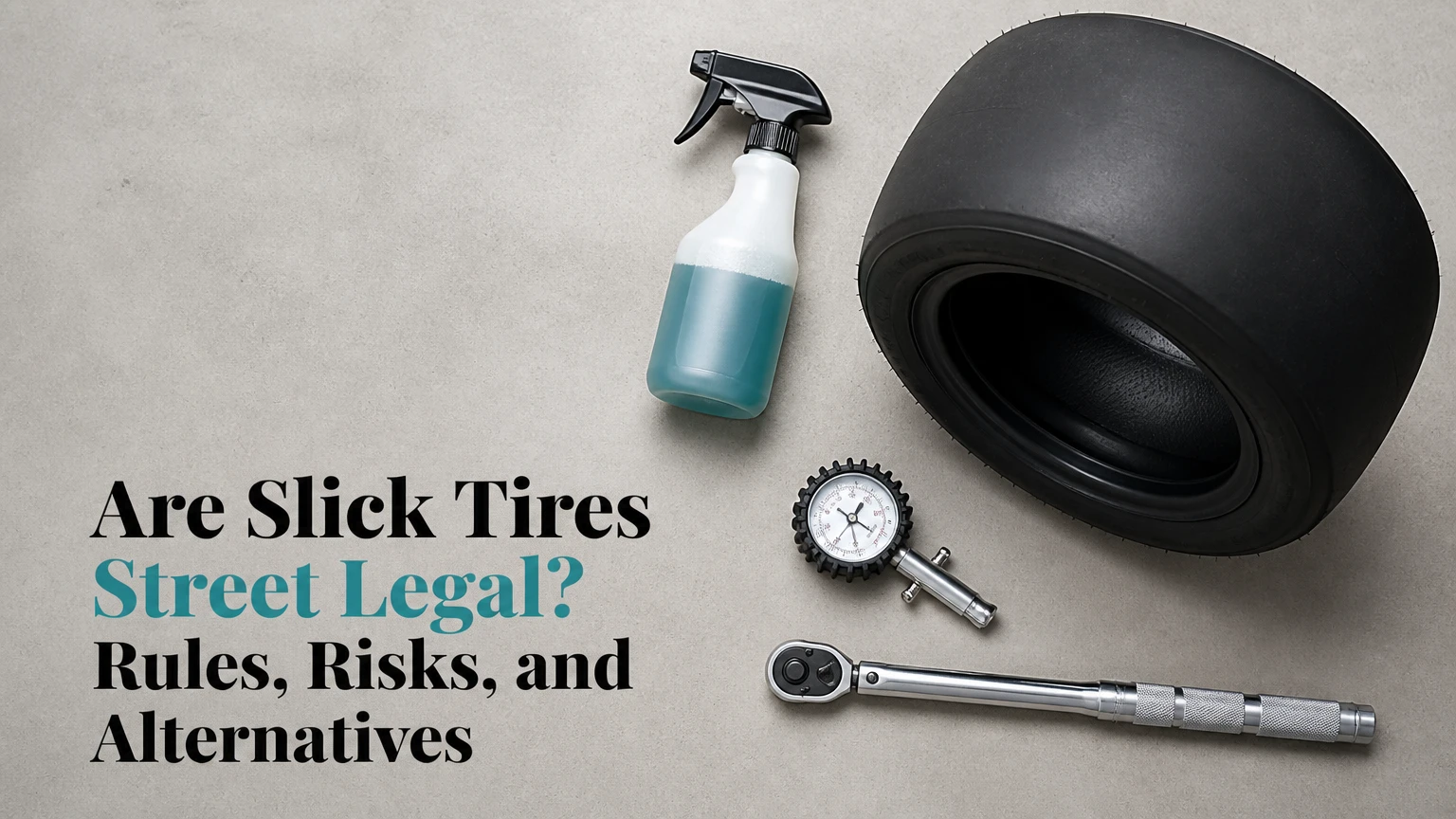
Pure racing slick tires are generally not legal for ordinary public-road use because their completely smooth tread, competition-only construction, or missing road-approval markings fails one or more local requirements. A DOT-marked or E-marked competition tire with molded grooves may be road-legal in some jurisdictions, but the marking, tread, size, load, speed rating, and vehicle rules must all match.
Key Facts
A full racing slick has a smooth tread and is designed for closed-course use, not ordinary public roads.
DOT or E-mark approval identifies a regulatory certification, but it does not override local tread, fitment, inspection, or insurance rules.
A road-legal track tire still performs poorly in standing water and may provide limited cold-weather grip.
The common 1.6 mm, or 2/32-inch, tread figure applies in many jurisdictions, but local laws differ.
Tire placard pressure remains the baseline for public-road driving; track pressure requires the tire maker’s published procedure.
A separate wheel set with approved road tires is usually safer and cheaper than commuting on competition tires.
Are Slick Tires Street Legal?
Pure slicks are usually track-only, while some grooved competition tires can be legal on public roads if the complete tire and vehicle comply with local law. The decisive question is not whether a tire looks almost smooth; it is whether the exact model is approved for road use and meets every applicable requirement.
A completely smooth racing tire has no water-dispersing grooves. That design maximizes dry contact on a prepared circuit, where the surface is inspected, drainage is predictable, and the driver can monitor tire temperature. Public roads create different conditions: rain, diesel residue, potholes, gravel, painted lines, cold asphalt, and traffic conflicts.
Legal treatment varies by location. In the United States, Federal Motor Vehicle Safety Standard No. 139 governs many new radial passenger-car tires, and a tire generally needs the required DOT identification and other compliant characteristics for road use. State inspection laws can add tread-depth, damage, size, or equipment requirements. In the United Kingdom and European markets, UNECE approval, E-marking, dimensional compliance, and national roadworthiness rules may matter. Australia uses its own state and territory requirements.
The practical verdict is simple: never treat a seller’s phrase such as “street legal slick” as proof. Read the manufacturer’s road-use statement and verify the local code.
What Is a Racing Slick?
A racing slick is a competition tire with a continuous, treadless rubber surface across its intended contact area. The missing grooves increase dry-road contact and allow engineers to use soft compounds and specialized carcasses that generate high grip during a controlled race session.
A slick is more than a tire with its grooves removed. Its compound, sidewall stiffness, belt package, construction, and operating temperature are selected for a specific racing environment. A Formula car slick, a motorcycle slick, and a drag slick are not interchangeable products.
The dry-track advantage comes from several linked attributes:
- A larger uninterrupted rubber footprint.
- A soft compound that deforms into fine asphalt texture.
- A carcass tuned for cornering load and controlled slip.
- A profile designed for a specific wheel width and suspension setup.
- A heat range that may be reached only through sustained circuit driving.
The design loses its main advantage when the pavement is cold, contaminated, or wet. A smooth tire cannot channel water away as effectively as a grooved road tire. Tire and Rubber Association guidance repeatedly treats tread condition, inflation, damage, and application as separate safety factors. NHTSA summarizes the basic relationship in its tire-safety messaging: “Tires are the only thing between you and the road.”
How Do Slick Tires Work?
Slick tires generate peak dry grip when their compound and carcass reach the manufacturer’s target temperature and load range. Warm rubber conforms to microscopic pavement texture, while the tire’s construction controls deformation during braking, acceleration, and cornering.
Race tires do not have one universal temperature specification. Typical circuit slick targets may fall around 70-100°C, measured at the tread, while some products require a narrower or different window. The relevant measurement is usually tread temperature or carcass temperature, not the air temperature displayed by a dashboard.
Public-road driving often cannot create or maintain that range safely. A car may cruise for 20 minutes without placing enough lateral load into the tire, then encounter a wet corner before the compound reaches useful grip. Tire warmers can preheat race tires in the paddock, but they do not make a treadless tire suitable for rain or legal for a public highway.
Heat cycles also matter. A competition tire can lose performance after repeated heating and cooling even when visible tread remains. A track driver who records lap times, hot pressures, and session temperatures can identify this decline. A commuter usually cannot justify that level of monitoring.
What Actually Determines Road Legality?
Road legality depends on the exact tire model, approval markings, physical condition, vehicle fitment, and jurisdiction, not on tread appearance alone. A tire can have grooves and still be unsuitable or unlawful if its load index, speed rating, dimensions, construction, or approval status fails the applicable rule.
| Compliance item | What to inspect | Why it matters |
|---|---|---|
| Regulatory marking | DOT identification, E-mark, or local equivalent | Shows that the tire belongs to an approved regulatory category |
| Tread condition | Local minimum, often 1.6 mm or 2/32 inch in the United States | A worn tire may fail inspection and lose wet grip |
| Size and load | Example: 225/45R17, load index 94 | Must support the vehicle’s axle loads and clear surrounding components |
| Speed rating | Example: W, 270 km/h, or Y, 300 km/h | Must meet the vehicle and local legal requirement |
| Construction | Radial or approved bias-ply application | The vehicle maker and tire maker determine permitted use |
| Date and damage | DOT date code, cracks, punctures, bulges | Aging and damage can make a tire unsafe before tread disappears |
| Manufacturer use statement | Road approved, competition use, or track use only | The product’s intended application can override its appearance |
A DOT symbol is not a universal guarantee that a particular tire is acceptable everywhere. The United States Department of Transportation marking relates to compliance with applicable federal standards, while state rules govern many operating and inspection details. An E-mark indicates approval under a relevant UNECE regulation, but the approval number and vehicle rules still deserve verification.
Minimum tread depth is also misunderstood. A tire with 1.6 mm remaining tread may satisfy one numerical threshold but still fail because it has exposed cords, uneven wear, improper size, low load capacity, or no road approval. Conversely, some local rules measure tread in specified grooves or across a defined portion of the tire.
What Is the Difference Between Slicks, Semi-Slicks, and Road Tires?
Full slicks prioritize dry circuit performance, semi-slicks trade some dry grip for drainage and road approval, and road tires prioritize a broad range of temperatures, surfaces, and weather. The best choice depends more on rain, mileage, and track frequency than on peak lap-time potential.
| Tire category | Typical tread and use | Typical working conditions | Typical road suitability |
|---|---|---|---|
| Full racing slick | 0 mm grooves, closed-course racing | Dry track, roughly 70-100°C tread temperature | Track only unless a rare local exception applies |
| DOT-marked track tire | Shallow molded grooves, circuit-focused | Dry sessions, warm pavement, repeated cornering | Potentially legal, verify exact model and jurisdiction |
| Extreme-performance summer tire | Grooved tread, road and occasional track use | About 10°C and above, dry or damp pavement | Road approved when correctly sized and marked |
| Max-performance summer tire | Deeper channels and stable road carcass | Warm, mixed street conditions | Strong public-road compromise |
| Ultra-high-performance all-season | Multiple grooves and cold-weather flexibility | Broad temperature range, moderate performance driving | Best for variable climates and daily use |
“Semi-slick” is a marketing and enthusiast term, not a single legal classification. One model may carry road approval, while another with a similar appearance may be sold strictly for competition. Read the sidewall and technical sheet rather than relying on the category name.
Are DOT-Approved Slicks Really Legal?
A DOT-marked competition tire may be legal on public roads in the United States, but DOT marking alone does not settle every legal or safety question. The tire must also meet state requirements, fit the vehicle correctly, retain legal tread, and comply with the manufacturer’s stated operating limitations.
Some road-approved track tires have broad grooves, while others have narrow channels and treadwear indicators. Their wet performance can be dramatically worse than that of a touring tire despite their legal status. Road approval means the tire meets defined regulatory requirements; it does not mean the tire is safe at normal highway speed in heavy rain.
A tire that was hand-grooved after manufacture deserves special caution. Cutting grooves into a slick does not create the original engineered tread pattern, may damage belts or create stress concentrations, and generally does not create regulatory approval. A competition tire that lacks the required road certification remains a competition tire.
Can You Drive Slick Tires in the Rain?
A full slick should not be driven on a public road in rain, and even a grooved track tire can lose substantial control in standing water. No universal speed such as 45 mph makes a nearly smooth tire safe, because hydroplaning depends on water depth, tire pressure, load, speed, tread design, pavement texture, and tire condition.
When rain starts during a legal road journey on a road-approved track tire:
- Reduce speed smoothly and increase following distance substantially.
- Avoid standing water, road ruts, painted lines, metal covers, and heavy spray.
- Make steering, braking, and throttle inputs gradual.
- Do not use cruise control on a wet surface.
- Stop at a safe location if visibility or directional control deteriorates.
- Replace the tire with a broader-groove road tire for regular wet-weather use.
The common racing explanation is that slicks work on wet tracks only after rain tires are fitted or the surface dries. A wet circuit can sometimes drain better than a public road, but drainage does not eliminate aquaplaning. Public roads also expose tires to sudden puddles that a driver cannot inspect before entering.
How Much Do Slick and Semi-Slick Tires Cost?
A typical set of four road-approved track tires costs about $800-$1,800 before mounting, while full racing slicks often cost $1,200-$2,500 or more per set. Replacement frequency can make a cheaper-looking competition tire more expensive than a durable road tire over a full season.
| Tire choice | Typical set price | Typical usable distance or sessions | Additional ownership cost |
|---|---|---|---|
| Full circuit slick | $1,200-$2,500+ | 4-20 track sessions | Mounting, transport, warmers, storage |
| DOT track tire | $800-$1,800 | 5,000-15,000 km or 8-30 sessions | Frequent rotation or second wheels |
| Drag radial | $700-$1,400 | 3,000-12,000 km, highly variable | Alignment, replacement driven by launches |
| Max-performance summer tire | $700-$1,400 | 15,000-35,000 km | Mounting and alignment |
| Premium UHP road tire | $600-$1,200 | 40,000-80,000 km typical rating range | Lower replacement frequency |
These are typical market ranges, not guarantees. Vehicle weight, alignment, camber, asphalt abrasiveness, driving style, storage temperature, and heat cycles can change the result sharply. A tire with a 200 treadwear rating is not automatically twice as durable as one rated 100, because UTQG comparisons are most useful within the same brand and test context.
A second wheel set also changes the calculation. Mounting and balancing four tires several times per year can cost $80-$200 per visit in many markets, and repeated bead work increases the chance of cosmetic or valve damage.
Are Drag Radials and Cheater Slicks Street Legal?
Some drag radials are road approved, but purpose-built drag slicks and many cheater slicks are not. Drag radials use a flexible construction and limited tread to improve straight-line traction, whereas full drag slicks may use bias-ply construction and a treadless surface intended for a prepared drag strip.
| Product type | Main performance goal | Typical limitation | Road-use question |
|---|---|---|---|
| DOT drag radial | Launch traction and acceleration | Poor rain and cornering balance | Verify sidewall approval and local rules |
| Bias-ply drag slick | Maximum controlled launch | Wandering, heat, and road instability | Usually competition use only |
| Radial road tire | Braking, cornering, and weather balance | Less launch grip on prepared strips | Normal road application |
| Track-focused radial | Circuit braking and cornering | Fast wear and limited rain performance | Exact model approval required |
A drag radial can be legal yet inappropriate for a front axle, winter conditions, long highway trips, or a vehicle with electronic stability systems calibrated around ordinary radial tires. Follow the manufacturer’s axle and rotation restrictions.
What Should You Use for Daily Driving?
Daily drivers should use a road-approved summer, max-performance summer, or all-season tire selected for climate, mileage, and vehicle load. A competition tire rarely improves an ordinary commute because traffic prevents sustained heat, while rain, cold pavement, and road debris expose its weaknesses.
| Driver situation | Recommended tire type | Reasonable target | Avoid |
|---|---|---|---|
| Cold winters or frequent rain | Premium all-season or winter tire | Stable grip below 10°C, deep water channels | Full slick or dry-only compound |
| Warm climate, daily commuting | UHP summer tire | 30,000-60,000 km typical range | Track tire with 5,000-15,000 km life |
| Weekend canyon driving | Max-performance summer | Strong dry braking with molded grooves | Drag radial on the steering axle |
| Six to twelve track days yearly | Road-approved track tire on spare wheels | Quick swap and controlled circuit use | Driving home after heavy rain on worn tires |
| Dedicated race car | Full slick on transported wheels | Circuit-specific compound and size | Public-road transit on slicks |
A premium UHP tire usually delivers more usable performance over a year because it works immediately, tolerates changing surfaces, and retains predictable behavior during emergency braking. Peak dry grip is only one part of road safety.
How Do You Verify a Tire Before Buying?
Verify the exact product code, sidewall markings, technical sheet, and local vehicle rules before purchasing. The most reliable process takes 15-30 minutes and prevents the common mistake of confusing a road-approved version with a visually similar track-only version.
Step 1: Photograph the complete sidewall
Record the brand, model, size, load index, speed rating, construction, date code, and regulatory marking. A listing photograph may show a DOT logo from a different size or version, so inspect the actual tire.
Step 2: Search the manufacturer’s technical sheet
Look for explicit wording such as “for competition use only,” “not for highway use,” or a stated road approval. Confirm whether the tire is intended for passenger vehicles, motorcycles, trailers, or a restricted competition class.
Step 3: Compare the tire with the vehicle placard
Check the driver-door placard or owner’s manual for size, load, speed, and inflation requirements. A larger diameter or lower load index can create a compliance problem even when the tire fits the wheel.
Step 4: Check local inspection and tread rules
Use the relevant state, provincial, territorial, or national transport authority. Confirm the minimum tread measurement method, permitted tire projections, seasonal requirements, and whether competition tires are excluded.
Step 5: Ask the insurer about modified use
Insurance coverage depends on policy wording and local law. Ask whether track tires, non-original wheel sizes, or competition use affects coverage, especially if the vehicle will drive to an event.
Step 6: Inspect after every track session
Look for chunking, blistering, shoulder overheating, cords, punctures, and uneven wear. A legal tire becomes unsafe when damaged, regardless of its original certification.
What Tire Pressure Should You Use?
Use the vehicle placard pressure for public-road driving unless the tire manufacturer gives a specific alternative for the exact fitment. Track starting pressures such as 26-28 psi are setup examples, not universal street instructions, and lowering cold pressure on the road can reduce stability and overload the tire’s shoulder.
Track setup normally uses a controlled process: record cold pressure, drive a timed session, measure hot pressure quickly, inspect the tread, and adjust in small increments. The correct hot target depends on the tire model, vehicle weight, camber, surface, and ambient temperature.
A tire that gains pressure during a session is behaving normally. A driver should not bleed pressure casually after parking on the road, because the tire may cool below the manufacturer’s safe operating pressure. Use a calibrated gauge and follow the tire maker’s published range.
What Happens When Slicks Are Used on the Street?
Street use exposes slicks to cold starts, wet surfaces, debris, potholes, traffic braking, and long periods without the load needed to produce race grip. The result can be less predictable control, rapid wear, stone damage, irregular temperature distribution, and legal or insurance complications.
The most counterintuitive failure is a cold dry-road loss of grip. A soft race compound can feel sticky by hand yet slide under a lightly loaded tire when the pavement is 5-10°C. Hand feel is not a substitute for temperature data.
Another failure is shoulder overheating on a road car. Excessive negative camber, incorrect pressure, or a suspension alignment intended for a circuit can wear the inner shoulder while leaving the center apparently healthy. The tire may pass a casual inspection and still have little reserve.
A third failure is degradation without mileage. Ultraviolet exposure, ozone, storage beside electric motors or solvents, and repeated heat cycles can age a tire that has traveled only a few hundred kilometers. Competition tires need date and storage checks, not only tread checks.
Common Mistakes and Safer Responses
Mistake 1: Treating “DOT” as a complete legal answer
A DOT marking does not confirm correct size, load, tread, condition, or state inspection compliance. Verify the full sidewall specification and local rules.
Mistake 2: Driving through rain at a normal speed
A grooved semi-slick may remain controllable in light dampness but lose its margin rapidly in standing water. Slow before puddles appear, and stop if spray prevents clear lane visibility.
Mistake 3: Using race pressure on the highway
Track pressures are measured around a specific vehicle and session. Return to the road pressure specified for the vehicle and tire combination.
Mistake 4: Grooving a full slick by hand
Hand-cut grooves do not reproduce a certified tread pattern or necessarily preserve the carcass. Purchase a manufacturer-approved road tire instead.
Mistake 5: Mixing incompatible tires
Mixing a slick, drag radial, all-season tire, and ordinary summer tire can create large differences in grip and rolling behavior. Follow the vehicle maker’s axle-matching requirements and the tire manufacturer’s restrictions.
Mistake 6: Driving a track tire home after it is worn
A tire that has become heat-cycled, corded, blistered, or below the local tread limit should be transported, not driven. Track access does not exempt the return journey from road law.
Which Tire Fits Each Driver?
The daily commuter
Choose a premium UHP summer tire in a warm, dry climate, or a quality all-season or winter tire where temperatures and precipitation vary. The daily commuter needs predictable cold grip, wet braking, impact resistance, and service life.
The occasional track-day driver
Choose a road-approved max-performance tire for fewer than roughly six track days per year, then move to a DOT-marked track tire on separate wheels when circuit use becomes frequent. Keep the road set available for rain and the drive home.
The dedicated circuit driver
Choose a full slick only when the car is transported to a closed course and the driver can manage warmers, pressures, heat cycles, storage, and replacement. A slick is a race component, not a convenient upgrade for a road car.
The drag racer
Choose a drag radial only after confirming axle position, wheel width, electronic-control compatibility, load rating, and road approval. Use a dedicated non-road drag slick at the strip when the product is marked for competition only.
FAQ
Can I drive from my house to a track on slicks?
You should not drive on full racing slicks to reach a circuit unless local law and the tire manufacturer expressly permit that use, which is uncommon. Transport full slicks on a trailer or in a support vehicle, and install them after arriving. Use approved road tires for the journey.
Do slick tires have a treadwear rating?
Some road-approved competition tires carry a UTQG treadwear grade, while full racing slicks may not carry the same road-tire labeling. A low number, such as 0-100, indicates a very soft competition-oriented compound, but treadwear grades are not reliable cross-brand mileage promises.
Can I use racing slicks on a motorcycle road?
Motorcycle tire rules differ from passenger-car rules, and a motorcycle slick may have separate approval, speed, load, and construction requirements. Check the motorcycle manufacturer, tire manufacturer, and local transport authority. A motorcycle slick intended for racing should be treated as track-only.
Are semi-slick tires safe in cold weather?
Semi-slicks can provide limited grip when cold because their compounds and tread designs target warmer conditions. Below about 10°C, many track-focused tires need extra caution, and some manufacturers specify a higher minimum temperature. Winter or all-season tires are better where cold weather is routine.
Does more tread always make a tire faster on a track?
More tread does not automatically make a tire faster on a dry circuit, because compound, carcass stiffness, temperature range, and tread stability also affect lap time. Grooves usually improve water evacuation, while a slick can generate more dry grip when its operating conditions are controlled.
The Bottom Line
Are slick tires street legal? Full racing slicks are generally track-only because their smooth tread, competition construction, or missing road approval conflicts with public-road requirements. Some DOT-marked or E-marked semi-slicks are legal, but certification is only one part of the decision.
For daily driving, choose a road tire designed for your climate and vehicle. For occasional track use, carry a separate wheel set when possible. For dedicated racing, transport full slicks and manage their temperature, pressure, heat cycles, and inspection as specialized equipment. Always verify the exact tire model and local law before driving it on public roads.