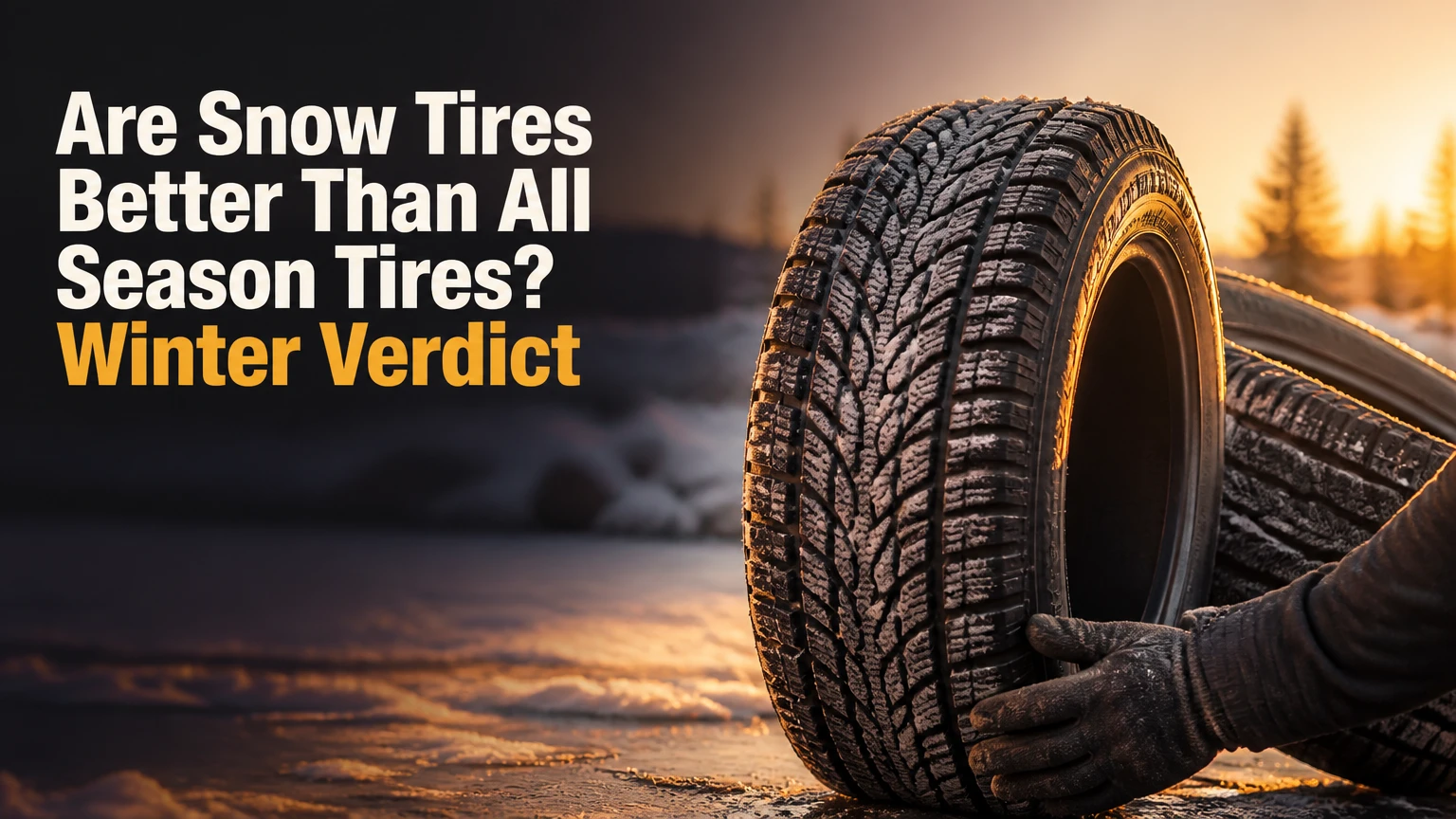
Yes. Snow tires are better than all-season tires whenever temperatures stay near or below 7°C (45°F), or roads regularly contain snow, ice, slush, or freezing rain. All-season tires are more convenient and usually quieter in warm weather, but dedicated winter tires provide more reliable braking, acceleration, and cornering in sustained cold. The advantage is largest on ice and packed snow.
Key Facts at a Glance
- Dedicated winter tires remain more flexible below 7°C (45°F), while many all-season compounds lose flexibility as temperatures approach freezing.
- The 3-Peak Mountain Snowflake, or 3PMSF, symbol confirms a tire passed a standardized packed-snow acceleration test; it does not guarantee equal ice braking.
- A typical winter tire set costs about $500-$1,200 before wheels, installation, storage, and seasonal service.
- Winter tires should be installed on all four wheels, not only the vehicle’s driven axle.
- AWD improves forward acceleration but does not provide extra tire grip for braking or cornering.
- All-weather tires with 3PMSF certification offer a practical compromise for moderate winters, but dedicated winter tires remain stronger in severe ice and snow.
What Is the Difference Between All-Season and Winter Tires?
All-season tires are year-round compromises designed for dry pavement, rain, mild cold, and occasional light snow. Winter tires use a cold-weather rubber compound, deeper grooves, and dense siping to preserve traction on frozen surfaces.
The names can mislead buyers. An all-season tire is not a four-season tire in every climate, and “snow tire” is the common consumer term for a modern winter tire that also targets ice, slush, and cold bare pavement.
| Tire category | Intended temperature | Winter marking | Primary strength | Main limitation |
|---|---|---|---|---|
| All-season | Above about 7°C (45°F) | Usually M+S; some models also 3PMSF | Dry roads and rain | Reduced cold-weather grip |
| All-weather | Year-round, including below 7°C | 3PMSF | Mixed climates and occasional snow | Less summer efficiency than all-season |
| Studless winter | Below about 7°C | 3PMSF | Ice, packed snow, freezing pavement | Faster warm-weather wear |
| Studded winter | Below about 7°C | 3PMSF, where certified | Hard ice and severe snow | Noise, road wear, legal restrictions |
The 3PMSF symbol is important because M+S, or mud and snow, is a manufacturer designation with a lower performance threshold. The U.S. Tire Manufacturers Association describes 3PMSF as a severe-snow-service designation based on standardized testing, not as proof that a tire performs equally well on ice.
Why Do Winter Tires Grip Better in Cold Weather?
Winter tires grip better because their compound stays pliable and their tread creates more edges at the road surface. A flexible tread can conform to microscopic irregularities in ice and cold asphalt, whereas a harder compound skates more readily across those irregularities.
Temperature is a practical screening tool, not a precise switch. Some modern all-season tires remain usable below 7°C, while a premium winter tire can outperform them before the thermometer reaches that point because road moisture, shade, wind, and surface temperature alter actual grip.
Rubber Compound and Contact Patch
Winter compounds use higher silica content and plasticizers selected for low-temperature flexibility. The result is a tread surface that deforms under load instead of behaving like a stiff block on frozen pavement.
That flexibility has a cost. On warm asphalt, winter tread blocks move more, steering response softens, rolling resistance can rise, and tread wear accelerates. Michelin and other tire manufacturers therefore recommend removing winter tires when sustained warm temperatures return, although the exact changeover point depends on the tire and local climate.
Sipes, Grooves, and Snow Traction
Sipes are small slits cut into tread blocks. They open under braking and cornering, creating additional biting edges that help evacuate water and engage compacted snow.
Open grooves also carry slush away from the contact patch. In loose snow, a winter tire can use packed snow within its tread because snow bonds to snow more effectively than rubber bonds to a slippery ice film. That mechanism helps explain why an aggressive winter pattern can climb a snowy incline where a highway all-season tire spins.
Ice Is Different From Snow
Winter tires improve ice traction, but no road tire makes polished ice behave like dry pavement. Studless designs use flexible compounds and micro-textures to remove some surface water, while studded designs add metal contact points that can penetrate hard ice.
The largest real-world benefit often appears before a driver notices wheelspin: the car stops with less ABS intervention, changes lanes with more stability, and retains steering authority during a brake-and-turn maneuver.
How Much Better Are Snow Tires Than All-Season Tires?
Snow tires can reduce stopping distance and improve cornering substantially in winter, but a universal 30-40% improvement is not guaranteed. The result changes with temperature, tire model, tread depth, vehicle weight, speed, road surface, ABS calibration, and whether the all-season tire is new or worn.
A typical comparison on packed snow may show winter tires stopping roughly 20-40% shorter than conventional all-season tires in controlled testing. On wet or merely cold pavement, the gap can be smaller. On glare ice, both tire types may have very limited grip, although a studded winter tire can gain a larger advantage where studs are legal and the surface is hard enough for penetration.
| Driving condition | All-season result | Winter-tire result | Practical consequence |
|---|---|---|---|
| Dry pavement at 20°C (68°F) | Shorter warm-weather response | Softer steering and longer wear | All-season advantage |
| Wet pavement at 5°C (41°F) | Acceptable to moderate grip | Typically stronger cold-wet traction | Winter advantage varies by model |
| Packed snow at -5°C (23°F) | Frequent wheelspin and ABS activity | Better acceleration and braking | Winter advantage often large |
| Glare ice at -10°C (14°F) | Very limited traction | Better studless grip; studs can add bite | Winter advantage, but speed must fall |
| Slush at 2°C (36°F) | Hydroplaning risk as tread wears | Deeper grooves and open pattern | Winter advantage when tread is healthy |
The Transportation Research Council and tire-industry testing both emphasize that test conditions strongly influence stopping-distance figures. Treat percentage claims as test results for specific tires and surfaces, not as a guaranteed property of every winter tire.
Which Tire Performs Better on Dry and Wet Roads?
All-season tires generally perform better on warm, dry roads because their tread blocks are designed for stability, low noise, and long wear at higher temperatures. Winter tires can perform well on cold, wet roads, but their soft tread may feel less precise when pavement is warm.
This is the central trade-off in the comparison. A driver in Minneapolis who sees temperatures below freezing for four months has a different answer from a driver in Seattle who usually encounters rain at 8°C (46°F).
| Road condition | Preferred tire | Why | Trade-off |
|---|---|---|---|
| Highway at 25°C (77°F) | All-season | Stiffer tread and stable handling | Poorer winter performance |
| City rain at 10°C (50°F) | All-season or all-weather | Adequate wet braking above cold threshold | Depends on tread and rain depth |
| Cold rain at 2°C (36°F) | Winter | Compound remains flexible | More noise and summer wear |
| Spring pavement at 15°C (59°F) | All-season | Better steering precision and durability | Requires seasonal changeover |
| Mixed daily temperatures from -5°C to 15°C | All-weather | Wider usable range | Less specialized than either seasonal tire |
An honest limitation matters here: dedicated winter tires are not the best permanent tire for a hot climate. Leaving them installed through a long summer can consume a significant portion of their usable tread and may weaken braking performance as the compound overheats.
Are All-Weather Tires Better Than All-Season Tires in Snow?
All-weather tires are better than conventional all-season tires in snow because they carry the 3PMSF rating and use a more winter-oriented compound and tread pattern. They are often the best single-set solution for drivers with occasional snow, but they do not replace dedicated winter tires in severe ice or mountain conditions.
All-weather tires occupy the middle ground between all-season and winter categories. A model such as the Michelin CrossClimate2 uses a directional tread and 3PMSF certification, while retaining enough warm-weather durability for year-round use.
Choose all-weather tires when:
- Temperatures fall below freezing only intermittently.
- Snow is usually cleared within hours or a day.
- Seasonal wheel storage is difficult.
- The vehicle travels fewer winter miles.
- Local law accepts 3PMSF tires where winter equipment is required.
Choose dedicated winter tires when roads remain snow-covered, freezing rain is common, steep grades are unavoidable, or the vehicle must travel during storms. The single-set convenience of all-weather tires cannot create the same ice specialization as a true winter compound.
Should You Choose Studded or Studless Winter Tires?
Studless winter tires suit most urban and suburban drivers, while studded tires make more sense on persistent hard-packed ice, unplowed rural roads, and steep mountain routes. Studless tires are quieter and avoid many seasonal legal restrictions.
Studs work by creating mechanical penetration into an ice surface. They do not provide the same benefit on bare dry pavement, loose deep snow, or wet roads, and they can increase road noise and pavement wear.
| Winter type | Best road surface | Typical noise | Legal consideration | Best user |
|---|---|---|---|---|
| Premium studless | Ice, slush, packed snow | Moderate, about 68-73 dB cabin range | Usually unrestricted | City commuter |
| Studdable, unstudded | Mixed winter roads | Moderate, about 68-74 dB | Usually unrestricted | Flexible rural driver |
| Factory-studded | Hard ice and frozen pack | Higher, about 72-78 dB | Seasonal restrictions common | Ice-belt resident |
| Performance winter | Cold clear pavement and light snow | Lower, about 67-72 dB | Usually unrestricted | Fast highway commuter |
Noise figures are typical ranges rather than universal specifications. Tire size, vehicle insulation, pavement texture, and speed can change cabin sound substantially.
Check provincial or state rules before buying studs. Quebec, for example, requires winter tires during a defined seasonal period for many passenger vehicles, while stud use and dates vary across Canadian provinces and U.S. states.
Does AWD Make All-Season Tires as Good as Winter Tires?
AWD does not make all-season tires equivalent to winter tires. All-wheel drive can distribute engine torque across four wheels and improve acceleration, but braking and cornering still depend on the friction available at each tire.
The National Highway Traffic Safety Administration summarizes the limitation this way: “Four-wheel drive helps you get going in snow, but it does not help you stop.” The same principle applies to AWD. A vehicle with winter tires can often brake and turn more predictably than an AWD vehicle on ordinary all-seasons.
| Vehicle setup | Acceleration on snow | Braking on ice | Cornering stability | Recommended winter approach |
|---|---|---|---|---|
| FWD with all-season | Moderate | Limited by tire compound | Moderate | Winter or 3PMSF all-weather |
| FWD with winter tires | Strong | Improved | Improved | Four matching winter tires |
| AWD with all-season | Stronger launch | Still limited | Still tire-limited | Winter tires for severe climates |
| AWD with winter tires | Strongest launch | Best available road-tire grip | Best available road-tire grip | Four matching winter tires |
| RWD with all-season | Weakest launch | Limited | Rear traction can fall quickly | Winter tires and careful loading |
Electronic stability control, ABS, and traction control remain valuable. None of them can manufacture friction where a tire compound and road surface provide very little.
How Much Do Winter Tires Cost?
A typical set of four winter tires costs $500-$1,200, while a second wheel set can add $250-$600 and seasonal service can add $80-$300 per year. Vehicle size, tire brand, run-flat construction, wheel diameter, and local labor determine the final price.
A second set of wheels often reduces repeated mounting costs and protects tire beads from twice-yearly dismounting. Steel wheels are inexpensive for many vehicles, while alloy wheels reduce weight but cost more.
| Ownership item | Typical compact car | Typical SUV or truck | Timing |
|---|---|---|---|
| Four winter tires | $500-$850 | $750-$1,400 | Every 3-5 winter seasons |
| Steel wheel set | $250-$400 | $350-$650 | One-time purchase |
| Seasonal swap on mounted wheels | $50-$100 | $70-$140 | Twice yearly |
| Mount and balance each season | $80-$150 | $100-$180 | Twice yearly |
| Commercial storage | $60-$150 | $80-$200 | Per season |
Winter tires do not automatically double tire spending if the two sets replace each other seasonally. Each set accumulates mileage during its intended months, although the owner pays more upfront and must manage storage.
Use a total-cost calculation: purchase price, wheel set, installation, storage, tire life, insurance discounts, and the value of avoiding a collision. Insurance savings may exist in some regions, but they vary by insurer and do not justify assuming a fixed payback period.
When Should You Install and Remove Winter Tires?
Install winter tires when temperatures regularly approach 7°C (45°F), usually before the first persistent snow, and remove them when sustained spring temperatures remain above that threshold. The calendar matters less than the temperature pattern and your driving schedule.
Installing early is usually safer than waiting for the first storm because appointment availability declines sharply after the first snowfall. Removing too early can leave a driver exposed to a late freeze, while removing too late accelerates warm-weather wear.
Seasonal Changeover Checklist
- Check the forecast seven to fourteen days ahead. Look for repeated overnight and daytime temperatures near 7°C.
- Inspect tread depth and sidewalls. Replace a winter tire with severe cracking, bulges, punctures, or inadequate tread.
- Install four matching tires. Match size, load index, speed rating, and preferably model.
- Set cold inflation pressure. Use the vehicle placard, not the maximum pressure molded into the sidewall.
- Reset or relearn TPMS. Some vehicles require a manual relearn after wheel installation.
- Retorque wheel fasteners. Recheck torque after approximately 50-100 kilometers if the wheel manufacturer recommends it.
- Store the removed set correctly. Clean and dry tires, then keep them cool, dark, and away from ozone-producing equipment.
Cold weather reduces pressure by approximately 1 psi for every 5°C (10°F) temperature drop, although the exact change depends on the tire’s starting pressure and air temperature. Check pressures monthly and before long highway trips.
Can You Install Winter Tires on Only Two Wheels?
No. Installing winter tires on only two wheels creates a handling imbalance and can cause sudden oversteer or understeer. Install four winter tires, even on a front-wheel-drive vehicle.
Two winter tires on the front may improve steering and forward pull but leave the rear axle with less lateral grip. During a wet or icy corner, the rear can rotate unexpectedly. Two winter tires on the rear can stabilize the rear axle while leaving the front unable to steer or stop effectively.
Some vehicles with AWD require tires within a narrow circumference difference to protect the center differential or electronically controlled clutch. Follow the owner’s manual for permitted tread-depth differences, tire sizes, and replacement pairing.
What Are the Most Common Winter Tire Mistakes?
The most damaging mistakes involve mismatched tires, warm-weather use, incorrect pressure, and overconfidence in vehicle technology. Each mistake reduces the safety advantage that the winter tire purchase was intended to provide.
- Running winter tires all summer: Heat increases tread wear and softens steering response. Schedule removal before sustained warm weather.
- Using only the driven axle: The car may accelerate acceptably but behave unpredictably during emergency braking.
- Ignoring tread depth: A winter tire with heavily worn grooves loses snow evacuation and biting-edge performance.
- Inflating by sidewall pressure: The molded maximum is not the vehicle’s recommended operating pressure.
- Buying old inventory without checking age: Use the DOT date code to identify the week and year of manufacture; rubber ages even when mileage is low.
- Driving too fast because AWD feels secure: AWD can hide traction loss during acceleration until braking exposes the limited grip.
- Leaving packed snow inside a wheel: Frozen debris can cause vibration at highway speed; remove it before requesting wheel balancing.
A tire with excellent tread can still be unsuitable if its rubber has aged, its load rating is wrong, or its size conflicts with the vehicle’s electronic systems.
Which Tires Should Different Drivers Choose?
The best choice depends on winter severity, road maintenance, annual mileage, storage, and whether the driver can avoid travel during storms. No single tire category wins every month or every road condition.
Urban and Suburban Commuter
Choose premium studless winter tires when commuting continues through snow, freezing rain, and icy intersections. Salted roads still freeze overnight, and city driving involves frequent braking, lane changes, and short stopping distances rather than sustained deep-snow travel.
Choose all-weather tires when snowfall is occasional and roads are usually cleared quickly. The compromise reduces seasonal service but gives up some severe-ice performance.
Rural, Mountain, and Snow-Belt Driver
Choose dedicated winter tires, with studded models where hard ice is persistent and local law permits them. Unplowed roads, steep grades, shaded corners, and freezing rain expose the limitations of ordinary all-seasons.
Carry approved chains or traction devices if the route or jurisdiction requires them. Chains can help in extreme conditions but cannot substitute for a complete set of properly rated winter tires during normal winter driving.
Mild-Climate or Low-Mileage Driver
Choose 3PMSF all-weather tires when winter temperatures occasionally fall below freezing but severe snow is uncommon. Choose high-quality all-season tires when snow is rare, the vehicle can remain parked during storms, and winter temperatures usually stay above 7°C.
Do not select a tire solely because it says “all season.” Verify the 3PMSF symbol, wet-braking tests, tread warranty, load index, and speed rating.
Frequently Asked Questions
Are snow tires worth the money for one or two snowstorms?
Snow tires can be worth the cost if the vehicle must travel during those storms, especially on hills, untreated roads, or icy routes. If the driver can reliably stay home and winter temperatures remain mild, 3PMSF all-weather tires may provide a more economical single-set solution.
Do winter tires use more fuel?
Winter tires can increase fuel consumption by roughly 1-5% in typical use because of higher rolling resistance, softer compounds, colder air, and deeper tread. Correct inflation, a narrow approved size, and timely spring removal reduce the penalty.
How many years do snow tires last?
Most winter tires last about three to five seasons or roughly 30,000-40,000 kilometers when used only in cold weather, but mileage is not a guarantee. Heat exposure, storage conditions, driving style, tread depth, and rubber age determine replacement timing.
Are winter tires noisy?
Winter tires are usually louder than touring all-seasons because their open grooves and flexible tread blocks create more pattern noise. Studded tires produce the most noticeable noise, particularly on bare pavement and coarse concrete.
Can I use winter tires on an electric vehicle?
Yes, provided the tires meet the electric vehicle’s load index, speed rating, size, and wheel requirements. EV weight and immediate motor torque can increase wear, while regenerative braking makes consistent tire grip important during low-traction deceleration.
What does M+S mean compared with 3PMSF?
M+S means the tread meets a mud-and-snow classification defined by the tire manufacturer or applicable standard, while 3PMSF means the tire passed a standardized severe-snow test. M+S alone does not establish winter performance equal to a certified winter tire.
The Bottom Line
Are snow tires better than all season tires? Yes, for sustained cold, snow, ice, slush, freezing rain, and drivers who cannot postpone travel. Dedicated winter tires provide the strongest cold-weather braking and cornering because their compound and tread remain usable below 7°C. All-season tires remain the better warm-weather and convenience choice, while 3PMSF all-weather tires bridge the two categories for moderate climates.