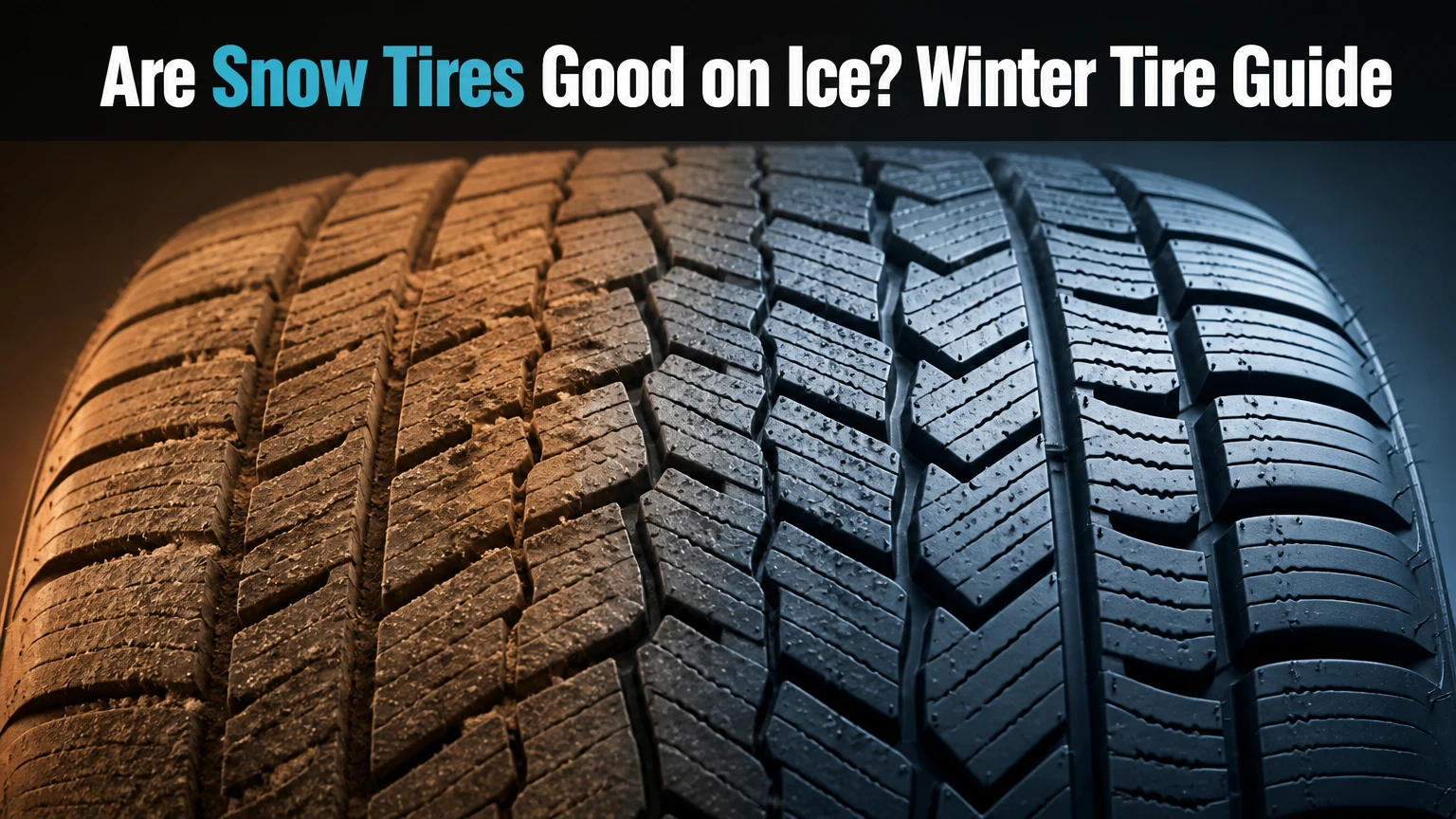
Yes, winter tires are substantially better on ice than ordinary all-season tires because their rubber stays flexible in freezing weather and their tread creates more edges for traction. Winter tires still cannot make glare ice safe: braking distances remain long, steering grip can disappear suddenly, and speed reduction matters more than any tire upgrade.
Key Facts at a Glance
- Winter tires generally outperform all-season tires below about 45°F (7°C), especially when pavement stays cold for extended periods.
- Nordic studless tires usually provide the best balance for mixed ice, snow, and cleared pavement.
- Studded tires can deliver stronger grip on wet, near-freezing glare ice, but local laws may restrict their use.
- All-wheel drive improves acceleration on slippery surfaces, but it does not provide extra tire grip for braking or cornering.
- Winter tires should be installed as a matched set of four, not only on the vehicle’s driven axle.
- A winter tire with shallow tread, hardened rubber, incorrect pressure, or advanced age may perform poorly despite its winter certification.
What Are Snow Tires?
“Snow tires” is the common consumer term for modern winter tires, although the industry generally uses “winter tire” for products designed to operate in cold conditions. Older snow tires focused on deep, loose snow with large tread blocks, while current winter tires address packed snow, slush, freezing rain, cold rain, black ice, and bare pavement.
The name can create the wrong expectation. A winter tire is not designed only to dig through snow. Its main advantage on ice comes from a cold-weather rubber compound and a tread pattern that maintains contact with a smooth, wet surface. Those properties matter even when the road appears clear.
A standard all-season tire is designed to compromise across a wide temperature range. A winter tire gives up some warm-weather handling and summer tread life to maintain flexibility and edge density during freezing conditions. That trade-off explains why winter tires can feel less precise on warm, dry roads yet provide more predictable traction during a winter commute.
Are Winter Tires Different From All-Weather Tires?
Winter tires are designed for sustained cold and frequent snow or ice, whereas all-weather tires are year-round tires with a winter certification. Both may carry the Three-Peak Mountain Snowflake, or 3PMSF, symbol, but certification does not mean identical ice performance.
All-weather tires typically use a firmer compound and a less specialized tread than Nordic winter tires. They suit drivers who encounter occasional snow, short cold spells, and mostly wet or dry pavement. Dedicated winter tires remain the stronger choice for repeated ice, packed snow, mountain travel, or temperatures well below freezing.
Why Do Winter Tires Grip Ice Better?
Winter tires grip ice better because the tread compound remains pliable and the tread contains many narrow edges that interact with the ice surface. All-season rubber stiffens as temperatures fall, reducing its ability to conform to microscopic surface texture and increasing sliding during braking and cornering.
Ice traction involves more than tread depth. A tire must generate friction while a thin film of water may exist between rubber and ice. Near the freezing point, pressure and friction can increase surface melting, while compacted snow and road contamination add another layer of uncertainty. Tire construction, temperature, speed, load, and surface texture all change the result.
The often-repeated claim that winter tires reduce stopping distances by exactly 30-40% is too broad for every road. Published results vary by tire, vehicle, test speed, ice temperature, ABS calibration, and whether the comparison uses worn or new all-season tires. A safer conclusion is that winter tires can materially shorten stops and improve control, but no universal percentage applies to every ice surface.
How Does the Rubber Compound Work?
Winter tire rubber stays flexible at temperatures where many all-season compounds become noticeably harder. Flexible rubber can deform around small irregularities in ice, preserving more real contact with the surface during acceleration, braking, and steering.
Manufacturers use different combinations of natural rubber, synthetic polymers, silica, oils, and other additives. A silica-rich formula does not automatically identify the best tire, because the full compound, curing process, tread design, and temperature range determine performance. Product tests are more useful than a single ingredient claim.
Cold weather also lowers tire pressure. A practical rule is that pressure changes by roughly 1 psi for every 10°F change in temperature, although the exact change depends on the tire and starting conditions. Check pressure when the tires are cold and use the vehicle manufacturer’s door-jamb specification, not the maximum pressure printed on the sidewall.
What Do Sipes and Microcell Treads Do?
Sipes are narrow cuts in tread blocks that add biting edges and allow the blocks to flex. Some winter tires also use porous or hydrophilic tread compounds that help manage water at the contact patch. These features improve traction, but descriptions that portray every sipe as a powerful vacuum or every pore as a sponge oversimplify tire physics.
Sipes do not eliminate the water film on glare ice. Their main practical effects are increasing edge density, improving block flexibility, and helping move small amounts of water through the tread. The rubber compound remains equally important. A heavily siped tire with hardened, worn rubber will not behave like a new winter tire.
Directional grooves can help evacuate water from wet pavement, but mounting direction must follow the arrow on the sidewall. An incorrectly mounted directional tire may lose its intended water-flow behavior and can compromise wet traction.
Which Winter Tire Type Fits Your Roads?
Nordic studless winter tires are usually the best general choice for drivers who face frequent ice, packed snow, and cold pavement while still spending substantial time on cleared roads. Studded tires become more attractive when wet glare ice and freezing rain dominate the route, while performance winter tires suit cold climates with mostly cleared pavement and higher-speed driving.
| Tire type | Ice and snow design | Best operating situation | Main compromise |
|---|---|---|---|
| Nordic studless | Very soft compound, dense siping, flexible blocks | Frequent ice, packed snow, temperatures below 20°F (-7°C) | Softer steering response and faster warm-weather wear |
| Studded winter | Metal studs, winter compound, deep siping | Repeated wet glare ice, rural roads, steep untreated routes | Road noise, pavement wear, legal restrictions |
| Performance winter | Firmer compound, stable blocks, high-speed casing | Cold, mostly cleared highways and performance vehicles | Less deep-ice and deep-snow grip than Nordic designs |
| All-weather | 3PMSF compound, moderate siping, year-round casing | Occasional snow and ice in mild winter regions | Lower severe-ice performance than dedicated winter tires |
| Standard all-season | Broad temperature compromise, limited winter specialization | Mild climates with rare freezing conditions | Weakest option for repeated ice and packed snow |
When Are Studded Tires Better?
Studded tires generally have an advantage on wet, near-freezing glare ice because metal studs can penetrate or fracture the surface. Their benefit is strongest on untreated rural roads, steep grades, freezing-rain routes, and persistent polished ice.
Studs are not universally superior. Very cold, dry ice can become hard enough that rubber flexibility and surface contact matter more than penetration. Studs also provide less comfortable performance on bare pavement, create noise, and may reduce grip on some dry or wet surfaces.
Studded-tire rules vary by jurisdiction. States and provinces may impose date windows, road-condition requirements, permitted months, or outright restrictions. Check the transportation authority where the vehicle is registered and where it will travel.
When Are Studless Tires Better?
Studless Nordic tires are better for mixed winter driving that includes ice, packed snow, dry asphalt, and wet pavement. Their quiet operation, flexible compound, and dense siping provide strong winter performance without the noise or regulatory limits associated with metal studs.
A studless tire is not a compromise in the ordinary sense. On extremely cold surfaces, a high-quality Nordic tire can outperform a studded design because it maintains a larger, more compliant contact patch. The choice depends on ice temperature, surface moisture, road treatment, and the proportion of bare pavement on the route.
How Do Winter Tires Compare With Alternatives?
Dedicated winter tires provide the strongest cold-weather margin, but all-weather tires can be reasonable for drivers with moderate exposure and limited storage. Standard all-season tires remain acceptable only when winter conditions are infrequent and postponing travel during storms is realistic.
| Option | Typical cold-weather capability | Ice braking expectation | Suitable driver |
|---|---|---|---|
| Nordic winter | Strong below 32°F (0°C), especially below 20°F (-7°C) | Best non-studded choice on repeated ice | Daily winter commuter |
| Studded winter | Strongest on wet, polished, near-freezing ice | Often strongest on severe glare ice | Rural or mountain-route driver |
| All-weather 3PMSF | Moderate in intermittent cold and snow | Better than standard all-season, below Nordic winter | Low-mileage urban driver |
| Standard all-season | Limited below freezing | Longer and less consistent on ice | Mild climate driver |
| Summer tire | Poor in cold conditions | Unsafe choice near freezing | Warm-weather use only |
The comparison must use equivalent tire condition. A new all-season tire may outperform a worn winter tire, and an old winter tire may lose flexibility even with adequate tread. Tire age, storage, pressure, alignment, and vehicle load can change the ranking.
Is AWD Better Than Winter Tires on Ice?
A two-wheel-drive vehicle with four winter tires can brake and corner more effectively on ice than an all-wheel-drive vehicle using ordinary all-season tires. AWD distributes engine torque to help the vehicle start moving, but the tires still create the friction used for stopping and steering.
AWD can mask poor traction during acceleration. That false confidence becomes dangerous when the driver approaches a turn or stop too quickly. Electronic stability control and ABS help manage a loss of control, but neither system can create friction that the tire-road interface does not have.
How Much Do Winter Tires Cost?
A typical dedicated winter setup costs about $600-$1,600 for four passenger-car tires, before tax and installation. Larger SUV, truck, specialty, and performance fitments can exceed $1,600, while mounting, balancing, storage, and local studding rules add recurring costs.
| Ownership item | Typical passenger-car range | Typical SUV or truck range |
|---|---|---|
| Four winter tires | $480-$1,000 | $800-$1,600+ |
| Seasonal mount and balance | $80-$150 | $100-$200 |
| Winter steel wheels | $300-$800 per set | $500-$1,200 per set |
| Stud installation | $15-$30 per tire | $20-$40 per tire |
| Seasonal storage | $50-$150 | $75-$200 |
A second wheel set can reduce future labor because technicians can swap complete wheels instead of demounting and balancing tires twice yearly. Storage should be cool, dry, and away from sunlight, ozone-producing equipment, solvents, and electric motors.
Dedicated winter tires commonly last four to five seasons when used only in cold months, but mileage and climate determine the actual life. Driving them through hot summer conditions accelerates wear and can damage the tread features that support ice grip.
When Should You Install Winter Tires?
Install winter tires before sustained cold arrives, commonly when daily temperatures regularly fall below about 45°F (7°C). Remove them when sustained warm weather returns, because the 45°F guideline is a practical compound rule, not a universal legal requirement or a precise performance switch.
Weather patterns matter more than one unusually cold morning. Drivers in northern climates may install winter tires in October or November, while drivers in mountain regions may need them earlier because passes can freeze before local valleys. Follow local regulations where winter-tire use is mandated.
A tire shop should inspect the vehicle before installation. Confirm correct size, load index, speed rating, rotation direction, wheel compatibility, TPMS operation, and lug-nut torque. After installation, recheck pressure when the tires are cold.
What Tread Depth and Age Are Safe on Ice?
A winter tire needs more than the legal minimum tread to maintain reliable ice performance. The commonly cited 4/32-inch threshold is a useful replacement warning for winter service, but local legal minimums may be lower and do not guarantee safe traction.
Many winter tires include a secondary winter-wear indicator around half of the original tread depth. When the winter indicator becomes flush with the tread, the tire may retain legal-looking grooves while losing much of its specialized winter performance.
Inspect all four tires for:
- Tread depth below the manufacturer’s winter recommendation.
- Uneven wear caused by alignment, suspension, or inflation problems.
- Cracks, bulges, punctures, or exposed cords.
- Hardened rubber or a production date indicating advanced age.
- Mismatched tread patterns or substantially different remaining depths.
Tire age is not determined by appearance alone. Find the Department of Transportation date code on the sidewall and ask a tire professional to assess aging, especially when tires have spent several summers in heat or were stored near sunlight.
How Can You Drive More Safely on Ice?
Reduce speed before the icy section, increase following distance, and make steering, braking, and throttle inputs gradual. Winter tires improve the available margin, but abrupt inputs can exceed that margin even at low speeds.
Use these practical controls:
- Look far ahead for shaded pavement, bridges, intersections, and polished tire tracks.
- Brake in a straight line and let ABS operate during an emergency stop.
- Avoid cruise control on snow or ice because it can maintain power when traction changes.
- Enter turns slowly rather than braking hard in the middle of the corner.
- Leave at least six to ten seconds of following distance on uncertain winter surfaces.
- Avoid passing snowplows or traveling during freezing rain unless the trip is necessary.
Black ice is especially difficult because the road may look wet rather than frozen. Bridges, overpasses, shaded curves, and areas beneath trees can freeze before surrounding pavement. Winter tires improve the response to black ice, but they cannot guarantee recovery after a sudden loss of grip.
What Common Winter-Tire Problems Reduce Ice Grip?
Incorrect installation, poor pressure, worn tread, old rubber, and excessive speed are frequent reasons a winter-equipped vehicle still slides. Tire selection cannot compensate for mechanical faults or driving faster than the available friction allows.
| Problem | Observable symptom | Corrective action |
|---|---|---|
| Low pressure | Heavy steering, unstable response, shoulder wear | Set cold pressure to the door-jamb specification |
| Only two winter tires | Front or rear instability during braking | Install four matching winter tires |
| Worn winter tread | Long stops, wheelspin, weak cornering | Measure tread and replace near the winter limit |
| Reversed directional tire | Poor wet-road evacuation | Remount according to the sidewall arrow |
| Summer use | Rapid wear, softened blocks, poor warm handling | Remove winter tires when sustained warmth returns |
| AWD overconfidence | Strong launch but poor stopping | Slow down and use winter tires on all wheels |
Installing winter tires only on the drive axle is unsafe. Front-wheel-drive vehicles can accelerate effectively while the rear tires lose lateral grip, producing oversteer during braking or cornering. Rear-wheel-drive vehicles have the opposite traction imbalance during acceleration, but the solution remains four matched tires.
One practitioner rule is worth remembering: compare the vehicle’s worst tire, not its best tire. A single damaged, mismatched, or severely worn tire can destabilize braking even when the other three tires are excellent.
Which Tire Should Different Drivers Choose?
The best winter tire depends on road temperature, ice frequency, pavement treatment, distance traveled, and the consequences of being delayed. A remote rural commuter and a low-mileage city driver should not buy the same tire automatically.
Daily Urban Commuter
Choose Nordic studless winter tires when roads regularly freeze but are usually plowed or salted. Models such as the Bridgestone Blizzak WS90 and Michelin X-Ice Snow represent the category, although independent tests for the exact vehicle size should guide the final choice.
Rural or Mountain Driver
Choose studded winter tires when the route includes frequent untreated glare ice, freezing rain, steep grades, or shaded roads that remain polished for days. Confirm legality first, because a tire that is prohibited during your travel period cannot provide a practical safety benefit.
Performance-Car Driver
Choose performance winter tires when the vehicle spends most winter miles on cleared highways and the driver values steering stability at normal highway speeds. These tires generally sacrifice some severe-ice and deep-snow performance for more controlled handling on cold pavement.
Mild-Climate, Low-Mileage Driver
Choose a premium all-weather 3PMSF tire when ice and snow occur occasionally, annual mileage is low, and postponing travel during severe storms is possible. All-weather tires reduce seasonal maintenance but do not match dedicated Nordic winter tires on repeated ice.
FAQ
Are snow tires worth it for one icy storm each year?
Dedicated winter tires may not be economical for a driver who encounters one storm and can safely remain home. A 3PMSF all-weather tire offers a middle option, while standard all-season tires require much greater speed reduction and may be unsuitable if travel during the storm is unavoidable.
Do winter tires help on freezing rain?
Winter tires help during freezing rain, but wet glare ice remains one of the hardest surfaces for any tire. Studded tires may provide an advantage near the freezing point, while studless tires can perform strongly in colder conditions. Avoiding travel during severe freezing rain is safer than relying on tire choice alone.
Are winter tires noisy?
Nordic studless winter tires are usually quieter than studded tires because they contain no metal pins. Studded tires produce a noticeable clicking or humming sound on bare pavement, and the noise level varies with vehicle insulation, pavement texture, speed, and stud design.
Can I use winter tires year-round?
You can physically use winter tires year-round, but doing so is poor practice. Warm pavement wears the softer tread rapidly, reduces handling precision, increases rolling resistance, and may remove the winter compound before the next cold season. Seasonal use preserves both performance and service life.
Do wider winter tires work better on ice?
Narrower tires can sometimes perform better in deep snow because they maintain higher pressure over a smaller contact path, but width alone does not determine ice grip. Compound, tread design, load, pressure, and vehicle calibration matter more. Use the vehicle manufacturer’s approved winter size unless a tire professional confirms an alternative.
How far can a car stop on ice with winter tires?
No single stopping distance applies to every vehicle or ice surface. Speed, temperature, slope, ABS operation, tire condition, and ice contamination can change the result dramatically. Treat winter tires as a way to increase available traction, not as permission to preserve dry-road following distances.
The Bottom Line
Are snow tires good on ice? Yes, winter tires are the most effective general tire upgrade for drivers who regularly encounter freezing pavement, packed snow, or black ice. Nordic studless tires fit most mixed winter routes, studded tires suit persistent wet glare ice where legal, and all-weather tires fit milder climates with occasional storms.
Winter tires do not defeat physics. Install four tires, maintain cold pressure, replace worn or aged rubber, slow down before icy sections, and postpone unnecessary travel during freezing rain. The tire creates the grip margin, but speed and road conditions determine whether that margin is enough.