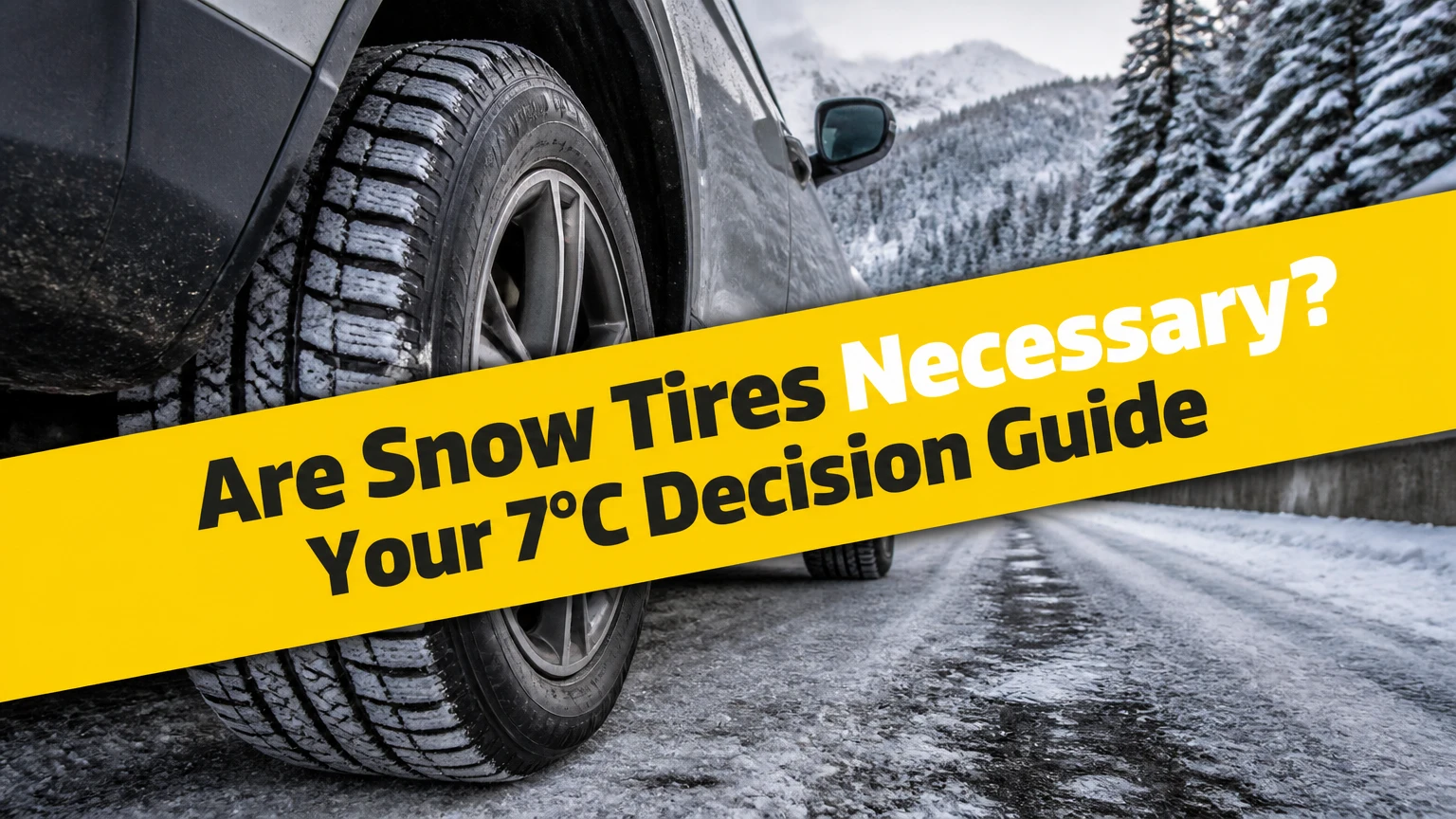
Snow tires, more accurately called winter tires, are necessary for drivers who regularly travel below 7°C (45°F), on packed snow, ice, or severe winter roads. They are usually optional for warm climates and infrequent snow, where a 3PMSF-rated all-weather tire may provide a better year-round compromise. Local law and route risk still control the final decision.
Key Facts
Winter tires remain more flexible than conventional all-season tires below approximately 7°C (45°F).
A Three-Peak Mountain Snowflake (3PMSF) marking confirms a certified severe-snow traction test, while M+S alone does not provide the same certification.
All-wheel drive improves acceleration but does not give a vehicle extra tire grip for braking or cornering.
Winter tires should be installed as a complete set of four, not only on the vehicle’s driven axle.
A practical winter replacement threshold is about 4/32 inch, or 3.2 millimeters, of remaining tread, even though many jurisdictions use a lower legal minimum.
Dedicated winter tires usually outperform all-weather tires on ice and deep snow, while all-weather tires eliminate seasonal swaps.
Are Snow Tires Necessary for Most Drivers?
Winter tires are necessary when cold temperatures, snow, ice, or road exposure make the extra traction worth their cost and inconvenience. A driver who commutes before roads are plowed, crosses mountain passes, or regularly encounters freezing temperatures should use four winter tires. A driver in a mild city with rare snow may reasonably choose 3PMSF all-weather tires instead.
The 7°C threshold is a useful planning rule because tire compounds change gradually as temperatures fall. It is not a physical switch, and it is not the winter-tire law in every state, province, or country. A vehicle that travels mostly on dry roads at 2°C still benefits from cold-weather flexibility, but a vehicle that never leaves a warm coastal area may not need a dedicated winter set.
Risk matters more than annual snowfall. A single trip on untreated black ice can matter more than several months of clear pavement, particularly for emergency braking, rural travel, steep grades, and routes where a delayed trip is not practical.
Who should buy dedicated winter tires?
Dedicated winter tires are the stronger choice for four situations:
- Frequent sub-freezing driving: Temperatures remain below 7°C for weeks or months.
- Regular snow and ice: Roads include packed snow, freezing rain, or untreated surfaces.
- High-consequence travel: The driver must reach work, school, medical appointments, or remote locations during storms.
- Mountain or northern routes: Elevation changes create colder pavement and rapid weather changes.
Drivers who make only occasional trips in light snow can often use all-weather tires, delay travel, or carry approved traction devices where local rules allow them. Those alternatives do not equal winter-tire performance on ice.
What Are Snow Tires, and How Do They Work?
Snow tires are winter tires engineered for low-temperature grip on dry pavement, wet roads, slush, packed snow, and ice. Winter tires use cold-weather rubber compounds, flexible tread blocks, dense siping, and higher void areas to preserve traction where many conventional all-season tires lose flexibility.
The common phrase “snow tire” is incomplete. Snow is only one operating condition. Winter tires also address frost, freezing rain, cold rain, and dry asphalt near or below freezing.
Why do winter tires grip cold roads?
Winter tire compounds contain polymers and silica formulations designed to remain flexible at low temperatures. Conventional all-season tires are designed around a broader annual range, so their tread may become less compliant as temperatures fall. The exact temperature behavior varies by model, inflation, tread wear, and pavement, so “all-season tires turn into plastic” is an exaggeration rather than a literal engineering description.
Tread design supplies the second part of the benefit. Sipes create additional biting edges, while grooves provide space for slush and snow. On packed snow, the tread can use snow-on-snow friction, which is why a winter tire can maintain propulsion where a relatively smooth all-season tread spins.
Ice remains the hardest surface. No tire can create unlimited grip on polished ice, and stopping distances can become many times longer than on dry pavement.
What do the tire markings mean?
The 3PMSF symbol means the tire passed a standardized severe-snow traction test. The M+S marking means the tread meets a manufacturer-declared mud-and-snow design criterion, but M+S alone does not establish the same tested snow performance.
| Sidewall marking | What it indicates | What it does not guarantee | Typical use |
|---|---|---|---|
| 3PMSF | Certified severe-snow acceleration performance | Equal ice braking across brands | Winter and all-weather tires |
| M+S | Tread pattern recognized for mud and snow | Modern severe-snow capability | Many all-season and truck tires |
| Stud symbol or studs | Mechanical ice-biting hardware | Legal use in every jurisdiction | Select icy-road regions |
| UTQG treadwear grade | Relative wear rating for many US-market tires | Winter traction or mileage equivalence | Comparing eligible passenger tires |
The Tire and Rubber Association of Canada and the US Tire Manufacturers Association distinguish severe-snow certification from ordinary M+S labeling. A certification mark is useful, but buyers still need to compare the tire’s ice, snow, wet-road, noise, and wear characteristics.
Which Winter Tire Type Fits Your Conditions?
Studless winter tires are the default choice for most drivers because they deliver strong snow and ice performance without the pavement damage, noise, and legal restrictions associated with metal studs. Studded tires make sense where prolonged glare ice dominates and local law permits them. Performance winter tires suit fast dry-road travel in cold conditions but are less specialized for deep snow.
| Tire type | Best temperature and surface | Main advantage | Main limitation |
|---|---|---|---|
| Studless winter | Below 7°C, snow, slush, ice | Strong balanced winter grip | Requires seasonal storage and swapping |
| Studded winter | Persistent ice below freezing | Mechanical bite on hard ice | Noise, road wear, seasonal restrictions |
| Performance winter | Cold, wet, dry highway pavement | Sharper steering and high-speed stability | Less deep-snow capability than Nordic designs |
| All-weather 3PMSF | Mild winters and mixed seasons | Year-round use with severe-snow rating | Weaker ice and deep-snow grip than winter tires |
| Traditional all-season | Warm climates and light winter exposure | Lower ownership complexity | Reduced cold-weather traction |
Are studded tires better than studless winter tires?
Studded tires can provide an advantage on repeated glare ice, but studless winter tires are usually more versatile on mixed roads. Studs may increase noise, reduce dry-road refinement, wear pavement, and violate seasonal regulations; some regions restrict them to specific dates or ban them on selected roads.
Drivers in a northern city with frequent packed snow but limited bare ice may gain more from a premium studless tire. Drivers on rural, untreated, icy roads may prefer studs after checking local transport-agency rules.
Are performance winter tires suitable for deep snow?
Performance winter tires are suitable for cold wet and dry pavement, occasional snow, and high-speed highway travel, but they are not the best category for deep snow or remote ice routes. Their tread and compound prioritize steering response, braking stability, and road manners over the maximum void volume and flexible tread found in severe winter designs.
A sports sedan owner who drives a cleared interstate may prefer a performance winter tire. A crossover owner who climbs an unplowed driveway needs a conventional studless winter pattern instead.
Winter Tires Versus All-Weather and All-Season Tires
Dedicated winter tires offer the most cold-weather grip, all-weather tires offer the most convenient compromise, and traditional all-season tires are appropriate mainly where winter exposure is limited. The correct choice depends on the coldest pavement, snow frequency, route timing, and whether the owner can store a second set.
| Decision factor | Dedicated winter | 3PMSF all-weather | Traditional all-season |
|---|---|---|---|
| Below 7°C traction | Strongest | Moderate to strong | Moderate to weak |
| Packed-snow launch | Strongest | Strong | Variable |
| Ice braking | Usually strongest | Usually intermediate | Usually weakest |
| Summer suitability | Poor for extended heat | Acceptable year-round | Strong |
| Seasonal swap | Required | Not required | Not required |
| Typical set price | $500-$1,400+ | $500-$1,200 | $400-$1,000 |
| Severe-snow marking | 3PMSF | 3PMSF | M+S or 3PMSF, model dependent |
| Best ownership pattern | Two optimized sets | One compromise set | One warm-climate set |
Are all-weather tires as good as snow tires?
All-weather tires are not as capable as dedicated winter tires on ice, deep snow, or sustained sub-freezing roads. All-weather tires generally outperform conventional all-season tires in winter because they carry the 3PMSF marking and use a more winter-oriented tread, but they trade some severe-cold performance for summer usability.
The Michelin CrossClimate 2 is a well-known all-weather example, while products such as the Bridgestone Blizzak WS90, Michelin X-Ice Snow, and Continental VikingContact families belong to the dedicated winter category. Model performance varies, so category labels should not replace independent testing and the vehicle manufacturer’s fitment guidance.
Do all-season tires work in light snow?
All-season tires can work in shallow, freshly cleared snow when temperatures are moderate, tread is healthy, and the driver can travel slowly. They become a poor risk choice when snow is packed, ice is present, temperatures stay below freezing, or the vehicle must stop quickly on an untreated road.
“All-season” does not mean “all-weather.” Check the sidewall for 3PMSF instead of relying on the product name.
Does AWD Replace Winter Tires?
All-wheel drive and four-wheel drive do not replace winter tires because drivetrains influence acceleration, while tires determine the available grip for braking and steering. AWD can help a vehicle start on a snowy incline, but four-wheel braking still depends on the tires’ contact with the road.
This distinction creates a common winter crash pattern: an AWD vehicle accelerates confidently through snow, then cannot stop or turn at the next icy intersection. Electronic stability control can reduce some loss-of-control events, but it cannot manufacture friction.
Should AWD vehicles use four winter tires?
AWD vehicles should use four matching winter tires with compatible circumference and load specifications. Mixing tire types or installing winter tires only on one axle can create handling imbalance and, on some AWD systems, mechanical stress from different rolling diameters.
Follow the vehicle manufacturer’s permitted tread-depth difference. Replace tires in pairs or as a complete set when possible, and ask whether a tire can be shaved to match the remaining tread on the other tires.
When Should You Install and Remove Winter Tires?
Install winter tires before temperatures regularly fall to about 7°C (45°F), and remove them when sustained warm weather returns. Waiting for the first major snowfall creates scheduling risk and leaves the vehicle on a less suitable tire during earlier cold rain or frost.
| Seasonal task | Practical timing or specification | Why it matters |
|---|---|---|
| Book installation | 1-3 weeks before regular 7°C days | Avoids storm-season appointment shortages |
| Install four tires | Before recurring frost or snow | Preserves balanced braking and cornering |
| Check cold pressure | Monthly and before long trips | Cold air lowers inflation pressure |
| Inspect tread | At each pressure check | Snow performance falls as void depth declines |
| Remove winter tires | Before sustained warm conditions | Limits accelerated wear and soft-road handling |
| Store tires | Cool, dry, dark location | Slows ozone and heat-related aging |
Tire pressure commonly changes by about 1 psi for each 10°F, or 5.6°C, temperature change. The exact change depends on tire volume and measurement conditions, so use the pressure on the driver-door placard, not the maximum pressure printed on the sidewall. Measure when the tires are cold, and remember that TPMS warns about pressure loss but does not confirm the correct target.
How much tread do winter tires need?
Winter tires should generally be considered near the end of their winter service around 4/32 inch, or approximately 3.2 millimeters, even if they remain above a local legal minimum. The 2/32-inch legal threshold used in many US jurisdictions is a regulatory limit, not a guarantee of safe snow traction.
Inspect for uneven wear, cracks, bulges, exposed cords, and age-related hardening. A tire can have adequate tread depth but poor winter performance if its compound has aged, been overheated, or suffered improper storage.
How Much Do Snow Tires Cost?
A typical set of four winter tires costs about $500-$1,400 or more, while installation, balancing, storage, and a second wheel set can add $100-$600 per season or purchase cycle. Compact-car tires often occupy the lower end, while large SUVs, performance cars, run-flat tires, and uncommon sizes cost more.
| Ownership item | Typical range | Main cost driver |
|---|---|---|
| Budget winter set | $500-$700 | Small passenger-car size |
| Premium winter set | $800-$1,400+ | SUV, run-flat, or premium brand |
| Mount and balance | $60-$150 | Tire-shop labor and local rates |
| Second wheel set | $400-$1,200 | Wheel material, sensors, vehicle fit |
| Seasonal storage | $50-$150 per season | Dealer, tire shop, or storage facility |
| Pressure sensors | $40-$100 per sensor | Vehicle system and sensor type |
A second wheel set can reduce repeated tire mounting and protect tire beads, although the initial purchase is higher. Owners should include alignment checks, valve stems, TPMS sensors, storage, and eventual replacement in the comparison rather than comparing tire prices alone.
Dedicated winter tires may also preserve summer-tire tread by splitting annual mileage between two sets. That does not automatically make the two-set arrangement cheaper, because aging, storage, mounting, and unused tread still carry a cost.
What Are the Biggest Winter-Tire Mistakes?
The most serious winter-tire mistakes are using only two tires, assuming AWD solves braking, ignoring tread depth, and driving dedicated winter tires through hot weather. Each error undermines the specific traction advantage the tire purchase was meant to provide.
- Installing winter tires only on the drive axle: The unmatched axle can lose grip first during braking or cornering, producing oversteer or understeer.
- Using the sidewall maximum pressure: The correct inflation target is the vehicle placard value, adjusted only when the manufacturer specifies a different load setting.
- Treating M+S as equivalent to 3PMSF: M+S labeling does not provide the same severe-snow certification.
- Keeping winter tires on through summer: Heat and dry-road loads accelerate wear and reduce handling precision.
- Ignoring tire age: Rubber hardening can reduce grip even when tread appears deep.
- Replacing one tire on an AWD system without checking circumference: Rolling-diameter differences can affect driveline components and electronic controls.
How should you respond to black ice?
When a vehicle feels light or loose on black ice, release the accelerator smoothly, keep steering inputs small, and avoid abrupt braking or lane changes. If braking is necessary, use the anti-lock system with firm, continuous pressure while looking and steering toward the intended path.
Black ice often forms on bridges, shaded curves, overpasses, and roads near freezing water. Winter tires improve the margin, but speed reduction and increased following distance remain necessary because no tread pattern eliminates ice.
Which Setup Should You Choose?
The best tire setup follows the route rather than the vehicle badge. A front-wheel-drive sedan that travels a mountain highway can need winter tires more urgently than an AWD crossover used only on plowed suburban streets.
The northern or mountain driver
Choose four studless winter tires, or studded tires where legal, if roads routinely contain packed snow or glare ice. Prioritize a 3PMSF winter model with strong ice testing, adequate load capacity, and a speed rating appropriate for the vehicle.
The mild urban driver
Choose 3PMSF all-weather tires if winter temperatures occur but snow is infrequent, roads are plowed quickly, and storage or seasonal installation is inconvenient. This setup does not match dedicated winter tires on severe ice, but it is a rational alternative to ordinary all-season tires.
The highway commuter
Choose dedicated winter tires if the commute continues through freezing rain, untreated shoulders, or early-morning frost. A performance winter design may suit a cleared highway, while a conventional studless design is safer for mixed rural roads and deep snow.
The low-mileage driver
Consider all-weather tires, winter tires, or postponing nonessential travel according to route risk. Low mileage does not remove the need for winter traction, because tire grip depends on temperature and surface conditions rather than annual distance.
The AWD or 4WD owner
Treat AWD as a mobility aid, not a winter-tire substitute. Use four matching tires with the correct load index, speed rating, circumference, and tread-depth compatibility specified for the vehicle.
Are Snow Tires Required by Law?
Winter tires are legally required in some jurisdictions during specified dates or road conditions, but no single rule applies across the United States, Canada, and Europe. Requirements can cover tire type, 3PMSF markings, minimum tread, chains, studded-tire dates, or commercial vehicles.
Check the transportation department or motor-vehicle agency where the vehicle is registered and where it will travel. Québec, British Columbia mountain routes, Colorado passes, and parts of Europe illustrate why a local rule check matters: requirements may differ by date, road, weather warning, or vehicle class.
Insurance policies and rental agreements can impose additional conditions after a collision or on a winter trip. Legal compliance is the minimum standard, not proof that a tire is appropriate for the route.
Frequently Asked Questions
Are snow tires necessary if it does not snow?
Snow tires can be useful without visible snow when temperatures remain below 7°C, because winter compounds stay more flexible on cold dry or wet pavement. They are most valuable when frost, freezing rain, shaded ice, or untreated roads are possible. In consistently warm climates, dedicated winter tires add little practical benefit.
Are snow tires necessary for front-wheel-drive cars?
Front-wheel-drive cars benefit from winter tires on all four wheels, especially during braking and cornering. Front-wheel drive helps transmit engine power through the front tires, but it cannot prevent the rear tires from losing grip. Installing only two winter tires can create an unstable handling imbalance.
Can I use winter tires on only two wheels?
Using winter tires on only two wheels is unsafe and generally not recommended. Two winter tires create different traction levels between axles, which can cause sudden oversteer or understeer during braking, acceleration, or a turn. Install a complete matching set of four unless the vehicle manufacturer gives a specific alternative.
Do winter tires improve braking on wet roads?
Winter tires can improve braking on cold wet roads when temperatures are near or below the compound’s design range, but they are not automatically superior in warm rain. Summer tires often provide stronger warm-wet grip, while winter tires gain the advantage as pavement becomes colder and the all-season or summer compound stiffens.
How long do winter tires last?
Winter tires commonly last about 3-5 seasons, or roughly 20,000-30,000 miles of winter use, depending on mileage, storage, alignment, inflation, road temperature, and driving style. A premium tire may last longer, but a mileage promise cannot override tread depth, cracking, age, or loss of compound flexibility.
Can I drive winter tires all year?
You can physically drive winter tires all year, but extended warm-weather use accelerates tread wear, increases road noise, and reduces dry-road handling. Remove dedicated winter tires when warm temperatures become consistent. All-weather tires are the better one-set option for drivers who need 3PMSF winter capability throughout the year.
The Bottom Line
Are snow tires necessary? They are the safest choice for regular driving below 7°C, packed snow, ice, mountain roads, and early or late-season frost. Traditional all-season tires may be adequate in warm climates with rare snow, while 3PMSF all-weather tires provide a practical middle ground for mild winter conditions. Choose four matching tires, follow local law, maintain cold pressure, and never mistake AWD for braking traction.