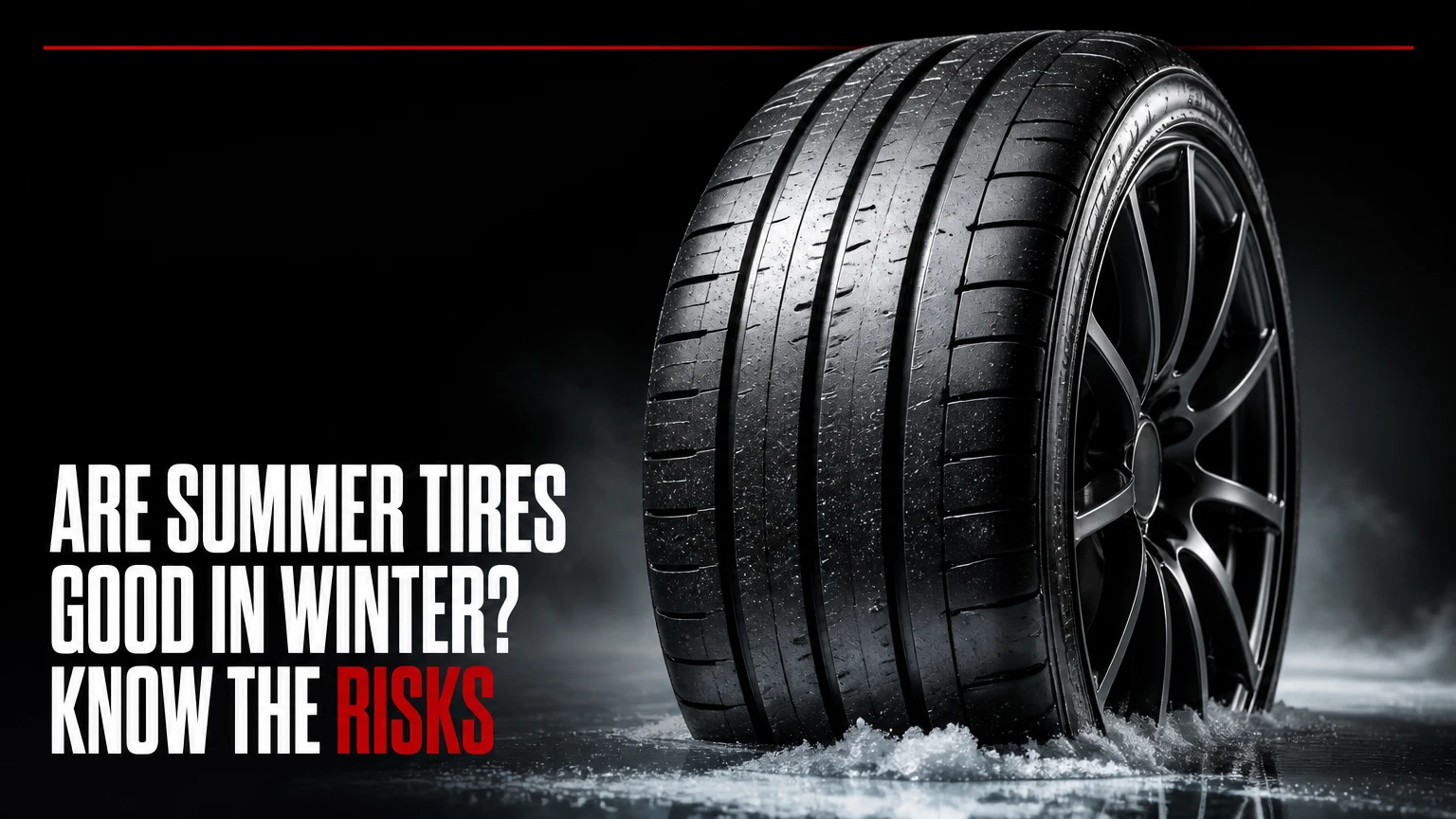
Summer tires are generally not good in winter because their warm-weather rubber hardens in cold temperatures and their tread lacks the biting edges needed for snow and ice. They may remain legal and usable on a cold, dry road at low speed, but winter tires provide substantially better braking, cornering, and traction once temperatures approach 7°C (45°F).
Key Facts
Summer tires are designed primarily for warm conditions, often above approximately 7°C (45°F).
Cold pavement can reduce summer-tire flexibility before snow appears.
Summer tread channels evacuate rainwater but do not replace winter tire sipes.
AWD improves acceleration but does not restore braking or cornering grip.
The 3PMSF symbol identifies tires tested against a defined severe-snow performance standard.
A practical seasonal switch is based on sustained temperatures, not the first snowfall.
What Are Summer Tires Designed to Do?
Summer tires use rubber compounds, tread patterns, and construction tuned for warm pavement. Their large tread blocks and relatively limited siping create precise steering response, strong dry-road cornering, and effective wet-road water evacuation when the compound remains flexible.
A summer tire is not automatically a racing tire. Touring summer tires may prioritize road comfort, while ultra-high-performance, max-performance, and extreme-performance models emphasize speed ratings, steering precision, and dry grip. All share a warm-weather design target, although their cold-weather tolerance varies by model.
The 7°C benchmark comes from tire-industry practice and manufacturer guidance. It does not mean every summer tire suddenly becomes unsafe at 6.9°C, or that every all-season tire performs equally at that temperature. Compound chemistry, road surface, tire age, speed, and moisture also affect grip.
Which Summer Tire Types Are Worst in Winter?
Extreme-performance summer tires usually have the narrowest operating window, followed by max-performance and many ultra-high-performance designs. Their soft warm-weather compounds and rigid tread structures can become particularly unforgiving on cold roads.
| Summer tire category | Typical design priority | Winter limitation | Appropriate seasonal use |
|---|---|---|---|
| Extreme-performance summer | Maximum dry grip, high steering load | Very poor snow traction, severe cold stiffness | Warm track days and dry summer roads |
| Max-performance summer | Dry grip plus wet-road stability | Reduced cold braking and weak snow evacuation | Warm spring, summer, and autumn |
| Ultra-high-performance summer | Speed stability and steering response | Harder feel below about 7°C | Warm daily driving |
| Grand-touring summer | Comfort, wet handling, highway stability | Better manners than track tires, still weak on snow and ice | Mild, snow-free climates |
Tire category alone cannot determine safety. The sidewall model, manufacturer specifications, tread depth, compound, and local road conditions matter more than the marketing label.
Why Do Summer Tires Lose Grip in Cold Weather?
Summer tires lose cold-weather grip because their rubber compound becomes less flexible and their tread cannot create enough mechanical interlock with snow, ice, or compacted slush. A stiff compound conforms less effectively to microscopic pavement texture, while broad tread blocks lack the dense biting edges found on winter tires.
Rubber does not switch from flexible to plastic at one universal instant. Tire compounds gradually change behavior as temperature falls, and the transition differs between products. The 7°C rule therefore works as a conservative planning threshold rather than a precise chemical cutoff.
Winter tires use compound formulations that retain flexibility at lower temperatures. They also use thousands of sipes, grooves, and edges that deform into snow and help remove water from the contact area. Summer tires generally trade those features for a more continuous tread surface and sharper response on warm asphalt.
How Does the Tread Pattern Change Winter Performance?
Summer tread blocks are often large and stable, which supports steering accuracy and dry braking. On packed snow, those blocks provide fewer edges for propulsion and lateral grip, so the tire can spin during acceleration or slide during a turn.
Slush creates a separate problem. A summer tire can channel liquid rain effectively while still struggling with thick, semi-solid slush that fills grooves faster than the tread can clear it. When the contact patch becomes partially lifted by slush, steering response can deteriorate quickly.
Winter performance involves more than tread depth. A nearly new summer tire can still perform poorly on ice because its compound and siping are unsuitable, while a worn winter tire may also be unsafe despite its category.
Are Summer Tires Safe on Cold, Dry Roads?
Summer tires can be driven cautiously on cold, dry roads in an emergency, but they are not the safest choice when temperatures remain below roughly 7°C. Cold, dry asphalt may provide more friction than snow or ice, yet a stiff summer compound can lengthen braking and reduce steering precision without producing an obvious visual warning.
The risk increases with speed, sudden inputs, shaded roads, bridges, early-morning frost, and tire age. A driver may feel normal grip while cruising, then discover the limitation during an emergency lane change or hard stop.
Tire Rack’s guidance on performance tires in cold temperatures warns that some summer tires can become brittle and may suffer damage when used or stored in very cold conditions. The exact lower limit depends on the tire manufacturer, so owners should check the model’s documentation.
| Road condition | Summer tire behavior | Safer tire choice | Immediate driving advice |
|---|---|---|---|
| Dry pavement, 10°C | Normal warm-season performance | Summer or all-season | Drive normally if tread and pressure are correct |
| Dry pavement, 2°C | Reduced flexibility and braking margin | Winter or all-weather | Reduce speed and increase following distance |
| Wet pavement, 4°C | Cold compound plus water reduces control | Winter or all-weather | Avoid hard braking and standing water |
| Fresh snow, -2°C | Weak propulsion and lateral grip | 3PMSF winter or all-weather | Do not continue unless reaching safety |
| Packed snow, -8°C | Severe traction and steering loss | Dedicated winter tires | Avoid driving |
| Glare ice, any temperature below freezing | Very low friction for every tire, especially summer | Studded or premium winter where legal | Do not rely on tire type alone |
No temperature threshold guarantees safety. The table provides a planning framework, not permission to drive aggressively below a stated value.
How Bad Are Summer Tires on Snow and Ice?
Summer tires are poor on snow and ice because they combine a stiff cold compound with tread blocks that have too few small edges to grip a low-friction surface. Acceleration, cornering, and braking can all deteriorate, with braking usually becoming the most dangerous limitation because the driver cannot compensate with steering skill.
Published stopping-distance results vary by tire model, vehicle, temperature, snow condition, test speed, and measurement method. Claims that summer tires always quadruple braking distance are too broad. A two-to-four-times increase can occur in severe comparisons, but it should not be treated as a universal number.
Transport Canada describes winter tires as providing better “traction, braking and handling” in cold weather, on ice, and in snow. That recommendation reflects the combined effect of compound flexibility and tread design, not simply a deeper groove.
Does AWD Make Summer Tires Safe in Winter?
AWD and 4WD can help a vehicle transmit engine power during acceleration, but they cannot create additional tire-road friction for braking or cornering. A heavy AWD vehicle on summer tires may pull away confidently and still slide through an intersection.
Electronic stability control and anti-lock braking systems also have limits. ABS can prevent wheel lock, but it cannot shorten the available friction distance when the tires have little grip. Drivers should match speed to the weakest condition, not to the vehicle’s drivetrain badge.
Practitioner rule: If a vehicle accelerates easily but the steering feels vague or ABS activates early, the drivetrain is masking a tire limitation rather than solving it.
What Is the Difference Between Summer, Winter, All-Season, and All-Weather Tires?
Winter tires are the strongest choice for recurring snow, ice, and temperatures below about 7°C. All-season tires provide broader annual usability but usually sacrifice cold-weather and warm-weather performance. All-weather tires are a more winter-capable compromise and commonly carry the 3PMSF severe-snow symbol.
| Tire type | Cold flexibility | Snow equipment | Warm-weather behavior | Best fit |
|---|---|---|---|---|
| Summer | Low below about 7°C | Minimal siping, no winter focus | Sharp steering and strong dry grip | Snow-free warm climates |
| All-season | Moderate across seasons | Varies by model, often no 3PMSF | Balanced, less precise than summer | Mild climates with occasional light snow |
| All-weather | Higher than all-season | 3PMSF on qualifying models | More tread noise and wear than summer | Drivers wanting one set with winter ability |
| Dedicated winter | Highest in cold conditions | Dense siping and snow-focused tread | Faster wear and softer handling in heat | Frequent snow, ice, and sub-7°C driving |
The 3PMSF mark shows that the tire passed a standardized severe-snow traction test. It does not mean the tire matches a dedicated winter tire on every icy or mountainous road, and it does not replace correct pressure, tread depth, or cautious driving.
Are All-Season Tires Better Than Summer Tires in Winter?
All-season tires are generally better than summer tires in mild winter conditions, but “all-season” does not guarantee reliable snow or ice performance. Some all-season models are designed for warm climates and may lack the 3PMSF mark.
A driver who sees occasional frost and light snow may find a quality all-season tire adequate. A driver who regularly commutes before roads are cleared should choose a 3PMSF all-weather tire or dedicated winter tire instead.
When Should You Remove Summer Tires?
Remove summer tires before temperatures regularly fall to approximately 7°C (45°F), especially if overnight driving, rain, frost, or snow is common. Install winter or winter-capable alternatives before the first storm because tire shops become busy and the first snowfall can arrive before an appointment.
Use local climate patterns rather than calendar dates. In southern Ontario, the northern United States, and much of northern Europe, autumn temperatures can cross the threshold weeks before persistent snow. In coastal climates with rare freezing conditions, a 3PMSF all-weather tire may be more practical than two seasonal sets.
Check local law separately. Quebec requires winter tires during a defined winter period, while other jurisdictions may regulate chains, studs, or commercial vehicles differently. Insurance consequences can also depend on policy wording and collision circumstances.
What Should You Check Before Switching?
Inspect both the tires and the vehicle during the seasonal change:
- Confirm the replacement tire size, load index, and speed rating match the vehicle requirement.
- Measure tread depth and inspect for uneven wear, bulges, cuts, exposed cords, and sidewall damage.
- Reset or relearn the TPMS after installation if the vehicle requires it.
- Torque wheel fasteners to the manufacturer’s specification, not a generic shop estimate.
- Check cold inflation pressure using the door-jamb label, not the maximum pressure molded into the sidewall.
- Recheck pressure after the first cold snap because air pressure falls as temperature drops.
- Retorque fasteners after approximately 50-100 kilometers if the wheel installer recommends it.
A separate wheel set can reduce seasonal labor time and protect tire beads from repeated mounting. It does not eliminate the need for annual inspection.
How Much Do Seasonal Tire Changes and Storage Cost?
A typical seasonal tire swap costs about $80-$160 for four mounted wheels or approximately $120-$250 when tires must be removed from and installed on the same wheels. Storage commonly costs $60-$150 per season, while a second set of basic wheels may cost $400-$1,200 depending on vehicle size and material.
Retail tire prices vary widely. A typical passenger-car set may cost $500-$1,400 for all-season or summer tires and $600-$1,600 for dedicated winter tires, excluding premium performance sizes, mounting, taxes, and wheels.
| Purchase or service | Typical range in USD | Typical timing | Main cost variable |
|---|---|---|---|
| Four summer tires | $500-$1,400 | Every 3-6 warm seasons | Size, speed rating, performance category |
| Four winter tires | $600-$1,600 | Every 3-6 winter seasons | Stud capability, brand, SUV size |
| Mounted-wheel seasonal swap | $80-$160 | 30-60 minutes | Wheel size and local labor |
| Tire dismount and remount | $120-$250 | 45-90 minutes | Low-profile tires and balancing |
| Seasonal tire storage | $60-$150 | 4-6 months | Region and storage provider |
| Second wheel set | $400-$1,200 | One-time purchase | Steel versus alloy wheels |
These are typical planning ranges, not quoted prices. Performance tires in large SUV or sports-car sizes can exceed them substantially.
How Should You Store Summer Tires in Winter?
Store summer tires indoors in a cool, dry, dark area away from heaters, ozone-producing electrical equipment, solvents, and direct sunlight. Clean and dry the tires, identify their vehicle position, and follow the manufacturer’s stacking or hanging guidance for mounted and unmounted assemblies.
Do not assume an unheated garage automatically damages every tire. The larger concerns are prolonged extreme cold, repeated temperature cycling, moisture, sunlight, chemical exposure, and existing age-related cracking. Some performance tire manufacturers specifically warn against mounting or flexing certain summer tires at very low temperatures.
Plastic bags can limit exposure to ozone and moisture, but tires should be dry before sealing. Keep them away from fuel, oil, paint, and electric motors. Inspect the tread grooves and sidewalls in spring, then replace any tire with deep cracking, bulges, exposed cords, or structural damage.
Can Cold Permanently Damage Summer Tires?
Cold storage can contribute to cracking or damage, but a single night below freezing does not automatically destroy a summer tire. Damage risk depends on the tire compound, temperature, duration, physical flexing, age, and storage conditions.
Avoid driving aggressively on a summer tire that has been stored extremely cold. Let the tire warm gradually indoors and ask the manufacturer or a tire professional to assess visible cracking. Never use heat guns, open flames, or improvised heating to soften the rubber.
What Mistakes Do Drivers Make With Summer Tires in Winter?
The most serious mistakes involve confusing vehicle capability with tire capability, treating a temperature guideline as an exact switch, and waiting until snow blocks access to a tire shop. Correcting those assumptions improves safety more than lowering tire pressure or relying on electronic controls.
- Relying on AWD: AWD assists acceleration, not stopping. Slow down before intersections and turns.
- Lowering pressure for grip: Underinflation does not soften a cold summer compound reliably; it increases heat, shoulder wear, steering delay, and rim damage risk.
- Waiting for visible snow: Cold wet pavement and frost can be dangerous before snowfall.
- Using only tread depth: Adequate depth cannot convert a summer tread pattern into a winter design.
- Ignoring tire age: Oxidation and hardening can reduce grip even when the grooves look deep.
- Driving through a warning light: ABS or traction-control activity on a clear road may indicate low friction, a mechanical fault, or both. Stop safely and arrange inspection.
Expert insight: The first loss may be lateral grip rather than obvious wheelspin. A car can launch acceptably yet understeer during the first cold, wet corner.
What Should You Do If Snow Starts While You Have Summer Tires?
If snow begins while summer tires are installed, reduce speed smoothly, increase following distance by several times, avoid abrupt steering and braking, and leave the road at the first safe location. Do not continue a normal commute simply because the vehicle has AWD, traction control, or high ground clearance.
Choose a cleared parking area, service station, or other safe destination rather than stopping in a travel lane. If the route is already icy or visibility is poor, call roadside assistance or arrange a ride. Tire chains may be restricted by vehicle clearance, local law, or manufacturer instructions, so do not install them without confirming compatibility.
Vibration, thumping, or a sudden change in steering after cold exposure requires inspection. Flat spotting can occur after parking, but persistent vibration may indicate tire damage, wheel imbalance, or a separated belt.
Which Tire Setup Fits Your Winter?
Drivers in regions with frequent snow or ice should use dedicated winter tires on all four wheels. Drivers in mild regions with occasional snow can consider quality 3PMSF all-weather tires, while drivers who never encounter freezing temperatures may retain summer tires year-round if the tire manufacturer and local conditions support that choice.
Daily Commuter in a Snowy Region
Choose four dedicated winter tires, preferably on a second compatible wheel set. Install them before sustained 7°C temperatures arrive, keep summer tires for warm months, and replace the set when tread, age, or damage reaches the manufacturer’s limit.
Performance Enthusiast
Keep summer tires for warm road driving or track use and use winter-capable tires for cold commutes. Extreme-performance summer tires are particularly unsuitable for winter storage and low-temperature driving, especially when the car must be driven immediately after sitting outdoors.
Mild-Climate Driver
Choose between summer tires and 3PMSF all-weather tires based on actual frost and snowfall exposure. If winter trips are occasional but unavoidable, all-weather tires reduce the risk of being caught on a cold, wet, or snowy day.
Mountain or Rural Driver
Use dedicated winter tires and consider local requirements for studs or chains. Elevation, shaded roads, packed snow, and delayed plowing can create winter conditions when nearby urban roads remain clear.
Frequently Asked Questions
Can I drive summer tires in winter if there is no snow?
You can drive cautiously in an emergency on a cold, dry road, but summer tires remain a compromised choice below approximately 7°C. Cold pavement, frost, wet leaves, bridges, and shaded corners can reduce grip without visible snow. Keep speeds low, increase space, and replace the tires before routine winter driving.
Are summer tires good in winter on a front-wheel-drive car?
Summer tires are not a good winter choice on a front-wheel-drive car because front-wheel drive cannot restore braking or cornering friction. The driven front wheels may pull the car forward, yet the vehicle can still understeer or slide during braking. Four winter or winter-capable tires are safer than mixing seasonal categories.
Can I use winter tires on only the drive wheels?
Using winter tires only on the driven axle is unsafe because it creates an imbalance in front-to-rear traction. The higher-grip axle can make the lower-grip axle lose control during braking or cornering. Install matching winter tires on all four positions unless the vehicle and tire manufacturer specify another arrangement.
How long do summer tires last?
Summer tires commonly last about 30,000-60,000 miles, or 48,000-97,000 kilometers, but high-performance driving, alignment problems, underinflation, hot pavement, and track use can shorten life dramatically. Replace tires for age-related cracking or damage, not only when tread reaches the legal minimum.
Are 3PMSF all-weather tires as good as winter tires?
3PMSF all-weather tires are more capable than ordinary all-season tires in severe snow, but dedicated winter tires usually provide better performance on frequent snow, ice, and very cold roads. All-weather tires trade some winter capability for year-round convenience, warmer-weather handling, noise, and reduced seasonal maintenance.
The Bottom Line
Are summer tires good in winter? Usually no. Summer tires can remain acceptable for warm, snow-free conditions, but cold pavement, snow, ice, and slush expose their compound and tread limitations quickly. Use dedicated winter tires for recurring winter conditions, or choose 3PMSF all-weather tires when occasional snow and one-set convenience matter more than maximum winter grip.


