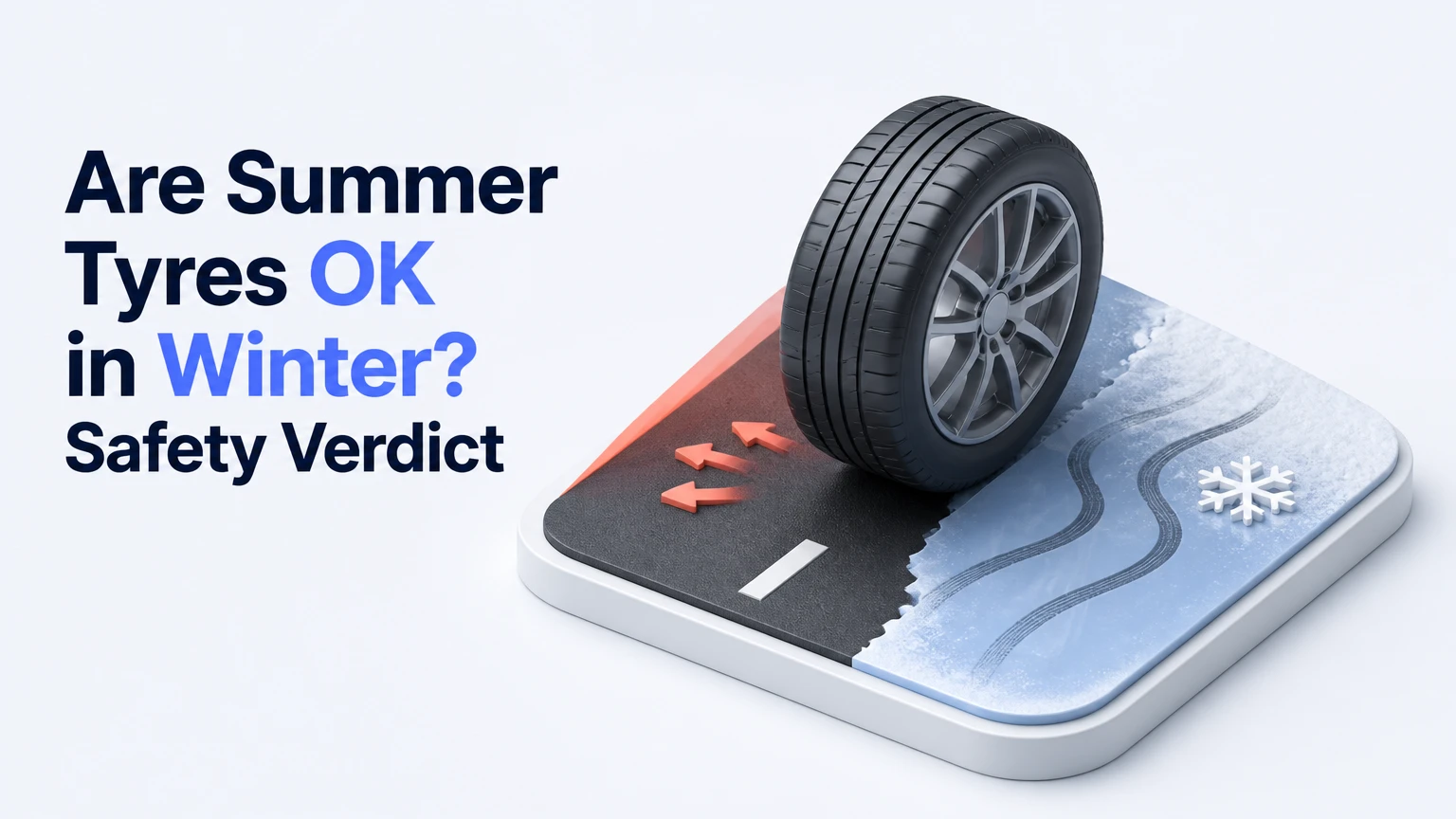
No, summer tyres are not generally safe for winter driving when temperatures regularly fall below about 7°C, especially on snow, ice, or slush. Summer tyres become less flexible in cold conditions and lack the tread features needed for winter traction, so braking, steering, and cornering margins can shrink sharply even when the road looks merely wet.
Key Facts at a Glance
- Summer tyres are designed primarily for warm conditions, commonly above approximately 7°C, but 7°C is a practical industry guideline rather than a precise rubber switch.
- Cold weather makes summer tyre compounds less compliant, reducing their ability to conform to small irregularities in the road surface.
- Snow and ice require more than soft rubber: winter tyres also use deeper grooves, more biting edges, and dense sipe patterns.
- The Three-Peak Mountain Snowflake, or 3PMSF, marking identifies a tyre that meets a standardized snow-traction performance test; it does not make every all-season tyre equal to a dedicated winter tyre.
- All-wheel drive can help a vehicle accelerate, but it cannot restore summer-tyre grip during braking or cornering.
- Replace or switch all four tyres as a matched set unless a tyre manufacturer or qualified technician gives a specific alternative instruction.
Are Summer Tyres OK in Winter?
Summer tyres are acceptable only for limited winter conditions where temperatures remain moderate, roads stay clear, and local law permits them. Summer tyres are a poor choice for regular driving below 7°C, and they are unsuitable for snow or ice because their compound and tread are not designed for those surfaces.
The practical decision depends on both temperature and road surface. A summer tyre may still perform adequately on a dry road at 5°C during a short, careful journey, while a 9°C road covered in compacted ice remains hazardous. The 7°C figure helps drivers identify the seasonal changeover period; it is not permission to ignore freezing conditions above or below that number.
The UK’s Royal Automobile Club (RAC) describes winter tyres as useful when temperatures fall below 7°C, while tyre manufacturers including Michelin, Continental, and Goodyear use the same threshold as a practical guide. That consensus concerns typical performance, not a universal legal limit.
Why Does Cold Weather Reduce Summer-Tyre Grip?
Cold weather reduces summer-tyre grip because the tread compound loses flexibility as temperature falls. A flexible tread can deform around microscopic texture in the asphalt, but a colder, stiffer tread makes less effective contact with that texture.
The term “glass transition” is often used in consumer explanations, but the 7°C rule should not be understood as a sudden moment when a summer tyre turns into glass. Rubber compounds change gradually across a temperature range, and the exact response depends on the tyre formulation, road temperature, speed, load, and surface moisture.
Cold pavement also changes the available friction. Water can remain on the surface, frost can form in shaded areas, and salt-treated roads can still contain slush or compacted snow. Summer tyres have less tread flexibility and fewer edges to generate traction when those conditions appear.
How Do Summer Tyres Differ From Winter and All-Season Tyres?
Summer, winter, and all-season tyres differ in compound flexibility, tread geometry, operating range, and snow certification. Summer tyres prioritize warm-weather dry and wet handling, winter tyres prioritize cold and snow traction, and all-season tyres balance those goals with a larger compromise.
| Tyre type | Compound and temperature focus | Tread characteristics | Snow marking and primary use |
|---|---|---|---|
| Summer tyre | Relatively firm compound for warm conditions, typically above 7°C | Large tread blocks, fewer sipes, efficient water channels | Usually no 3PMSF; warm dry and wet roads |
| All-season tyre | Intermediate compound for a wider annual temperature range | Moderate grooves and sipes, balanced block design | Some carry 3PMSF; mixed climates and occasional snow |
| All-weather tyre | Cold-capable compound with stronger winter bias | More winter-oriented siping and grooves | Commonly 3PMSF; year-round use with moderate snow |
| Dedicated winter tyre | Flexible cold-weather compound below 7°C | Deep grooves, many sipes, snow-shedding edges | Usually 3PMSF; repeated snow, ice, and freezing weather |
| Studded winter tyre | Winter compound plus metal studs where permitted | Ice-biting studs and winter tread | Local approval required; severe ice conditions |
The labels are not perfectly standardized worldwide. In North America, “all-weather” often describes a 3PMSF-marked tyre intended for year-round use, while “all-season” can describe products with only modest snow capability.
What Does the 3PMSF Symbol Mean?
The 3PMSF symbol is a mountain outline containing a snowflake. It means the tyre passed a regulated snow-traction test under the relevant United Nations Economic Commission for Europe framework or an equivalent regional standard.
The marking is more meaningful than the word “all-season” alone, but it is not a complete performance ranking. A narrow, lightweight vehicle tyre and a premium severe-snow tyre can both carry 3PMSF while differing in ice braking, wet handling, tread life, noise, and temperature range.
The mud-and-snow, or M+S, marking is weaker evidence. M+S indicates a tread configuration judged suitable for mud and snow, but it does not necessarily require the same standardized snow test. Drivers expecting regular winter conditions should look for 3PMSF and compare independent tests, not rely on M+S alone.
How Much Worse Are Summer Tyres on Snow and Ice?
Summer tyres can require substantially more stopping distance on snow and ice than winter tyres, but no single percentage applies to every vehicle, speed, tyre, temperature, or test surface. A claim that summer tyres always stop twice as far, or that winter tyres always shorten braking by 40-50%, is too broad without test conditions.
Independent tests from organizations such as ADAC, ÖAMTC, Auto Bild, and Consumer Reports regularly find large differences between tyre categories, particularly for snow braking and traction. Results vary because winter tests use different temperatures, snow types, vehicle weights, speeds, and tread depths.
| Driving condition | Summer tyre risk | 3PMSF all-season response | Dedicated winter response |
|---|---|---|---|
| Dry road at 15°C | Strong warm-weather handling | Adequate, usually less precise | Adequate, often softer and less precise |
| Wet road at 5°C | Reduced cold compliance and braking margin | Usually balanced | Strong cold grip, possible warm-weather trade-off |
| Packed snow at 0°C | Poor traction and braking | Moderate, varies by design | Strongest consistent snow traction |
| Glazed ice at -5°C | Very poor control | Poor to moderate, studless limits remain | Better, but no ordinary tyre makes ice safe |
| Slush at 2°C | Greater risk of unstable steering | Good if grooves remain open | Good, with stronger cold flexibility |
| Dry road at -10°C | Compound stiffness and reduced grip | Better flexibility | Best cold-weather compliance |
A driver should treat the table as a decision framework, not a promise of a fixed stopping distance. Speed reduction matters more as grip falls: stopping distance rises approximately with the square of speed under similar conditions, so a vehicle traveling 40 mph carries roughly four times the kinetic energy of one traveling 20 mph.
Is Cold Wet Asphalt Dangerous With Summer Tyres?
Cold wet asphalt can be dangerous with summer tyres because water, low pavement temperature, and reduced tread flexibility combine before visible snow appears. The risk is lower than on ice, but the tyre may provide a smaller margin for emergency braking or sudden lane changes.
This condition commonly affects coastal cities, bridges, shaded roads, and early-morning commutes. Drivers often assume winter tyre decisions matter only after snowfall, yet cold rain can arrive weeks before the first snow and remain after daytime temperatures appear mild.
Summer tyres can still be excellent in warm rain because their tread is optimized for water evacuation and their compound works well at higher temperatures. The problem is the combined condition of cold pavement and an emergency maneuver, not rain alone.
When Should You Change From Summer to Winter Tyres?
Change to winter tyres when temperatures consistently approach 7°C during the times you drive, or earlier if snow, ice, or mountain travel is forecast. Waiting for the first snowfall is a poor strategy because fitting appointments become scarce and the first cold roads may arrive before the forecast changes.
Use a temperature pattern rather than a single cold morning:
- Check the typical morning and evening temperatures for the next 7-14 days.
- Book the change when regular driving temperatures are near or below 7°C.
- Inspect winter tyres before fitting for cracks, bulges, uneven wear, and tread depth.
- Confirm the size, load index, speed rating, and vehicle compatibility.
- Fit four suitable tyres, then set cold inflation pressure to the vehicle placard.
- Recheck pressure after the first significant temperature change or 50-100 miles.
The reverse change should happen when sustained temperatures rise above the winter operating range and severe frost or snow is no longer expected. Running winter tyres in warm weather increases wear and can reduce dry-road steering precision, so seasonal tyres should not remain fitted throughout a hot summer unless the manufacturer specifically permits that use.
How Much Tread Do Winter Tyres Need?
Winter tyres need enough tread to preserve snow-clearing channels and biting edges, and 4 mm is a widely used practical replacement guideline for winter conditions. The statutory minimum may be lower in some countries, but legal tread depth is not the same as strong snow performance.
Measure tread in several locations across each tyre. Uneven wear can leave one shoulder below the safe threshold even when the central grooves appear acceptable. Replace a tyre with sidewall damage, exposed cords, a major bulge, or persistent pressure loss regardless of remaining tread.
Winter tyres also age. Rubber hardens over time, so a tyre with adequate tread may still perform poorly if it has been stored badly or used for many seasons. Find the four-digit DOT date code on the sidewall, such as 2523 for the 25th week of 2023, and ask a tyre professional to assess older tyres.
Which Winter-Tyre Option Fits Your Driving?
The right option depends on winter severity, annual mileage, storage, and whether you regularly travel before roads are cleared. Dedicated winter tyres provide the greatest margin in repeated snow and ice, while a 3PMSF all-season or all-weather tyre can suit a mild climate with occasional light snow.
| Driver situation | Recommended choice | Typical purchase range for four tyres | Main limitation |
|---|---|---|---|
| Mild city climate, rare snow | Premium 3PMSF all-season | £320-£800 or €380-€950 | Less snow and ice grip than winter tyres |
| Frequent commuting below 7°C | Dedicated winter set | £350-£1,000 or €420-€1,200 | Seasonal fitting and storage |
| Mountain roads and regular snow | Premium dedicated winter | £450-£1,200 or €530-€1,450 | Higher annual logistics and warm-weather wear |
| Very low annual mileage | 3PMSF all-season, if legally suitable | £320-£800 or €380-€950 | Tyre age may limit value before tread wears out |
| Performance summer driving | Summer plus winter sets | £700-£2,000 total before fitting | Highest upfront cost and storage need |
Typical prices vary with wheel diameter, vehicle size, brand, local taxes, and run-flat construction. A 15-inch passenger-car tyre can cost far less than an 18-inch SUV or performance tyre.
Are All-Season Tyres Better Than Summer Tyres in Winter?
A 3PMSF all-season or all-weather tyre is better than a summer tyre in cold weather and occasional snow, but it is not automatically equal to a dedicated winter tyre. Its compromise usually produces acceptable year-round utility rather than maximum winter traction or maximum summer handling.
All-season tyres can reduce the cost of owning two wheel sets and eliminate twice-yearly tyre changes. They are particularly practical where roads are usually wet and cold, snowfall is infrequent, and temperatures fluctuate around freezing.
A dedicated winter tyre remains the stronger choice for repeated snow, hard-packed roads, steep gradients, prolonged sub-zero temperatures, or remote travel where recovery would be difficult. The correct comparison is not the label; it is the specific 3PMSF tyre against the specific winter tyre in the conditions you actually face.
Does AWD Make Summer Tyres Safe in Snow?
AWD does not make summer tyres safe in snow because four-wheel drive improves power delivery but does not create additional tyre-road friction for braking or cornering. An AWD vehicle can pull away more effectively and still slide straight through a junction or lose control in a bend.
The RAC states that four-wheel drive “will help you get going, but it won’t help you stop,” a concise warning that applies to SUVs and passenger cars alike. Braking force passes through the tyre contact patches, and cornering force depends on the same limited friction budget.
Electronic stability control can reduce some loss-of-control events, but it cannot overcome inadequate tyre grip. AWD, traction control, anti-lock braking, and winter tyres solve different problems. A heavy SUV on summer tyres may be harder to stop than a lighter front-wheel-drive car on suitable winter tyres.
Is It Legal to Use Summer Tyres in Winter?
Using summer tyres in winter is legal in some jurisdictions and restricted or prohibited in others, so the safety answer and the legal answer must be checked separately. Countries and regions can impose dates, weather-based requirements, minimum tread rules, or mandatory equipment rules for specific roads.
For example, Germany requires winter-capable tyres in wintry road conditions rather than simply on a fixed calendar date, and the Alpine region can impose additional chain or tyre requirements. The UK generally does not mandate winter tyres, while several Canadian provinces regulate winter tyres through dates, insurance rules, or road conditions.
Check the transport authority for the exact country, state, province, or road route. Also check your insurer and vehicle lease agreement, because an otherwise legal tyre choice can conflict with policy or manufacturer requirements.
What Are the Costs of Running Two Tyre Sets?
A second tyre set costs more initially but can distribute annual mileage across two sets, while a single 3PMSF all-season set reduces fitting, storage, and wheel costs. The financial winner depends on mileage, tyre life, wheel size, local service prices, and whether winter safety justifies the extra margin.
| Cost item | Typical low range | Typical high range | Main price driver |
|---|---|---|---|
| Four passenger-car winter tyres | £300 or €350 | £800 or €950 | Size, brand, rating |
| Four SUV or performance winter tyres | £500 or €600 | £1,500 or €1,800 | Diameter, load, run-flat design |
| Seasonal swap on existing wheels | £40 or €50 | £120 or €150 | Local labour and wheel size |
| Second wheel set | £250 or €300 | £1,200 or €1,400 | Steel versus alloy, sensors |
| Tyre storage per season | £30 or €35 | £100 or €120 | Location and tyre hotel service |
| Pressure-monitoring sensors | £80 or €100 | £300 or €350 | Vehicle system and programming |
These are typical planning ranges, not quoted prices. A second wheel set can reduce repeated bead mounting and shorten future change appointments, but direct TPMS sensors may require programming or replacement.
Two sets do not automatically double tyre ownership costs because each set accumulates fewer warm-season or cold-season miles. However, low-mileage drivers may replace tyres because of age before tread wear, making a single high-quality 3PMSF set financially sensible in a mild climate.
Can Summer Tyres Be Damaged by Freezing Weather?
Freezing weather can increase the risk of tread chipping, surface cracking, impact damage, and pressure loss in summer tyres, particularly when the tyre is already aged, underinflated, or driven aggressively. Cold storage alone does not usually destroy a healthy tyre, but severe cold exposes weaknesses that warm conditions may hide.
Do not confuse cold-related stiffness with immediate structural failure. A sound tyre parked overnight at -10°C is not automatically ruined; the greater concern is driving it hard on frozen surfaces, striking potholes with a stiffened casing, or using a cracked and underinflated tyre.
Inspect for:
- Cracks between tread blocks or in the sidewall.
- Bulges, cuts, flat spots, or exposed cords.
- Uneven shoulder wear caused by alignment or pressure.
- Tread blocks that are chipped or torn.
- A manufacturing date that indicates advanced age.
A tyre with visible sidewall cracking or a bulge should be replaced, not warmed up or repaired with sealant.
How Should You Check Tyre Pressure in Winter?
Check tyre pressure when the tyres are cold and inflate them to the vehicle manufacturer’s placard value, not to a generic winter setting. Cold air lowers measured pressure, so the TPMS warning may appear during the first cold snap even when the tyre has no puncture.
A common engineering approximation is a pressure change of about 1 psi for every 10°F, or 5-6°C, change in air temperature, although the exact result varies with tyre volume and starting temperature. Do not deliberately overinflate or underinflate to compensate for weather.
Check all four tyres and the spare, if fitted, after the vehicle has been parked for at least three hours or driven less than a mile at low speed. Refit valve caps, reset TPMS only according to the vehicle instructions, and investigate repeated pressure loss.
What Should You Do If You Have Summer Tyres During a Snow Warning?
If summer tyres are fitted during a snow or ice warning, postpone non-essential travel and arrange suitable tyres before driving. If an emergency journey is unavoidable, use cleared main roads, reduce speed substantially, increase following distance, avoid steep or untreated routes, and carry recovery equipment.
Emergency precautions cannot turn summer tyres into winter tyres. Do not rely on AWD, momentum, engine braking, or a heavy vehicle to compensate for poor grip.
If the car begins to slide, look and steer gently toward the intended path, avoid abrupt throttle or steering inputs, and brake progressively unless ABS requires firm sustained pressure. If traction is already poor at low speed, stop in a safe location rather than continuing into a more exposed route.
Should You Replace Two Tyres or All Four?
Replace all four tyres when changing seasonal categories because mixing summer and winter grip levels can create an unstable handling balance. If only two tyres are being replaced because of damage, follow the vehicle and tyre manufacturer’s guidance; many professionals recommend placing the tyres with greater remaining grip on the rear axle.
Mixing different seasonal designs across axles can cause one axle to lose grip first during braking or cornering. Front-wheel drive does not remove that risk, and rear-wheel-drive vehicles can become especially difficult to control when the rear tyres have less traction.
Use matching size, load index, speed rating, construction, and seasonal category. A tyre shop should verify compatibility with the vehicle’s axle, drivetrain, and electronic systems.
How Should You Store Summer Tyres?
Store summer tyres clean, dry, dark, and away from heat, solvents, ozone-producing equipment, and direct sunlight. Bagging clean tyres can limit exposure to oils and ozone, but storage bags must not trap wet salt or moisture against the rubber.
For tyres mounted on wheels, stack them horizontally or hang them from suitable wheel supports. For unmounted tyres, store them upright and rotate them periodically. Keep them away from boilers, electric motors, welders, and chemical containers.
Record each tyre’s position before removal, then ask for rotation at the next fitting if the tread pattern and vehicle requirements permit it. Directional tyres must remain on the correct rotational side, and asymmetric tyres must retain their inside and outside orientation.
Common Mistakes That Make Winter Driving Worse
Treating 7°C as a Precise Cutoff
The 7°C guideline is not a physical on-off switch. Road temperature, sun exposure, tyre design, wetness, speed, and driving time matter, so a forecast around 7°C should trigger preparation rather than a rigid one-day decision.
Looking Only at Legal Tread Depth
A tyre can satisfy the legal minimum yet perform poorly on snow because its remaining tread lacks the depth and edge density needed for snow traction. Measure actual tread, inspect wear across the tyre, and use a winter replacement guideline such as 4 mm where appropriate.
Trusting the Vehicle’s Safety Electronics
ABS helps prevent wheel lock, traction control limits wheelspin, and stability control can correct some yaw. None of these systems can manufacture friction that the summer tyre cannot obtain from cold snow or ice.
Buying Any Tyre Marked All-Season
“All-season” is a marketing category with variable performance. Confirm 3PMSF certification, read independent tests, and choose a tyre with a winter capability that matches the worst route you routinely drive.
Changing Only the Driven Axle
Fitting winter tyres only to the front or rear creates a mismatch in braking and cornering behaviour. A complete set of four provides a more predictable balance and reduces the chance of sudden oversteer or understeer.
Ignoring Road Temperature
A weather app may show 8°C air temperature while a shaded bridge remains near freezing. Bridges, elevated roads, forest sections, and untreated rural lanes deserve extra caution during transitional weather.
Frequently Asked Questions
Can I use summer tyres in winter if there is no snow?
Summer tyres can be used legally in some places on clear winter roads, but cold temperatures still reduce their performance margin. If temperatures regularly fall below 7°C, a 3PMSF all-season tyre or dedicated winter tyre is safer for routine driving, especially on wet roads and during emergency braking.
Are summer tyres better than winter tyres on dry roads?
Summer tyres are usually better than winter tyres on warm, dry roads because their compound and tread blocks support sharper steering response and shorter braking in higher temperatures. At low temperatures, the advantage narrows or can reverse, particularly when the road is damp, frosty, or contaminated.
Do winter tyres increase fuel consumption?
Winter tyres can increase fuel consumption slightly because their tread and compound often create greater rolling resistance, although the difference varies by model, pressure, temperature, and vehicle. Correct inflation and a low-rolling-resistance winter design can reduce the penalty without removing the need for cold-weather traction.
How long do winter tyres last?
Winter tyres commonly last around three to five seasons, but mileage, storage, alignment, driving style, tread depth, and tyre age determine the real lifespan. Replace them sooner if they develop cracks, damage, uneven wear, or insufficient winter tread, even when the calendar age appears acceptable.
Can I drive summer tyres to a tyre shop after snow falls?
A short trip to a nearby tyre shop may be possible only if roads are clear and conditions permit, but driving on snow or ice with summer tyres is unsafe. Call the shop first, choose the shortest low-speed route, or arrange mobile fitting or recovery instead.
Are winter tyres required everywhere?
Winter tyres are not required everywhere. Some jurisdictions have no general mandate, while others impose requirements based on dates, snow conditions, road signs, vehicle class, or insurance terms, so drivers must check the rules for their exact route and jurisdiction.
The Bottom Line
Summer tyres are not a suitable winter choice when temperatures regularly fall below 7°C or when snow, ice, and slush are possible. A 3PMSF all-season tyre suits many mild climates with occasional snow, while dedicated winter tyres provide the strongest safety margin for repeated freezing conditions and severe winter roads.
The exact keyword question, are summer tyres ok in winter, has a practical answer: do not judge safety by the absence of snow alone. Match the tyre category to the coldest roads you regularly drive, fit four compatible tyres, maintain cold pressure, and verify local legal requirements before the first serious cold spell.