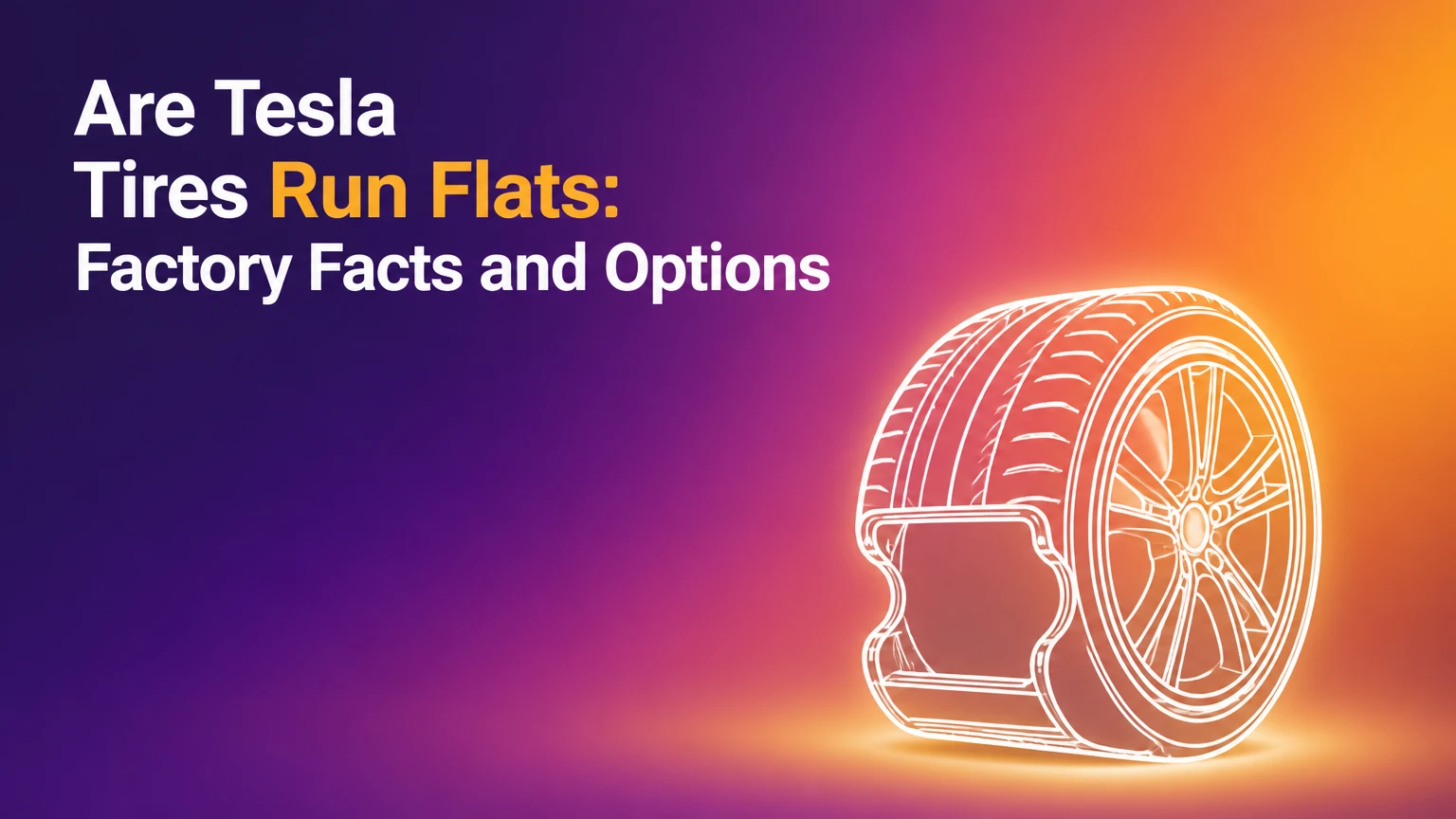
No, Tesla vehicles generally do not leave the factory with run-flat tires. Tesla factory tires are conventional pneumatic tires, although some versions include an acoustic polyurethane foam liner to reduce road noise. The foam does not hold the vehicle up after pressure loss, so a punctured Tesla tire requires air, repair, a replacement wheel, or roadside assistance.
Key Facts at a Glance
- Tesla factory tires are typically standard pneumatic tires, not self-supporting run-flats.
- Acoustic foam inside a Tesla tire reduces cavity noise but provides no zero-pressure driving capability.
- Tesla vehicles commonly omit a spare tire, so drivers need a contingency plan for punctures.
- A true run-flat tire uses reinforced sidewalls or an internal support ring to carry vehicle weight after deflation.
- Many self-supporting run-flats permit about 50 miles at no more than 50 mph, but the tire manufacturer sets the actual limit.
- Tesla-compatible aftermarket run-flats must match the vehicle’s tire size, load index, speed rating, wheel, and TPMS requirements.
Are Tesla Tires Run-Flats From the Factory?
Tesla factory tires are not run-flats, although exact tire equipment varies by model year, wheel package, market, and original-equipment supplier. A Tesla Model 3, Model Y, Model S, or Model X may use an EV-specific tire with low rolling resistance, a high load rating, sound-absorbing foam, or a combination of those features without having reinforced run-flat construction.
Tesla’s official tire guidance tells owners to monitor pressure, inspect damage, and contact Tesla Roadside Assistance when a disabled vehicle cannot be safely driven. That support model differs from a run-flat strategy, where the tire manufacturer provides a defined distance and speed allowance after pressure loss.
The sidewall marking is the practical test. Look for the tire maker’s run-flat designation, such as RFT, SSR, ROF, ZP, or another manufacturer-specific symbol. “Acoustic,” “SoundComfort,” “Elect,” “T0,” “T1,” or foam-lined descriptions do not automatically mean run-flat.
Why Does Tesla Use Foam-Lined Tires?
Tesla and its tire suppliers use acoustic foam to reduce the resonance created inside the tire cavity. Michelin’s Acoustic technology, Pirelli’s PNCS, and Continental’s ContiSilent are examples of noise-reduction systems that attach foam to the inside of the tire.
The foam is lightweight and flexible. It does not create a load-bearing structure when air disappears. A Tesla tire with acoustic foam can therefore look technically different inside while behaving like an ordinary tire after a puncture.
Tesla’s tire choice reflects several EV priorities:
- Low rolling resistance protects driving range.
- High load capacity supports battery weight.
- Foam reduces tire cavity noise in a quiet electric cabin.
- A compliant sidewall improves ride comfort.
- Specialized compounds manage instant electric-motor torque.
These properties can coexist with ordinary pneumatic construction. Foam is a noise-control feature, not a puncture-mobility feature.
How Do Run-Flat Tires Work?
Run-flat tires maintain temporary vehicle mobility after major pressure loss because reinforced sidewalls or a support ring carries the load that air normally supports. A self-supporting run-flat has stiff sidewall inserts, while a support-ring design uses a separate ring mounted inside the wheel.
During normal driving, a run-flat still depends on air pressure for the best ride, handling, cooling, and tread contact. After deflation, the reinforced structure prevents the sidewall from collapsing completely against the wheel rim.
The safety envelope is limited. Michelin states that many run-flat systems allow driving for up to 50 miles at a maximum of 50 mph after a puncture, but the actual limit depends on tire design, vehicle load, ambient temperature, road surface, and the manufacturer’s instructions. The allowance is an emergency mobility provision, not a permanent operating mode.
Why Is TPMS Required With Run-Flats?
A tire-pressure monitoring system is essential because a run-flat can look nearly normal after losing air. The rigid sidewall reduces the visual warning that a conventional tire usually provides.
The driver must respond to the Tesla TPMS warning rather than waiting for a visibly collapsed tire. Continuing beyond the stated speed or distance can overheat the sidewall, damage the wheel, and eliminate the possibility of a safe repair.
A pressure warning also does not prove that the tire is suitable for zero-pressure travel. A nail in the tread, a torn sidewall, wheel damage, or a valve failure may create different risks. Stop as soon as practical, inspect the situation, and follow the tire maker’s instructions.
What Is the Difference Between Tesla Acoustic Tires and Run-Flats?
Tesla acoustic tires prioritize noise reduction and efficiency, while run-flat tires prioritize short-distance mobility after air loss. Neither design automatically replaces the other, and acoustic foam does not make a normal Tesla tire a run-flat.
| Attribute | Tesla acoustic tire | Self-supporting run-flat | Support-ring run-flat |
|---|---|---|---|
| Primary purpose | Reduce cavity noise | Continue limited travel after deflation | Support vehicle after deflation |
| Load support without air | None | Reinforced sidewalls | Internal ring |
| Typical pressure-loss mobility | 0 miles recommended | Up to 50 miles at 50 mph, if specified | Manufacturer-specific |
| Ride character | Usually more compliant | Usually firmer | Often firm and heavy |
| Common consumer availability | Common on Tesla fitments | Available in selected sizes | Rare for passenger Teslas |
| Repair decision | Puncture rules apply | Depends on zero-pressure use | Usually specialist inspection |
| Noise treatment | Acoustic foam may be present | May or may not include foam | Usually not foam-dependent |
A normal Tesla tire can sometimes be temporarily reinflated with a portable compressor after a small tread puncture. That does not make the tire run-flat. It only restores pressure long enough to reach a repair facility if the puncture is repairable and the tire has not been driven while severely underinflated.
Why Does Tesla Omit Run-Flats and Spare Tires?
Tesla omits a conventional spare tire from many vehicles because the company prioritizes weight, cargo space, efficiency, and vehicle packaging. A spare wheel, jack, tools, and mounting structure add mass and consume storage that Tesla can allocate to battery, passenger, or cargo systems.
Run-flats also impose trade-offs that do not suit every Tesla configuration. Their reinforced sidewalls commonly increase stiffness, rolling resistance, tire weight, or replacement cost. EVs make those compromises more noticeable because battery mass already creates high tire loads, while regenerative braking and instant torque accelerate tread wear when alignment or pressure is poor.
The omission creates a real inconvenience. A standard Tesla tire can lose all pressure quickly after a sidewall cut or large puncture, and the driver may have no usable way to move the vehicle. Tesla’s roadside program can provide assistance, but response time varies by location, traffic, weather, hours, and available equipment.
Tesla’s design is therefore an optimization, not a claim that flats are impossible. Owners who travel remote highways should prepare differently from owners who drive five miles to work in a dense metropolitan area.
Can You Install Aftermarket Run-Flats on a Tesla?
You can install aftermarket run-flat tires on some Tesla vehicles, provided the complete tire and wheel specification is compatible. The correct size alone is insufficient because Tesla fitment also depends on load index, speed rating, wheel width, diameter, clearance, TPMS hardware, and axle configuration.
Check these specifications before purchasing:
| Fitment check | What to verify | Typical Tesla consequence |
|---|---|---|
| Tire size | Example: 235/45R18 or 255/45R19 | Incorrect diameter can affect speed and stability calculations |
| Load index | Match or exceed the placard value | EV battery weight demands adequate capacity |
| Speed rating | Match the vehicle requirement | Lower rating may be unsafe or noncompliant |
| XL construction | Often required for EV loads | Standard-load construction may lack capacity |
| Wheel width | Tire maker’s approved range | Incorrect width harms bead seating and handling |
| TPMS | Tesla-compatible sensor frequency and protocol | Warning remains active if sensors do not communicate |
| Tread and axle pairing | Same model and construction per axle | Sidewall differences alter steering response |
| Clearance | Brake, suspension, and body clearance | Reinforced sidewalls can alter fitment behavior |
The tire placard on the driver-side door pillar and the owner’s manual are the starting points. A reputable tire shop should confirm the load index and speed rating from the exact vehicle identification number or factory wheel package, not rely only on a generic online size chart.
An aftermarket run-flat may fit physically but still be a poor engineering match. The added stiffness can change steering effort, ride quality, traction-control behavior, and the balance between front and rear axles.
Can You Mix Run-Flats and Standard Tires?
Do not mix run-flat and conventional tires on the same axle. Mixing them can create different cornering stiffness, braking response, hydroplaning behavior, and steering response between the left and right sides.
Replacing only one tire also requires care. Tire manufacturers commonly recommend replacing run-flats in pairs on an axle when tread depth or construction differs significantly. Tesla all-wheel-drive models add another concern: substantial circumference differences can affect motor control and drivetrain behavior.
A temporary mismatch may be unavoidable after roadside damage, but it should be treated as a short-term repair plan. Ask the tire shop to match the remaining tire’s construction, tread pattern, size, load rating, and speed rating as closely as possible.
How Much Do Tesla Run-Flats Cost?
A Tesla-compatible run-flat typically costs about $200-$450 or more per tire in common 18-inch to 21-inch sizes, while a premium EV touring tire often costs approximately $150-$350 per tire. Installation, balancing, TPMS service, disposal, taxes, and alignment add to the invoice.
| Cost item | Typical range | Main price driver |
|---|---|---|
| Standard EV tire | $150-$350 each | Brand, size, tread warranty |
| Aftermarket run-flat | $200-$450+ each | Run-flat design and wheel diameter |
| Mounting and balancing | $25-$60 per tire | Shop and wheel size |
| TPMS sensor service | $0-$100 per tire | Sensor replacement or relearn |
| Four-wheel alignment | $120-$250 | Regional labor and adjustment needs |
| Roadside tow after flat | $100-$300+ without coverage | Distance, location, and provider |
Run-flats may also cost more over the life of the vehicle. Their stiffer construction can transmit impacts more sharply, and a tire driven at zero pressure may require replacement even when the puncture itself would normally be repairable.
No universal range penalty applies to every run-flat. A typical owner may see a small efficiency loss, but the result depends on tire mass, compound, temperature, pressure, wheel size, alignment, road speed, and driving style. Treat claims such as a guaranteed 3%-7% reduction as estimates, not Tesla specifications.
Do Run-Flats Reduce Tesla Range?
Run-flats can reduce Tesla efficiency when their additional mass and rolling resistance exceed those of the original tire, but the exact range change must be measured on the same vehicle and route. A heavier 21-inch run-flat with a high-performance tread can consume more energy than a lighter 19-inch EV touring tire even when both carry the same nominal size.
The strongest range influences often include:
- Tire pressure relative to the door-placard specification.
- Wheel diameter and tire width.
- Ambient temperature and wind.
- Alignment, especially toe.
- Tread compound and tire wear.
- Highway speed and acceleration behavior.
Energy impact should be evaluated through the Tesla energy display over several comparable drives, not one trip. Record average Wh/mile before and after the tire change, use similar temperatures, and avoid treating a short-term weather change as a tire test.
The trade-off is straightforward: run-flats buy temporary mobility, while low-rolling-resistance EV tires generally favor efficiency and ride compliance. Drivers who rarely leave populated areas may value the latter more.
What Should You Do When a Tesla Tire Goes Flat?
When a Tesla tire loses pressure, slow down, avoid sudden steering, stop at a safe location, and inspect the tire before deciding whether to inflate, repair, or tow it. A conventional tire driven with little or no air can destroy its sidewall and damage the wheel within a short distance.
Use this response sequence:
- Reduce speed smoothly. Avoid hard braking and sharp lane changes.
- Move away from traffic. A shoulder is acceptable only if it is safer than continuing.
- Read the TPMS warning. Confirm which tire lost pressure and whether pressure continues falling.
- Inspect without touching embedded objects. A nail in the tread may be temporarily manageable; a sidewall cut is not.
- Measure pressure with a gauge. Do not rely on appearance, especially with run-flats.
- Inflate only when appropriate. Use the door-placard pressure, not the tire’s maximum molded pressure.
- Use sealant only as directed. Sealant can be temporary and may contaminate the TPMS sensor.
- Call Tesla Roadside Assistance or a towing provider. Request a flatbed or equipment that protects the drive wheels and low-clearance body.
- Have the tire and wheel inspected. Check the inner sidewall, bead, rim flange, and alignment.
Tesla’s support guidance is more relevant than generic roadside advice because towing requirements vary among Model 3, Model Y, Model S, and Model X configurations. Do not allow a tow operator to drag a disabled all-wheel-drive Tesla with wheels rotating on the ground unless Tesla specifically approves that method.
Can a Tesla Tire Be Plugged?
A tread puncture within the repairable central area may be repairable with a professional combination plug-patch, but a puncture near the shoulder, a sidewall injury, a split, or damage from underinflation generally requires replacement. The Tire Industry Association and tire manufacturers distinguish temporary external plugs from permanent internal repairs.
A plug kit is a contingency tool, not a substitute for inspection. A driver should not plug a tire without first checking whether the tire has been driven underinflated, because internal structural damage may be invisible from outside.
Sealant and compressor kits also have limits. They cannot repair a torn sidewall, restore a damaged bead, straighten a bent wheel, or make a tire safe after prolonged zero-pressure driving.
Can a Driven-Flat Run-Flat Tire Be Repaired?
A run-flat driven at zero or very low pressure may need replacement even when no external damage is visible. Internal sidewall flexing can generate heat and structural damage that cannot be reliably judged from the outside.
Manufacturers differ in their inspection and repair policies. Some permit repair when the tire never operated below a specified pressure or distance, while others recommend replacement after any zero-pressure event. The tire maker’s warranty and service bulletin control the decision.
Ask the technician to document:
- The lowest recorded pressure.
- Distance and speed driven after the warning.
- Puncture location and size.
- Inner-liner, bead, and sidewall condition.
- Wheel runout and impact damage.
- Remaining tread depth and axle matching.
Replacing a driven-flat tire without checking the wheel is another common failure. A pothole can bend the rim, damage the suspension, or disturb alignment while the tire is losing pressure.
Which Tesla Owners Should Choose Run-Flats?
Run-flats are most defensible for Tesla owners who regularly travel remote roads, carry children or passengers where roadside exposure is unacceptable, or drive in regions where a tow may take several hours. They are less attractive for drivers who prioritize quietness, efficiency, soft ride quality, and low replacement cost.
| Driver profile | Better default | Reason | Carry or verify |
|---|---|---|---|
| Urban commuter within 25 miles of service | Standard EV tire | Lower cost and better comfort | Inflator, gauge, roadside coverage |
| Long-distance highway traveler | Run-flat, if correctly approved | Temporary mobility after puncture | 50 mph and distance limits |
| Remote-area traveler | Run-flat plus recovery plan | Cellular and service gaps remain risks | Satellite or emergency communication |
| Performance-focused Tesla driver | OEM-approved performance tire | Predictable handling matters | Pressure checks and alignment |
| Winter-region owner | Dedicated winter tire | Cold-weather grip exceeds run-flat priority | Seasonal storage and tread checks |
| Budget-conscious owner | Standard repairable tire | Lower purchase and replacement cost | Professional plug-patch service |
Run-flats do not eliminate roadside risk. A sidewall cut, damaged wheel, overheating tire, or loss beyond the rated distance can still immobilize the vehicle.
What Is the Best Alternative to a Tesla Spare Tire?
For most Tesla owners, the most useful alternative is a compact emergency kit combined with a reliable roadside plan. A suitable kit includes a 12-volt compressor rated for passenger-vehicle tires, a digital pressure gauge, gloves, a flashlight, a tire plug kit, and sealant approved for the tire and TPMS system.
A compressor helps only with a slow puncture or low pressure. It cannot safely solve a large tread opening or sidewall failure. A plug kit can shorten a delay when the puncture is repairable, but professional internal inspection remains necessary.
A compact spare wheel can be practical for some Tesla models, but fitment must be verified for brake clearance, rolling diameter, load capacity, and storage. A generic spare that fits the bolt pattern may still interfere with the brake caliper or create an unacceptable axle-speed difference.
Common Mistakes Tesla Owners Make
Mistaking Acoustic Foam for Run-Flat Support
Acoustic foam reduces resonance and does not support vehicle weight. If a foam-lined tire loses pressure, treat it as a conventional pneumatic tire unless the sidewall separately carries a recognized run-flat designation.
Using the Maximum Sidewall Pressure
The pressure molded on the sidewall is usually the tire’s maximum permissible pressure, not the Tesla’s cold inflation target. Use the driver-door placard and check pressure when the tires are cold.
Driving to a Shop After a Fast Pressure Loss
A tire that loses pressure quickly can suffer internal damage before the vehicle travels several miles. Stop safely and arrange assistance instead of assuming a nearby tire shop is close enough.
Replacing Only the Damaged Tire Without Measuring Tread
A new tire can have a materially different circumference from a worn tire. On an all-wheel-drive Tesla, ask the shop to compare tread depth and follow the vehicle and tire manufacturer’s replacement guidance.
Assuming Run-Flats Protect Wheels
Reinforced sidewalls reduce collapse, but they do not guarantee protection from potholes, curb impacts, bent rims, or suspension damage. The wheel still absorbs road impact after pressure loss.
Buying by Size Alone
Two tires marked 255/45R19 may differ in load index, speed rating, construction, rim approval, noise design, and EV suitability. Compare the complete sidewall specification and manufacturer fitment statement.
The Bottom Line
Are Tesla tires run flats? Factory Tesla tires are generally not run-flats, even when they contain acoustic foam. Tesla uses conventional EV tires to balance range, load capacity, noise, ride quality, and cost, while relying on roadside assistance and owner preparation instead of a spare or zero-pressure tire system.
Aftermarket run-flats can be appropriate for a Tesla that frequently travels remote highways, but they require exact fitment and impose possible penalties in price, comfort, efficiency, and replacement flexibility. For city drivers, a correctly sized EV tire, portable compressor, pressure gauge, repair plan, and suitable roadside coverage usually provide the better overall balance.
Frequently Asked Questions
Do all Tesla models use the same tire pressure?
No. Tesla tire pressure varies by model, wheel size, tire load rating, market, and production configuration. Use the driver-door placard as the authoritative cold-pressure reference, because the number molded on the tire sidewall is not the vehicle’s recommended setting.
Does Tesla Roadside Assistance repair flat tires?
Tesla Roadside Assistance may provide services such as transport, towing, or a loaner wheel depending on location, coverage, and availability. Service terms can change, so check the Tesla app and current regional policy. A severe sidewall or wheel failure normally requires a tire shop rather than roadside patching.
Are EV tires different from ordinary car tires?
EV tires often use higher load ratings, stronger construction, low-rolling-resistance compounds, optimized tread patterns, and noise-control features. An ordinary tire can fit dimensionally yet fail to meet the Tesla’s required load or speed rating, so replacement should follow the placard and manufacturer fitment data.
Can I use winter run-flats on a Tesla?
A winter run-flat is suitable only when the exact tire size, load index, speed rating, wheel, and vehicle application are approved. Winter grip, temperature range, and tread compound matter more than run-flat capability in snow and ice, so compare tested winter performance rather than choosing solely for puncture mobility.
How often should Tesla tire pressure be checked?
Check Tesla tire pressure at least monthly and before long trips, with the tires cold. Inspect pressure after major temperature changes, because cold weather lowers measured pressure. Check tread wear, shoulder damage, embedded objects, and valve leakage whenever the wheels are inspected or rotated.
Do Tesla tires need rotation?
Tesla tire rotation intervals depend on tread pattern, wear difference, tire type, and the vehicle’s maintenance guidance. Many owners inspect every 6,250 miles or sooner, but staggered, directional, or different-size setups may limit rotation. Uneven inner-edge wear requires alignment inspection, not rotation alone.