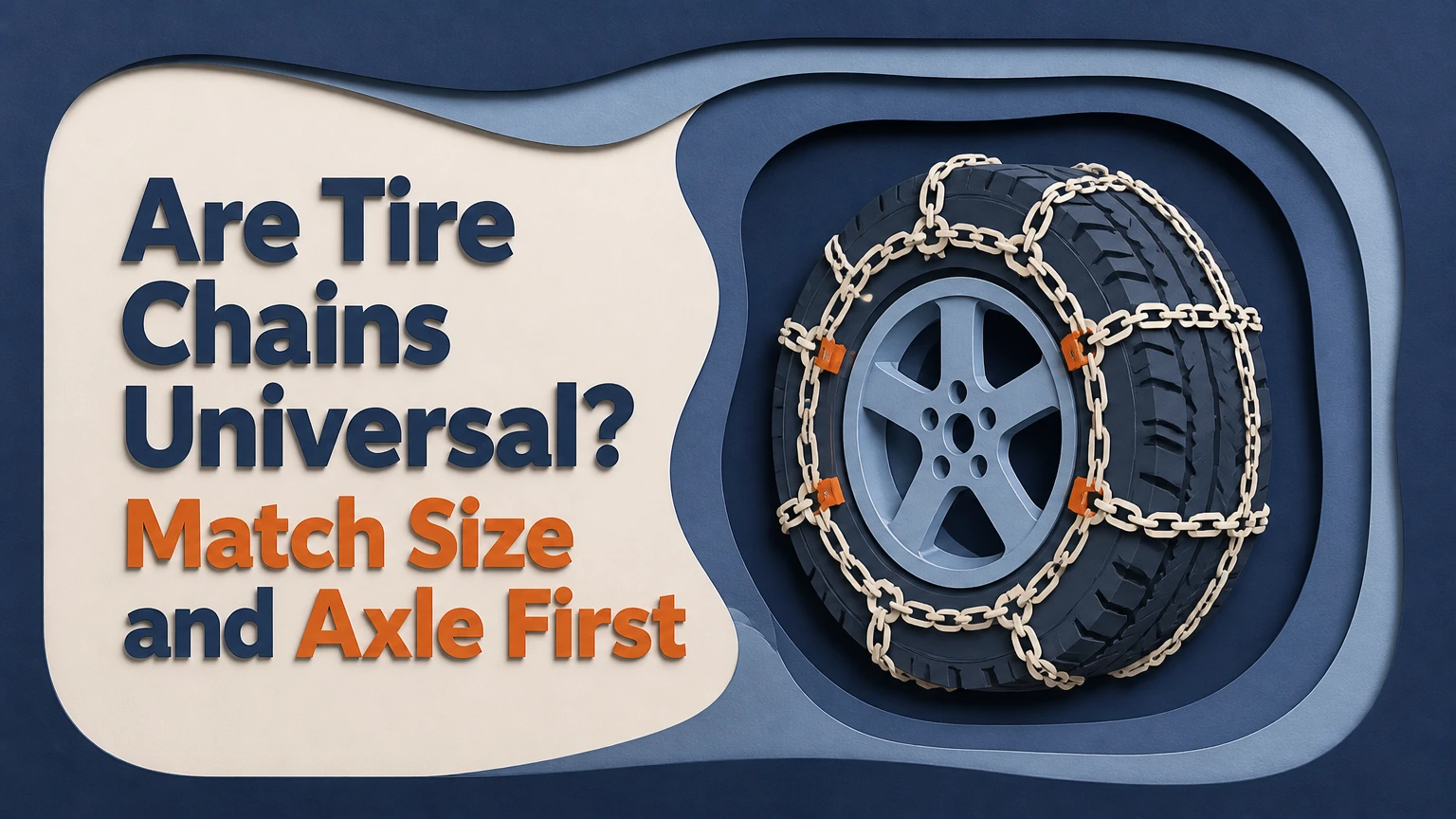
No, tire chains are not universal. Each tire chain set must match the tire’s complete size, the vehicle’s available wheel-well clearance, and the axle approved by the vehicle manufacturer. A chain that fits the tire diameter but not its width, sidewall profile, or clearance can damage suspension parts, brake lines, fenders, wheel sensors, or the tire itself.
Key Facts at a Glance
- Tire chains are sized for a defined tire-size range, not for every tire or vehicle.
- The code
225/65R17identifies tire width, aspect ratio, construction, and wheel diameter. - A vehicle owner’s manual determines whether chains are permitted, which axle receives them, and whether low-profile devices are required.
- Front-wheel-drive vehicles normally use chains on the front axle; rear-wheel-drive vehicles normally use them on the rear axle.
- All-wheel-drive and four-wheel-drive vehicles may require chains on one axle or all four wheels, depending on the manufacturer.
- Textile snow socks can solve some clearance problems, but chain-control laws may not treat them as equivalent to metal chains.
Why Are Tire Chains Not Universal?
Tire chains are not universal because tire dimensions and wheel-well geometry vary independently. Two tires can both be called 17-inch tires while having different widths and sidewall heights, and the same tire size can fit one vehicle safely but create interference on another vehicle with less suspension clearance.
A tire chain must wrap around the tread with enough adjustment range to remain centered and tight. The chain must also avoid contact with the inner sidewall, strut, brake hose, ABS wiring, suspension arm, fender liner, and bodywork while the wheel turns and steers. Correct tread fit alone does not prove vehicle compatibility.
The practical rule is simple: match the exact tire size, then verify the vehicle’s chain clearance and axle instructions. Product packaging, the chain manufacturer’s fitment chart, and the owner’s manual must agree.
What Does a Tire Size Such as 225/65R17 Mean?
The tire code 225/65R17 means the tire is 225 millimeters wide, has a sidewall height equal to 65% of its width, uses radial construction, and fits a 17-inch wheel. Chain fitment depends on all of those dimensions because each changes the chain’s required circumference or lateral coverage.
| Tire-size element | Example value | What it changes for chain fitment |
|---|---|---|
| Section width | 225 mm | Chain width across the tread and side clearance |
| Aspect ratio | 65 | Sidewall height and total tire diameter |
| Construction | R, radial | Required chain design and manufacturer listing |
| Wheel diameter | 17 in | Inner circumference and mounting range |
| Complete size | 225/65R17 | The size to enter in a fitment chart |
A replacement tire marked 235/60R17 is not interchangeable for chain purposes with 225/65R17, even though both fit a 17-inch wheel. The replacement is wider, has a different sidewall height, and may need a different chain size or a low-clearance design.
How Do Tire Chains Create Traction?
Tire chains create traction by concentrating vehicle load on steel links, cables, or composite elements that penetrate snow and roughen the contact surface. The chain interrupts the smooth rubber-to-ice interface, allowing the driven tire to transmit more acceleration and braking force when ordinary tread cannot.
As the wheel rotates, chain cross-links contact packed snow and ice in repeated intervals. Diamond-pattern chains provide more continuous contact than ladder-pattern chains, while V-bar links create aggressive edges for severe conditions. Cable chains generally occupy less space but provide less bite and durability than heavy steel links.
Chains do not make a vehicle immune to sliding. Steering, braking distance, downhill control, road temperature, tire condition, and vehicle weight still matter. Drivers should also avoid sudden throttle inputs because wheelspin can break links or pull a loose chain into the wheel well.
What Do Link, Cable, and Textile Chains Do Differently?
Link chains provide the strongest mechanical grip and generally tolerate severe snow better than cables or textile products. Cable chains use steel cables and rollers in a lower-profile arrangement, while textile snow socks use fabric fibers rather than metal links.
| Traction device | Typical construction | Typical best use | Main limitation |
|---|---|---|---|
| Diamond link chain | Hardened steel cross-links | Packed snow, ice, mountain roads | Needs verified clearance; rougher ride |
| Ladder link chain | Steel cross-links across tread | Straight-line acceleration, trucks | More vibration and less lateral continuity |
| Cable chain | Steel cables with rollers | Passenger cars with limited clearance | Lower durability and ice bite |
| Textile snow sock | High-friction woven fabric | Temporary light-to-moderate snow | Rapid wear on bare pavement |
| External spider system | Outside-mounted arms and hub | Very limited wheel-well access | High cost and vehicle-specific mounting |
“Snow socks” are not necessarily chains in the legal or technical sense. The Washington State Department of Transportation, California Department of Transportation, and local authorities can define permitted traction devices differently, so the road agency’s current rules matter more than a retailer’s product label.
Which Vehicle and Axle Should Receive Chains?
The approved axle depends on the drivetrain and the vehicle manufacturer’s instructions. FWD vehicles usually receive chains on the front wheels, RWD vehicles usually receive them on the rear wheels, and AWD or 4WD vehicles require the specific arrangement stated in the owner’s manual.
| Drivetrain | Usual traction axle | Important qualification |
|---|---|---|
| Front-wheel drive | Front axle | Confirm front wheel-well clearance while steering |
| Rear-wheel drive | Rear axle | Rear chains do not improve front-axle steering grip |
| Part-time 4WD | Usually both drive axles when required | Follow transfer-case and chain instructions |
| Full-time AWD | One axle or all four wheels | Manufacturer may require matching sets |
| AWD with limited clearance | Approved low-profile device | Some models prohibit conventional chains entirely |
Putting chains only on the front of a rear-wheel-drive vehicle can leave the driven rear tires without traction. Putting chains on only one axle of an AWD vehicle can also conflict with the manufacturer’s drivetrain requirements and create speed or handling restrictions.
Some vehicles prohibit chains because the gap between the tire and suspension is too small. Others permit only SAE Class S or equivalent low-clearance devices. Never infer permission from the vehicle’s ground clearance, SUV body style, or four-wheel-drive badge.
Does SAE Class S Mean Every Class S Chain Fits?
No. SAE Class S identifies a low-clearance chain category; it does not make the chain universal. The chain still needs a tire-size listing, and the vehicle manufacturer must permit that type for the specific wheel and tire combination.
Clearance measurements are easy to misunderstand because standards describe more than a single gap above the tread. The relevant spaces include radial clearance over the tread, lateral clearance beside the sidewall, and movement clearance during steering and suspension travel. The owner’s manual may impose a stricter requirement than the generic classification.
A practitioner’s rule is to treat Class S as a screening requirement, not a final approval. If the manual says “chains not permitted,” a Class S label does not override it.
How Should You Choose Between Chains and Snow Socks?
Choose steel chains for the highest traction and repeated travel on packed snow or ice, cable chains for a lower-profile metal option, and textile snow socks when the vehicle permits them and the expected conditions are moderate. None is automatically best for every vehicle or road authority.
| Decision factor | Link chains | Cable chains | Snow socks | External systems |
|---|---|---|---|---|
| Typical purchase price | $50-$200 | $50-$120 | $80-$150 | $300-$600+ |
| Typical installation time | 10-20 minutes initially | 10-20 minutes initially | 3-10 minutes | 2-5 minutes |
| Bare-asphalt tolerance | Very low | Very low | Extremely low | Low |
| Ice and packed-snow grip | Highest among listed types | Moderate to high | Moderate | Moderate to high |
| Wheel-well space required | Moderate to high | Low | Very low | Very low |
| Typical repairability | Individual links often replaceable | Limited | Usually not repairable | Component-specific |
| Legal acceptance | Commonly recognized | Commonly recognized | Varies by jurisdiction | Varies by jurisdiction |
Typical prices vary by tire size, steel grade, automatic tensioning, and retailer. A set for a compact passenger car may cost $50-$120, while heavy-duty truck chains or premium external systems can exceed $300.
Snow socks are honest solutions for light, occasional use, but they are not a substitute for steel chains in every mountain chain-control situation. They also need removal as soon as the route becomes mostly clear because bare asphalt can destroy the fabric within a short distance.
Are Winter Tires Better Than Tire Chains?
Winter tires are better for routine cold-weather driving because they remain flexible below freezing and provide predictable traction on cold pavement, snow, and wet roads. Tire chains provide a much larger temporary traction increase on severe packed snow and ice but are slower, noisier, and usually restricted to low speeds.
Winter tires do not automatically satisfy chain-control laws. A road authority may require chains or approved traction devices even when a vehicle has winter tires, although some jurisdictions exempt certain AWD vehicles or vehicles with approved snow tires under specified conditions.
The strongest setup for severe mountain travel is often winter tires plus a correctly fitted chain set carried for mandatory controls. Chains remain emergency equipment, not a replacement for appropriate tires or careful driving.
How Do You Install Tire Chains Correctly?
Install tire chains on the manufacturer-approved axle before the road becomes steep or fully covered, and expect a first-time installation to take about 15-20 minutes per axle. The most important success factor is a centered, tight chain that clears every component through steering and suspension movement.
Before Installation
Prepare the following:
- The exact chain set listed for the tire size
- Two pairs of gloves and a waterproof ground mat
- A flashlight or headlamp for roadside work
- The chain manufacturer’s tensioners, if required
- The vehicle owner’s manual and roadside warning equipment
Practice at home on dry ground before a trip. Confirm that the chain can be fitted without jacking the vehicle unless the product instructions specifically require another method.
Step 1: Lay Out and Inspect the Chains
Place each chain flat beside the approved tire and remove twists, crossed cables, damaged links, or missing tensioners. The locking mechanism should face outward or follow the product instructions.
You will know the chain is ready when the cross-links lie evenly across the tread and the inner connector can reach behind the tire without force. A broken link or frayed cable is a replacement issue, not a roadside adjustment.
Step 2: Center the Chain Over the Tread
Drape the chain over the top half of the tire, or connect the front and rear sections according to the design. Keep the cross-chain pattern centered across the tread rather than favoring the inner or outer shoulder.
A centered pattern prevents one side from carrying excessive load. Misalignment can create chain slap, uneven wear, and contact with suspension components.
Step 3: Connect the Inner and Outer Fasteners
Fasten the inner connector first, then connect the outer hook, cam, or locking ring. Keep your fingers clear of spring-loaded tensioners and check that no hook points toward the tire sidewall.
The chain should be snug but still capable of moving with the tire. If the inner connector cannot close without excessive force, the product may be the wrong size or incorrectly routed.
Step 4: Tension the Chain
Attach the supplied tensioner or tighten the built-in cam system evenly. Do not substitute improvised rope, wire, or non-rated elastic because those materials can enter the wheel well or fail under rotation.
A correct installation leaves no large loop hanging from the outside face. Automatic tensioners reduce adjustment work, but they do not eliminate the need for a clearance inspection.
Step 5: Drive About 100 Feet and Recheck
Move forward approximately 100 feet, stop in a safe location, and inspect both chains. Retighten any slack because the chain settles into the tread after the first rotation cycle.
The chain is ready when it remains centered, the tension is even, and no component touches the body, brake hose, suspension, or wheel sensor while the steering is turned. Remove it immediately if you hear repeated striking.
What Speed Is Safe With Tire Chains?
Follow the chain manufacturer’s limit and never exceed the lower limit shown on the packaging, vehicle manual, or road-control notice. Many passenger-car chain products specify a maximum near 30 mph, while some specify a lower speed.
Chain speed limits are not performance targets. Reduce speed further for curves, downhill travel, poor visibility, or uneven snow because chains improve available grip without changing vehicle mass or stopping physics.
What Problems Do Incorrect Tire Chains Cause?
Incorrect or loose tire chains can damage brake hoses, ABS wiring, wheel-well liners, struts, suspension arms, fenders, alloy wheels, and the tire sidewall. Chain damage can occur within seconds if a loose section repeatedly strikes a component at road speed.
| Symptom | Likely cause | Immediate response |
|---|---|---|
| Repeated metallic slapping | Loose tensioner or oversized chain | Stop immediately and inspect |
| One side has heavy wear | Chain is off-center | Refit and center the pattern |
| Inner cable unhooks | Incorrect routing or inadequate tension | Stop, reconnect, and retension |
| Steering feels restricted | Insufficient lateral clearance | Remove and use an approved low-profile device |
| Broken cross-link | Wheelspin, dry pavement, or damaged chain | Stop before the broken part causes impact |
| Vibration begins suddenly | Chain has shifted or failed | Stop in a safe area and inspect both sides |
Do not continue driving to “see whether the noise goes away.” A chain that touches the inner fender during a slow inspection can strike much harder when the suspension compresses or the steering reaches full lock.
Can You Drive on Bare Pavement With Chains?
You should remove tire chains when the route is clear of snow and ice unless a specific authority or manufacturer instruction says otherwise. Bare pavement rapidly wears steel links, increases vibration, reduces steering smoothness, and can damage tires and road surfaces.
If a short cleared section cannot be avoided, drive slowly and smoothly without wheelspin, then remove the chains at the first safe location. Never use dry pavement as a testing surface after installation.
Can Tire Chains Damage TPMS Sensors?
Tire chains can damage tire-pressure monitoring system sensors indirectly when a loose or incorrectly fitted chain strikes the inner wheel area. The risk depends on the sensor design, wheel construction, available clearance, and chain routing.
A TPMS warning after installation does not prove that the chain caused the failure, because cold temperatures also lower tire pressure. Inspect for impact marks, confirm pressure with a gauge, and follow the vehicle manufacturer’s reset procedure.
How Much Do Tire Chains Cost and How Long Do They Last?
Typical tire-chain prices range from $50-$120 for cable chains, $50-$200 for passenger-vehicle steel chains, $80-$150 for textile socks, and $300-$600 or more for premium external systems. Steel chains can last for multiple winters on snow-covered roads but may wear out rapidly after extended bare-asphalt driving.
Lifespan depends more on surface and driving behavior than on calendar age. Wheelspin, high speed, dry pavement, inadequate tension, and undersized tires can destroy a chain set during one trip.
| Use condition | Typical service expectation | Inspection requirement |
|---|---|---|
| Packed snow and ice only | Multiple seasons with proper care | Check links after every trip |
| Intermittent bare pavement | Shortened life, sometimes one season | Inspect for flattened or missing links |
| Long dry-asphalt distance | Rapid wear within tens of miles | Remove at the first safe opportunity |
| Frequent commercial truck use | Heavy-duty replacement cycle | Inspect before every route |
| Textile sock on bare asphalt | Very short service life | Remove immediately |
Store clean, dry steel chains after use. Rinse road salt away, dry the links, and inspect the storage bag for moisture before putting the set in the vehicle.
What Should You Check Before Buying?
Check the tire sidewall, owner’s manual, chain manufacturer’s fitment chart, clearance category, axle requirement, and local legal rules before purchasing. Buying from the tire size alone is unsafe because the vehicle can prohibit chains even when the product listing claims a dimensional fit.
Use this checklist:
- Record the complete sidewall size, such as
225/65R17. - Confirm the current tire size matches the vehicle placard.
- Read the owner’s manual for chain permission and axle placement.
- Identify whether low-clearance or Class S equipment is required.
- Confirm the product lists the exact tire size, not merely a similar size.
- Check whether tensioners are included or required separately.
- Verify the chain-control authority accepts the device.
- Practice installation before winter travel.
- Carry gloves, a mat, a light, and a safe roadside warning setup.
- Recheck fit after the first 100 feet.
A tire retailer can identify a dimensional match, but only the vehicle manufacturer can establish whether the chain clears that vehicle’s suspension and bodywork. When the manual and retailer disagree, follow the manual or obtain written guidance from the manufacturer.
FAQ
Can I use the same tire chains on different cars?
Only when both vehicles use a tire size listed for the chains and both manufacturers permit that chain type. The same 225/65R17 tire size does not guarantee equal wheel-well clearance, steering clearance, or approved axle placement between two vehicles.
Do tire chains fit both front and rear tires?
A chain set may physically fit either axle, but the vehicle may approve only one axle. FWD vehicles normally use the front axle, RWD vehicles the rear axle, and AWD vehicles require the manufacturer’s stated configuration, which can include all four tires.
Are tire cables the same as snow chains?
Tire cables are a lower-profile form of traction device made from steel cables and rollers, while conventional snow chains use larger steel links. Cables can suit vehicles with restricted clearance, but they generally provide less severe-snow durability and must still match the exact tire size.
Can I use chains on low-profile tires?
You can use chains on low-profile tires only when the vehicle manual permits them and the chain manufacturer lists the exact tire size. Low-profile tires often leave less sidewall and suspension clearance, so a Class S or external system may be required, or chains may be prohibited.
Do all-season tires eliminate the need for chains?
All-season tires do not eliminate the need for chains. Their rubber compound and tread may perform adequately in mild conditions, but chain-control rules can still require traction devices, and severe packed snow may exceed the tire’s available grip.
Should I buy chains before a mountain trip?
Buy and test the approved chains before the trip rather than waiting for a roadside checkpoint. Mountain roads may have limited stopping areas, cold weather, wet snow, and long queues, so a practiced installation is safer than opening an unfamiliar package in traffic.
The Bottom Line
Are tire chains universal? No. Tire chains are vehicle-and-tire-specific safety equipment that must match the complete tire size, available clearance, approved axle, chain-control rules, and manufacturer instructions. Confirm those five conditions before buying, practice fitting the set, retighten after roughly 100 feet, and remove the chains when the road becomes clear.