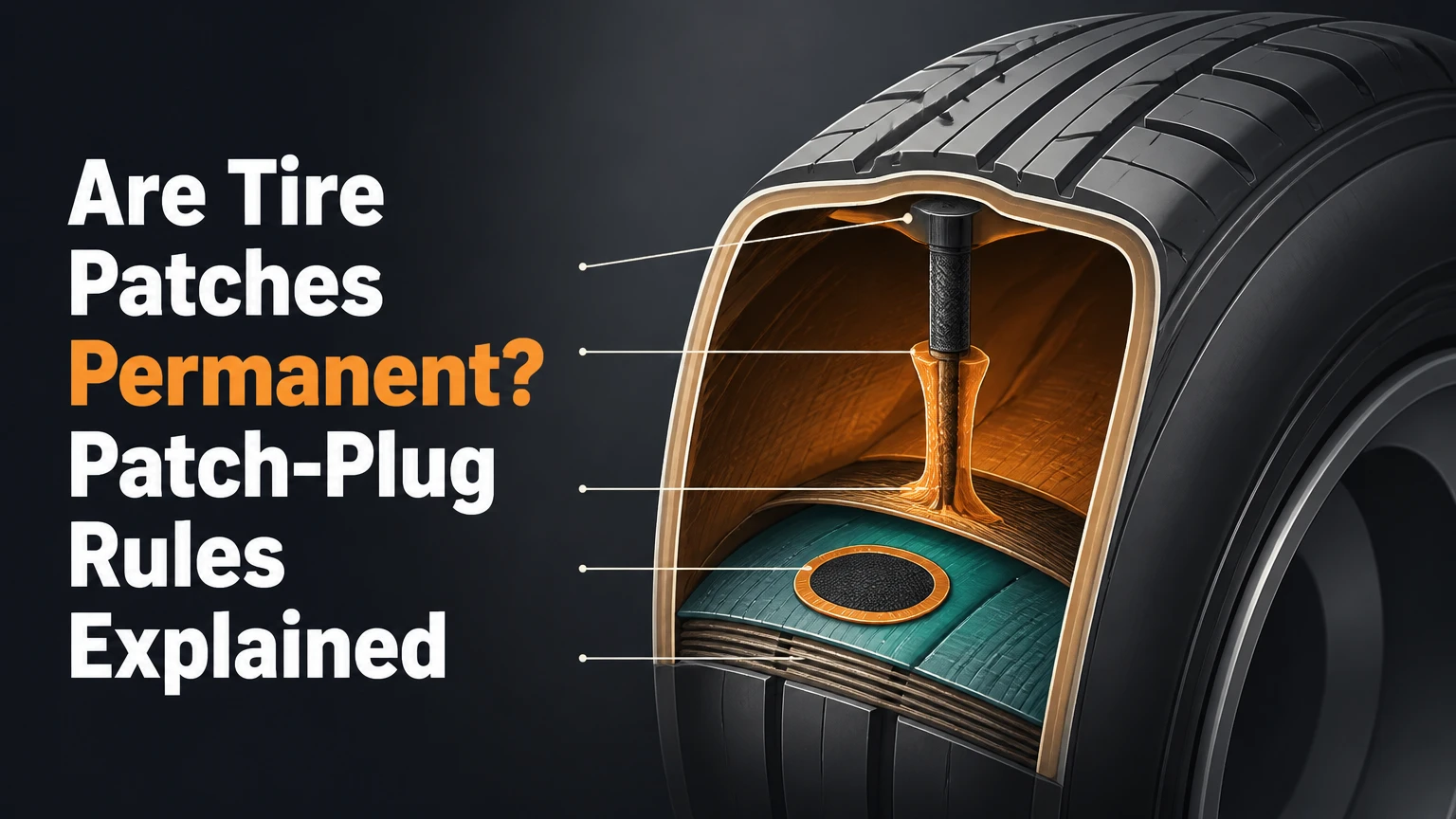
A properly installed internal tire repair can remain serviceable for the rest of a tire’s usable life, but a flat patch alone is not the standard permanent repair for most modern radial passenger tires. A permanent repair normally combines an internal patch with a plug or stem that fills the puncture channel, provided the damage, tire condition, and manufacturer rules allow repair.
Key Facts at a Glance
- A professional permanent tire repair requires the tire to be removed from the wheel for an internal inspection.
- Most passenger-tire puncture repairs use a combination patch-plug, not a flat patch alone.
- A common maximum puncture diameter is 1/4 inch, or approximately 6 mm, in the repairable tread area.
- Sidewall and shoulder punctures generally require tire replacement because those areas flex heavily.
- An external rope plug is an emergency measure or temporary field repair, not the preferred final repair under USTMA guidance.
- A repair does not restore a tire that was driven underinflated, has exposed cords, contains a bulge, or has age-related deterioration.
Are Tire Patches Permanent?
A tire patch is permanent only when “patch” refers to a correctly installed internal repair that meets the tire manufacturer’s and applicable industry procedures. A standalone flat patch may seal the inner liner, but it does not necessarily close the full puncture channel through the tread and belt package.
The U.S. Tire Manufacturers Association, or USTMA, and the Tire Industry Association, or TIA, describe a proper puncture repair as an internal repair that addresses both the injury channel and the inner liner. USTMA’s published repair guidance states, “The repair must be done from the inside of the tire,” a requirement that rules out treating an outside-in rope plug as the finished repair.
“Permanent” means the repair is intended to last through the tire’s remaining usable service life. It does not mean the tire becomes new, nor does it override tread wear, tire age, heat damage, improper inflation, or a manufacturer’s prohibition on repair. A repaired tire still needs normal pressure checks and inspection.
What does a permanent repair actually restore?
A permanent tire repair restores two functions:
- Air retention: The patch bonds to the inner liner and closes the area around the injury.
- Puncture-channel protection: The plug or stem fills the path through the tread rubber and belt area, limiting water, oxygen, and contaminants from reaching internal components.
The distinction matters because a nail can create a channel much longer than the visible hole. A flat patch placed inside may stop air escaping while leaving the channel open to moisture. A combination repair addresses both surfaces.
How Does a Professional Tire Repair Work?
A professional tire repair usually takes 30-60 minutes, including removal, inspection, repair, leak testing, remounting, and balancing. The outcome depends more on the tire’s internal condition and correct preparation than on the patch’s adhesive strength alone.
Step 1: Remove and inspect the tire
The technician removes the tire from the wheel and examines the inner liner, tread, sidewall, bead, and belt area. The inspection looks for abrasion, rubber dust, heat discoloration, creases, exposed cords, and other evidence that the tire was driven while significantly underinflated.
A tire can look acceptable externally after a flat drive and still contain hidden casing damage. If the inner liner shows a circumferential scuff or severe abrasion, repair is generally unsafe.
Step 2: Identify and prepare the injury
The technician follows the puncture channel to determine its angle and extent. Industry procedures may use a probe and a specialized carbide cutter to clean damaged rubber and standardize the injury without unnecessarily enlarging it.
The repair must follow the original channel. Inserting a stem at the wrong angle can distort the repair and leave part of the puncture unsealed.
Step 3: Clean and buff the inner liner
The technician removes contamination and lightly buffs the designated patch area. Buffing creates a clean, textured rubber surface for the repair cement and patch to bond with.
Over-buffing is a serious error. Grinding into the inner liner or ply material can weaken the tire even when the finished patch looks smooth.
Step 4: Apply cement and install the repair
The technician applies the specified vulcanizing cement, allows the solvent to evaporate according to the product instructions, and installs the combination patch-plug from inside the tire. The stem passes through the puncture while the patch sits against the inner liner.
The repair is then stitched from the center outward. Stitching removes air pockets and improves contact between the patch and prepared rubber.
Step 5: Seal, test, balance, and reinstall
The technician seals the patch perimeter where required, trims the stem flush with the tread surface, and remounts the tire. A soap solution or water-bath inspection checks for bubbles, while a wheel balancer verifies that the repair and remounting have not introduced an imbalance.
A pressure check after installation is essential. The tire should also be checked again if the vehicle develops a pressure warning or loses more than the normal small amount of pressure between routine checks.
Which Tire Repair Method Is Safest?
For an eligible puncture in the central tread, a professional combination patch-plug is generally the safest long-term option. An external plug can restore mobility, while liquid sealant can stop a small leak temporarily, but neither substitutes for an internal inspection.
| Repair method | Typical use | Typical time | Typical U.S. cost | Long-term status |
|---|---|---|---|---|
| Internal combination patch-plug | Passenger and light-truck tread puncture | 30-60 minutes | $20-$50 | Intended permanent repair |
| Standalone internal patch | Tubes or specified specialty tires | 20-45 minutes | $15-$40 | Manufacturer-dependent |
| External rope plug | Roadside or off-road emergency | 5-15 minutes | $5-$25 | Temporary or limited-use |
| Aerosol or liquid sealant | Small emergency leak | 5-10 minutes | $8-$30 | Temporary emergency measure |
| Tire replacement | Sidewall, shoulder, large, or structural damage | 30-90 minutes | $100-$400-plus | New tire solution |
Prices are typical consumer ranges in the United States, not guaranteed quotes. Mounting, balancing, disposal fees, TPMS servicing, specialty tires, and regional labor rates can change the final amount.
Are roadside rope plugs permanent?
Roadside rope plugs are not the preferred permanent repair for a passenger tire under USTMA and TIA procedures. A rope plug enters from the outside, so the technician cannot inspect the inner liner or determine whether the tire was damaged while flat.
A rope plug can be appropriate as a temporary recovery measure when a driver is stranded or an off-road vehicle needs to leave a remote trail. Drive conservatively, restore the correct pressure, and have the tire removed and inspected as soon as practical. A plug that has held air for months is not proof that the internal casing is undamaged.
Is liquid tire sealant a permanent fix?
Liquid tire sealant is an emergency product, not a permanent structural repair. Sealant can temporarily close a small puncture, but it does not rebuild damaged tread rubber or repair belts, cords, or sidewalls.
Sealant can also create service problems. Some products interfere with TPMS sensors, produce an internal liquid mess, or violate tire and wheel warranty procedures. Tell the tire shop that sealant was used before the tire is removed.
What Punctures Can Be Repaired?
A puncture is usually repairable only when it is small, located in the central tread, and found before the tire suffers internal damage. A common industry limit is 1/4 inch, or 6 mm, but the tire manufacturer’s instructions control when they are more restrictive.
| Inspection factor | Common repair threshold | Replacement trigger | Why it matters |
|---|---|---|---|
| Puncture diameter | Up to 1/4 inch, 6 mm | Larger than 1/4 inch or manufacturer limit | Larger injuries can damage belts and resist sealing |
| Location | Central tread between shoulder grooves | Shoulder or sidewall | Flexing makes repairs unreliable |
| Tread depth | Above 2/32 inch in many U.S. jurisdictions | At or below wear bars, or manufacturer limit | Worn tread has little remaining service life |
| Number of repairs | Manufacturer-specific | Overlapping or excessive repairs | Repairs can weaken adjacent casing areas |
| Injury direction | Original channel identified | Unknown, elongated, or branching channel | Incorrect alignment can leave leaks |
| Internal condition | No heat or run-flat damage | Scuffing, cords, liner separation, or creases | Hidden structural damage can cause failure |
The 2/32-inch figure needs context. It is commonly used as a minimum legal tread-depth threshold for passenger tires in the United States, but it is not a universal rule that makes every tire above 2/32 inch repairable. Tire age, damage history, speed rating, load rating, and manufacturer policy also matter.
There is no universal industry rule allowing exactly two or three repairs with 90-degree spacing on every tire. Some manufacturers specify repair limits or spacing requirements, while others direct the dealer to reject a tire after particular combinations of damage. A technician should inspect the actual tire and follow its published service guidance.
Can Sidewall or Shoulder Damage Be Repaired?
Sidewall and shoulder punctures generally cannot be permanently repaired on passenger tires. The sidewall flexes repeatedly during every rotation, and a rigid repair in that zone can fail as the casing bends, heats, and deflects.
The shoulder is the transition between tread and sidewall. Although it may look like tread from a distance, the shoulder experiences substantially more flex than the central tread. A puncture near the outermost groove may therefore be outside the permitted repair zone even if the hole is small.
Replace the tire when you find any of these signs:
- A puncture or cut on the sidewall or shoulder.
- A bulge, blister, egg-shaped deformation, or localized knot.
- Exposed fabric, steel cords, or separated rubber.
- A cut longer than the tire maker permits.
- Air loss after impact with a pothole or curb.
- A tire that was driven while flat or severely underinflated.
Do not use a patch to repair a sidewall bulge. A bulge indicates casing separation, not a simple air leak.
How Much Does a Permanent Tire Repair Cost?
A professional internal patch-plug repair typically costs $20-$50 and takes 30-60 minutes in the United States. Many tire retailers repair eligible punctures at no charge when the tire was purchased from that retailer, but free service policies vary by store and warranty.
| Cost factor | Typical range | Effect on price |
|---|---|---|
| Basic puncture repair | $20-$50 | Standard central-tread injury |
| Mounting and balancing | $15-$40 per tire | Added when the shop separates these services |
| TPMS service | $0-$25 | May apply to sensor inspection or replacement parts |
| Emergency mobile service | $50-$150-plus | Includes travel and after-hours labor |
| Replacement passenger tire | $100-$250 | Common economy to premium range |
| Replacement EV or performance tire | $180-$450-plus | Specialty size, compound, and load rating |
A low repair price is not necessarily suspicious, and a high price does not prove superior workmanship. Ask whether the quoted service includes dismounting, internal inspection, a combination repair, leak testing, and balancing.
How Long Does Professional Repair Take?
A normal professional repair takes about 30-60 minutes when the shop has the correct equipment and no internal damage is found. A tire replacement, TPMS issue, seized wheel, unusual size, or busy service queue can extend the visit to 60-90 minutes or longer.
A repaired tire does not have a separate expiration date created by the patch. The tire remains subject to its original tread life, age limits, heat exposure, inflation requirements, and load and speed ratings. The repair shop may provide a workmanship warranty, but that warranty does not extend the tire’s safe service life.
Check tire pressure with a gauge after the repair and again within several days. A pressure warning, visible bubbling at the repair, repeated loss of more than about 1-2 psi per month, or vibration requires prompt inspection.
When Should You Replace the Tire Instead?
Replacement is the correct decision when the tire has structural damage, an ineligible repair location, excessive wear, or a repair history that conflicts with the manufacturer’s rules. Repairing a cheap tire is not economical when the remaining tread is near its wear bars or the casing has already experienced a severe impact.
Tire age changes the decision
Tire age is measured from the date of manufacture, not the date of installation. The Department of Transportation identification number on the sidewall ends with four digits: the first two identify the production week and the last two identify the year. For example, “3522” indicates the 35th week of 2022.
The National Highway Traffic Safety Administration advises consumers to follow the tire maker’s age recommendations because manufacturers differ. Michelin, for example, recommends professional inspection after five years in service and replacement at ten years from manufacture as a precaution, regardless of remaining tread. Other manufacturers publish different limits.
Driving while flat is a separate hazard
A puncture that occurred while the tire retained substantial pressure is different from a tire driven several miles at low pressure. Sidewall wrinkling can generate heat and abrade the inner liner, causing damage that an external visual inspection cannot reveal.
Run-flat tires require additional caution. Some run-flat manufacturers permit limited repairs in specific tread locations, while others prohibit repair after any run-flat event. The tire’s brand, model, speed rating, distance driven, and pressure history determine the answer.
What Common Repair Mistakes Cause Failure?
Repair failures usually result from an incorrect repair zone, inadequate internal inspection, contaminated rubber, or damage that existed before the repair. A patch that peels later is often a symptom of poor preparation or an unsuitable tire, not evidence that all patches are temporary.
Mistake 1: Accepting an outside-only plug as the finished repair
An external plug cannot reveal inner-liner scuffing, belt damage, or a puncture that entered at an unusual angle. Use it only to reach a repair facility unless the tire manufacturer and applicable professional procedure specifically permit another method.
Mistake 2: Applying cement before the solvent has flashed off
Repair cement normally needs to dry according to its product instructions before the patch is installed. Trapped solvent can weaken adhesion, but drying time varies with product, temperature, humidity, and application thickness. The technician should follow the cement manufacturer’s instructions rather than rely on a fixed universal time.
Mistake 3: Over-buffing the liner
A technician should prepare the rubber without cutting into the casing or exposing structural cords. A new bulge, vibration, or localized deformation after repair requires immediate removal from service.
Mistake 4: Repairing without locating the full channel
A visible nail hole may conceal an angled or enlarged injury. The repair must follow the channel and meet the specified size and location limits.
Mistake 5: Ignoring the original cause of pressure loss
A tire can lose air through a valve core, bead leak, wheel crack, or second puncture. If pressure falls after a successful repair, test the complete wheel assembly instead of automatically blaming the patch.
What Should Different Drivers Do?
Daily commuter
A commuter with a nail in the central tread should avoid driving far while underinflated, inflate the tire to the vehicle placard pressure if safe, and request an internal inspection. Ask for a repair that follows the tire manufacturer’s procedure, usually an internal combination patch-plug.
Highway and long-distance driver
A driver planning sustained high-speed travel should be especially cautious with repaired tires on performance vehicles. Confirm the repair policy for the tire’s speed rating and inspect the tire for previous repairs, uneven wear, and pressure loss before a long trip.
Off-road driver
An off-road driver should carry an external plug kit, an air compressor, a pressure gauge, and a method for locating leaks. A field plug can recover the vehicle, but the tire should receive a professional internal inspection before returning to highway speeds.
EV or heavy vehicle owner
Electric vehicles and heavy SUVs place higher load demands on tires, although vehicle weight alone does not automatically prohibit repair. Use the tire’s load index, speed rating, model-specific repair policy, and the vehicle manufacturer’s requirements when deciding whether to repair.
FAQ
Can a tire patch come off while driving?
A correctly installed internal repair should not detach during normal service, but failure is possible when the injury is outside the repair zone, the tire was driven flat, the surface was contaminated, or the repair was installed incorrectly. Stop driving after a pressure warning, vibration, bulge, or renewed leak.
Is it safe to drive long-distance on a patched tire?
Long-distance driving can be safe on an eligible tire with a correctly installed internal repair and stable pressure. Check the tire before departure, verify the cold pressure against the vehicle placard, and confirm that the repair complies with the tire manufacturer’s instructions and speed rating.
Can I patch a tire without removing it from the wheel?
A professional permanent repair cannot be properly verified without removing the tire from the wheel. Outside-in plug kits avoid dismounting, but they prevent a complete inner-liner inspection and are generally temporary emergency repairs rather than the preferred final method.
Does a tire patch affect balancing?
The rubber repair itself usually creates little imbalance, but removing and reinstalling the tire can change the wheel assembly’s balance. A professional shop should check balance after remounting, especially when the vehicle develops steering-wheel vibration at a particular speed.
Can a tire be repaired twice?
A tire may be repairable more than once when each injury meets the size and location limits, the repairs do not overlap, and the tire manufacturer permits the combination. There is no universal two-repair or three-repair rule, so the actual tire model and repair layout must be inspected.
The Bottom Line
A tire patch can be permanent when it is part of a properly installed internal combination patch-plug repair on an otherwise sound tire. A standalone patch, outside rope plug, or liquid sealant should not automatically be treated as an equivalent long-term solution.
For the question “are tire patches permanent,” the practical answer is conditional: permanent repair applies only to an eligible central-tread puncture that passes internal inspection and follows USTMA, TIA, and tire-maker procedures. Replace the tire when damage reaches the shoulder or sidewall, the casing shows run-flat damage, the tread is worn out, or the manufacturer prohibits repair.