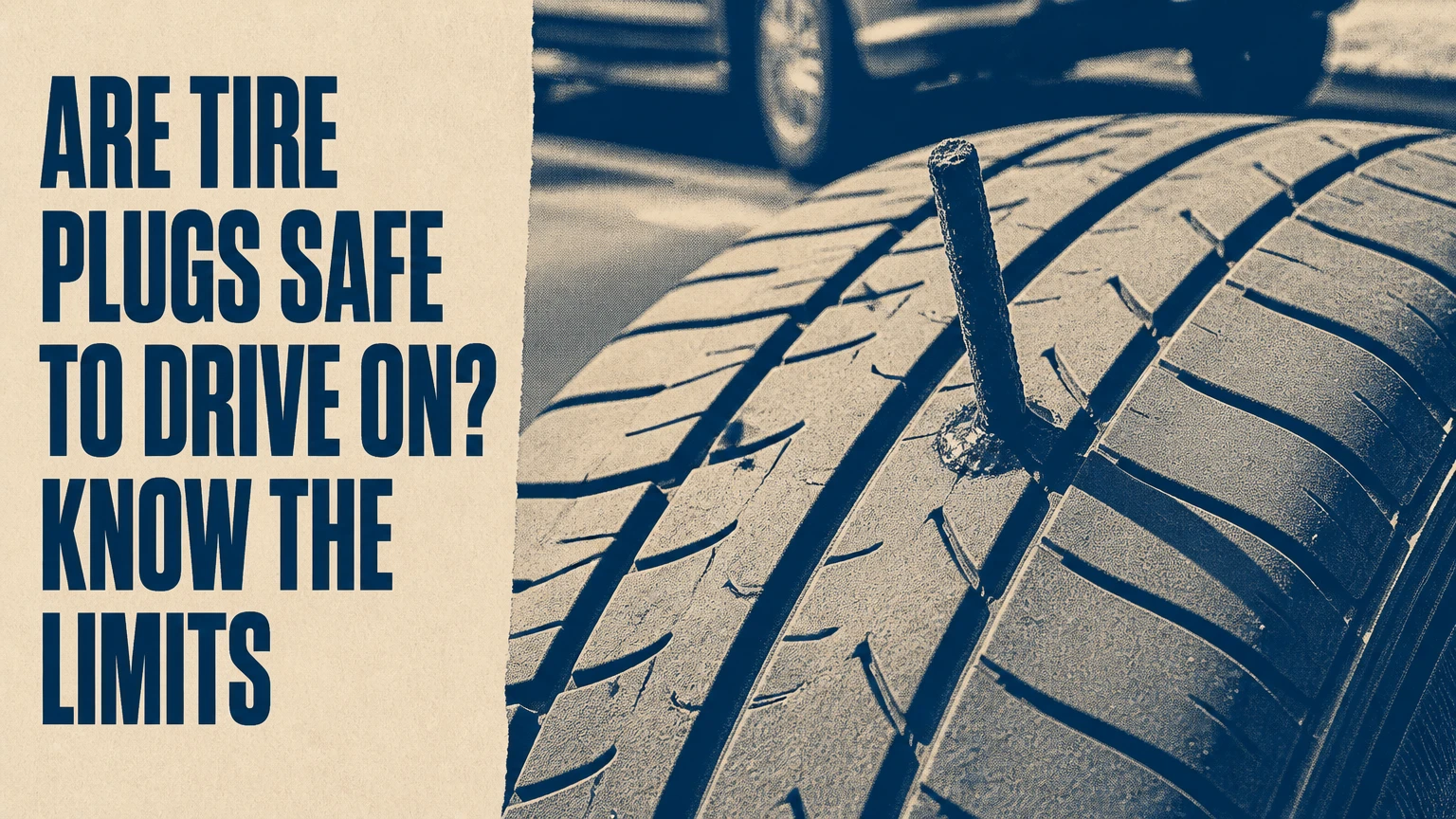
Tire plugs are generally safe for a short, careful drive only when the puncture is small, centered in the tread, and the tire has no internal damage. A basic string plug is an emergency repair, not automatically a permanent repair. A tire shop should remove the tire, inspect the inside, and install a proper puncture repair or recommend replacement.
Key Facts at a Glance
A repairable puncture is commonly limited to 1/4 inch, or 6 mm, in the tread’s repairable area.
A shoulder or sidewall puncture is not safely repaired with a plug or patch.
A string plug seals from the outside and cannot reveal damage caused by driving underinflated.
The preferred permanent method is a combination repair unit, often called a plug-patch, installed from inside the tire.
The 50 mph and 100-mile limits are not universal USTMA rules for every plugged tire; the repair kit, tire maker, vehicle, and shop instructions control.
A bulge, repeated pressure loss, exposed cords, vibration, or a puncture larger than the limit means the tire should not continue in service.
What Is a Tire Plug?
A tire plug is a rubber-coated cord forced into a puncture in a tubeless tire. The plug material grips the puncture channel and reduces air loss, allowing a temporarily disabled tire to hold inflation.
External string plugs are inexpensive and quick. A driver can often install one without removing the wheel, which explains their usefulness beside a road. The limitation is equally important: the tool reaches the injury from the outside, so it does not inspect the inner liner, steel belts, carcass, or sidewall.
A professional combination repair uses a stem that fills the puncture channel and a rubber patch that seals the inner liner. That construction addresses both air retention and the path through which moisture can reach the belt package. The U.S. Tire Manufacturers Association, or USTMA, states that “the tire must be removed from the wheel for a complete inspection” before a permanent repair. That instruction is the dividing line between an emergency plug and a properly evaluated repair.
How Does a Plugged Tire Hold Air?
A tire plug holds air by occupying the puncture channel with a flexible, tacky rubber compound. Pressure from inside the tire presses the material against the channel walls, while the plug’s outer fibers resist being pulled through the tread.
The seal depends on several variables:
- The puncture must be small enough for the plug to grip.
- The plug must follow the original injury path.
- The tread must contain the repair.
- The tire must not have been driven flat or severely underinflated.
- The repair must remain stable at the tire’s operating temperature and load.
A plug does not restore damaged steel cords or rubber that has overheated from low pressure. That hidden structural damage is why a tire can appear sealed externally and still be unsafe. Tire pressure loss also changes handling before a complete failure occurs, especially on a heavily loaded SUV or pickup.
Are Tire Plugs Safe to Drive On?
Yes, a properly installed tire plug can be safe for a short trip to a tire professional when the puncture is small, in the central tread, and the tire has retained its structural integrity. Long-term use of an external string plug is less reliable because the inner liner remains uninspected and the repair can leak or loosen.
A cautious driver should reduce speed, avoid hard cornering, keep the vehicle lightly loaded, and check pressure before moving. The destination should be a tire shop, not a normal week of commuting. If the tire cannot hold the vehicle manufacturer’s recommended cold pressure, do not drive it.
A professionally installed combination repair can remain in service for the tire’s usable life when the tire manufacturer permits the repair and the puncture meets industry criteria. Even then, “repairable” does not mean “repair every time.” Tire age, tread wear, previous repairs, run-flat operation, and internal scuffing can change the decision.
Is a 50-Mph, 100-Mile Limit Universal?
No. The often-repeated 50 mph and 100-mile limit is not a universal USTMA rule for every tire plug. Some emergency products print their own speed or distance restrictions, while tire manufacturers and repair shops may prohibit continued use of an externally plugged tire altogether.
Follow the most restrictive applicable instruction from the plug manufacturer, tire manufacturer, vehicle manufacturer, or professional repairer. A tire’s speed rating does not make an emergency plug suitable for that speed. A V-rated tire, for example, does not convert a roadside string plug into a high-speed repair.
Which Punctures Can Be Repaired?
A tire puncture is most likely repairable when it is no larger than 1/4 inch, lies within the tread repair area, and has not damaged the internal structure. USTMA and major tire manufacturers generally use these conditions as a baseline, although exact policies vary by brand and tire type.
| Inspection factor | Common repair limit | Why it matters | Required action |
|---|---|---|---|
| Puncture diameter | 1/4 inch, 6 mm, maximum | Larger injuries remove more rubber and weaken belts | Repair only after professional inspection |
| Remaining tread | At least 2/32 inch | Worn tread has little material for a reliable repair | Replace at or below 2/32 inch |
| Injury location | Center tread only | The center tread flexes less than shoulders and sidewalls | Repair if all other conditions pass |
| Repair count | Manufacturer-specific | Nearby repairs can weaken the same tread section | Ask the tire maker or replace |
| Inflation damage | No visible scuffing or heat ring | Low pressure can destroy the carcass internally | Remove and inspect before deciding |
| Tire age and condition | No cracks, bulges, or exposed cords | Aging rubber and structural defects remain unsafe after sealing | Replace the tire |
The center tread is the section between the main shoulder transitions. A repair near the shoulder can fail because the area bends more during steering and cornering. A sidewall injury is a replacement condition for ordinary passenger tires, not a plugging opportunity.
A nail or screw that remains in the tire may slow the leak, but it should not be treated as a safe repair. Removing it can reveal the injury’s size and angle. Driving farther on a soft tire can create more damage than the original puncture.
What Does a Professional Tire Repair Include?
A permanent tire repair normally requires removing the tire from the wheel, inspecting the inside, preparing the injury, and installing a combination repair unit from the inner side. The technician then checks inflation, bead seating, and leakage before returning the wheel to the vehicle.
A proper inspection looks for:
- Inner-liner abrasion or separation.
- A circular heat mark from underinflated driving.
- Broken or distorted steel belts.
- A puncture channel that is too large or irregular.
- Previous repairs that overlap or sit too close together.
- Damage around the bead, shoulder, or sidewall.
The technician should also identify the puncture angle. Reaming straight through an angled injury can enlarge the channel or create a second path. A plug-patch must follow the injury rather than force a new straight hole through the tread.
The USTMA repair approach is deliberately conservative because a tire repair must restore the inner liner and fill the injury channel. A patch by itself seals the liner but may leave the puncture channel open. A plug by itself fills the channel but does not provide the same inner-liner seal.
Plug, Patch, Plug-Patch, or Sealant: Which Is Better?
For an eligible passenger-tire puncture, a professional plug-patch combination is usually the strongest repair choice. A string plug is fastest for roadside recovery, an internal patch is better than an external plug in some limited contexts, and liquid sealant is primarily an emergency mobility product.
| Repair method | Typical material cost | Typical shop time | Intended use | Main limitation |
|---|---|---|---|---|
| String plug kit | $5-$15 | 5-15 minutes DIY | Emergency roadside sealing | No internal inspection |
| Internal patch | $20-$40 | 20-40 minutes | Certain small tread injuries | Does not fill the channel alone |
| Plug-patch unit | $30-$60 | 30-60 minutes | Professional permanent repair | Requires tire removal and inspection |
| Liquid sealant | $8-$25 | 2-10 minutes | Temporary mobility | Cleanup, TPMS, and compatibility problems |
Prices are typical United States retail and independent-shop ranges, not guaranteed quotes. Run-flat tires, large wheels, premium tire constructions, roadside service, and dealer labor can raise the total.
Liquid sealant can clog a tire pressure monitoring system sensor and complicate an internal inspection. Some formulas are incompatible with certain sensors or wheels, so the product label matters. Sealant should not replace a proper repair when a shop is accessible.
Why Is a Plug-Patch Usually Preferred?
A plug-patch is preferred because its stem fills the puncture channel while its patch base seals the inner liner. The two functions address the two main paths for air loss and moisture intrusion.
A patch-only repair can be appropriate only when the tire maker and technician accept the injury and the repair method. A plug-only repair is convenient but does not prove that the tire’s interior is sound. The combination unit therefore gives the technician a more complete repair method, not merely a tighter external seal.
No repair method can make an ineligible tire safe. A combination repair cannot reverse a belt separation, sidewall flex damage, run-flat overheating, or excessive tread wear.
How Do You Use a Tire Plug Kit in an Emergency?
A basic tubeless tire plug can be installed in about 5-15 minutes with pliers, a reaming tool, an insertion tool, plug strips, rubber cement if specified, an air compressor, and soapy water. The emergency objective is to restore enough pressure to reach professional help, not to certify the tire for permanent use.
Before You Start
| Requirement | Typical specification | Practical checkpoint |
|---|---|---|
| Compressor | 12-volt unit, 100-150 psi maximum | Inflate to the door-jamb pressure |
| Plug strips | 1-3 compatible rubber strips | Use the kit’s stated tire size range |
| Tools | Pliers, reamer, insertion tool, cutter | Keep hands clear of tool handles |
| Leak solution | 1-2 teaspoons dish soap in water | Bubbles identify air escape |
| Time and cost | 5-15 minutes, $5-$25 | Stop if the tire will not hold pressure |
Step 1: Find the Injury
Inflate the tire enough to locate escaping air, then apply soapy water to the tread and valve area. Mark the location where bubbles repeatedly form.
Do not pull out a screw immediately if the tire is losing air quickly. A tire professional or roadside technician may need to move the vehicle safely first. If the puncture is in the shoulder or sidewall, use the spare or call for assistance instead of plugging it.
Step 2: Remove the Object and Follow the Channel
Use pliers to remove the nail or screw while noting its entry angle. Insert the reaming tool through the same channel and use only the motion and depth specified by the kit.
Over-reaming enlarges the injury and removes rubber that the plug needs for grip. Forcing the tool straight through an angled puncture can create a second channel.
Step 3: Insert the Plug
Thread the plug through the insertion-tool eyelet, apply cement only if the kit requires it, and push the plug along the original injury path. Leave the amount specified by the product instructions outside the tread, then withdraw the tool sharply.
The plug should remain centered without tearing or folding excessively. If the plug slides in with almost no resistance, the hole may be too large for that repair.
Step 4: Inflate and Test
Inflate the tire to the vehicle placard pressure, then cover the plug, tread, valve, and bead with soapy water. Wait several minutes and watch for growing bubbles.
A successful emergency seal shows no continuing bubble stream and maintains pressure during the check. Trim excess material flush with the tread only after the seal is stable. Recheck pressure after a short drive and proceed directly to a repair facility.
When Should You Replace the Tire Instead?
Replace the tire when the injury reaches the shoulder or sidewall, exceeds the permitted diameter, follows driving while flat, or accompanies a bulge, exposed cord, belt separation, or irregular wear. Replacement is also appropriate when tread depth, age, or previous repairs make the tire unsuitable.
| Condition | Plug or patch decision | Safe driving decision |
|---|---|---|
| 3-mm nail in central tread, normal pressure | Professional repair may qualify | Short trip after pressure check |
| 8-mm puncture in central tread | Outside common 6-mm limit | Do not drive on a repair |
| Screw in shoulder groove | Not repairable by standard methods | Use spare or tow |
| Sidewall cut with visible cord | Structurally unsafe | Do not inflate and drive |
| Tire driven several miles flat | Internal damage likely | Remove for inspection or replace |
| Bulge near any repair | Belt or carcass failure possible | Stop driving immediately |
A tire with tread at 2/32 inch has reached the commonly used replacement threshold, even if a puncture itself is small. Wet braking also deteriorates before that point, so replacing at a higher tread depth may be sensible for frequent rain, snow, or heavy loads.
Michelin’s consumer guidance similarly directs drivers to inspect for internal damage and follow the tire manufacturer’s repair limits. The vehicle owner’s manual and tire sidewall provide additional requirements for load, speed, inflation, and replacement matching.
Can You Drive a Plugged Tire on the Highway?
Highway driving on an external string plug is a poor risk choice because speed, heat, load, and road impacts increase the consequences of a leak or plug failure. If the tire has been professionally repaired and approved for continued service, normal highway use may be acceptable within the tire and vehicle manufacturer’s limits.
For an emergency drive, choose the shortest route to a repair shop. Avoid sustained high speed, abrupt lane changes, heavy cargo, towing, potholes, and long-distance travel. Check pressure before departure and stop immediately if the tire-pressure warning returns, steering changes, vibration develops, or the vehicle pulls.
A tire plug does not inherit the tire’s original speed rating. The repair product and installation determine the emergency limitation, while the tire manufacturer determines whether the repaired tire may remain in service.
What Changes for AWD, Run-Flat, and Motorcycle Tires?
AWD vehicles, run-flat tires, and motorcycles require extra caution because tire diameter, carcass design, heat, and handling sensitivity differ from ordinary passenger-car applications. A repair that appears acceptable on one vehicle can violate the manufacturer’s rules on another.
- AWD and 4WD: A new replacement tire may need to match the rolling circumference of the other tires. Consult the vehicle manual before replacing only one tire.
- Run-flat tires: Driving after pressure loss can create internal damage before the driver notices handling changes. Some manufacturers prohibit repairs after run-flat operation.
- Motorcycles: A tubeless motorcycle tire plug may provide emergency mobility, but motorcycle manufacturers and tire makers often recommend replacement or professional evaluation, especially for front tires.
- Commercial and high-load tires: Load, heat, and mileage raise the consequences of a marginal repair. Follow commercial tire regulations and fleet policy.
- Track and competition tires: Do not use a roadside plug for track driving. Heat and cornering loads demand replacement or a manufacturer-approved repair decision.
The safest answer for a specialty tire comes from the tire manufacturer and vehicle manufacturer, not from the plug package alone.
What Problems Can Appear After Plugging?
Pressure loss, vibration, a bulge, uneven wear, or a renewed warning light indicates that the plugged tire needs immediate inspection. A stable-looking plug does not make continued driving acceptable when the tire’s behavior changes.
| Symptom | Likely cause | Immediate response |
|---|---|---|
| Pressure drops overnight | Plug leak, valve leak, or rim leak | Inflate only if safe, then inspect |
| Bubbles at the plug | Poor seal or oversized injury | Do not continue normal driving |
| Steering vibration | Wheel imbalance, tire damage, or belt issue | Reduce speed and schedule inspection |
| Bulge near repair | Belt or carcass damage | Stop driving and replace or tow |
| TPMS warning returns | Ongoing pressure loss or sensor issue | Stop and verify pressure manually |
| Pulling or thumping | Structural failure or low pressure | Stop in a safe location immediately |
A plug that leaks should not be repaired by adding a second plug on top of the first. Remove the tire and let a technician assess whether a compliant combination repair remains possible.
Expert practice rule: pressure loss is more informative than appearance. A plug that looks neat but loses 2 psi overnight deserves more concern than a rough-looking plug that remains stable during a controlled inspection, although neither replaces professional evaluation.
How Many Times Can a Tire Be Plugged?
There is no universal safe number of plugs for every tire. One small, separated puncture in the repairable tread area may qualify for a professional repair, while multiple injuries, overlapping repairs, or punctures close to one another can require replacement.
Tire manufacturers may specify minimum spacing between repairs or prohibit repairs in certain tread zones. A technician should map every injury after removing the tire, because external inspection can miss older repairs, liner damage, or belt distortion.
Do not use multiple roadside plugs as a strategy for extending a worn tire. The cost of a proper inspection is usually lower than the cost of a failed tire, damaged wheel, or roadside recovery.
How Much Does Tire Repair or Replacement Cost?
A professional puncture repair typically costs $20-$60, while replacement commonly costs $100-$400 or more per tire, depending on size, brand, performance rating, and installation. Roadside service, run-flat construction, large wheels, and dealer labor can add $25-$150.
| Service or tire category | Typical United States price | Typical time | Main price driver |
|---|---|---|---|
| Standard puncture repair | $20-$40 | 20-45 minutes | Local labor policy |
| Plug-patch repair | $30-$60 | 30-60 minutes | Tire removal and inspection |
| Roadside plug service | $50-$150 | 20-45 minutes | Travel and after-hours labor |
| Standard all-season replacement | $100-$220 | 45-90 minutes | Size and brand |
| Run-flat replacement | $180-$400 | 60-120 minutes | Specialized mounting equipment |
| Alignment after damage | $90-$180 | 60-90 minutes | Suspension or impact damage |
These figures are typical ranges rather than guarantees. A puncture caused by a pothole may also damage the wheel or alignment, turning a simple repair into a larger safety inspection.
What Should You Do Right Now?
Use the following decision sequence before driving on a plugged tire:
- Check whether the puncture is in the center tread, not the shoulder or sidewall.
- Measure or estimate the injury, with 1/4 inch as the common maximum.
- Confirm the tire holds the vehicle placard pressure.
- Look for bulges, exposed cords, cracks, or a heat ring.
- Limit the trip to the nearest qualified tire shop.
- Stop if pressure falls, vibration appears, or handling changes.
- Ask for an internal inspection and a manufacturer-compliant repair.
The lowest-risk choice is the spare tire or a tow when the puncture location, size, or internal condition is uncertain. A portable compressor can restore pressure temporarily, but it cannot restore damaged cords.
Frequently Asked Questions
How Long Can You Drive on a Plugged Tire?
Drive only as far as needed to reach a tire professional when using an external string plug. A professionally installed combination repair may remain in service for the tire’s usable life if the tire maker permits it and the injury meets all repair criteria. No universal mileage limit applies to every plug.
Can Rain Make a Tire Plug Fail?
Rain does not automatically make a sound repair fail, but standing water, lower traction, potholes, and hidden pressure loss increase driving risk. Check pressure before leaving, reduce speed, and avoid a plugged tire in severe weather when a spare or tow is available.
Can a Tire Plug Damage the TPMS Sensor?
A conventional tread plug normally does not contact the TPMS sensor inside the wheel. Liquid sealants can coat or damage some sensors and may require cleaning or replacement, so tell the tire technician which sealant was used.
Is a Tire Plug Better Than a Patch?
A professional plug-patch combination is generally better than a plug alone because the stem fills the puncture channel and the patch seals the inner liner. A patch alone may be accepted for some injuries, but the tire must be removed and inspected first.
Can You Plug a Tire With a Screw Still in It?
A screw should be removed and the injury inspected before repair. Leaving the screw in place can hide the puncture’s size and angle, while pulling it out without a plan can cause rapid air loss. Use a spare or call roadside assistance if pressure is already low.
Should You Replace Two Tires Instead of One?
Replace two tires on the same axle when the new tire’s tread depth or rolling circumference would differ materially from the existing tire, especially on AWD vehicles. The vehicle and tire manufacturers’ matching rules determine whether one tire is acceptable.
The Bottom Line
Are tire plugs safe to drive on? A small, correctly placed tread puncture can support a short emergency trip after a careful plug installation, but an external string plug should not be treated as a guaranteed permanent repair. The safest lasting solution is a professional internal inspection and, when permitted, a plug-patch combination.
Replace the tire instead when the injury is in the sidewall or shoulder, exceeds the common 1/4-inch limit, follows flat-tire driving, or shows a bulge, exposed cord, separation, or continuing pressure loss. A plug restores air retention only when the tire’s structure is still sound.