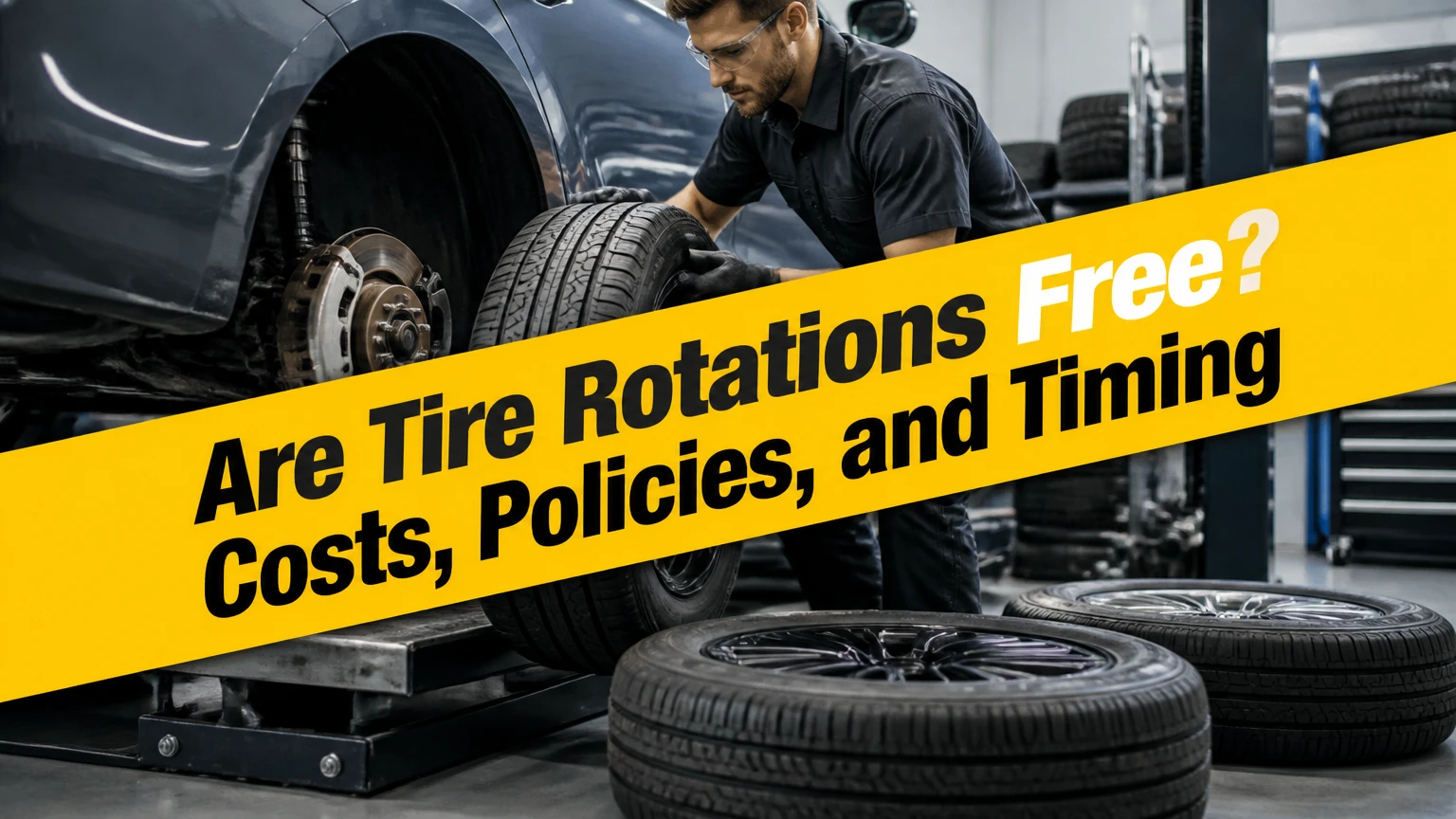
Tire rotations are sometimes free, but there is no universal free-service rule. A tire retailer may include free lifetime rotations when you buy a qualifying set, while a dealership or independent repair shop commonly charges about $20-$50; your vehicle’s maintenance plan may also cover the service for a limited period.
Are tire rotations free where you bought the tires?
Tire rotations are usually free where you bought the tires when the purchase includes a lifetime rotation benefit, but the offer may require four tires, an installation package, or service at the original retailer. The store may also require an appointment, proof of purchase, and tires that remain safely repairable.
Free does not always mean unconditional. Some retailers limit the benefit to the original purchaser, the vehicle listed on the invoice, or tires installed by that location. A retailer can also refuse service when lug nuts are damaged, wheels are aftermarket and incompatible with its equipment, or tread wear makes the requested rotation unsafe.
Typical places that may include complimentary rotations are Discount Tire and America’s Tire, Costco Wholesale, Sam’s Club, Firestone Complete Auto Care, and Goodyear Auto Service. Benefits, exclusions, and balancing coverage vary by location and purchase package, so confirm the current policy before driving to the store.
What should you ask before booking?
Ask five specific questions: whether the benefit is lifetime, whether balancing is included, whether appointments are required, whether the original invoice is necessary, and whether the shop services tires purchased elsewhere. Those answers distinguish a genuinely free rotation from a low-cost introductory promotion.
A service advisor should also confirm that the vehicle has a standard, rotatable tire arrangement. Directional tires, staggered wheel sizes, and severe tread-depth differences can limit the available pattern even when the rotation itself is covered.
How much does a tire rotation cost without a free benefit?
A standalone tire rotation typically costs $20-$50 in the United States and takes about 15-30 minutes at a professional shop. The price rises when the shop must remove locking lug nuts, reset a complex TPMS system, correct tire pressures, or inspect a damaged wheel.
| Service location | Typical rotation price | Typical time | Common condition |
|---|---|---|---|
| Tire retailer with purchase benefit | $0 | 20-40 minutes | Qualifying tires bought from that retailer |
| Independent repair shop | $20-$40 | 15-30 minutes | Standard four-wheel vehicle |
| Dealership service department | $30-$50 | 30-60 minutes | Often bundled with inspection or maintenance |
| Oil-change chain | $25-$50 | 20-45 minutes | May require another purchased service |
| DIY driveway rotation | $0 labor | 45-90 minutes | Owner supplies safe lifting and torque tools |
Prices are typical practitioner ranges, not guaranteed national rates. Urban labor markets, vehicle size, wheel design, and local taxes can change the invoice. A shop may quote a combined tire service price rather than listing rotation separately.
Is tire balancing included with a free rotation?
Tire balancing is not automatically included with a free rotation. Rotation changes wheel positions, while balancing corrects uneven mass distribution with wheel weights; many retailers bundle both after a tire purchase, but a standalone rotation may include only removal, repositioning, torque, and pressure adjustment.
A vibration that increases with road speed usually deserves a balancing inspection rather than another rotation. Rotation cannot correct a bent wheel, a separated belt, a missing wheel weight, or a tire with excessive radial runout.
Why rotate tires if the service may cost money?
Tire rotation redistributes position-specific wear so the four tires approach replacement condition more evenly. Front tires often handle steering forces and, on front-wheel-drive vehicles, engine torque; rear tires may wear differently because they carry less power-transfer load but still affect vehicle stability.
Rotation does not create new tread or repair a mechanical defect. It can delay uneven replacement when the tires are otherwise healthy, but alignment, inflation, suspension condition, driving style, road surfaces, and vehicle weight determine the actual result.
The American Automobile Association describes rotation as moving tires to different positions to promote more uniform wear and help maximize tread life. Michelin likewise recommends following the vehicle manufacturer’s interval and pattern rather than applying one universal schedule to every vehicle.
How much tire life can rotation save?
There is no reliable fixed percentage that applies to every vehicle. A typical well-maintained vehicle may obtain more even wear and avoid replacing one axle prematurely, but claims that rotation always extends life by 20%-30% are too broad without specifying tire model, alignment, inflation, and driving conditions.
The financial benefit is clearest when the front tires would otherwise wear several thousand miles before the rear tires. If a $600-$1,200 set reaches the legal or manufacturer replacement threshold together, the owner avoids buying two tires early and creating tread-depth differences.
When should tires be rotated?
Most vehicles need rotation about every 5,000-8,000 miles, or according to the owner’s manual and tire manufacturer instructions. Six months is a practical calendar interval for low-mileage drivers, while frequent towing, aggressive cornering, heavy loads, and severe front-tire wear justify checking the tires sooner.
Many drivers combine rotation with every oil change because the intervals are similar. That convenience should not override the manual: some vehicles specify 5,000 miles, others 7,500 miles, and certain directional or staggered setups have restricted or nonexistent rotation schedules.
| Driving situation | Inspection interval | Rotation guidance |
|---|---|---|
| Normal mixed driving | Every 5,000-8,000 miles | Follow manual pattern |
| Low-mileage commuter | Every 6 months | Rotate if wear is uneven or interval is due |
| Frequent towing or heavy loads | Every 3,000-5,000 miles | Inspect pressure and axle wear early |
| Front-wheel-drive urban driving | Every 5,000-6,000 miles | Watch front shoulder wear |
| Performance staggered setup | At each service visit | Rotate side-to-side only if permitted |
Measure tread depth across the tire, not only in one groove. A difference of roughly 2/32 inch between axle positions deserves professional advice, especially on all-wheel-drive vehicles where manufacturers may specify a narrow circumference or tread-depth tolerance.
What happens during a professional tire rotation?
A professional tire rotation removes the wheels, inspects the tires and related components, installs each wheel in the correct position, tightens the lug nuts to the manufacturer’s torque specification, and checks inflation. The technician should also note tread depth, wear pattern, brake condition, and visible suspension or wheel damage.
A typical workflow is:
- Verify the correct pattern. The technician checks the owner’s manual, tire sidewalls, wheel sizes, and directional arrows.
- Loosen the lug nuts safely. Nuts are broken loose before the vehicle is fully lifted.
- Lift and support the vehicle. A shop lift is preferred; a DIY owner needs rated jack stands on solid, level ground.
- Remove and inspect the wheels. The technician looks for cupping, feathering, shoulder wear, punctures, bent rims, brake damage, and seized hardware.
- Move the wheels. The shop uses the approved forward-cross, rearward-cross, X-pattern, front-to-back, or side-to-side arrangement.
- Hand-start the lug nuts. Hand-threading reduces cross-threading risk.
- Torque the wheels. Final tightening uses a calibrated torque wrench at the vehicle maker’s specification.
- Set cold tire pressure. Front and rear pressures may differ, and the door-jamb label takes priority over the maximum pressure printed on the sidewall.
- Complete TPMS procedures. Some vehicles learn positions automatically; others require a relearn tool or a prescribed drive cycle.
- Record the service. The invoice should identify tire positions, pressure, torque if documented, and tread measurements.
A TPMS reset is not required in the same way on every vehicle. Direct systems use pressure sensors at the wheels, while indirect systems infer pressure changes from wheel-speed data. The dashboard may still need a position relearn after rotation, particularly when the display identifies individual tire locations.
Which tire rotation pattern is correct?
The correct tire rotation pattern depends on drivetrain, tire direction, wheel width, and the owner’s manual. Non-directional tires offer the most flexibility, while directional tires must continue rotating in the direction shown by the sidewall arrow.
| Vehicle or tire configuration | Approved typical pattern | Position change |
|---|---|---|
| Front-wheel drive, non-directional | Forward cross | Front tires move straight rearward; rear tires cross to front |
| Rear-wheel or four-wheel drive, non-directional | Rearward cross | Rear tires move straight forward; front tires cross rearward |
| Non-directional tires with compatible fitment | X-pattern | Each tire crosses to the opposite axle and side |
| Directional tires | Front-to-back | Each tire stays on its side |
| Staggered non-directional fitment | Side-to-side | Tires remain on the same axle if wheel widths differ |
| Matching full-size spare | Five-tire pattern | Spare enters according to the manual’s sequence |
Can directional tires be crossed?
Directional tires generally cannot be crossed from left to right unless the tire is dismounted and remounted on the wheel. The arrow or “rotation” marking indicates the required rolling direction, and reversing it can reduce wet-road water evacuation and handling performance.
A directional tire may move from front-left to rear-left or front-right to rear-right. The tire stays on its original vehicle side. A shop should never force a conventional cross pattern onto a directional tire.
Can staggered tires be rotated?
Staggered tires can usually be rotated side-to-side on the same axle only when the tire model is non-directional and the wheel fitment permits it. A staggered vehicle has different front and rear tire or wheel widths, so front-to-rear movement may be physically impossible.
Some high-performance vehicles combine staggered and directional tires. That combination may leave no practical rotation pattern. In that case, the correct maintenance plan is frequent pressure and tread inspections, not an improvised tire swap.
Should AWD vehicles receive tire rotations?
AWD vehicles should receive rotations when the manufacturer permits them, but tread-depth matching matters more than on many two-wheel-drive vehicles. An all-wheel-drive system can react poorly to substantially different rolling circumferences, which may increase driveline stress or trigger control-system intervention.
Check the manual for maximum tread-depth variation, tire circumference limits, and replacement rules. Subaru, Audi, BMW, Mercedes-Benz, and other manufacturers may specify model-specific tolerances, so a generic “rotate every 5,000 miles” rule is incomplete for AWD owners.
Replace or shave tires according to the manufacturer’s procedure when one tire is damaged and the remaining tires have significant wear. Buying one random replacement tire with a different tread depth can be more expensive than correcting the mismatch properly.
Is rotation the same as alignment or balancing?
Tire rotation, wheel alignment, and wheel balancing are different services. Rotation changes wheel positions, alignment adjusts suspension angles, and balancing adds or moves wheel weights to reduce vibration from uneven wheel-and-tire mass.
| Service | What changes | Typical symptom or purpose | Typical price |
|---|---|---|---|
| Tire rotation | Wheel position | Uneven axle wear prevention | $20-$50 |
| Wheel balancing | Wheel weights or tire-wheel match | Steering or seat vibration at speed | $40-$100 for four wheels |
| Four-wheel alignment | Toe, camber, and caster angles | Pulling, crooked steering, feathered tread | $90-$200 |
| Tire replacement | Tire casing and tread | Low tread, damage, age, or mismatch | $600-$1,200 for four typical tires |
Rotation cannot correct a vehicle that pulls to one side. Alignment cannot restore worn tread. Balancing cannot fix a tire whose inner shoulder has been destroyed by incorrect toe. The services can be recommended together, but they solve different mechanical problems.
Should tires be rotated before an alignment?
A shop can rotate tires before or after an alignment, but the best sequence depends on the wear pattern and the reason for service. If the current positions reveal alignment-related wear, document and diagnose the condition before moving the tires, because rotation can make the original location harder to identify.
After alignment, the shop should verify steering-wheel centering and road-test the vehicle. Rotating a severely damaged tire does not make it safe for the other axle.
Can you rotate tires yourself for free?
A DIY tire rotation costs $0 in labor but requires safe lifting equipment, a torque wrench, wheel chocks, and a level work surface. The task commonly takes 45-90 minutes for a first-time owner and carries serious injury risk if the vehicle falls or a wheel is improperly torqued.
Use the owner’s manual for the pattern and torque specification. A typical safe equipment list includes:
- One hydraulic floor jack rated for the vehicle
- Four appropriately rated jack stands
- Two wheel chocks
- One torque wrench covering the vehicle’s lug-torque range
- A socket that fits the lug nuts without damaging them
- A tire-pressure gauge and air source
- A tread-depth gauge
Do not rely on the emergency scissor jack for a complete rotation. It is intended for a roadside wheel change, not for supporting a vehicle while multiple wheels are removed.
After installation, lower the vehicle enough to prevent wheel spin, torque the lug nuts in a star pattern, and recheck them after approximately 25-50 miles if the wheel or vehicle manufacturer recommends retorquing. Stop immediately if the steering wheel vibrates, a wheel feels loose, or a TPMS warning remains unresolved.
What mistakes make a free rotation unsafe?
A free tire rotation is not a good deal when the shop ignores tire direction, tread mismatch, lug torque, or an underlying mechanical defect. The service should be declined or changed when moving a tire would place an unsafe or incompatible tire on the steering axle.
Common failure modes include:
- Crossing a directional tire. Recovery requires returning it to the correct side or remounting it on the wheel.
- Rotating over severe uneven wear. Diagnose alignment, worn suspension, or inflation problems before repositioning the tire.
- Using impact-gun final torque. An impact tool may tighten unevenly or beyond specification; request calibrated torque verification.
- Skipping pressure adjustment. Front and rear pressure specifications can differ by several PSI.
- Assuming TPMS always self-learns. Check the dashboard and manual for a relearn procedure.
- Mixing incompatible tread depths on AWD. Confirm the manufacturer’s circumference or tread-depth tolerance first.
An expert rule of thumb is to photograph each tire’s tread before service when a vehicle has unusual wear. The images preserve evidence of the original position and make it easier to identify a developing alignment or suspension fault.
Which option should you choose for a free tire rotation?
The best option depends on where the tires came from, whether the vehicle has a maintenance plan, and whether the fitment is mechanically simple. Returning to the selling retailer is usually the lowest-cost choice, while a dealership offers model-specific inspection and an independent shop often provides the fastest paid service.
| Driver situation | Best first option | Expected cost | Reason |
|---|---|---|---|
| Tires bought from Discount Tire or America’s Tire | Original retailer | $0 if eligible | Lifetime rotation policy may apply |
| Costco or Sam’s Club member | Warehouse tire center | $0 if package qualifies | Purchase records link to membership |
| New vehicle under maintenance coverage | Selling dealership | $0 if plan includes rotation | Coverage ends by time or mileage |
| Staggered luxury vehicle | Brand-specialist shop | $30-$75 | Correct fitment knowledge matters |
| Standard vehicle without coverage | Independent tire shop | $20-$40 | Lower labor cost is common |
| Confident DIY owner with equipment | Home service | $0 labor | Requires safe tools and correct torque |
A dealership is not automatically the best choice for every rotation. It is valuable when the vehicle has an AWD tread-depth rule, a complex TPMS system, warranty documentation requirements, or a staggered performance setup.
An independent shop is often the practical choice for a standard vehicle when the retailer is far away or has a long wait. Ask for the final torque specification and a tread-depth reading rather than accepting a rotation with no inspection record.
What should you check after a rotation?
After a tire rotation, verify that the vehicle drives normally, the tire-pressure warning is cleared or correctly relearned, and the lug nuts have been torqued. Recheck pressure when the tires are cold, because driving heat temporarily raises the measured PSI.
Use this short post-service check:
- Confirm the invoice lists the rotation and any balancing or alignment work.
- Match the dashboard tire positions with the actual tire locations.
- Check the door-jamb pressure label, not the sidewall maximum.
- Inspect for a missing valve-stem cap or visible sidewall damage.
- Listen for new clicking, rubbing, or vibration during the first drive.
- Return for inspection if the vehicle pulls, shakes, or develops a warning light.
A rotation should not produce a new vibration or handling change. If it does, possible causes include an incorrectly torqued wheel, a wheel-weight problem, a damaged tire, incorrect direction, or a pre-existing suspension fault exposed during inspection.
FAQ
Are tire rotations free with a new car?
Tire rotations may be free under a new-car maintenance plan, but coverage depends on the manufacturer, model, market, time limit, mileage limit, and plan terms. Confirm whether the plan covers rotation alone or only includes it when performed with scheduled maintenance, such as an oil and filter service.
Do tire shops rotate tires bought somewhere else?
Some tire shops rotate outside-purchased tires for a fee, while others offer free service only for tires bought and installed through their store. Call before arrival and provide the tire brand, vehicle model, tire size, and purchase location so the shop can identify fitment and eligibility restrictions.
Do new tires need a rotation?
New tires do not need an immediate rotation when they are installed on the correct axles, but they should enter the vehicle’s normal rotation schedule. Record the installation mileage, then follow the owner’s manual or tire maker’s recommended interval, commonly 5,000-8,000 miles.
Can rotation fix a tire that pulls?
Tire rotation can sometimes change a pull caused by tire conicity, but it does not repair misalignment, worn suspension parts, uneven inflation, or a damaged tire. Check pressure first, then request an inspection and alignment measurement if the vehicle continues pulling after rotation.
Is a tire rotation worth paying for?
A $20-$50 rotation is usually worthwhile when it prevents one axle from wearing substantially faster than the other. The value is lower when tires are directional and cannot cross, the tread is already damaged, or the vehicle’s alignment or suspension problem will continue destroying the tire.
Do electric vehicles need tire rotations?
Electric vehicles need rotations when their tire design and fitment permit them, and they may require closer wear monitoring because battery weight and instant motor torque increase tire loads. Follow the EV manufacturer’s interval, pressure specification, and AWD tread-matching requirement rather than applying a gasoline-vehicle assumption.
The Bottom Line
Are tire rotations free? They are free in many tire-purchase programs and some factory maintenance plans, but independent shops and dealerships commonly charge $20-$50 when no benefit applies. Confirm the policy, use the vehicle’s approved pattern, check pressure and TPMS afterward, and avoid rotation when directional, staggered, AWD, or severely worn tires require a specialized procedure.


