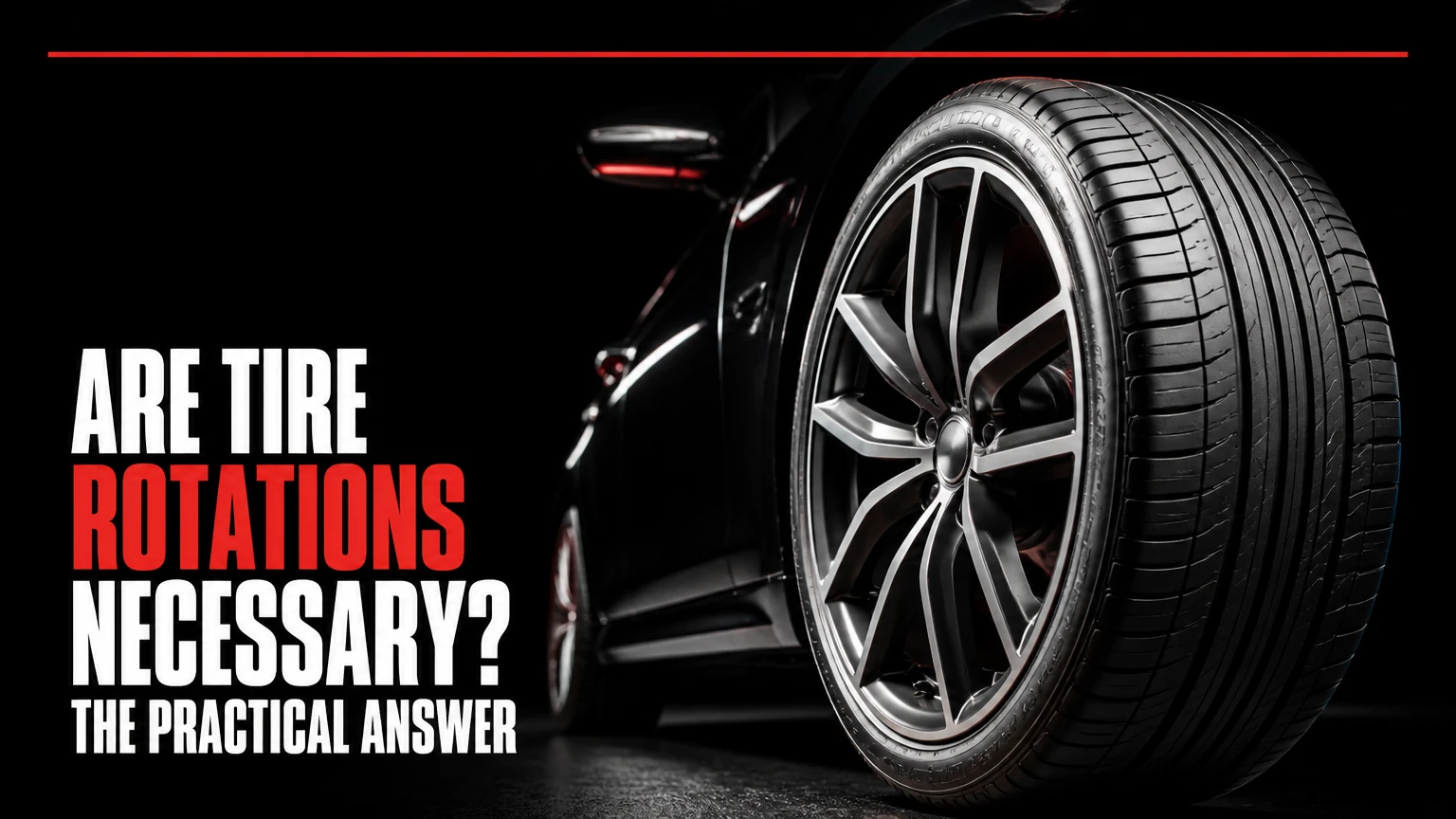
Yes, tire rotations are necessary for most vehicles because they distribute unequal tread wear among the four tires. Regular rotation helps preserve predictable braking, steering, wet-road traction, and usable tire life, but it cannot fix faulty alignment, poor inflation, wheel imbalance, worn suspension parts, or a damaged tire.
Key Facts at a Glance
- Most vehicles need tire rotation at the interval specified in the owner’s manual, commonly every 5,000-7,500 miles or about every six months.
- Front-wheel-drive vehicles usually wear front tires faster because the front axle steers, brakes, and delivers engine torque.
- Directional tires rotate front-to-back only, while staggered tire sizes usually allow side-to-side movement only.
- Tire rotation does not balance a wheel, correct alignment, repair a separated tire, or replace unsafe tread.
- AWD vehicles benefit from similar tire circumference, and some manufacturers limit allowable tread-depth differences.
- Typical tire-rotation service costs $20-$50 and takes about 15-30 minutes at a shop.
What Is Tire Rotation?
Tire rotation is the planned movement of tires to different wheel positions so each tire experiences the vehicle’s steering, braking, acceleration, and cornering forces over time. A technician may move the front tires rearward, cross tires diagonally, or swap tires across the same axle, depending on tread direction, tire size, wheel size, and drivetrain.
The procedure does not change the tires themselves. It changes their positions. A front tire that has carried more steering and braking load can spend part of its remaining life on the rear axle, where wear forces differ.
The National Highway Traffic Safety Administration describes tires as “the only thing that connects your vehicle to the road.” That connection explains why rotation is maintenance rather than a cosmetic service. Even tread depth across the set helps the vehicle respond consistently when braking or turning.
Why Does Tire Rotation Matter?
Tire rotation matters because tires on the same vehicle do not perform identical jobs. A FWD front tire handles engine torque, steering input, much of the braking load, and cornering forces, so it commonly wears faster than a rear tire. RWD vehicles place more acceleration work at the rear, while AWD systems distribute torque according to traction and control demands.
Even wear provides three practical benefits:
- More consistent grip: Similar tread depth makes front-to-rear handling more predictable, especially in rain.
- Longer set life: Rotation allows the less-worn tires to share future work rather than leaving two tires unused while two wear out.
- Earlier fault detection: A rotation inspection can reveal alignment errors, low pressure, bent wheels, damaged suspension parts, or brake problems.
Rotation is preventive. It does not create tread that has already worn away.
What Happens If Tires Are Not Rotated?
Unrotated tires usually develop an uneven wear difference between axles, and the result can be premature replacement of two tires, reduced wet traction, noise, vibration, or less predictable handling. The severity depends on drivetrain, tire compound, alignment, inflation, load, road surface, and driving style.
Common wear patterns include:
| Wear pattern | Visible or tactile symptom | Common causes | Required response |
|---|---|---|---|
| Shoulder wear | Inner or outer edge is noticeably lower | Underinflation, alignment error, overload | Check pressure and alignment |
| Center wear | Tread center is lower than shoulders | Overinflation | Set pressure at vehicle placard value |
| Feathering | Tread blocks feel smooth one way and sharp the other | Toe misalignment | Alignment inspection |
| Cupping or scalloping | Repeating dips around the tread | Imbalance, worn shocks, wheel issue | Balance and suspension inspection |
| One-sided wear | One side of tread wears faster | Camber or suspension problem | Professional alignment diagnosis |
| Heel-and-toe wear | Each tread block has a stepped height | Suspension, inflation, or rotation issue | Inspect tire and chassis |
A rotation may make an existing noise more noticeable because a tire with rear-axle cupping now contacts the road differently on the front axle. The service did not necessarily cause the defect.
What Rotation Cannot Fix
Tire rotation cannot correct a wheel alignment angle, restore missing rubber, repair internal belt separation, or remove a wheel imbalance. A vehicle that pulls, shakes, or produces irregular wear needs diagnosis rather than repeated rotations.
Replace a tire instead of rotating it when it has a sidewall bulge, exposed cords, a deep cut, an object that has damaged the sidewall, visible belt separation, or tread at or below the legal limit. In the United States, 2/32 inch is the commonly cited minimum usable tread depth, but wet-weather performance declines before that point and local laws vary.
How Often Should Tires Be Rotated?
Most vehicles should receive a tire rotation every 5,000-7,500 miles, or at the time specified by the vehicle manufacturer, whichever schedule applies first. Time-based maintenance commonly falls near six months for lower-mileage drivers, but an owner’s manual takes priority over a generic mileage rule.
Use the following as typical planning ranges, not universal specifications:
| Vehicle or operating condition | Typical interval | Why the interval changes |
|---|---|---|
| FWD passenger car, normal use | 5,000-7,500 miles | Front tires manage steering, braking, and drive torque |
| RWD passenger car, normal use | 5,000-7,500 miles | Rear tires receive greater propulsion load |
| AWD crossover or sedan | 5,000-7,500 miles | Similar circumference reduces driveline stress |
| EV with high torque or heavy curb weight | 4,000-6,000 miles | Instant torque and vehicle mass can accelerate wear |
| Pickup, towing, or heavy loads | 4,000-5,000 miles | Load and axle force increase tread stress |
| Off-road or aggressive all-terrain use | 4,000-5,000 miles | Gravel, mud, and uneven surfaces encourage cupping |
Rotating with every oil change is convenient when the oil interval matches the tire manufacturer’s recommendation. Modern vehicles may have oil intervals longer than 7,500 miles, so an oil-change appointment alone is not a reliable rotation schedule.
Do not wait for a visible problem. Uneven wear often becomes obvious only after the tire has lost substantial tread.
Which Rotation Pattern Is Correct?
The correct tire-rotation pattern depends first on tire direction and size, then on drivetrain and manufacturer instructions. A rotation diagram printed in the owner’s manual or tire documentation overrides a generic pattern because some vehicles use unusual suspension, wheel, or tire arrangements.
| Tire and vehicle configuration | Standard movement | Can tires cross sides? | Main restriction |
|---|---|---|---|
| Non-directional, same-size FWD | Front straight back, rear cross to front | Yes, at the rear-to-front move | Confirm manufacturer pattern |
| Non-directional, same-size RWD | Rear straight forward, front cross to rear | Yes, at the front-to-rear move | Confirm manufacturer pattern |
| Non-directional, same-size AWD | Often rearward cross or manufacturer pattern | Usually yes | Keep tread circumference closely matched |
| Directional, same-size tires | Front-left to rear-left, front-right to rear-right | No | Arrow must point in forward rotation direction |
| Staggered tire sizes | Left to right on the same axle | Only across the same axle | Front and rear sizes cannot exchange positions |
| Five matching tires | Four-road-wheel pattern plus spare | Pattern-specific | Spare must match and be serviceable |
Directional Tires
Directional tires have tread designed to roll in one direction, usually marked by a rotation arrow and the word “Rotation” on the sidewall. A directional tire can move from front to rear on the same side, but crossing it to the opposite side reverses its intended rotation.
If a directional tire must change sides, a technician must dismount the tire, remount it on the wheel, and rebalance it. That is a tire-service operation, not a simple rotation.
Staggered Fitments
A staggered fitment uses different tire or wheel sizes on the front and rear axles. For example, a sports car may use 225/40R19 front tires and 255/35R19 rear tires. Those tires cannot exchange axles because their widths, diameters, load ratings, or wheel requirements differ.
Side-to-side rotation is possible only when the tire is non-directional and the vehicle manufacturer permits it. Directional staggered tires normally remain in their original corner positions unless a tire shop dismounts and remounts them.
Five-Tire Rotation
A matching full-size spare can join a five-tire rotation, allowing the spare to accumulate mileage instead of aging unused. The spare must have the same size, construction, load rating, speed rating, and compatible tread design; a temporary “donut” spare is not part of a normal rotation.
A five-tire schedule must follow a defined pattern. Mark each tire’s position after service so the next move uses the correct sequence.
Are AWD Tire Rotations Necessary?
AWD tire rotations are necessary when the vehicle manufacturer specifies them because AWD systems can react poorly to substantially different tire circumferences. Tread-depth differences, mismatched tire models, inflation errors, and unequal wear can force the center differential or electronically controlled coupling to compensate continuously.
AWD does not automatically require a special crossing pattern. Some AWD vehicles use the same pattern as RWD vehicles, while others specify front-to-rear movement or prohibit certain tire arrangements. The service manual is decisive.
A useful practitioner rule is to measure tread depth on all four tires rather than judging them visually. If one tire is dramatically more worn, ask the manufacturer or dealer about the permitted difference before replacing only one tire. Some AWD systems require a matched set or tread shaving on a replacement tire, while others allow a limited difference.
Rotation reduces circumference differences over time. It cannot make mismatched tires equivalent after the fact.
What About EVs, Trucks, and Performance Cars?
EVs, trucks, and performance cars need the same basic inspection principles, but their tire-wear patterns can differ substantially. Electric vehicles combine high curb weight with immediate motor torque, pickups may operate under heavy axle loads, and performance cars often use soft compounds or staggered fitments.
| Vehicle type | Typical wear concern | Practical interval | Special check |
|---|---|---|---|
| Compact EV | Drive-axle wear and heavy curb weight | 4,000-6,000 miles | Confirm EV-rated load specification |
| AWD EV | Circumference difference across four tires | 4,000-6,000 miles | Measure tread depth at each service |
| Half-ton pickup | Rear wear under towing or payload | 4,000-5,000 miles | Use the correct cold-pressure values |
| Off-road SUV | Shoulder wear and tread block cupping | 4,000-5,000 miles | Inspect after gravel or trail use |
| Sports coupe | Soft compound and staggered sizing | Manual-specific | Check directional and asymmetrical markings |
| Winter-tire setup | Seasonal storage and position changes | At seasonal installation | Keep tires marked by corner and direction |
Performance tires may need replacement sooner even when rotated correctly because their compounds prioritize grip over tread longevity. Rotation cannot turn a track-oriented tire into a long-life commuter tire.
Should Winter Tires Be Rotated?
Winter tires should be rotated according to their directional markings and the vehicle manufacturer’s schedule. If a vehicle uses a separate winter set on identical wheels, mark each tire’s corner during removal and inspect tread depth before reinstallation.
A directional winter tire must stay on the same side unless it is remounted. A non-directional winter tire may cross, but the chosen pattern should preserve even wear and comply with the manufacturer’s instructions.
What Happens During a Professional Rotation?
A professional tire rotation usually takes 15-30 minutes and includes wheel removal, tire-position changes, tread inspection, pressure adjustment, and lug-nut torque verification. A competent technician should also look for brake, suspension, wheel, and tire defects that could explain uneven wear.
The normal sequence is:
- Confirm the pattern: Read the tire sidewalls and identify directional arrows, asymmetric labels, and different sizes.
- Inspect before removal: Check tread depth, punctures, sidewalls, wear patterns, and wheel condition.
- Lift safely: Use a vehicle lift or correctly rated jack stands on approved lift points.
- Move the wheels: Follow the specified pattern without crossing directional tires.
- Inspect related parts: Check brake components, wheel studs, shocks, ball joints, and visible suspension hardware.
- Set pressure: Use the cold inflation pressure on the driver-door placard, not the maximum pressure molded into the tire sidewall.
- Torque the lugs: Tighten in a star pattern to the vehicle manufacturer’s torque specification.
- Verify the result: Recheck torque as required, confirm valve stems and TPMS sensors, and road-test if vibration or pulling existed.
The tire sidewall’s maximum pressure is not the normal operating target. The door placard and owner’s manual provide the vehicle-specific pressure, which may differ between front and rear axles.
How Much Does Rotation Cost?
A typical tire rotation costs $20-$50 at an independent repair shop and takes 15-30 minutes, although prices vary by region, vehicle, wheel size, access, and whether inspection or balancing is included. Some tire retailers provide free lifetime rotations for tires purchased from that retailer, subject to their terms.
| Service situation | Typical price | Typical time | What may be included |
|---|---|---|---|
| Standalone rotation, independent shop | $20-$50 | 15-30 minutes | Position change and lug torque |
| Rotation with tire purchase | $0 or bundled | 15-30 minutes | Retailer-specific lifetime service |
| Rotation plus balance check | $40-$100 | 30-60 minutes | Rotation and wheel-balance diagnosis |
| Directional tire side change | Higher than rotation | 45-90 minutes | Dismount, remount, and rebalance |
| DIY rotation | Existing equipment cost | 45-90 minutes | No labor charge, safety responsibility remains |
A shop may recommend balancing, alignment, or suspension inspection after seeing an abnormal pattern. Those services are not automatically part of a basic rotation and should be explained with measurements or observed symptoms.
Is Professional Service Better Than DIY?
Professional service is usually the safer choice because a shop has a lift, calibrated torque equipment, vehicle-specific specifications, and the ability to inspect suspension and brakes while the wheels are removed. DIY rotation can save labor cost when the owner has suitable equipment and understands the vehicle’s pattern.
| Factor | Professional shop | DIY garage |
|---|---|---|
| Equipment | Two-post lift or commercial jack, calibrated torque wrench | Rated jack, four jack stands, wheel chocks, torque wrench |
| Typical labor cost | $20-$50 | $0 after equipment ownership |
| Typical time | 15-30 minutes | 45-90 minutes |
| Main advantage | Safe access and inspection | Convenience and labor savings |
| Main risk | Incorrect service or upselling | Vehicle fall, cross-threading, incorrect torque |
| Best use case | Unknown wear, AWD, heavy vehicle, symptoms | Experienced owner with level pavement |
Never support a vehicle with a jack alone while removing wheels. Use level ground, wheel chocks, properly rated stands, and the manufacturer’s lift points. A compact emergency jack is intended for a roadside wheel change, not routine four-wheel service.
What Can Go Wrong After a Rotation?
A new symptom after rotation requires diagnosis rather than immediate blame. Moving tires changes their position, so a pre-existing imbalance, tread deformation, radial pull, or noise may become more noticeable at the steering axle.
| Post-rotation symptom | Most likely direction | First diagnostic action |
|---|---|---|
| Steering-wheel vibration at 50-70 mph | Wheel imbalance or tire radial force | Check balance and wheel seating |
| Vehicle pulls left or right | Alignment, tire conicity, pressure difference | Verify cold pressures, then inspect alignment |
| Humming or growling | Cupped or feathered tread, wheel bearing | Compare tire noise and inspect tread |
| TPMS warning | Pressure change or sensor issue | Measure all pressures and check sensor status |
| Steering feels different | Front tires now have different stiffness or wear | Confirm pattern, pressure, and tread condition |
| Repeated lug loosening | Incorrect torque or damaged hardware | Stop driving and inspect immediately |
A wheel may need balancing after rotation even when it was previously balanced. The tire’s position relative to the steering system changes how the driver feels its force variation.
If the vehicle pulls after service, first verify pressure with a reliable gauge. If pressures match, request an alignment and tire-conicity diagnosis rather than accepting rotation as the cure.
Expert Insight: Rotation Does Not Equal Alignment
Technicians often find that customers use “rotation” to describe several tire services. Rotation changes wheel position, balancing corrects mass distribution, and alignment sets suspension angles. These services address different symptoms and cannot substitute for one another.
Expert Insight: The Best Tire Is Usually on the Rear
When only two tires are replaced, many tire manufacturers and safety organizations recommend placing the tires with greater remaining tread on the rear axle, regardless of whether the vehicle is FWD, RWD, or AWD. Better rear traction reduces the chance of oversteer on wet roads. Follow the tire manufacturer and vehicle maker when their instructions differ.
Expert Insight: Rotation Records Protect More Than Warranty Claims
A dated record showing mileage, tread depth, pressure, and lug torque creates a wear history. That history can distinguish gradual underinflation from an alignment failure and helps identify whether a single tire is losing air or a whole axle is wearing abnormally.
Does Rotation Affect a Tire Warranty?
Tire rotation can affect a treadwear warranty because many manufacturers require rotation at specified intervals and may request service records. Warranty terms differ by brand, tire line, country, and purchase channel, so the actual policy must be checked in the tire warranty booklet.
Keep invoices, service dates, mileage, tread-depth measurements, and records of alignment or balancing. A retailer’s free-rotation program may provide documentation automatically, but the owner remains responsible for meeting the stated interval.
Rotation does not guarantee a warranty replacement. Neglect, improper inflation, overloaded use, collision damage, racing, unauthorized repairs, and alignment-related wear may fall outside coverage.
The Bottom Line
Are tire rotations necessary? For most vehicles, yes. Rotation helps distribute unequal axle loads, preserve more even tread wear, maintain predictable handling, and delay premature replacement of two tires.
Use the owner’s manual as the primary schedule, with 5,000-7,500 miles as a common planning range. Confirm the pattern before moving a tire, especially with directional, staggered, AWD, EV, winter, or five-tire configurations. A rotation is worthwhile maintenance, but it is not a substitute for correct pressure, wheel balance, alignment, suspension repair, or timely tire replacement.
Frequently Asked Questions
Is it okay to skip a tire rotation once?
Skipping one rotation is unlikely to create immediate danger if pressures, tread, and alignment are correct, but wear differences accumulate with mileage. Reschedule the service promptly, inspect all four tires, and shorten the next interval if one axle has already developed visible feathering or shoulder wear.
Do tires need rotation after being replaced?
New tires should enter the vehicle’s normal rotation schedule as soon as the manufacturer recommends, commonly after 5,000-7,500 miles. If only two tires are replaced, place the tires with greater tread on the rear when permitted, then follow the vehicle and tire manufacturer’s fitment guidance.
Does tire rotation improve gas mileage?
Tire rotation may preserve efficient rolling behavior when it prevents severe uneven wear, but it is not a direct fuel-economy repair. Correct cold inflation pressure has a more immediate effect on rolling resistance. Underinflated tires, overloaded use, aggressive acceleration, and poor alignment can increase energy consumption.
Do tires need balancing every time they are rotated?
Tires do not automatically need balancing at every rotation. Request a balance check when a steering-wheel vibration appears, a wheel loses a weight, a tire is repaired, or irregular wear suggests force variation. Rotation changes wheel position, so an existing imbalance may become more noticeable.
Can I rotate tires with different tread depths?
Tires with modest tread-depth differences can often be rotated when the vehicle manufacturer permits the arrangement. A severely worn, damaged, mismatched, or structurally compromised tire should not be moved simply to complete a pattern. AWD vehicles require particular caution because circumference differences can stress driveline components.
How do I know whether my tires are directional?
Look for a molded arrow or the word “Rotation” on the sidewall. The arrow must point toward forward travel when the tire is mounted. The word “Outside” identifies an asymmetrical tire’s mounting orientation, but it does not by itself mean the tire is directional. A tire shop can confirm both markings.