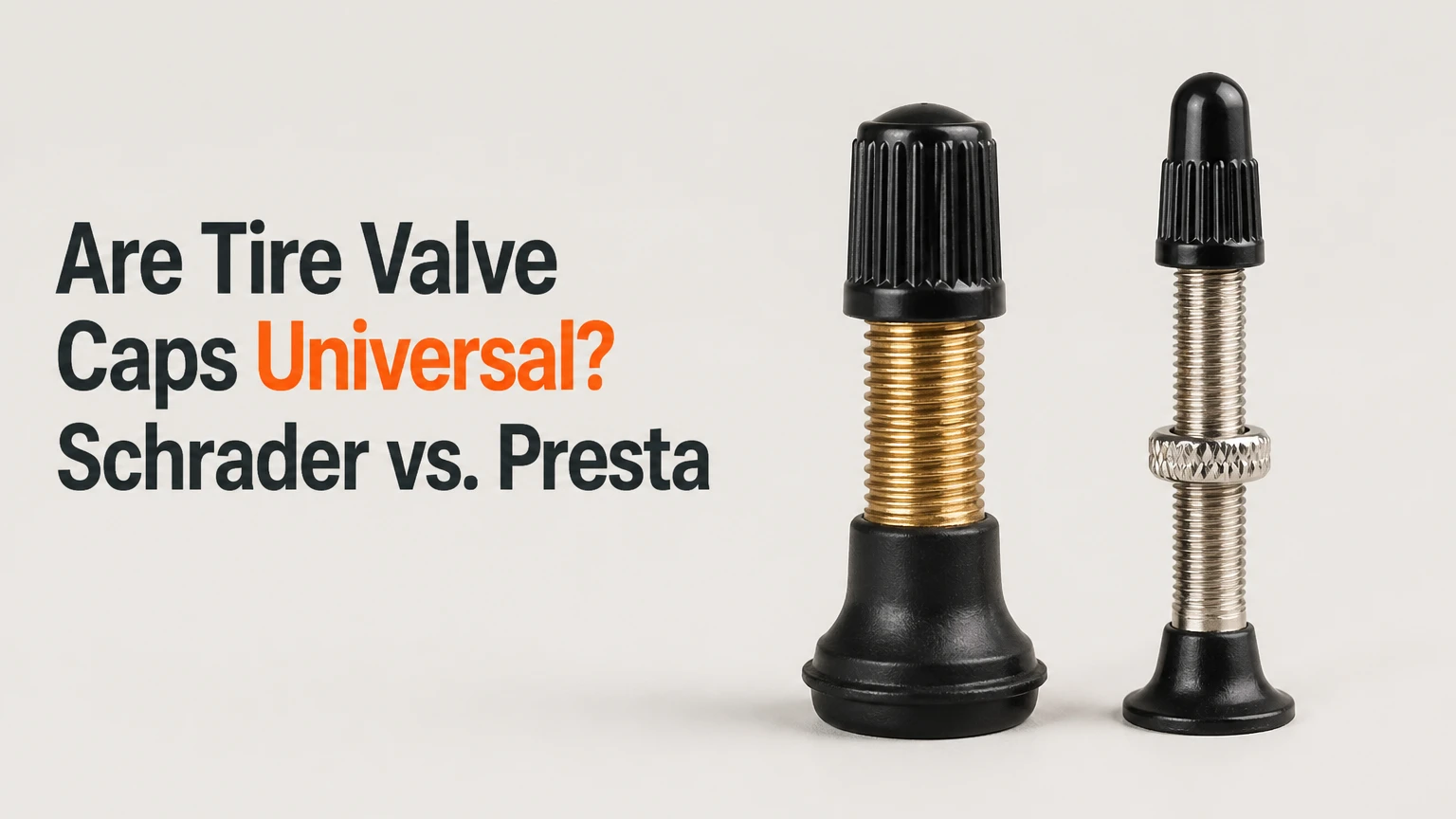
Tire valve caps are broadly interchangeable only when the valve stem uses the same standard. Most cars, SUVs, motorcycles, bicycles with wide stems, trailers, and light trucks use Schrader valves, so a standard Schrader cap fits many of them. Presta bicycle valves, high-pressure equipment, and some specialty applications require different caps.
Key Facts at a Glance
- A standard automotive valve cap fits a standard Schrader valve, regardless of most vehicle makes and models.
- Schrader caps commonly use a 0.305-inch stem thread with 32 threads per inch.
- Presta valves are narrower and require Presta-specific caps, not automotive Schrader caps.
- The valve core holds tire pressure; the cap mainly blocks dirt, water, salt, and debris.
- Plastic caps are the safest default for most aluminum TPMS valve stems.
- Metal caps can seize through corrosion, especially when dissimilar metals contact each other.
Are Tire Valve Caps Universal?
Tire valve caps are not universally compatible, but standard Schrader caps are universal across most ordinary automotive applications. The cap must match the valve stem’s outside thread, diameter, and available clearance; vehicle brand, wheel design, and tire size usually do not determine cap fit.
The word “universal” therefore means “fits standard Schrader stems,” not “fits every tire valve.” A cap sold for cars will normally fit a car, pickup, SUV, motorcycle, trailer, lawn tractor, or bicycle fitted with a Schrader valve. It will not fit a narrow Presta valve on a road bicycle, and it may not suit a specialty racing, industrial, agricultural, or high-pressure valve.
A practical compatibility check takes seconds: compare the replacement cap with the old one, inspect whether the stem is thick or narrow, and start the cap by hand. If the threads engage smoothly for several turns, compatibility is likely. If the cap stops immediately, wobbles, or requires force, remove it rather than treating resistance as normal.
What does “universal Schrader cap” actually mean?
A universal Schrader cap is a replacement cover made for the common external thread used by standard Schrader valve stems. The description usually covers thread compatibility, not material, sealing quality, pressure-indicator accuracy, or resistance to corrosion.
The common automotive Schrader stem thread is generally specified as 0.305 inch by 32 threads per inch. The valve core itself is standardized separately from the cap, so a cap can fit the stem even when the core, sensor, rubber base, or wheel application differs.
How Does a Tire Valve Cap Work?
A tire valve cap screws over the external end of a valve stem, where it blocks contaminants and may provide a secondary air seal. The spring-loaded valve core inside the stem remains the primary pressure seal when the cap has been removed.
A Schrader valve contains a small spring-loaded core with a pin in its center. Pressing the pin opens the valve for inflation or pressure measurement. The cap does not normally press that pin, so a correctly made cap should not release air when installed.
A cap still matters because dirt or moisture around the core can interfere with sealing. Road salt, dried mud, sand, and ice can damage the core or prevent the pin from closing completely. Caps with an internal rubber gasket can also retain pressure if a slightly leaking core allows air to reach the cap.
That secondary function has limits. A cap with an O-ring is not a substitute for a failed valve core, cracked rubber stem, leaking TPMS service valve, or damaged tire. A tire that loses pressure needs diagnosis, even if a sealing cap appears to slow the leak.
Can a missing cap cause a flat tire?
A missing valve cap does not normally release air immediately because the valve core holds the pressure. It can contribute to a leak over time if contamination damages the core or moisture freezes against the sealing surfaces, but a sudden loss of pressure usually indicates a separate valve-core, stem, wheel, or tire problem.
The sensible response is to replace the cap and check pressure with an accurate gauge. Do not use a cap as evidence that the tire is safe. The U.S. National Highway Traffic Safety Administration recommends checking tire pressure when the tires are cold and following the vehicle placard or owner’s manual rather than the maximum pressure molded into the tire sidewall.
Which Valve Type Does Each Cap Fit?
Valve type determines cap compatibility more reliably than vehicle category. The following table covers the common applications that cause most purchasing mistakes.
| Valve type | Typical outside appearance | Common applications | Compatible cap |
|---|---|---|---|
| Standard Schrader | Thick stem, approximately 8 mm wide | Cars, SUVs, trucks, motorcycles, trailers | Standard Schrader cap |
| Presta | Narrow stem with small locknut | Road bikes, many mountain bikes, tubeless bicycles | Presta cap |
| Woods or Dunlop | Narrow bicycle valve with removable core | Some traditional bicycles in Europe and Asia | Woods or Dunlop cap |
| High-pressure specialty valve | Application-specific body or fittings | Racing wheels, aircraft, industrial equipment | Manufacturer-specific cap |
| Tubeless Schrader | Standard Schrader end on a tubeless valve stem | Cars, motorcycles, bicycles, utility equipment | Schrader cap |
How can you identify a Schrader valve?
A Schrader valve has a relatively thick, tube-like stem and a visible spring-loaded pin in the center. Automotive Schrader stems may be flexible black rubber or rigid metal assemblies attached to a TPMS sensor, while bicycle Schrader stems are usually wider than Presta stems and use the same basic cap thread.
A simple test is visual rather than dimensional. A cap from an ordinary car should begin threading onto a Schrader stem without an adapter. Never press the center pin merely to identify the valve, because doing so releases air.
How can you identify a Presta valve?
A Presta valve is narrower than a Schrader valve and has a small threaded tip with a locknut that opens and closes the valve. Presta caps are longer and narrower, and their internal thread is too small for a standard car valve cap.
A Presta-to-Schrader adapter may let you inflate a Presta tube with a car-style pump, but the adapter does not convert the valve into a normal Schrader stem for cap purposes. Remove the adapter after inflation if the manufacturer instructs you to do so, then install the proper Presta dust cap.
Schrader, Presta, and Specialty Caps Compared
The cap options below differ in fit, sealing, maintenance, and appropriate use. Price ranges are typical retail prices for a four-pack in the United States and vary by brand, finish, and region.
| Cap category | Approximate pack price | Typical material | Best application | Main limitation |
|---|---|---|---|---|
| Basic Schrader plastic | $1-$4 | Nylon or polyethylene | Cars, SUVs, motorcycles | UV and impact degradation |
| Sealing Schrader plastic | $2-$6 | Nylon with rubber gasket | TPMS-equipped daily vehicles | Gasket can harden |
| Metal Schrader | $4-$15 | Brass, aluminum, or steel | Appearance, off-road use | Seizure and galvanic corrosion |
| Presta bicycle | $2-$10 | Plastic or aluminum | Road and mountain bicycles | Does not fit Schrader |
| Pressure-indicator cap | $6-$20 | Plastic and metal | Quick visual checks on basic stems | Not a calibrated replacement gauge |
| Specialty equipment cap | $5-$30 | Application-specific alloy or polymer | Racing and industrial valves | Requires exact part matching |
Are metal caps better than plastic caps?
Metal caps provide greater impact resistance and a more durable finish, but plastic or nylon caps are the safer default for most passenger vehicles. Metal caps can corrode onto aluminum valve stems, interfere with TPMS service, or become difficult to remove after repeated exposure to water and road salt.
Material affects maintenance more than basic fit. A plastic Schrader cap usually costs less, weighs less, and avoids metal-to-metal corrosion. A metal cap with an internal rubber seal can provide stronger physical protection, but the cap should be removed periodically and replaced at the first sign of binding.
Aluminum caps deserve particular caution. Aluminum cap and aluminum stem contact does not automatically prevent seizure, because contamination, damaged coatings, and moisture can still create binding. Brass caps on aluminum stems can also create galvanic-corrosion problems in wet, salty environments.
Are metal valve caps safe with TPMS?
Metal valve caps are not automatically unsafe with tire-pressure monitoring systems, but plastic caps are the lower-risk choice for most TPMS-equipped vehicles. The major TPMS risk comes from damaging the valve stem or sensor assembly during installation, service, corrosion removal, or over-tightening.
A direct TPMS sensor is often attached to the valve stem inside the wheel. The external cap does not electronically communicate with that sensor. However, a seized cap can make a future pressure check or tire service difficult, and excessive force applied to a metal valve assembly can damage the sensor seal.
Use the vehicle or sensor manufacturer’s material recommendation when available. Do not assume that a cap advertised as “TPMS compatible” has been approved for every sensor design.
How Do You Install a Tire Valve Cap Correctly?
Install a tire valve cap by cleaning the stem, aligning the cap squarely, threading it clockwise by hand, and stopping at firm hand resistance. Replacing four ordinary caps usually takes 2-5 minutes and requires no tool, lubricant, or change to the tire-pressure setting.
- Inspect the valve stem. Look for damaged threads, cracked rubber, corrosion, missing sealing rings, or a bent metal stem.
- Clean the external threads. Wipe loose dirt and salt away with a dry cloth. For heavy contamination, use a small nylon brush and keep debris away from the valve opening.
- Check the cap interior. Confirm that a rubber gasket or O-ring is seated flat and that no molding flash touches the center pin.
- Align the cap squarely. Place the cap straight over the stem rather than approaching at an angle.
- Thread by hand. Turn clockwise until the cap reaches firm resistance. Two or more smooth turns indicate that the thread has started correctly.
- Check the result. Remove the cap once and reinstall it. The cap should turn freely, sit straight, and not press the valve-core pin.
Never use pliers to tighten an ordinary cap. Tools can strip plastic threads, distort an O-ring, or twist a TPMS valve stem. “Hand-tight” means secure enough to resist vibration, not compressed as tightly as a wheel fastener.
Should you use lubricant on valve-cap threads?
Do not apply wet lubricant routinely to tire valve-cap threads, especially on TPMS valve assemblies. Grease and oil can collect abrasive dirt, attack some rubber compounds, or hide corrosion; a clean, correctly fitting cap should install without lubrication.
If a metal cap is already stuck, lubricant may assist removal, but the procedure changes. Use a product approved for the stem and sensor materials, follow the product instructions, and avoid spraying into the valve opening. A tire shop should handle a cap that requires force, cutting, or heat.
What Problems Occur With Valve Caps?
The most common valve-cap problems are cross-threading, corrosion seizure, missing seals, cracked plastic, and caps that contact the valve-core pin. Each problem produces a different symptom, so replacing the cap without inspecting the stem can leave the actual fault unresolved.
| Symptom | Likely cause | Immediate action | Correct repair |
|---|---|---|---|
| Cap starts crooked | Cross-threading or damaged threads | Remove immediately | Replace cap or valve stem |
| Cap will not turn | Corrosion, dirt, or seized metals | Stop using force | Professional removal if necessary |
| Air escapes with cap installed | Cap presses core or core leaks | Remove cap and measure pressure | Replace cap, core, or stem |
| Cap splits or becomes brittle | UV, cold, or age damage | Replace all damaged caps | Use nylon or fresh plastic |
| O-ring falls out | Poor fit or deterioration | Do not reinstall | Replace the cap |
| Stem bends during removal | Excessive torque or loose hardware | Stop and support the assembly | TPMS or valve-stem inspection |
What should you do if a valve cap is stuck?
A stuck valve cap usually results from cross-threading, corrosion, or dissimilar metals. Do not grip the valve stem with pliers while twisting the cap, because force can damage the stem, sensor, or sealing grommet.
First, check whether the cap can move by hand after cleaning the exposed joint. If it cannot, a tire technician can use controlled penetrating treatment and the correct support method. Cutting the cap may be safer than twisting a fragile TPMS assembly. Replace the cap after removal and inspect the stem threads.
One practitioner rule is worth remembering: remove decorative metal caps at least twice a year in regions that use winter road salt. The exact interval is not a universal standard, but periodic removal exposes seizure before the next tire service.
Are Pressure-Indicator Caps Accurate?
Pressure-indicator caps are useful visual alerts, but they are not a dependable replacement for a calibrated tire-pressure gauge. Indicator caps react to a preset pressure range and may not match the vehicle manufacturer’s recommended pressure for each axle or load condition.
A green, yellow, or red indicator can help identify a severely low tire on a vehicle without functioning dashboard TPMS. It cannot reliably confirm that a tire has the correct cold pressure, and four caps may not respond identically after aging, temperature changes, or spring contamination.
Use the door-jamb placard or owner’s manual for the target pressure. Check with a quality gauge when the tires are cold, then treat indicator caps as supplementary warnings rather than measurement instruments.
Which Caps Fit Trucks, Trailers, Motorcycles, and Bikes?
Most light trucks, trailers, and motorcycles use standard Schrader valve caps, but heavier equipment and specialty wheels require confirmation from the valve manufacturer. Application category narrows the search, yet the physical stem thread remains the final compatibility test.
- Passenger cars and SUVs: Standard Schrader plastic caps are usually sufficient, including vehicles with direct TPMS.
- Light trucks and trailers: Schrader caps generally fit, but off-road and trailer use may justify a cap with a protected rubber seal.
- Motorcycles: Most use Schrader valves, although wheel-specific aftermarket stems can differ.
- Bicycles: Wide Schrader bicycle valves use automotive-style caps; narrow Presta valves require Presta caps.
- Racing wheels: Confirm the stem manufacturer’s specification because lightweight assemblies may use unusual materials or clearances.
- Agricultural and industrial equipment: Match the cap to the equipment valve, pressure range, and chemical exposure rather than relying on a “universal” label.
High-pressure service also changes the risk profile. A cap does not increase the safe inflation pressure of a tire, tube, stem, or wheel, and a decorative cap should never replace the specified pressure-rated component.
How Much Do Tire Valve Caps Cost?
Standard plastic caps typically cost $1-$4 for four, sealing plastic caps cost $2-$6, metal caps cost $4-$15, and pressure-indicator sets cost $6-$20. A professional replacement may cost more when a damaged valve stem, TPMS seal, or seized cap requires service.
| Purchase situation | Quantity to buy | Typical part cost | Typical replacement time |
|---|---|---|---|
| One lost cap | 1 | $0.50-$3 | 1 minute |
| Four-car replacement | 4 | $1-$20 | 2-5 minutes |
| Car plus spare | 5 | $2-$25 | 3-7 minutes |
| Fleet or workshop stock | 20-100 | $5-$80 | 15-60 minutes |
| Stuck metal cap service | 1 assembly | $20-$100+ labor | 20-60 minutes |
Buying a five-pack can be practical when a vehicle has a full-size spare with a valve stem. Keep one spare cap in the glove box, because a missing cap is inexpensive to correct before dirt enters the valve.
What Is the Best Cap for Your Situation?
The best cap depends on the stem material, environment, and maintenance habits rather than appearance alone. For most daily drivers, a nylon Schrader cap with a properly fitted internal seal offers the strongest balance of low cost, easy removal, and TPMS compatibility.
- Daily commuter: Choose black nylon or plastic Schrader caps, especially with aluminum TPMS stems.
- Salt-belt vehicle: Choose corrosion-resistant plastic and inspect the stem twice each year.
- Off-road truck: Choose a robust cap with a protected seal, but avoid over-tightening and check for trapped mud.
- Classic car without electronic TPMS: Indicator caps can add a quick visual warning, but verify pressure with a gauge.
- Road bicycle: Choose a Presta cap and carry the correct pump adapter separately.
- Show or weekend vehicle: Metal caps are acceptable when the owner removes and inspects them periodically.
- Commercial or specialty equipment: Use the valve manufacturer’s specified cap, not a generic automotive accessory.
An honest limitation matters here: expensive metal caps do not improve tire handling, braking, or recommended pressure. Their benefits are physical protection and appearance. The tire, valve core, inflation pressure, and wheel condition determine safety.
What Mistakes Should You Avoid?
Avoid treating all caps as identical, using tools for installation, and assuming a sealing cap repairs an air leak. Those errors can turn a one-dollar replacement into a damaged TPMS valve or a missed tire-pressure problem.
- Buying by vehicle brand alone: A cap listed for a specific BMW, Ford, or Toyota usually fits because the vehicle uses a standard Schrader stem, not because the brand requires a unique cap.
- Confusing an adapter with a cap: A Presta-to-Schrader adapter changes pump compatibility, not the underlying valve-cap thread.
- Installing metal on an unknown stem: Identify whether the stem is rubber, aluminum, brass, or coated steel before choosing a decorative metal cap.
- Ignoring the O-ring: A displaced seal can touch the valve-core pin and create a leak after installation.
- Checking pressure after driving: Heat raises pressure readings. Follow cold-pressure measurement practice.
- Forcing a cap through resistance: Resistance during the first turn usually indicates misalignment, dirt, or incompatible threads.
Frequently Asked Questions
Do tire valve caps affect tire pressure?
A correctly fitted tire valve cap does not materially change tire pressure because the valve core provides the primary seal. A cap with a damaged gasket or incorrect internal shape can press the core and cause leakage, so remove any cap that produces hissing or a pressure drop.
Can I drive without a valve cap?
You can usually drive a short distance without a valve cap if the valve core holds pressure and the stem is clean, but replacement should be immediate. Driving for days or weeks exposes the core to water, salt, sand, and ice that can create a later leak.
Do all car valve stems use the same cap?
Most modern cars use standard Schrader valve stems and accept the same basic cap, but not every automotive or specialty stem is identical. Aftermarket wheels, racing assemblies, unusual TPMS hardware, and damaged threads can require a specified replacement.
Can a valve cap leak air?
A valve cap can leak air when its gasket is missing, displaced, or pressing the valve-core pin. The cap itself is rarely the original source of a major leak. Test the valve with soapy water and repair the core or stem if bubbles continue after cap removal.
Should valve caps have rubber seals?
Rubber-sealed caps provide useful secondary protection, particularly on vehicles exposed to salt, mud, or frequent washing. A seal is optional for basic dust protection, but it must sit inside the cap without touching the valve-core pin or falling out during installation.
How often should valve caps be replaced?
Replace a cap when it cracks, becomes brittle, loses its gasket, cross-threads, or shows corrosion. Typical plastic caps last approximately 2-3 years in outdoor use, while metal caps can last longer but require periodic removal to prevent seizure.
The Bottom Line
Are tire valve caps universal? Standard Schrader caps are broadly universal for ordinary cars, trucks, motorcycles, trailers, and Schrader-equipped bicycles, but they are not universal for every tire valve. Identify the valve first, choose a plastic cap for most TPMS vehicles, install it by hand, and treat any continuing pressure loss as a valve or tire repair issue rather than a cap problem.


