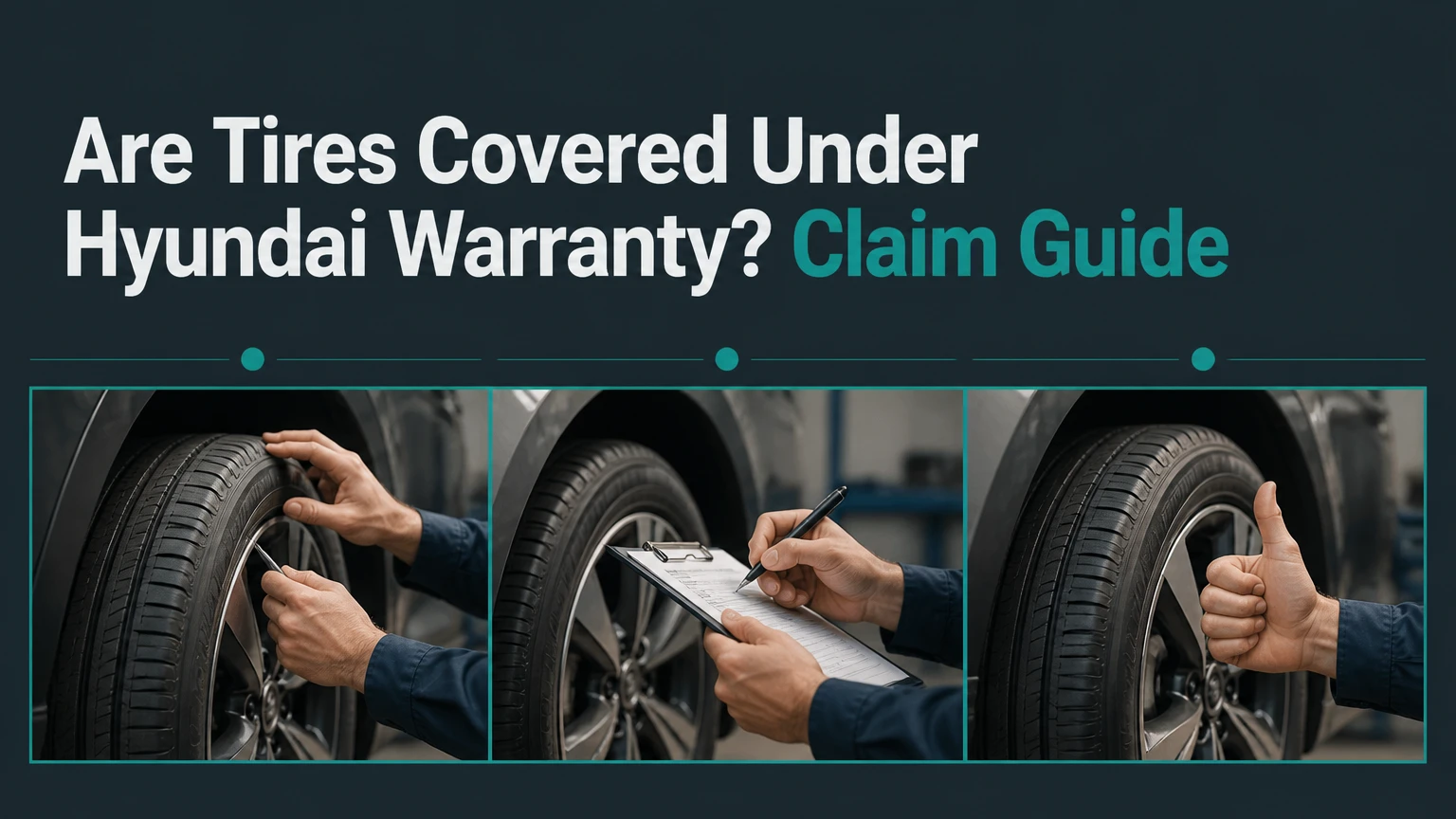
Original-equipment tires are generally not covered directly by the Hyundai New Vehicle Limited Warranty. The tire manufacturer, such as Michelin, Hankook, Continental, Goodyear, or Kumho, provides the applicable warranty for manufacturing defects, while Hyundai covers vehicle components such as suspension or alignment parts when a covered defect causes the problem.
Key Facts / At a Glance
Hyundai’s new-vehicle warranty generally excludes tires as consumable items.
The tire brand’s limited warranty may cover manufacturing defects, subject to time, mileage, tread, and maintenance conditions.
Potholes, nails, glass, curb impacts, underinflation, and normal wear usually fall outside a standard tire-defect warranty.
An authorized Hyundai dealer can inspect the tire and often help route a claim to the tire manufacturer.
Hyundai roadside assistance can typically help with a flat or tow, but roadside service does not usually pay for the replacement tire.
Replacement may be free for a new tire or prorated after measurable tread wear, depending on the tire brand’s policy.
Are Tires Covered Under Hyundai Warranty?
No, Hyundai’s factory vehicle warranty does not normally pay for a worn, punctured, or impact-damaged tire. Original-equipment tires have a separate warranty from the tire manufacturer, and the tire sidewall identifies the brand, size, load rating, speed rating, and DOT identification number needed for a claim.
The distinction matters because a tire problem can involve three separate products: the tire, the wheel, and the vehicle. A defective tire may qualify under the tire maker’s policy. A bent wheel caused by a pothole usually does not qualify under either the Hyundai vehicle warranty or the tire manufacturer’s defect warranty. A failed suspension component that damages a tire may create a separate Hyundai warranty claim, although the resulting tire wear is not automatically reimbursed.
Hyundai’s 5-year/60,000-mile New Vehicle Limited Warranty is broad, but broad does not mean every item installed on the vehicle is included. Tires are treated as externally supplied wear items, much like brake friction material and wiper blades.
How Is Hyundai Warranty Coverage Divided?
Hyundai covers the vehicle; the tire company covers the tire. The correct claim provider depends on the failed component and the cause of damage, not simply on where the tire was purchased or installed.
| Problem or failed item | Likely responsible provider | Typical evidence needed | Usual outcome |
|---|---|---|---|
| Tire tread separates without impact evidence | Tire manufacturer | Tire, DOT number, inspection | Replacement or prorated adjustment |
| Tire hits a pothole and develops a bulge | Road-hazard plan, insurer, or owner | Impact inspection, photographs | Repair or replacement if optional coverage applies |
| Wheel bends after road impact | Wheel plan, insurer, or owner | Wheel inspection, impact evidence | Wheel repair or replacement if covered |
| Suspension part causes abnormal wear | Hyundai, if defect is covered | Alignment report, failed-part diagnosis | Vehicle-part repair; tire reimbursement varies |
| Nail punctures repairable tread | Owner or road-hazard provider | Puncture location and repair inspection | Repair, often at the owner’s expense |
| Tire wears out through normal use | Owner | Tread-depth measurement | Replacement at owner’s expense |
The Hyundai owner’s warranty booklet controls the vehicle warranty in the United States. The tire manufacturer’s warranty booklet controls the tire adjustment. Terms can differ by country, model year, tire brand, retailer, and replacement date.
Who Warranties the Original Hyundai Tires?
The tire brand molded into the sidewall warranties the original Hyundai tire, subject to that brand’s written policy. Common Hyundai suppliers include Michelin, Hankook, Continental, Goodyear, Kumho, and Nexen, but supplier assignments vary by model, factory, trim, and market.
Read the sidewall before contacting anyone. Record the brand, complete tire size, load index, speed symbol, DOT code, and current tread depth. The DOT code can help identify the tire’s production week and year, while the full serial information may appear on only one side of the tire.
| Sidewall detail | Example | Why it matters |
|---|---|---|
| Brand | Michelin | Identifies the warranty provider |
| Tire size | 235/55R19 | Confirms the approved replacement specification |
| Load and speed rating | 101H | Helps prevent an unsuitable replacement |
| DOT code | DOT XXXX XXXX 2324 | Identifies plant and production date |
| Treadwear rating | 500 | Provides comparative labeling, not a guaranteed mileage promise |
| Original-equipment marking | Hyundai-specific code, when present | Helps confirm factory fitment |
A Hyundai dealer can inspect the tire, but the dealer does not replace the tire manufacturer as the warrantor. An authorized retailer for the tire brand may also process the adjustment, and some brands require the claim to go through an approved dealer network.
What Tire Defects Can Qualify for Warranty Coverage?
A tire manufacturer’s defect warranty may cover structural or workmanship failures that occur without an external cause. Examples include internal belt separation, a sidewall bulge with no impact mark, casing failure, or severe irregularity attributable to faulty construction.
A visible sidewall bubble requires prompt action because the tire may have lost structural integrity. A bubble often results from a pothole or curb strike, however, so an inspection must determine whether impact evidence exists. The appearance alone does not prove a factory defect.
Tire warranties commonly impose conditions involving the original owner, the service life of the tire, remaining tread, proof of purchase, and proper maintenance. Some policies provide full replacement during an early adjustment period and prorated credit afterward. Exact thresholds differ among manufacturers, so a dealer’s verbal estimate is not a substitute for the tire brand’s current policy.
What evidence supports a defect claim?
Strong evidence connects the failure to the tire and eliminates common external causes. Provide:
- The failed tire, without cutting or discarding it.
- Photographs of the complete tread, both sidewalls, bead area, and damage.
- The DOT identification code and purchase or delivery records.
- Tread-depth readings from multiple grooves.
- Alignment, rotation, inflation, and maintenance records.
- A written inspection result describing the failure mechanism.
Do not continue driving on a bulging, rapidly deflating, or separated tire. Safety takes priority over preserving evidence; photograph the tire after safely reaching a repair facility.
What Tire Damage Is Excluded?
Standard tire-defect warranties usually exclude road hazards, normal tread wear, misuse, racing, overloading, underinflation, improper mounting, poor repairs, and damage caused by vehicle defects that the tire maker did not create. A pothole claim is therefore different from a manufacturing-defect claim.
| Damage type | Standard defect warranty | Possible alternative payer | Practical action |
|---|---|---|---|
| Nail in repairable tread area | Usually excluded | Road-hazard plan | Have a qualified shop inspect and repair |
| Sidewall cut from glass | Usually excluded | Road-hazard plan or insurance | Replace if sidewall integrity is compromised |
| Bulge after pothole impact | Usually excluded | Tire-and-wheel plan or insurance | Photograph impact evidence and inspect wheel |
| Evenly worn tread at legal limit | Excluded | None ordinarily | Replace based on tread and age |
| Cupping from bad alignment | Usually excluded by tire maker | Hyundai, if a covered vehicle defect exists | Obtain alignment and suspension diagnosis |
| Wear from chronic underinflation | Excluded | None ordinarily | Correct pressure and replace unsafe tire |
| Defect with no impact evidence | Potentially covered | Tire manufacturer | Preserve tire and request adjustment |
“Road hazard” normally means accidental damage from an object or road condition. It does not mean a tire was poorly made. A puncture from a screw and a spontaneous belt separation require different inspections and different claim routes.
How Do You File a Hyundai Tire Claim?
Start with a safe inspection, then submit the tire and supporting records to an authorized Hyundai dealer or authorized retailer for the tire brand. A complete claim commonly takes one inspection visit, although a disputed diagnosis can require additional measurements, manufacturer review, or replacement authorization.
Step 1: Make the vehicle safe
Move away from traffic, avoid driving on a flat tire, and use Hyundai roadside assistance if changing the tire is unsafe. Photograph the damage only from a safe position. A damaged sidewall, exposed cord, tread separation, or persistent pressure loss requires professional inspection rather than a temporary inflation.
Step 2: Record tire and vehicle information
Write down the vehicle identification number, mileage, delivery date, tire brand, size, DOT code, and tread depth. Keep the damaged tire available because a claim cannot be meaningfully evaluated after disposal.
Step 3: Gather maintenance evidence
Collect invoices showing tire rotations, inflation checks, alignments, suspension work, and tire purchases. Hyundai maintenance schedules and tire-maker policies differ, so do not assume that an oil-change receipt alone proves the tire was rotated.
Step 4: Select the claim location
Contact the selling Hyundai dealer, another authorized Hyundai dealer, or an authorized retailer for the tire brand. Ask whether the location handles original-equipment tire adjustments and whether an appointment is required.
Step 5: Request a written diagnosis
Ask the technician to document impact breaks, puncture location, tread measurements, internal separation, alignment readings, and wheel condition. A written diagnosis is valuable if the initial result conflicts with visible evidence.
Step 6: Review the proposed remedy
Confirm whether the offer is a free replacement, prorated credit, repair, or denial. Ask which tire warranty clause applies, whether mounting and balancing are included, and whether the replacement must match the other tires.
You will know the process is complete when the provider gives a written disposition and the vehicle leaves with a safe tire, correct inflation, and any required TPMS relearn or balance service.
Is Tire Replacement Free or Prorated?
A tire replacement is free only when the applicable tire policy allows full adjustment and the defect meets its conditions. Tires with substantial use are commonly handled through a prorated credit based on the usable tread remaining, with the owner paying the balance and related service charges.
A simplified calculation often resembles:
Adjustment credit = eligible tire price × percentage of usable tread remaining
The actual formula may use the manufacturer’s current replacement price, original purchase price, tax, or a defined tread-depth threshold. “Usable tread” usually excludes the legal wear limit, so a tire with 6/32 inch remaining is not treated as having 60 percent of a brand-new tire’s value automatically.
| Claim stage | Typical tire condition | Likely financial result | Common owner payment |
|---|---|---|---|
| Early defect adjustment | Little or no tread wear | Full tire replacement under policy | Mounting, balancing, tax, or disposal |
| Mid-life defect adjustment | Measurable usable tread | Prorated credit | Remaining tire price and service |
| Late-life defect adjustment | Near wear limit | Small credit or no adjustment | Most replacement cost |
| Road-hazard damage without plan | Puncture or impact | No standard defect benefit | Repair or full replacement |
| Road-hazard plan claim | Covered accidental damage | Repair or replacement under contract | Deductible or excluded service, if applicable |
The tire manufacturer, not Hyundai, determines the adjustment amount for an original-equipment tire. Replacement tires purchased later may have a new warranty start date and a different road-hazard policy.
What Does Hyundai Roadside Assistance Pay For?
Hyundai roadside assistance is designed to restore mobility, not to warranty the tire. Hyundai USA describes roadside assistance as including services such as flat-tire assistance, jump-starts, lockout support, fuel delivery under program terms, and towing, with coverage limits controlled by the vehicle’s applicable program.
For a flat, roadside personnel may install the vehicle’s serviceable spare or tow the Hyundai to a qualified facility. Roadside assistance generally does not pay for a new tire, wheel, alignment, tire repair, or damage caused by a pothole.
Coverage duration and terms must be checked against the vehicle’s warranty materials and market. In the United States, Hyundai commonly advertises 5 years of roadside assistance with unlimited mileage for qualifying new vehicles, but program details can change.
How Do Optional Protection Plans Compare?
Optional protection plans can cover risks that the factory tire warranty excludes, especially pothole damage and wheel replacement. They are contracts with their own term, exclusions, claim limits, and cancellation rules, not extensions of the Hyundai New Vehicle Limited Warranty.
| Protection option | Typical covered event | Typical term or price | Main limitation |
|---|---|---|---|
| Tire manufacturer defect warranty | Workmanship or material failure | Often several years, policy-specific | Usually excludes road hazards |
| Hyundai roadside assistance | Flat-tire labor or towing | Commonly 5 years in the USA | Does not normally buy the tire |
| Dealer road-hazard plan | Puncture or impact damage | Often 12-24 months | Usually applies only to purchased tires |
| Tire-and-wheel protection contract | Covered tire and wheel road damage | Commonly 3-5 years | Contract exclusions and claim procedures apply |
| Auto insurance comprehensive coverage | Some accidental road or object damage | Policy-specific | Deductible may exceed a low-cost tire |
| Credit-card or retailer benefit | Limited purchase protection | Often 60-120 days | Rarely covers ordinary tire use |
Typical tire-and-wheel plan prices range from approximately $600 to $1,500 for a vehicle contract, but price depends on wheel diameter, vehicle class, term, deductible, and dealer pricing. Compare the total premium with the cost of likely replacement tires, low-profile wheel damage, deductible, and the probability of repeated road hazards.
A plan can make financial sense for expensive 20-inch tires or fragile low-profile sidewalls. It is less attractive when replacement tires cost $150-$250 and the contract excludes the road conditions most likely to cause damage.
What Costs Should You Expect?
Typical out-of-pocket costs depend on tire size, brand, location, and whether the damage is repairable. The figures below are planning ranges for common passenger vehicles in the United States, not Hyundai-authorized price guarantees.
| Service or replacement | Typical range | Main price drivers | Warranty relevance |
|---|---|---|---|
| Tire puncture repair | $20-$45 | Shop policy and puncture location | Usually owner-paid without road-hazard coverage |
| Passenger replacement tire | $150-$300 | Size, brand, performance rating | Defect adjustment may reduce price |
| Large SUV or EV tire | $220-$450 | Load rating, size, noise rating | Warranty does not cover normal wear |
| Mounting and balancing | $25-$60 per tire | Local labor and wheel size | May remain payable during adjustment |
| Four-wheel alignment | $100-$200 | Suspension design and local labor | Vehicle-defect diagnosis may change responsibility |
| Wheel replacement | $300-$1,200 or more | Alloy design, diameter, OEM status | Usually requires separate protection or insurance |
An AWD Hyundai may require additional tires when one tire cannot be matched closely enough to the others. The owner’s manual or tire professional should determine acceptable tread-depth difference, because driveline systems can react badly to mismatched rolling circumferences.
What Should You Do About Uneven Wear?
Uneven wear requires two inspections: a tire inspection and a vehicle alignment or suspension inspection. Tire manufacturers commonly deny wear claims when evidence points to incorrect inflation, missing rotations, bent wheels, worn suspension parts, or misalignment rather than defective tire construction.
Measure tread at the inner, center, and outer grooves. Inner-edge wear can indicate excessive negative camber or toe, while center wear often indicates overinflation and both-shoulder wear commonly indicates underinflation. Cupping or scalloping may involve balance, shock absorbers, wheel runout, or rotation history.
Hyundai may cover a defective alignment-related component if the component itself fails within the applicable warranty. That does not guarantee payment for every tire damaged by the condition. Ask the dealer to separate the failed vehicle part, the alignment result, and the tire consequence on the repair order.
Rotate tires according to the Hyundai owner’s manual and maintain cold inflation at the door-jamb specification. The 5,000-7,500-mile interval sometimes cited by dealers is a typical maintenance range, not a universal tire-warranty rule for every Hyundai model.
What Should You Do After a Puncture or Blowout?
A repairable tread puncture should be inspected promptly, while a sidewall puncture, blowout, exposed cord, or large tear normally requires tire replacement. Do not drive any distance on a flat tire unless a qualified professional confirms that the tire and wheel remain safe.
For a puncture, use roadside assistance when traffic or location makes self-help unsafe. A tire shop should remove the tire and inspect the inside, because an external plug alone may conceal internal damage from driving while underinflated.
For a blowout, retain the tire and photograph the tread, sidewall, wheel, and road conditions. Contact the tire brand’s authorized dealer for a defect evaluation only after impact damage has been considered. If a pothole caused the event, check a tire-and-wheel contract, road-hazard plan, insurance policy, and possible local-road damage process.
What changes for AWD, EV, and hybrid models?
AWD Hyundai vehicles need closely matched tire circumference across axles, and many EV or hybrid Hyundai models use high-load tires designed for heavier curb weights. Low-profile performance tires also provide less sidewall cushioning, which increases the risk of sidewall damage and wheel bending after a sharp impact.
Replace the damaged tire with the same approved size, load index, speed rating, and preferably the same model. For AWD, ask the service department to measure all four tread depths before buying only one tire. For an IONIQ 5, IONIQ 6, Tucson Hybrid, Santa Fe Hybrid, or other electrified model, do not assume battery weight or instant torque creates a warranty defect; accelerated wear is usually normal use unless a covered vehicle fault caused it.
Can a Used Hyundai Claim Tire Warranty Coverage?
A used Hyundai may retain whatever transferable tire-manufacturer warranty remains, but transfer rules vary. Some tire policies follow the tire and vehicle; others require the original purchaser, proof of purchase, or an authorized installation record.
Ask the seller for the original delivery paperwork and tire invoices. Check the tire’s age, remaining tread, DOT code, and current manufacturer policy before relying on coverage. A Hyundai vehicle warranty remaining after resale does not automatically create tire coverage.
A replacement tire purchased from a retailer may have a separate workmanship warranty and optional road-hazard benefit. Confirm whether the benefit starts on the purchase date, whether it transfers to another owner, and whether rotations or inflation checks are conditions of adjustment.
Which Claim Route Should You Choose?
Use the tire manufacturer or Hyundai dealer for suspected manufacturing defects, roadside assistance for immediate mobility, and a road-hazard provider or insurer for pothole and puncture damage. Choosing the wrong route can delay inspection and cause the tire to be discarded before evidence is recorded.
| Your situation | First contact | Do not assume | Best next evidence |
|---|---|---|---|
| Sidewall bulge with no visible impact | Tire-brand dealer or Hyundai dealer | A bulge automatically proves defect | Photos, DOT code, inspection |
| Nail in tread | Roadside service or tire shop | Factory warranty pays for puncture | Internal repair inspection |
| Pothole damages tire and wheel | Tire-and-wheel provider or insurer | Roadside assistance pays repair costs | Photos, police or road report if available |
| Four tires wear unevenly | Hyundai service department and tire shop | Tire warranty covers all wear | Alignment printout and tread map |
| One AWD tire fails | Hyundai dealer or tire specialist | Any same-size tire is sufficient | Four-tire tread measurements |
| Tire fails soon after delivery | Selling dealer and tire manufacturer | Hyundai automatically owns tire liability | Delivery date, invoice, DOT code |
FAQ
Does Hyundai cover tire rotation under warranty?
Hyundai’s factory warranty does not generally pay for routine tire rotation because rotation is maintenance, not a failed vehicle component. Complimentary maintenance programs may include scheduled rotations for eligible models and intervals, but coverage depends on the model, market, enrollment terms, and service schedule.
How long do Hyundai original tires have warranty coverage?
There is no single Hyundai tire-warranty period because the tire manufacturer sets the terms. Coverage may depend on calendar age, mileage, remaining tread, ownership, and proof of purchase. Read the warranty booklet for the brand printed on the sidewall instead of applying Hyundai’s 5-year/60,000-mile vehicle warranty to the tire.
Does Hyundai cover a tire-pressure sensor?
The TPMS sensor is a vehicle component, not the tire itself. A sensor that fails because of a covered manufacturing defect may qualify under the Hyundai vehicle warranty, while damage during tire mounting, corrosion, impact, or a depleted sensor battery may be excluded. The diagnosis must identify the failed part.
Does Hyundai cover alignment?
Hyundai may cover an alignment-related issue when a covered vehicle defect, such as a failed suspension or steering component, causes the condition. Routine alignment adjustments, pothole damage, curb impacts, and tire wear generally are not warranty benefits. Ask for alignment readings and a component diagnosis rather than requesting a tire-only claim.
Can a Hyundai dealer deny a tire claim?
A Hyundai dealer can determine that the claim is not a Hyundai vehicle-warranty repair, but the tire manufacturer or its authorized retailer makes the tire-warranty decision. Request the inspection findings and contact the tire brand’s customer-support channel if the diagnosis omits impact evidence, tread measurements, or the applicable warranty provision.
Should you replace all four tires after one fails?
Replace all four only when tread mismatch, AWD requirements, tire age, or vehicle handling makes a single replacement unsuitable. A tire professional can measure the remaining tread and consult the Hyundai owner’s manual. On two-wheel-drive vehicles, replacing one axle pair may be sufficient when the tire models and tread depths are properly matched.
The Bottom Line
Tires are generally not covered directly under the Hyundai vehicle warranty. The tire manufacturer handles manufacturing defects, Hyundai handles covered vehicle components, roadside assistance handles mobility services, and optional road-hazard or tire-and-wheel contracts handle qualifying impact damage.
For the strongest claim, preserve the tire, record the DOT number and tread depth, gather maintenance records, and obtain a written diagnosis before authorizing disposal. If the question is specifically “are tires covered under Hyundai warranty,” the practical answer is no for ordinary tire damage, with a possible tire-brand remedy when the failure is a documented manufacturing defect.