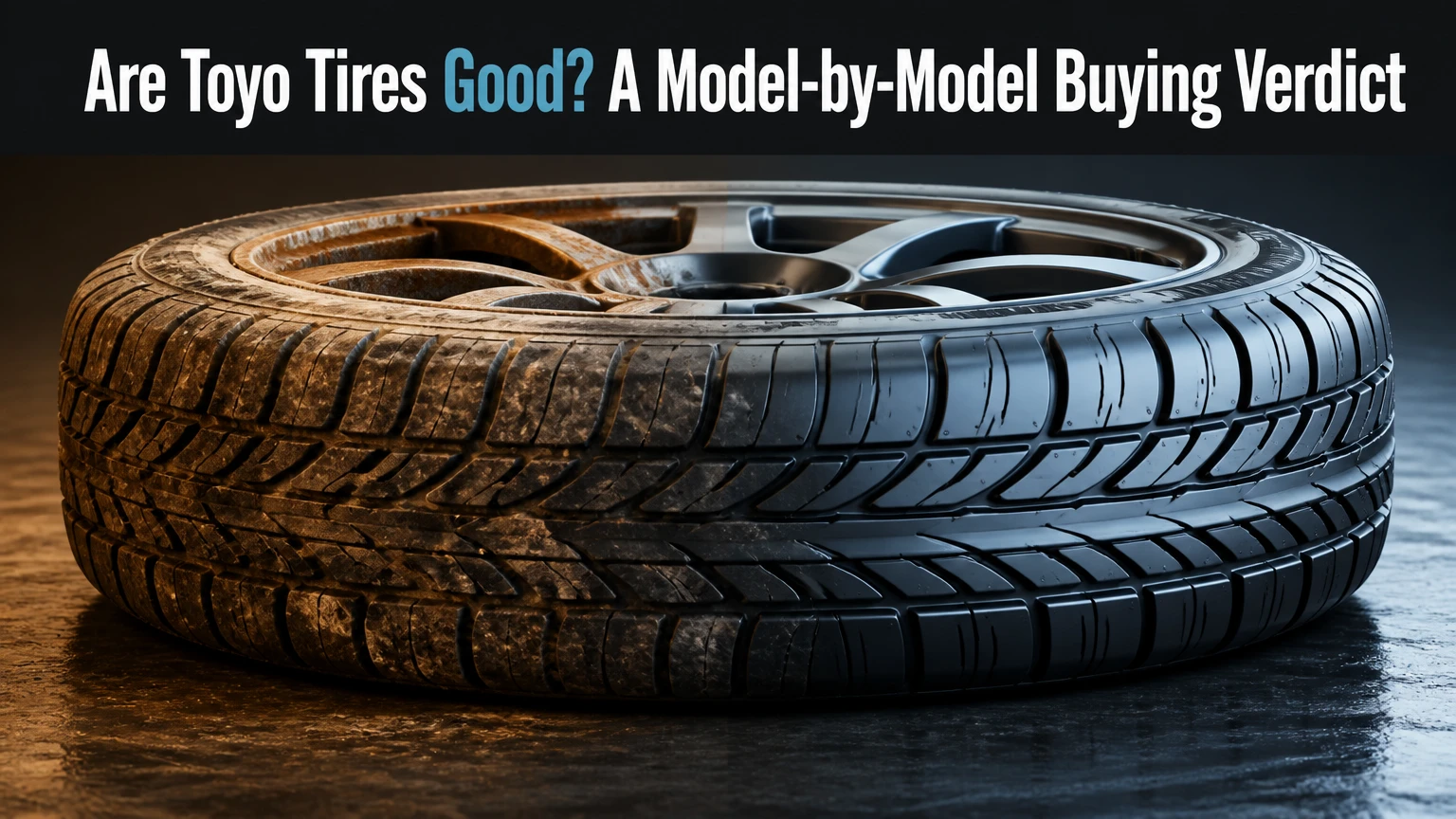
Toyo tires are good when you choose the model for the vehicle and driving conditions. Toyo’s Open Country tires are especially strong for trucks, SUVs, towing, and off-road use, while Proxes models suit performance driving and Extensa models target affordable commuting. Toyo does not consistently beat Michelin or Continental for quiet touring, wet braking, or refined passenger-car comfort.
Key Facts at a Glance
- Toyo Tire Corporation was founded in Japan in 1945 and sells passenger, performance, truck, SUV, commercial, and competition tires.
- Toyo Open Country A/T III is a strong all-terrain choice for drivers who divide time between pavement and moderate trails.
- Toyo mud-terrain tires improve mud and rock traction but usually increase road noise, rolling resistance, and tread wear.
- Toyo Proxes, Extensa, and Celsius tires have different purposes, so brand-level ratings can mislead buyers.
- A 3PMSF symbol identifies a tire tested for severe snow conditions; it does not make the tire equivalent to a dedicated winter tire.
- Tire pressure, alignment, rotation, load rating, and vehicle fitment affect safety and life more than the logo on the sidewall.
What Kind of Tire Brand Is Toyo?
Toyo is a Japanese tire manufacturer positioned between budget brands and the most expensive global premium brands. The company is best known in North America for Open Country truck and SUV tires, although its catalog also includes Proxes performance tires, Extensa touring tires, Celsius all-weather tires, commercial products, and motorsport tires.
Toyo tires are not one uniform product. A Toyo Open Country A/T III has a different engineering target from an Extensa A/S II or a Proxes R888R. The first prioritizes mixed-surface traction, the second emphasizes economical transportation, and the third sacrifices tread life for track grip.
That distinction explains conflicting owner reviews. A driver comparing an aggressive all-terrain tire with a Michelin touring tire is evaluating noise, steering response, tread life, and traction priorities that cannot be optimized simultaneously.
How Does Toyo Compare With Premium Brands?
Toyo commonly offers a lower purchase price than comparable Michelin, Continental, or Pirelli tires, but the saving does not guarantee equal performance in every category. Independent tire tests frequently separate competitors by wet braking, snow traction, handling, comfort, and rolling resistance rather than producing one universal brand winner.
The practical verdict is narrow and useful: Toyo is often a premium-value choice for trucks, SUVs, and enthusiast applications, but buyers seeking the quietest highway ride or strongest all-weather commuter performance should compare the exact model against Michelin, Continental, Bridgestone, and Hankook.
The National Highway Traffic Safety Administration states that “Tires are the only thing between your vehicle and the road.” That principle matters more than a brand reputation because the correct load index, speed rating, and weather category determine whether a tire suits a particular vehicle.
Are Toyo Tires Good for Trucks and SUVs?
Toyo tires are particularly good for trucks and SUVs when the buyer selects the correct Open Country variant. Open Country A/T III suits mixed highway and trail driving, Open Country M/T suits mud and rocky terrain, and highway-oriented products suit drivers who rarely leave paved roads.
Toyo’s truck range also includes products for towing, commercial pickup use, and severe-duty applications. An LT tire may carry more load and resist abuse better than a P-metric tire, but its heavier construction can reduce ride comfort and fuel economy.
Toyo Truck and SUV Models Compared
| Toyo family | Primary surface | Typical strengths | Main trade-off | Suitable driver |
|---|---|---|---|---|
| Open Country A/T III | Highway, gravel, dirt, moderate trail | All-terrain grip, sidewall protection, highway stability | More noise than a touring tire | Weekend off-roader |
| Open Country M/T | Deep mud, rocks, loose terrain | Open lugs, self-cleaning tread, puncture resistance | Loud pavement ride and faster wear | Dedicated mud user |
| Open Country R/T | Pavement, gravel, moderate rock | Aggressive appearance, stronger trail manners than M/T | Less quiet than highway tires | Style-focused truck owner |
| Open Country H/T II | Highway, wet pavement, light towing | Ride comfort, predictable handling, long-distance use | Limited off-road traction | Highway truck driver |
| Open Country C/T | Work trucks, pavement, job sites | Durability and commercial-use construction | Heavier feel and cost | Contractor or fleet user |
The 65,000-mile warranty often associated with Open Country A/T III applies only to specified sizes and service conditions. LT sizes, severe off-road use, irregular wear, commercial use, and failure to rotate the tires can reduce or eliminate warranty eligibility.
A 50/50 highway-trail split is a useful marketing shorthand, not a technical promise. Drivers who spend 90 percent of their time on pavement may prefer a highway-terrain or mild all-terrain tire, because aggressive tread can add noise and reduce wet-road efficiency without providing a meaningful daily benefit.
Is Toyo Open Country A/T III Good in Snow?
Open Country A/T III can perform well in light to moderate snow, especially when it carries the Three-Peak Mountain Snowflake, or 3PMSF, marking. The marking indicates a standardized severe-snow traction test, but it does not mean the tire matches a studless winter tire on ice or packed snow.
Drivers in mountain regions should distinguish between snow depth and ice traction. An all-terrain tire can clear loose snow effectively, while a winter tire uses a softer cold-weather compound and dense siping to maintain grip below freezing.
For frequent ice, freezing rain, or temperatures below approximately 45°F, a dedicated winter tire remains the more defensible choice. For occasional snow in a moderate climate, a 3PMSF-rated all-terrain tire can avoid the storage and seasonal changeover required by two tire sets.
Are Toyo Tires Good for Everyday Cars?
Toyo tires are adequate to very good for everyday cars, depending on the product line and the driver’s priorities. Extensa models focus on price and mileage, Celsius models add cold-weather capability, and Proxes models emphasize steering response rather than maximum comfort.
Toyo passenger tires can be sensible for older sedans, compact cars, and drivers who value a competitive installed price. They are less compelling when the vehicle is a luxury sedan whose owner prioritizes low cabin noise, gentle impact absorption, and strong wet braking above purchase cost.
Passenger and Performance Families
| Tire family | Tire category | Typical price per tire | Typical warranty range | Best use |
|---|---|---|---|---|
| Extensa A/S II | Standard all-season | $80-$150 | Up to about 75,000 miles on eligible sizes | Low-cost commuting |
| Celsius II or AS2 | All-weather | $110-$190 | Model and market dependent | Occasional snow and cold rain |
| Proxes Sport A/S | Ultra-high-performance all-season | $150-$300 | Often shorter than touring products | Sport sedans and responsive steering |
| Proxes Comfort | Grand touring | $120-$220 | Model and size dependent | Quieter daily driving |
| Proxes R888R | DOT competition tire | $250-$550 | No normal long-mileage expectation | Track days and autocross |
Price ranges are typical United States retail estimates before installation, taxes, disposal fees, and alignment. Wheel diameter, vehicle size, regional inventory, and seasonal promotions can move the final price substantially.
A high UTQG treadwear number does not prove that one brand will last longer than another. The National Highway Traffic Safety Administration explains that UTQG ratings help consumers compare tires, but treadwear values are assigned by manufacturer testing and are not a guarantee of actual mileage.
What Does Toyo’s Technology Actually Do?
Toyo uses several design and compound technologies, but the feature name must be tied to the individual product. Nano Balance Technology refers to material and compound development intended to balance rolling resistance, wet grip, and durability; it does not mean every Toyo tire has identical fuel-economy behavior.
Silent Wall design uses molded features in selected grooves to disrupt air movement and reduce certain tread frequencies. Those features can moderate noise, but tread pattern, inflation, vehicle insulation, pavement texture, and uneven wear remain larger influences on cabin sound.
Multi-Wave Sipes interlock tread elements under load while creating additional biting edges. The design can stabilize blocks and improve wet or winter traction, but siping cannot overcome a summer compound used in freezing temperatures or a worn tread with insufficient groove depth.
The technical takeaway is simple: Toyo technologies are trade-off management, not magic performance upgrades. Compound, casing, void ratio, tread depth, and intended operating temperature still control the real-world result.
How Much Do Toyo Tires Cost?
A complete Toyo tire purchase typically costs about $400-$1,600 before tax and installation, with compact-car sets near the lower end and large truck or performance sets near the upper end. Mounting, balancing, valve hardware, disposal, road-hazard coverage, and alignment can add $100-$300.
| Vehicle and use | Typical tire set | Installation estimate | Realistic service target |
|---|---|---|---|
| Compact sedan, touring | $320-$650 | $100-$180 | 45,000-75,000 miles |
| Crossover, all-weather | $450-$850 | $110-$200 | 40,000-65,000 miles |
| Half-ton pickup, all-terrain | $650-$1,400 | $130-$250 | 35,000-65,000 miles |
| Heavy-duty pickup, LT all-terrain | $850-$1,700 | $150-$300 | 30,000-55,000 miles |
| Performance car, Proxes | $600-$1,300 | $110-$220 | 15,000-40,000 miles |
| Track use, R888R | $1,000-$2,200 | $120-$250 | About 10-20 track events, highly variable |
A treadwear warranty is conditional rather than prepaid mileage. The owner generally must maintain correct inflation, rotate according to the manufacturer’s schedule, retain service records, and replace tires before the warranty’s legal wear limit.
Toyo’s customer-care policies and promotions vary by country, retailer, product, and purchase date. A 45-day or 500-mile trial should never be assumed to apply unless the written offer covers the exact model and seller.
What Are the Main Advantages and Disadvantages?
Toyo’s main advantage is product specialization, particularly in truck, SUV, off-road, and performance categories. Toyo’s main disadvantage is that aggressive products can impose noticeable penalties in road noise, fuel consumption, winter ice traction, and tread life.
Advantages of Toyo Tires
- Open Country products offer strong sidewall and tread protection for gravel, work sites, and trails.
- Toyo often undercuts comparable premium truck tires while retaining a substantial dealer network.
- Proxes products give enthusiasts multiple choices between street performance and competition use.
- Celsius all-weather products can simplify ownership for drivers who experience occasional snow.
- Many sizes carry competitive mileage warranties for normal highway service.
- The catalog includes P-metric and LT constructions for different load and ride requirements.
Limitations to Consider
- Mud-terrain tires can be tiring on long highway trips because tread noise rises as lugs wear.
- An all-terrain tire cannot deliver the same ice grip as a dedicated winter tire.
- LT construction can make an unloaded pickup ride more firmly than a P-metric tire.
- Performance compounds usually wear faster than touring compounds.
- Aggressive tread can reduce fuel economy through higher rolling resistance.
- Owner complaints about noise often result from cupping or alignment problems rather than a defective tire.
A tire that is excellent for a rock crawler is a poor choice for a quiet commuter. Toyo is not automatically the best answer for luxury touring, maximum electric-vehicle range, or severe winter driving.
Which Tire Brands Are Better Alternatives?
Michelin and Continental are usually stronger alternatives for drivers who prioritize quiet touring, wet braking, and polished highway manners. Falken and BFGoodrich are close comparisons for all-terrain truck use, while Hankook and General often compete effectively on value and long-warranty commuter applications.
| Priority | Toyo comparison | Alternative brands to inspect | Why the alternative may win |
|---|---|---|---|
| Quiet sedan ride | Proxes Comfort or Extensa | Michelin Primacy, Continental PureContact | Lower perceived road noise and refined ride |
| Long commuter mileage | Extensa A/S II | General Altimax, Hankook Kinergy | Competitive warranty and purchase price |
| Truck all-terrain use | Open Country A/T III | Falken Wildpeak A/T4W, BFGoodrich KO3 | Snow behavior, warranty, or sidewall preference |
| Deep mud and rocks | Open Country M/T | BFGoodrich Mud-Terrain, Nitto Trail Grappler | Different lug, casing, and noise balance |
| Severe winter | Celsius where available | Bridgestone Blizzak, Michelin X-Ice | Better ice and cold-compound performance |
| Track driving | Proxes R888R | Yokohama ADVAN, Falken Azenis | Heat-cycle behavior and track-specific grip |
No comparison is valid without matching size, load index, speed rating, and vehicle. A 265/70R17 LT tire and a 265/70R17 P-metric tire may share dimensions while differing materially in capacity, casing, pressure range, and ride.
How Should You Choose the Right Toyo Tire?
Choose a Toyo tire by confirming fitment first, then ranking weather, surface, load, comfort, and cost requirements. The correct process takes approximately 20-30 minutes online and another 15-30 minutes at the retailer if alignment or suspension inspection is needed.
Step 1: Read the Vehicle Placard
Find the placard inside the driver-side doorjamb. Record the original tire size, recommended cold inflation pressure, and required load information; do not use the maximum pressure molded into the tire as the normal operating pressure.
The owner’s manual may list alternate sizes, but an alternate size must preserve safe load capacity, clearance, speed rating, and TPMS compatibility. Tire Rack, Toyo’s catalog, and a qualified tire shop can help verify the application.
Step 2: Match the Tire to the Surface
Use a touring or highway-terrain tire when pavement accounts for nearly all driving. Choose an all-terrain tire for regular gravel, forest roads, construction access, or moderate trails, and reserve mud-terrain products for terrain that genuinely requires open lugs.
Over-tiring is expensive. A mud tire used only on pavement can provide less total utility than a quieter all-terrain tire because it adds noise and wear without improving the driver’s normal route.
Step 3: Confirm P-Metric, LT, Load Index, and Speed Rating
P-metric tires generally prioritize ride comfort and ordinary passenger loads. LT tires use stronger construction for higher loads, towing, and abuse, but the truck’s door-placard requirements and axle ratings remain the authority.
Never reduce the load index below the vehicle requirement. For towing, account for passengers, cargo, tongue weight, trailer load, and rear-axle capacity rather than choosing a tire based only on its advertised appearance.
Step 4: Check the DOT Date Code
The final four digits of the DOT Tire Identification Number identify the manufacturing week and year. A code ending in 1226 means the 12th week of 2026, not a 2026 model number.
Buyers should prefer fresh inventory, inspect for cracking, and avoid accepting old stock without a price adjustment and a clear understanding of the retailer’s policy. The U.S. Tire Manufacturers Association advises replacing tires based on age and condition, while several vehicle and tire manufacturers recommend inspection and possible replacement around six years, regardless of remaining tread.
Step 5: Budget for Alignment and Maintenance
Ask for an alignment inspection when the vehicle pulls, the steering wheel is off-center, or the old tires show one-sided wear. Rotate according to the vehicle and tire manufacturer’s schedule, check pressure monthly, and inspect after pothole impacts.
The most expensive tire cannot compensate for worn tie rods, bent wheels, weak shocks, or incorrect toe settings. Cupping often reflects suspension or balance problems, and replacing tires without correcting the cause repeats the expense.
What Problems Do Toyo Tire Owners Commonly Encounter?
The most common Toyo tire problems are application mismatch, irregular wear, road noise, age-related cracking, and misunderstood warranty limits. These problems are usually diagnosed through tread patterns, pressure history, alignment measurements, and operating conditions rather than brand name alone.
| Symptom | Likely cause | Immediate check | Corrective action |
|---|---|---|---|
| Center tread wears first | Overinflation | Compare cold pressure with placard | Restore placard pressure |
| Both shoulders wear | Underinflation or overload | Check pressure and axle load | Inflate correctly and reduce overload |
| Repeating thump or roar | Cupping, imbalance, aggressive tread | Inspect tread and wheel balance | Balance, align, inspect shocks |
| One inside shoulder wears | Excessive toe or camber | Request alignment printout | Correct geometry before replacement |
| Cracks in grooves or sidewall | Aging, UV, ozone, chemical exposure | Check DOT date and cracking depth | Replace if structural cracking appears |
| Steering wanders under load | Wrong load range or worn suspension | Inspect casing, joints, and shocks | Correct tire specification and repairs |
The practitioner rule is to diagnose wear before blaming the tire. A new set installed on a misaligned vehicle can develop visible shoulder damage within several thousand miles, especially on low-profile performance tires.
Do not mix substantially different tread patterns or constructions on the same axle unless the vehicle manufacturer and tire professional approve the arrangement. Replace tires in axle pairs when possible, and place deeper-tread tires on the rear axle for many front-wheel-drive vehicles to reduce oversteer risk on wet roads.
Are Toyo Tires Safe and Reliable?
Toyo tires are safe and reliable when they are correctly sized, properly inflated, undamaged, and used within their design conditions. Reliability depends on casing construction, road hazards, heat, maintenance, loading, and age, so no brand can guarantee a fixed mileage or puncture outcome.
Inspect tires before long trips and after impacts. Replace a tire with a sidewall bulge, exposed cord, deep cut, persistent pressure loss, or structural cracking; sidewall damage is not safely repaired with an external plug.
Tread depth also matters. In the United States, 2/32 inch is commonly treated as the legal replacement threshold, but wet-weather performance declines before that point, and winter traction can deteriorate substantially with reduced siping and groove depth.
A useful ownership schedule is monthly pressure checks, rotation approximately every 5,000-8,000 miles when compatible with the vehicle, and a professional inspection at every service visit. The vehicle placard, owner’s manual, and tire manufacturer’s instructions take priority over generic intervals.
Which Drivers Should Buy Toyo Tires?
Toyo is a strong choice for an off-road weekend driver, a pickup owner who wants an aggressive but usable all-terrain tire, or an enthusiast who accepts faster wear for sharper handling. Toyo is less attractive for a luxury commuter seeking the quietest ride or a mountain driver who needs maximum ice traction.
Best Fit: Truck and SUV Owners
Choose Open Country A/T III or a comparable all-terrain product when driving includes pavement, gravel, dirt, and moderate trails. Verify whether the chosen size is P-metric or LT, then compare the tire’s load index with towing and payload demands.
Best Fit: Value-Oriented Commuters
Choose Extensa when purchase price and ordinary highway mileage outweigh premium wet-road refinement. Compare the actual warranty, independent test results, and retailer support against General, Hankook, and comparable all-season tires before deciding.
Best Fit: Drivers With Occasional Snow
Choose Celsius when the product is available in the required size and the climate includes regular cold weather with intermittent snow. Choose a dedicated winter tire instead when ice, mountain passes, or prolonged subfreezing temperatures define the driving environment.
Best Fit: Performance and Track Users
Choose a Proxes street tire for responsive road handling and a competition tire only when the owner understands heat cycles, alignment, tire temperature, and reduced wet-weather safety. A DOT-approved track tire is still a poor daily tire in heavy rain or cold weather.
FAQ
Do Toyo tires last as long as Michelin tires?
Toyo tires can last as long as comparable Michelin tires in some touring and highway applications, but mileage varies by model, vehicle, alignment, pressure, climate, and driving style. A long-warranty Extensa may outlast a soft performance Michelin, while a Michelin touring tire may provide better refined wear and wet-road behavior than an aggressive Toyo product.
Are Toyo tires noisy on the highway?
Toyo tires can be quiet, moderate, or loud depending on tread design. Extensa and touring Proxes products generally produce less noise than Open Country M/T tires, while an A/T tire may become louder as the tread develops cupping or uneven wear. Pavement texture and vehicle insulation also change the cabin result.
Are Toyo tires good in rain?
Toyo tires can perform well in rain when the model has appropriate grooves, compound, and remaining tread depth. Proxes and touring products are better suited to wet pavement than mud-terrain tires, while worn or incorrectly inflated tires can hydroplane regardless of brand. Compare wet-braking tests for the exact size and model.
Can Toyo tires be used for towing?
Toyo tires can be used for towing when their load index, construction, speed rating, and inflation range meet the vehicle and trailer requirements. LT tires may suit heavier pickup loads, but tire capacity does not increase the truck’s axle, suspension, hitch, or gross vehicle weight ratings.
How old can unused Toyo tires be?
Unused tires should be inspected for age, cracking, storage damage, and proper dealer handling before installation. The DOT code identifies the production week and year, while manufacturers and safety organizations commonly recommend increased inspection around six years and replacement around ten years from manufacture, with earlier replacement if damage appears.
Do Toyo tires need a break-in period?
Toyo tires generally need a cautious first 100 miles so the tread surface can stabilize and the driver can confirm steering, pressure, vibration, and clearance. Avoid immediate hard cornering or emergency-style testing on a new set, especially with performance or competition-oriented Proxes tires.
The Bottom Line: Are Toyo Tires Good?
Yes, Toyo tires are good when the model matches the job, and they are particularly compelling for truck, SUV, all-terrain, and enthusiast applications. Toyo Open Country products offer a strong balance of traction, durability, and price, while passenger-car products deserve direct comparison with Michelin, Continental, Hankook, and General.
The safest purchase is not the most aggressive tread or highest warranty number. It is the tire with the correct size, load rating, weather capability, maintenance plan, and road behavior for the vehicle. That is the standard by which to decide whether Toyo tires are good for your driving.