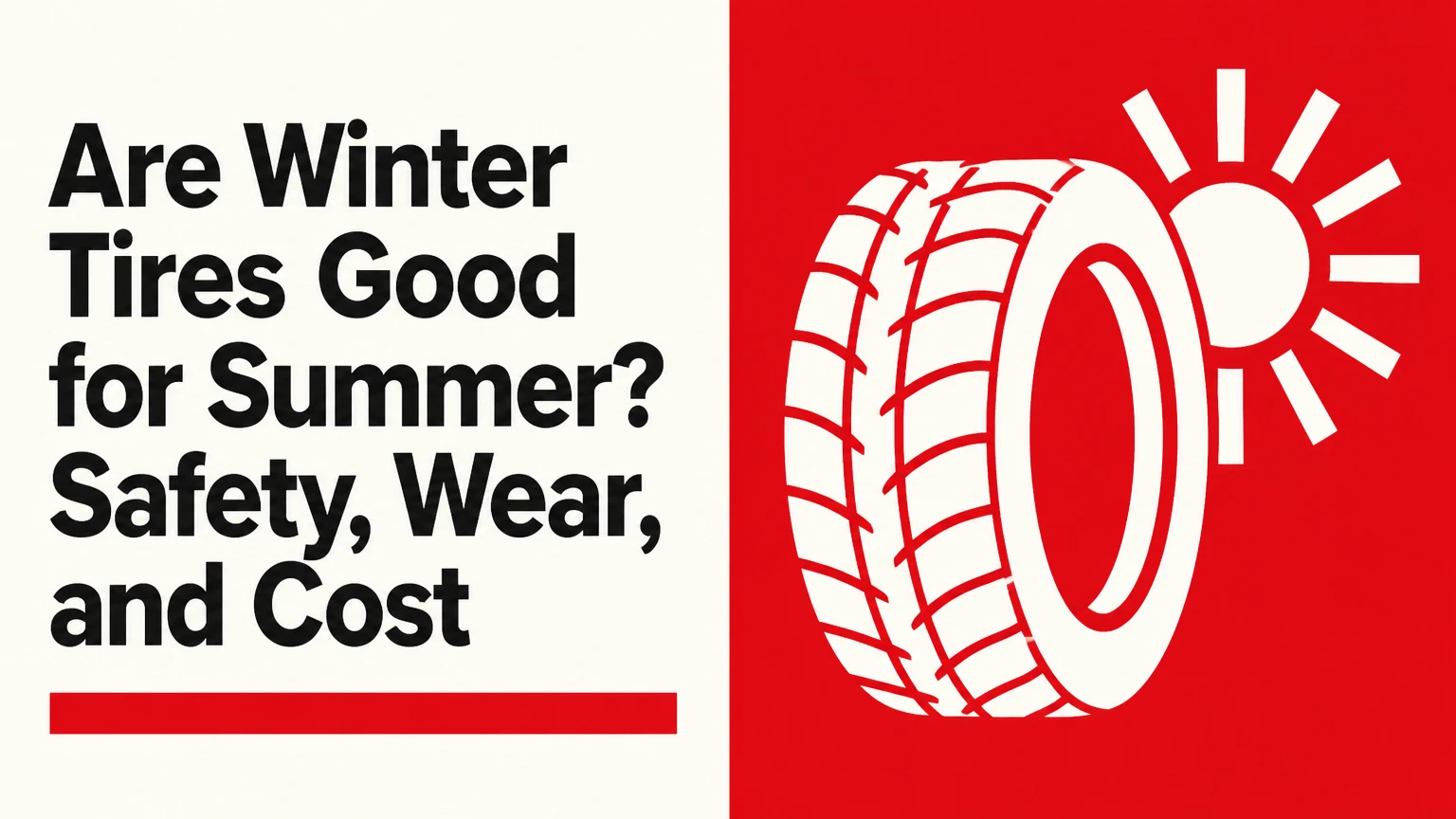
Winter tires are not a good choice for regular summer driving. Their cold-weather rubber compound becomes too soft as pavement warms, while their flexible tread blocks reduce steering precision, increase wear, and can lengthen braking on warm roads. Use summer, all-season, or all-weather tires matched to your climate once winter conditions have ended.
Key Facts at a Glance
Winter tires are optimized for cold temperatures, commonly below 7°C (45°F), snow, and ice.
The 7°C guideline is not a legal or mechanical cliff; tire performance changes progressively with temperature, road surface, model, and driving conditions.
Warm pavement makes winter-tire tread blocks flex more, which can produce vague steering and rapid shoulder or heel-and-toe wear.
Winter tires can remain temporarily usable during a cool spring week, but they are inefficient and less suitable for sustained summer heat.
Summer tires provide the strongest warm-weather dry and wet-road performance; all-season tires trade some peak grip for broader usability.
Never replace a complete winter set with only two summer tires, because mixed tire behavior can destabilize braking and cornering.
Are Winter Tires Good for Summer?
Winter tires are acceptable only as a short-term compromise in cool transitional weather, not as a summer tire strategy. A driver may safely reach a tire shop on winter tires during a warm day, but months of hot pavement expose the compound and tread to conditions they were not designed to handle.
Michelin describes winter tires as “designed to perform in temperatures below 7°C.” That phrase communicates a useful operating guideline, although 7°C is not a precise point at which a winter tire suddenly becomes unsafe. A winter tire does not transform at 7.1°C; grip, steering response, rolling resistance, and wear shift gradually as temperature rises.
The practical decision depends on the entire pattern. A driver in a northern climate with cold mornings, late snow, and occasional frost may delay the changeover briefly. A driver facing sustained 20-35°C temperatures should remove winter tires promptly, particularly before frequent motorway travel, heavy rain, towing, or spirited cornering.
Why do winter tires handle poorly in heat?
Winter tires handle poorly in heat because their cold-weather compound stays softer than a summer compound at warm pavement temperatures. Softness allows grip on ice, but it also increases tread movement, steering delay, rolling resistance, and heat generation on dry asphalt.
The tread design adds another compromise. Winter tires use open grooves and many sipes, or narrow slits, to clear snow and create biting edges. Those features are valuable on packed snow, yet they leave more unsupported tread material to bend during braking and cornering. The driver may notice a squirming response before any obvious loss of control occurs.
Studded winter tires add a separate issue. Metal studs can damage warm pavement where regulations permit them, and their tread designs often create more noise and vibration. Studded tires should follow local seasonal restrictions, which differ by jurisdiction.
How Do Winter Tires Affect Braking and Handling?
Winter tires can reduce warm-weather steering precision and may increase braking distance, but no universal percentage applies to every vehicle or road. Tire model, tread depth, road temperature, water depth, inflation pressure, vehicle weight, ABS calibration, and driver input all change the result.
On a dry, warm road, a summer tire generally provides more stable tread support and higher cornering precision. On a wet summer road, the answer still usually favors a suitable summer tire, although a worn summer tire can perform worse than a new winter tire with deeper tread. Tire condition matters as much as category.
The often-repeated claim that winter tires increase wet-summer stopping distance by exactly 10-26% should not be treated as a universal specification. A controlled comparison may produce a number within that range for particular tires and conditions, but the figure cannot predict a specific vehicle’s stopping distance.
What does the driver feel first?
The first warning is often a soft or delayed steering response rather than a dramatic slide. The steering wheel may require more correction, lane changes may feel less settled, and the vehicle can take longer to return to center after a turn.
A second warning is increased tread noise or vibration. Noise alone does not prove a safety failure, because aggressive winter tread is naturally louder, but a new hum combined with cupping, feathering, or vibration requires inspection.
A third warning is rapid tread loss. Hard acceleration, emergency braking, mountain roads, and repeated high-speed cornering generate more heat and scrub, so a winter tire can lose usable tread much faster than it would during cold-weather driving.
Does ABS or all-wheel drive solve the problem?
ABS and all-wheel drive do not turn winter tires into summer tires. ABS helps prevent wheel lock during braking, while AWD helps distribute engine torque during acceleration; neither system creates additional tire grip for steering or stopping.
This distinction matters in SUVs and performance vehicles. AWD can make a vehicle feel confident when pulling away on a wet road, but the same vehicle still relies on four contact patches for braking. A mismatched or overheated tire can therefore remain the limiting component.
How Much Faster Do Winter Tires Wear in Summer?
Winter tires commonly wear noticeably faster in warm weather, but a fixed lifespan reduction such as 60% cannot be guaranteed. Typical wear depends on pavement temperature, vehicle alignment, tire age, tread depth, speed, load, and the number of hot kilometres driven.
A single cool spring commute will not destroy a winter tire. Several months of hot city traffic can remove a substantial portion of the tread, particularly when the tire has flexible blocks, a high void ratio, or a soft performance-oriented compound. Front-wheel-drive vehicles often wear the front pair faster during steering and acceleration.
The economic loss includes more than tread depth. Heat and ultraviolet exposure age rubber, while improper storage can create additional cracking or deformation. A driver who wears out a winter set in summer may need to buy replacement winter tires earlier, eliminating the apparent savings from skipping a seasonal swap.
What wear patterns should you inspect?
| Wear pattern | Likely cause | Immediate action |
|---|---|---|
| Shoulder wear under 2 mm difference across tread | Low pressure, aggressive cornering, alignment issue | Check pressure and alignment |
| Heel-and-toe stepping across blocks | Tread-block movement, toe misalignment, rotation interval | Measure tread and inspect suspension |
| Center wear greater than shoulders | Overinflation or incorrect load pressure | Set pressure from the door placard |
| Cupping with repeated high and low spots | Imbalance, worn damper, suspension fault | Stop highway use until inspected |
| Cracks in sidewall grooves | Age, ozone, heat, or improper storage | Replace if cracking reaches casing |
| Tread below 4 mm on winter tire | Reduced snow performance reserve | Plan replacement before winter |
Transport Canada advises drivers to inspect tire condition, inflation, and tread before winter travel. The same principle applies in summer: a tire with uneven wear or damage should not remain in service simply because its tread appears deep.
Do Winter Tires Increase Fuel Consumption?
Winter tires can reduce fuel economy because their soft compound and open tread pattern generally create more rolling resistance on warm pavement. A 5-8% fuel penalty is possible in some vehicle and tire combinations, but it is not a dependable result for every car.
Fuel use also changes with pressure. A tire that loses pressure during a temperature change creates more sidewall flex and rolling resistance, while an overinflated tire can wear unevenly and reduce braking reserve. Measure pressure with a gauge when the tires are cold, then follow the vehicle manufacturer’s placard rather than the maximum pressure molded into the sidewall.
Roof loads, traffic, acceleration, wheel alignment, and air-conditioning use can outweigh tire-related differences. A fuel log over several comparable tanks is more useful than assuming a fixed percentage.
How should you check pressure after a seasonal change?
- Check all four tires and the spare when cold.
- Set pressure to the vehicle door placard value.
- Inspect valve stems and caps for leaks.
- Confirm that the TPMS warning light turns off after driving.
- Recheck pressure after a temperature change of about 10°C.
TPMS may need a relearn procedure after a wheel swap. Some vehicles use direct sensors inside each wheel; others infer pressure through wheel-speed sensors. The owner’s manual identifies the correct reset method.
Which Tires Should Replace Winter Tires for Summer?
Summer tires are the strongest choice for warm climates and drivers who prioritize dry braking, wet-road grip, and precise handling. Standard all-season tires suit moderate climates with limited snow, while all-weather tires marked with the Three-Peak Mountain Snowflake, or 3PMSF, suit drivers who need year-round capability without maintaining two complete sets.
| Tire type | Intended temperature pattern | Snow certification | Warm-road behavior | Best fit |
|---|---|---|---|---|
| Winter, studless | Below about 7°C | 3PMSF | Soft, flexible, higher wear | Frequent snow and ice |
| Winter, studded | Below about 7°C | 3PMSF where certified | Noisy, pavement restrictions | Regular ice and packed snow |
| Summer | Usually above about 7°C | None | Precise, strong dry and wet grip | Warm climate and performance driving |
| Standard all-season | Mild to warm year-round | Usually M+S, not always 3PMSF | Balanced, lower peak grip | Light snow and moderate weather |
| All-weather | Broad temperature range | 3PMSF | More stable than winter tires in heat | Mild winter plus hot summer |
| Performance all-season | Warm to moderate conditions | Model-dependent | Sharper response, faster wear | Sport sedans and drivers |
The 3PMSF symbol indicates that a tire meets a defined severe-snow traction test. It does not mean the tire matches a dedicated winter tire on ice, nor does it mean the tire is optimized for high-temperature performance.
Are all-season tires better than winter tires in summer?
All-season tires are generally better than winter tires for summer because their compound and tread balance warm-road stability with moderate cold-weather ability. Standard all-season tires still surrender dry and wet grip to summer tires, especially during hard cornering or emergency braking.
An all-season tire is not automatically suitable for a snowy region. Check the sidewall for 3PMSF if winter snow is a regular risk. “M+S” alone does not establish the same severe-snow capability.
Are all-weather tires a true year-round solution?
All-weather tires are a genuine year-round option for drivers who face occasional snow, freezing mornings, and hot summers. They use a more cold-capable compound and deeper tread than many standard all-season tires, while their construction is usually more stable in summer than a dedicated winter tire.
The trade-off is measurable in feel and wear. All-weather tires may be noisier, less efficient, and less precise than summer tires, and they cannot provide the same ice performance as a dedicated winter model. They are a compromise, not a universal replacement for two specialized sets.
When Should Winter Tires Come Off?
Remove winter tires when warm temperatures become consistent and snow or ice is no longer likely, often when daily temperatures remain above about 7°C. Local weather matters more than a calendar date, so a mountain region may change later than a coastal city at the same latitude.
| Driving situation | Changeover approach | Reason |
|---|---|---|
| Daily highs 5-10°C, late snow possible | Keep winter tires temporarily | Cold mornings and snowfall remain possible |
| Daily highs 10-20°C for two weeks | Schedule removal | Warm-road wear begins to dominate |
| Daily highs above 20°C | Change promptly | Heat and tread flex increase |
| Mountain pass travel in spring | Wait for route conditions | Snow and ice can persist at elevation |
| Coastal mild winter with no snow | Use all-season or summer tires | Dedicated winter traction is rarely needed |
| Sudden one-day heat wave | Do not panic or make an emergency swap | Short exposure is less important than the seasonal pattern |
The 7°C rule is a scheduling aid, not a legal standard everywhere. Some jurisdictions set dates for studded tires, and some require winter tires under specified conditions. Check the transportation authority where the vehicle is registered and where it will travel.
Can You Mix Winter and Summer Tires?
Do not mix winter and summer tires on the same vehicle unless the vehicle manufacturer or a qualified tire professional provides a specific approved arrangement. Different compounds and tread responses can create uneven braking, cornering, and hydroplaning behavior.
Never install only two winter tires on a vehicle that needs four. On a front-wheel-drive car, placing winter tires only on the drive axle may improve acceleration but leave the rear axle with less lateral grip. That imbalance can promote oversteer during a wet-road turn.
If a temporary puncture requires a mismatched tire, keep speed and distance low, follow the vehicle manual, and correct the mismatch as soon as possible. A temporary spare is an emergency device, not a seasonal setup.
Does tire position matter on front-wheel drive?
Tire position matters on every drivetrain because all four tires contribute to stability. Front-wheel drive places greater demand on the front tires for steering and acceleration, but the rear tires still control directional stability during braking and cornering.
Replace tires in axle pairs when possible. If only two new tires are installed, many manufacturers and tire retailers recommend placing the deeper-tread pair on the rear, subject to the vehicle maker’s instructions.
What Does Summer Driving Do to Stored Winter Tires?
Summer driving wears winter tires; proper summer storage preserves them. Clean and dry the tires, remove embedded stones, inspect for damage, label their positions, and store them away from sunlight, ozone sources, heat, and chemicals.
Tires mounted on wheels can be stored horizontally in a stack or vertically with occasional rotation. Unmounted tires should remain upright and should not be hung by the bead, because hanging can deform the bead area.
A five-to-six-year storage expectation is not a guarantee of service life. Tire age begins at manufacture, not purchase. Check the DOT date code on the sidewall, inspect for cracks or hardening, and follow the tire maker’s maximum age guidance. A rarely used tire can still age out.
What should you inspect before reinstalling them?
- DOT manufacture date and remaining tread depth.
- Sidewall cracks, bulges, puncture repairs, and bead damage.
- Tread separation, exposed cords, or flat spotting.
- Uneven wear recorded before storage.
- Correct size, load index, speed rating, and rotation position.
- Wheel corrosion and valve-stem condition.
A tire with a bulge, exposed cord, or suspected internal damage should be replaced, not tested on the road. Visual inspection cannot identify every internal failure, so vibration or repeated pressure loss warrants professional examination.
How Much Does Seasonal Tire Use Cost?
A complete seasonal setup typically costs about $500-$1,500 for four tires in the United States, with premium sizes, run-flat construction, and performance compounds increasing the total. Mounting, balancing, storage, a second wheel set, and TPMS service determine the long-term cost.
| Expense | Typical USD range | Timing or quantity |
|---|---|---|
| Four winter tires | $500-$1,400 | One complete set |
| Four summer tires | $450-$1,600 | One complete set |
| Seasonal mount and balance | $80-$180 | Per changeover |
| Tire-only seasonal swap | $120-$240 | Two annual visits |
| Four dedicated steel wheels | $250-$700 | One-time purchase |
| Four alloy wheels | $500-$1,500 | One-time purchase |
| Seasonal tire storage | $60-$150 | Per season |
| TPMS sensor service | $0-$250 | Vehicle and sensor dependent |
A second wheel set can reduce repeated tire mounting and protect tire beads from frequent demounting. It also makes home storage and faster changeovers easier, but the initial wheel and sensor cost may not repay itself for a driver who changes vehicles frequently.
The cheapest safe option depends on climate. A single high-quality 3PMSF all-weather set may cost less over several years than two tire sets, while two specialized sets provide better performance when both summer heat and severe winter conditions are common.
Why do winter tires feel noisy or unstable in summer?
Winter tires feel noisy or unstable in summer because their open grooves, sipes, and flexible tread blocks generate more air pumping and movement on hard pavement. A new humming sound can be normal for the tread pattern, but sudden noise often points to uneven wear or a mechanical problem.
Use the following troubleshooting sequence:
- Check cold inflation pressures against the door placard.
- Inspect tread depth and look for cupping or feathering.
- Confirm wheel balance after a vibration appears.
- Check alignment if the steering wheel is off-center.
- Inspect dampers, wheel bearings, and suspension joints.
- Schedule the seasonal change if temperatures remain warm.
Lowering highway speed reduces heat and load while you arrange service, but it does not restore summer-tire performance. Avoid hard cornering, towing, and high-speed travel on badly worn or damaged winter tires.
Which Setup Fits Your Driving Pattern?
Four-season driver with frequent snow
Use four dedicated winter tires from late autumn through spring, then use summer or suitable all-season tires for warm months. A second wheel set reduces mounting time and may lower recurring service costs.
Mild-winter driver with occasional snow
Choose 3PMSF all-weather tires if snow is occasional and peak summer handling is not a priority. Keep tire chains or approved traction devices available where local rules and road conditions require them.
Hot-climate driver with no snow
Use summer tires for maximum warm-road grip, or standard all-season tires if long tread life and occasional cold rain matter more than ultimate handling. Dedicated winter tires provide little benefit without repeated freezing or snow conditions.
Performance driver or frequent highway traveler
Use summer tires during sustained warm weather. Winter tread blocks can feel imprecise under fast lane changes, emergency braking, and repeated cornering, even when the tires retain legal tread depth.
Electric vehicle owner
Select tires with the vehicle’s required load index and, where available, an EV-appropriate construction. Electric vehicles can accelerate rapidly and carry substantial battery weight, which may increase tread wear and expose the cost of using winter tires in warm weather.
Expert Rules That Prevent Expensive Mistakes
Do not judge safety by remaining tread alone. A winter tire can have 6 mm of tread yet perform poorly in heat because compound softness, age, and tread-block movement still affect control.
Do not use the 7°C guideline as a stopwatch. Weather trends, overnight frost, road elevation, and the next planned trip matter more than one afternoon reading. A short warm spell is different from a month of hot pavement.
Do not let AWD influence the tire category decision. AWD changes acceleration capability, not the friction available for braking or turning. Four appropriate tires remain necessary.
Do not choose by label alone. “All-season” covers a broad range of compounds and tread designs. Verify the 3PMSF symbol, load index, speed rating, vehicle fitment, and independent test results for the exact model.
FAQ
Can I drive winter tires in summer for one week?
You can usually drive winter tires for a short, necessary period in cool or moderate weather, provided they are correctly inflated, undamaged, and driven conservatively. One week will not normally destroy a sound tire, but sustained hot pavement, highway speed, heavy loads, and emergency manoeuvres increase wear and reduce handling reserve.
Are winter tires bad in summer rain?
Winter tires are not automatically unsafe in summer rain, but they are usually less precise and less efficient than suitable summer tires on warm wet pavement. Deep grooves may evacuate water effectively, while soft tread blocks can flex during braking and cornering. Replace them when warm conditions become the normal seasonal pattern.
Can I leave winter tires on if the tread is almost worn out?
Leaving nearly worn winter tires on through summer is a poor replacement strategy. Warm pavement accelerates wear, and using the remaining tread in summer may leave insufficient snow traction for the next winter. Measure depth, check age and damage, and replace the set if it cannot safely cover the next cold season.
Are summer tires dangerous below 7°C?
Summer tires can lose flexibility and traction as temperatures approach freezing, especially on wet roads, frost, snow, or ice. The 7°C figure is a practical warning threshold rather than a universal legal limit. If cold temperatures and winter precipitation are regular, use winter tires or a 3PMSF all-weather alternative.
Should I buy a second set of rims for winter tires?
A second wheel set is usually worthwhile when you change tires twice yearly for several seasons. Typical steel wheels cost $250-$700 per set, while alloy wheels cost more; the setup can reduce repeated mounting charges and shorten each changeover, but vehicle fitment and TPMS compatibility must be confirmed.
How often should winter tires be rotated?
Rotate winter tires according to the tire and vehicle manufacturer’s schedule, commonly every 8,000-12,000 kilometres, unless directional or staggered fitment requires a different pattern. Check tread wear at every rotation because winter tires lose snow performance as tread depth falls, even when the tires remain legally usable.
The Bottom Line
Are winter tires good for summer? No, not for sustained warm-weather driving. Winter tires use soft compounds and flexible, snow-focused tread that are valuable below about 7°C but bring faster wear, higher rolling resistance, and less precise warm-road handling. Change to summer, all-season, or 3PMSF all-weather tires when local temperatures and road conditions support the switch.