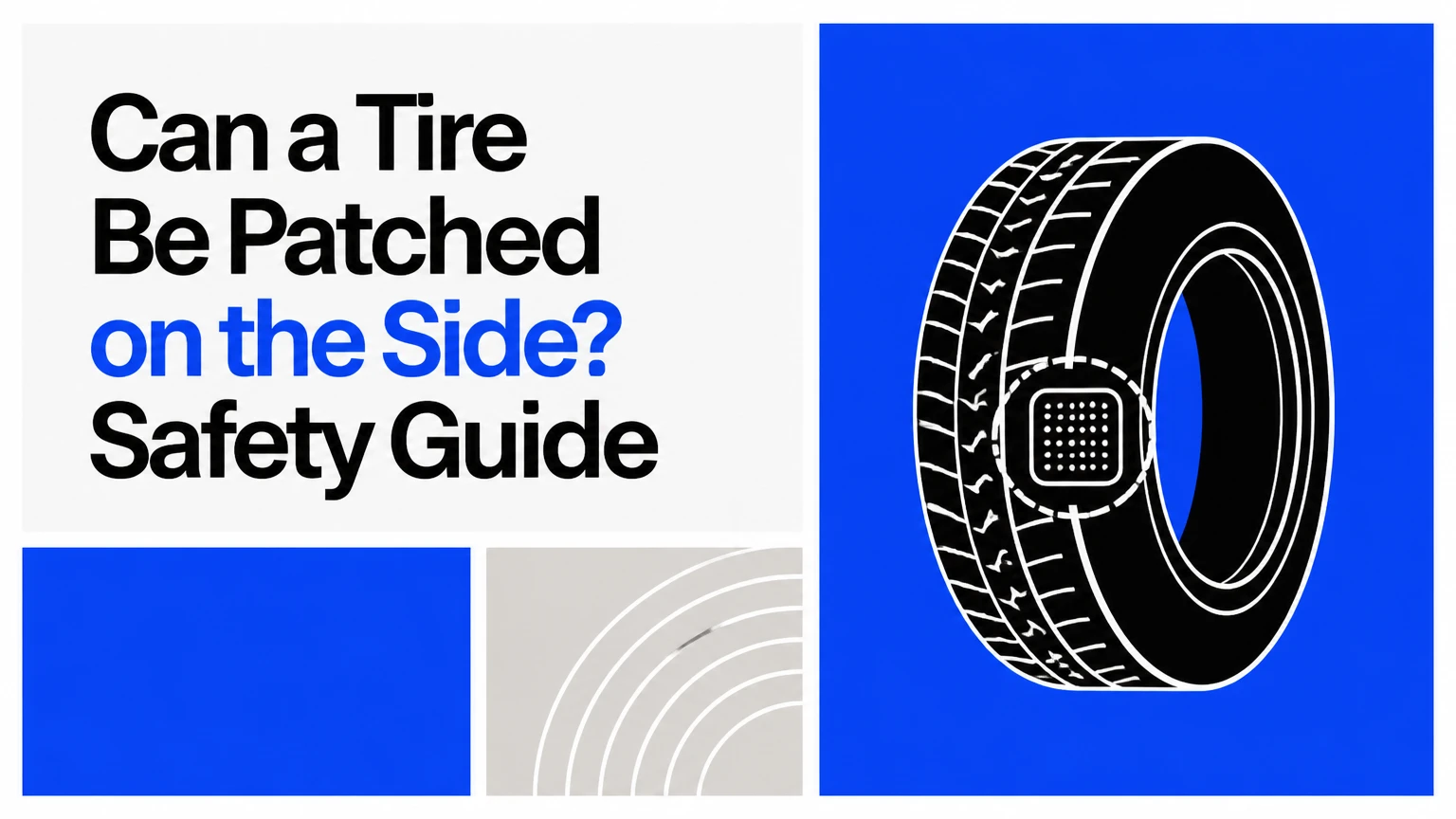
A tire cannot be safely patched on the sidewall for normal road use. A puncture, cut, or other breach in the sidewall can damage load-bearing cords that a patch cannot restore, so the accepted safety action is to replace the tire after professional inspection rather than drive on a sidewall repair.
Key Facts at a Glance
The accepted permanent repair zone is the tread area, not the shoulder or sidewall.
A sidewall puncture can sever polyester, nylon, or rayon cords inside the casing.
A sidewall bubble or bulge indicates internal structural separation and requires replacement.
A common maximum tread-puncture repair diameter is 1/4 inch, or 6 mm, when the tire maker permits repair.
A tire driven while flat can suffer hidden internal damage even if the original hole is small.
An external string plug may provide emergency off-road mobility, but it is not a permanent highway repair.
Can a Tire Be Patched on the Side?
No. A passenger-car, SUV, truck, or motorcycle tire with actual sidewall damage should not receive a permanent patch or plug for ordinary driving. USTMA and TIA repair guidance limits permanent puncture repairs to the central tread area within the manufacturer’s permitted repairable zone.
The sidewall extends from the tread shoulder to the bead, where the tire grips the wheel rim. That section bends repeatedly whenever the vehicle moves, while the tread has a thicker, more stable package designed to contact the road and distribute load.
A shop may inspect a sidewall mark and determine that it is only superficial rubber abrasion. That finding is different from approving a sidewall puncture repair. If the damage penetrates the casing, exposes cords, leaks air, creates a bulge, or came from driving underinflated, replacement is the safe outcome.
What Counts as Sidewall Damage?
Sidewall damage is any penetration or structural deformation between the tread shoulder and the rim bead. Common examples include a nail hole, screw puncture, knife cut, curb slice, rock tear, abrasion through the outer rubber, sidewall bubble, and a flap with visible casing material.
The location matters more than the shape. A small round hole in the sidewall can be more dangerous than a larger puncture in the center tread because the sidewall has less structural reinforcement and experiences greater cyclic movement.
Sidewall, Shoulder, and Bead Locations
| Area | Approximate location | Typical construction | Permanent repair status |
|---|---|---|---|
| Center tread | Middle 60-70% of road-contact surface | Tread rubber plus belt package | Sometimes repairable |
| Outer tread | Near the tread edge | Curved belt and shoulder transition | Often restricted |
| Shoulder | Tread-to-sidewall transition | High flex and edge stress | Generally not repairable |
| Sidewall | Shoulder to rim bead | Flexible casing cords | Not repairable |
| Bead area | Rim-contact edge | Steel bead wires and rubber | Not repairable |
Tire manufacturers define the exact repair boundary differently, and a tire shop must follow the specific maker’s instructions. The frequently quoted 1/2-inch, or 13 mm, distance from the shoulder is a useful rule of thumb, not a universal legal measurement for every tire.
Why Is the Sidewall Different From the Tread?
The sidewall cannot reliably hold a permanent repair because it flexes continuously, contains fewer stabilizing belt layers, and operates under repeated heat and strain. A patch can seal rubber temporarily, but it cannot reconstruct severed casing cords or restore the tire’s original load capacity.
The tread’s steel belts stabilize the road-contact area. Sidewalls instead use flexible cord plies, commonly polyester with other reinforcement materials, so the casing can deflect over bumps and maintain the contact patch.
What Happens Inside a Sidewall?
A puncture can cut or pull apart casing cords. Those cords carry tension as the tire supports the vehicle, and the damage may grow as the tire rotates, corners, brakes, and absorbs impacts.
Flexing also creates heat. A sidewall patch must move with the casing thousands of times during a drive, which places stress on the bond and on the damaged rubber around the repair. Even a repair that appears airtight while stationary may fail after heat and load cycles.
Tire Industry Association training emphasizes that a proper puncture repair requires inspection from inside the tire, not merely an external seal. Internal inspection can reveal liner damage, cord exposure, separation, or evidence of having been driven flat. No patch can reverse those conditions.
Where Does the Repairable Tread Zone End?
The repairable zone normally excludes the shoulder and begins inside the central tread area. A common industry limit is a puncture no larger than 1/4 inch, or 6 mm, but the tire manufacturer’s instructions, injury angle, tire type, and internal condition also determine eligibility.
| Tread injury factor | Common guideline | Why it matters |
|---|---|---|
| Maximum puncture diameter | 1/4 in, 6 mm | Larger holes remove more rubber and casing material |
| Minimum shoulder clearance | Often 1/2 in, 13 mm | Shoulder flex makes sealing less durable |
| Repair method | Internal combination repair | Seals the liner and fills the injury channel |
| Inspection requirement | Tire removed from wheel | Hidden inner damage cannot be assessed externally |
| Post-repair pressure | Vehicle placard specification | Incorrect pressure increases heat and casing stress |
The 1/4-inch limit is not permission to repair every small hole. A puncture that entered at an angle, overlaps another repair, damaged the inner liner, or caused the tire to run flat may still require replacement.
Are Plugs, Patches, or Sealants Different?
Plugs, patches, and liquid sealants perform different jobs, but none makes a damaged sidewall suitable for normal highway driving. A permanent tread repair generally uses a combination repair unit, installed from the inside after the tire is removed and inspected.
| Repair type | Normal location | Typical use | Sidewall decision |
|---|---|---|---|
| External string plug | Center tread emergency use | Temporary seal without tire removal | Not a permanent sidewall repair |
| Internal patch | Inner liner | Seals some approved tread injuries | Not suitable for sidewall casing damage |
| Combination patch-plug | Approved tread zone | Seals channel and inner liner together | Not suitable for shoulder or sidewall |
| Liquid sealant | Small compatible tread leaks | Temporary mobility or slow leak | Does not restore sidewall cords |
| Tire replacement | Any structurally damaged zone | Restores a complete casing | Required for penetrating sidewall damage |
A plug fills the puncture channel, while a patch seals the inner liner. A combination unit does both. The two-part design helps prevent moisture from reaching steel belts and creates an airtight inner seal, but it does not rebuild sidewall cords.
Liquid sealants can also complicate TPMS sensor inspection, wheel cleaning, and later professional repairs. Use one only when the tire maker and sealant maker approve it for that tire and vehicle.
Should You Drive on a Damaged Sidewall?
Do not drive on a tire with a leaking, cut, bulging, or cord-exposing sidewall. Driving even a short distance can enlarge the injury, damage the wheel, or produce sudden air loss, particularly at highway speed or under heavy vehicle load.
Use the following response:
- Slow down smoothly if the damage occurs while moving.
- Stop in a safe location away from traffic.
- Do not kneel in a traffic lane or inspect beside passing vehicles.
- Turn on hazard lights and call roadside assistance if the location is unsafe.
- Fit the vehicle’s spare only if the spare, tools, and lifting points are serviceable.
- Arrange tire replacement or professional mobile service.
A tire that has lost pressure below its recommended level should not be judged by the hole alone. The sidewall may have folded against itself and generated internal abrasion. Tire makers often reject tires that have been driven significantly underinflated because casing damage may remain invisible from the outside.
How Can You Tell Cosmetic Damage From Structural Damage?
A shallow black rubber scuff may be cosmetic, but a cut that leaks air, opens under light flexing, exposes fabric, or forms a bulge is structural damage. Visual inspection cannot certify a tire as safe, so a suspected penetration deserves examination by a qualified tire technician.
| Visible condition | Likely meaning | Safe next action |
|---|---|---|
| Light black surface scuff | Outer rubber abrasion | Have the tire inspected before normal use |
| Cut with air bubbles in soapy water | Active air leak | Do not drive; replace or obtain mobile service |
| White, gray, or silver cords visible | Casing penetration | Replace the tire |
| Localized outward bubble | Cord separation or impact break | Replace immediately |
| Rubber flap with no leak | Possible cut beneath flap | Professional internal inspection |
| Repeated pressure loss | Puncture, bead, valve, or rim issue | Locate leak and inspect tire off the wheel |
Do not shave down a bubble, glue a flap, inject adhesive, or cover the injury with an outside patch. Those actions alter the surface without restoring the casing’s load-bearing structure.
Is a Sidewall Bubble Repairable?
A sidewall bubble is not repairable. A bubble usually means the internal cords have broken or separated after an impact, such as a pothole or curb strike, allowing air pressure to push the outer rubber outward.
The absence of a leak does not make a bulge safe. The casing has already lost part of its original strength, and heat, speed, or another impact can cause rapid failure. Replace the tire and have the wheel checked for bending, cracks, or air leakage.
Run-flat tires need the same caution. Their reinforced sidewalls can carry limited load for a limited distance after pressure loss, but that feature does not make a punctured or damaged sidewall repairable.
What Is the Safest Emergency Response Without a Spare?
Roadside assistance, a tow, or a full-size spare is safer than plugging a sidewall for road travel. If an off-road vehicle becomes stranded far from help, an experienced driver may use an external plug only as a temporary recovery measure at low speed and with minimal distance.
A trail plug cannot restore casing cords. It can reduce air loss long enough to reach a safer location, but the tire should then be removed from service. Do not convert an off-road recovery technique into a highway repair.
For remote travel, carry a full-size spare when vehicle fitment allows, a compressor, a pressure gauge, and a plug kit for approved tread emergencies. A plug kit is not a substitute for a spare when sidewall cuts are a realistic trail hazard.
How Much Does Replacement Cost?
A typical passenger-tire replacement costs about $80-$250 per tire, while premium SUV, truck, performance, run-flat, and specialty tires commonly cost $150-$350 or more. Mounting, balancing, valve service, disposal fees, taxes, and alignment checks can add to the invoice.
| Tire situation | Typical tire cost | Typical service time | Extra consideration |
|---|---|---|---|
| Economy passenger tire | $80-$140 | 30-60 minutes | Match size and load rating |
| Mid-range all-season tire | $120-$220 | 30-60 minutes | Compare tread depth on axle |
| SUV or light-truck tire | $150-$300 | 45-75 minutes | Check load range and speed rating |
| Run-flat or performance tire | $180-$350+ | 45-90 minutes | Special mounting equipment may apply |
| Approved tread puncture repair | $20-$40 typical | 20-40 minutes | Only after internal inspection |
Prices vary by region, tire brand, wheel size, and shop labor. A used replacement can reduce the immediate bill, but the replacement must have the correct size, load index, speed rating, construction, and adequate tread with no age or storage damage.
How Should You Replace the Tire?
Replace the damaged tire with the same size and at least the vehicle manufacturer’s required load index and speed rating. The replacement should also match the vehicle’s seasonal design, construction type, and intended service.
For two-wheel-drive vehicles, shops commonly recommend placing the pair with deeper tread on the rear axle, subject to manufacturer guidance. For AWD and 4WD vehicles, consult the owner’s manual because differences in rolling circumference can stress the driveline.
| Replacement check | Example specification | Why it matters |
|---|---|---|
| Tire size | 225/55R17 | Preserves fitment and rolling diameter |
| Load index | 97 or higher when specified | Supports the vehicle’s rated load |
| Speed rating | V, W, or manufacturer requirement | Matches operating capability |
| Construction | Radial, tubeless | Matches wheel and vehicle design |
| Tread depth match | Within vehicle-maker tolerance | Important for AWD systems |
| Manufacturing age | Inspect date code and condition | Rubber ages before installation |
Replace the valve stem or service kit when appropriate, reset the TPMS, and inflate the tire to the cold pressure listed on the vehicle placard. The pressure molded into the sidewall is usually a maximum operating pressure, not the vehicle’s recommended setting.
Do Run-Flat and Low-Profile Tires Change the Answer?
Run-flat and low-profile tires do not create an exception for sidewall repair. Run-flat construction may allow limited travel after pressure loss, but the distance and speed limits vary by design, load, temperature, and manufacturer instructions.
Low-profile tires have less sidewall height and often experience stronger impact loads at the rim. A pothole can damage both the casing and wheel without producing an obvious cut, so technicians should inspect the inner liner, bead, and wheel after a severe impact.
Never assume that a tire’s reinforced sidewall can tolerate a puncture repair. Reinforcement helps the tire support load under defined conditions; it does not make severed cords repairable.
Can a Nail Near the Sidewall Be Repaired?
A nail near the sidewall may be repairable only if the injury remains fully inside the manufacturer-approved tread repair area. The visible nail location is not enough because the puncture channel may travel diagonally toward the shoulder.
A technician should remove the tire, locate the complete injury path, measure its diameter, inspect the inner liner, and check for prior repairs or underinflation damage. If the channel reaches the shoulder or sidewall, replacement is the normal decision.
What Should You Ask the Tire Shop?
Ask the technician to identify the injury location from the inside and state whether the repair complies with the tire manufacturer’s instructions. A shop that proposes an external sidewall plug as a permanent highway fix is offering a riskier service than the industry repair procedure supports.
The answer can vary for specialty tires, agricultural equipment, bicycles, and off-road applications. Those products have different constructions and service rules, so the tire maker’s documentation controls.
What Mistakes Make Sidewall Damage Worse?
The most damaging mistake is treating an airtight repair as proof that the casing is structurally sound. Air retention tests the seal; it does not measure cord strength, fatigue resistance, or impact tolerance.
Avoid these errors:
- Driving normally after installing an emergency sidewall plug.
- Applying superglue, epoxy, rubber cement, or an outside patch.
- Continuing to drive after a TPMS warning without checking pressure.
- Reinflating a tire that has a visible bubble.
- Removing a puncturing object before reaching a safe location.
- Replacing only one tire on an AWD vehicle without checking tread-depth limits.
- Ignoring a bent wheel or damaged valve after a curb impact.
A practical technician rule is simple: a sidewall repair that saves $20-$40 is not a valid trade for unpredictable casing failure. The tire’s structural components cannot be evaluated or restored by an external adhesive.
What Is the Bottom Line?
Can a tire be patched on the side? Not safely for normal road use. A penetrating sidewall injury, exposed cord, air leak, bulge, or tire that was driven flat calls for replacement, while only a properly inspected puncture in the approved central tread zone may qualify for an internal patch-plug repair.
Use the spare or roadside assistance instead of driving on a damaged sidewall. If the mark is only a surface scuff, have a tire professional confirm that finding before returning the tire to highway service.
Frequently Asked Questions
Can I patch a tire from the outside?
An outside string plug can temporarily seal some tread punctures, but it is not the preferred permanent repair and is unsuitable for sidewall damage. A permanent repair requires removing the tire, inspecting the interior, and using a manufacturer-approved combination repair in the permitted tread zone.
Is a sidewall puncture always dangerous?
A penetrating sidewall puncture is unsafe for normal driving because it may damage casing cords. A superficial scuff may not be dangerous, but the difference cannot be established reliably by color or appearance alone. Air leakage, exposed cords, a flap, or a bulge means the tire should be removed from service.
Can tire slime fix a sidewall leak?
Tire sealant is not a structural repair for a sidewall leak. Sealant may be incompatible with a tire, wheel, or TPMS sensor, and it cannot replace severed casing cords. Use sealant only for a manufacturer-approved emergency application, then obtain professional inspection or tire replacement.
How long can I drive on a plugged sidewall?
There is no safe highway mileage or normal-use duration for a plugged sidewall. An off-road plug may help a stranded vehicle crawl to safety at low speed, but the tire should be replaced before road travel. A plug’s continued air retention does not prove structural safety.
Does a sidewall cut always require two new tires?
A sidewall cut requires replacement of that tire, but two tires are not automatically required. The shop should compare tread depth, axle position, vehicle drive system, and manufacturer limits. AWD vehicles may require a matched set or tread-depth adjustment when one tire is replaced.
Can a tire shop refuse to repair a sidewall?
Yes. A reputable tire shop should refuse a permanent sidewall repair because standard passenger-tire repair procedures limit repairs to an approved tread area. The shop can inspect the tire, explain the damage, and recommend a correctly specified replacement instead.