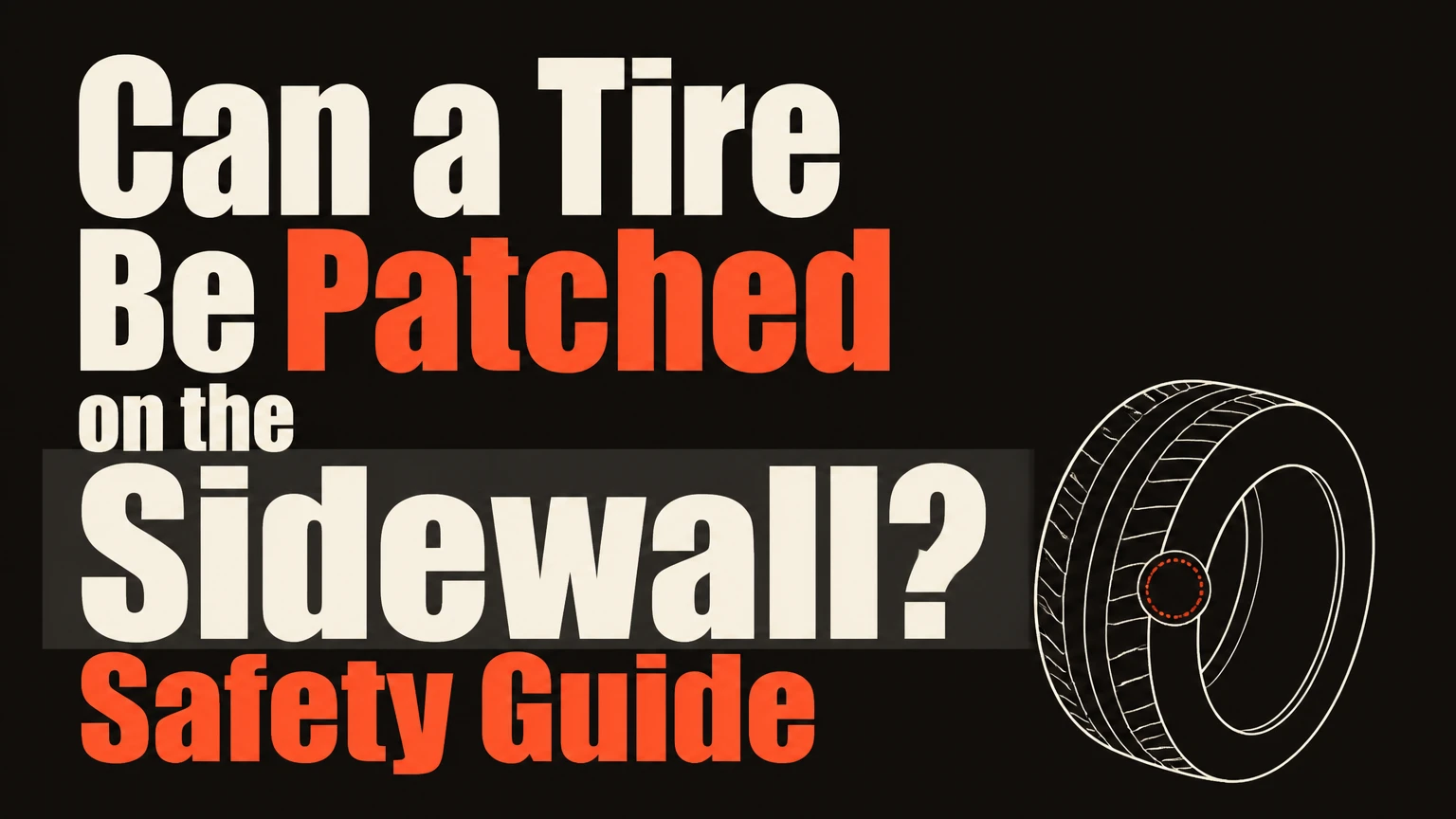
A tire cannot be safely repaired with a patch or plug when the puncture or cut is in the sidewall. The sidewall carries flexible casing cords and bends continuously under load, so damage there can progress into sudden air loss or a blowout. A qualified tire technician should inspect the tire, but replacement is the normal safe remedy.
Key Facts at a Glance
- A sidewall puncture, deep cut, or bulge normally requires tire replacement, not a patch.
- The standard repairable zone is the central tread, not the shoulder or sidewall.
- The commonly used maximum puncture size for passenger-tire repair is 1/4 inch, or 6 mm.
- A rope plug inserted from the outside is not a permanent repair and must never be used on a sidewall.
- A tire with exposed steel or nylon cords has lost casing protection and should be removed from service.
- On an AWD vehicle, the vehicle manufacturer may require matching tire circumference or replacement of multiple tires.
What Counts as the Sidewall?
The tire sidewall is the flexible rubber section between the tread shoulder and the bead that sits against the wheel rim. The sidewall contains molded markings such as tire size, load index, speed rating, maximum inflation pressure, and the DOT Tire Identification Number.
The shoulder is the rounded transition between the tread and sidewall. A puncture near that transition is often treated as non-repairable because the shoulder flexes and carries high cornering forces. The bead is different again: bead damage affects the tire’s seal to the wheel and also generally requires replacement.
| Tire area | Typical location | Normal repair decision | Main reason |
|---|---|---|---|
| Center tread | Middle grooves and ribs | Repairable if criteria are met | Lower flexing than sidewall |
| Tread edge | Within about 1.5 inches of sidewall | Usually replace | Shoulder flex and curvature |
| Sidewall | Between shoulder and bead | Replace | Casing damage under repeated flex |
| Bead area | Rim-contact edge | Replace | Air seal and mounting structure |
A sidewall mark is not automatically structural damage. A shallow white or gray scuff with no cut, bulge, air loss, or visible cords may be cosmetic, although cleaning and professional inspection are sensible after curb impact.
Why Does a Sidewall Patch Fail?
A sidewall patch cannot restore the original casing strength because the sidewall repeatedly flexes, heats, stretches, and compresses while the vehicle moves. A repair material may seal an opening temporarily, but it does not reliably rebuild the damaged load-bearing cords inside the tire.
Passenger tires use layers of textile and, in some designs, steel reinforcement. The tread belt package resists penetration and deformation, while the sidewall must flex enough to absorb road shocks and maintain the contact patch. A cut can sever or weaken those internal cords even when the outside rubber appears small.
A patch bonds to the inner liner and seals air. It does not reconnect broken casing cords. A plug fills a puncture channel but also does not rebuild the casing. Heat, centrifugal force, inflation pressure, and repeated sidewall movement can enlarge the damaged area or cause the repair to separate.
The U.S. Tire Manufacturers Association repair procedure describes an acceptable puncture repair as a combination repair unit installed from inside the tire, with a stem filling the injury and a patch sealing the inner liner. That procedure applies to an eligible tread puncture, not a damaged sidewall.
Can a Tire Be Patched on the Sidewall?
No. A tire cannot be safely patched on the sidewall, and a professional tire shop should refuse a sidewall patch or plug as a permanent repair. The sidewall’s casing structure may be compromised beyond what an external repair can evaluate or restore.
The word “illegal” requires more care. Some jurisdictions, vehicle inspections, commercial-tire rules, or manufacturer policies prohibit operating a tire with specified sidewall damage, while other laws use broader unsafe-equipment language rather than naming patches specifically. Regardless of local wording, a sidewall repair can fail inspection, violate a shop’s safety policy, and create insurance or liability complications.
A repair shop may inspect a cosmetic scuff and return the tire to service if the casing is intact. That is not the same as repairing a puncture. If a cut penetrates the rubber, exposes cords, creates a bulge, or leaks air, replacement is the appropriate decision.
Which Tire Damage Can Be Repaired?
A tire puncture is potentially repairable when it is confined to the central tread, is no larger than about 1/4 inch or 6 mm, enters relatively straight, and has not been driven while flat or severely underinflated. The tire must be removed from the wheel for an internal inspection before a permanent repair is approved.
The 6 mm limit is a widely used industry threshold, including guidance associated with the U.S. Tire Manufacturers Association. Tire manufacturers can impose stricter limits, and run-flat, high-performance, commercial, and motorcycle tires may have separate instructions.
| Damage type | Typical repair status | Common threshold or condition | Correct action |
|---|---|---|---|
| Screw in center tread | Potentially repairable | Injury no larger than 6 mm | Internal inspection and combination repair |
| Nail near shoulder | Usually non-repairable | Within approximately 1.5 inches of sidewall | Replace tire |
| Sidewall puncture | Non-repairable | Any penetrating injury | Replace tire |
| Superficial sidewall scuff | Potentially serviceable | No cords, bulge, cut, or leak | Clean and inspect |
| Sidewall bubble | Non-repairable | Any visible bulge or blister | Replace immediately |
| Tire driven flat | Often non-repairable | Internal damage may be hidden | Remove and inspect; replace if casing is compromised |
A plug-only repair is not equivalent to a proper repair. The Rubber Manufacturers Association, now represented by USTMA, has long distinguished a complete internal repair from an outside-in plug because the latter does not allow a technician to inspect the inner liner and casing.
How Should You Inspect Sidewall Damage?
Inspect sidewall damage while the vehicle is parked on a stable surface, with the tire unloaded as much as practical and the wheel turned for visibility. Do not crawl under a vehicle supported only by a jack, and do not handle a tire that is visibly separating or severely deformed.
Use this sequence:
- Clean the area. Wipe away dirt with water and a cloth. Do not cut away rubber or probe the injury with a screwdriver.
- Locate the damage. Identify whether the mark is on the sidewall, shoulder, bead, or tread. Measure the location from the nearest tread groove.
- Check for penetration. Look for a slit, hole, missing rubber, or a foreign object. Do not pull out a nail if the tire is losing pressure rapidly.
- Look for cords. White textile threads or shiny steel wires indicate casing exposure.
- Check for deformation. A bubble, blister, raised spot, or localized wobble indicates internal structural separation.
- Check pressure. Compare the cold pressure with the vehicle placard inside the driver’s door or fuel door.
- Use soapy water only as a leak check. Bubbles identify escaping air, but a lack of bubbles does not prove the casing is safe.
- Arrange professional inspection. Use a tire shop, roadside service, or tow truck rather than driving on a damaged tire.
A small puncture can be less dangerous than a large bulge, but location matters more than appearance. Sidewall damage can hide inside the tire, especially after a pothole impact or a period of driving with low pressure.
Can You Drive With a Cut or Bubble?
You should not drive normally with a sidewall cut, puncture, bulge, or exposed cord. A tire with confirmed structural sidewall damage should be replaced, and the vehicle should reach the tire shop by spare tire, mobile service, or tow truck.
Driving a short distance to a shop is not automatically safe. A tire can lose pressure gradually while the casing weakens, then fail when speed, heat, payload, or cornering force rises. The risk is higher on a highway, with passengers or cargo, during hot weather, or after the tire has been driven while flat.
A shallow surface scuff is different from a penetrating cut. If the rubber is only abraded, no cords show, the shape remains uniform, and pressure holds, a technician may determine that the tire remains usable. Do not make that decision from a photograph alone when the impact was hard enough to bend a wheel or trigger a TPMS warning.
What Does a Sidewall Bubble Mean?
A sidewall bubble usually means the tire’s internal cords have broken or separated after an impact, even when no nail or cut is visible. A bubble cannot be patched because the damaged casing is no longer reliably containing inflation pressure.
Common causes include potholes, curb strikes, underinflation, overloaded vehicles, and mounting damage. The bubble may appear on the outward-facing sidewall, the inward-facing sidewall, or near the shoulder. An inward bulge can remain unnoticed until the tire is removed.
Do not press, puncture, glue, or deflate a bubble as a DIY fix. Deflation reduces stored energy but does not repair the casing. Keep the tire away from traffic, install the spare if the vehicle is equipped with one, and have the damaged tire replaced.
How Much Does Sidewall Tire Replacement Cost?
Typical U.S. consumer replacement costs range from about $80-$350 or more per passenger tire, excluding unusual sizes, premium performance tires, mounting, balancing, taxes, and disposal. Inspection is often free or costs about $0-$20, while a standard shop replacement commonly takes 30-60 minutes.
| Service or item | Typical U.S. range | Typical time | Cost driver |
|---|---|---|---|
| Visual tire inspection | $0-$20 | 10-15 minutes | Shop policy and dismounting |
| Economy passenger tire | $80-$150 | 30-60 minutes | Size and load rating |
| Mid-range passenger tire | $150-$250 | 30-60 minutes | Brand, warranty, tread design |
| Premium or specialty tire | $250-$350+ | 45-75 minutes | Run-flat, EV, SUV, or performance fitment |
| Mount, balance, and disposal | $20-$60 per tire | 20-40 minutes | Local labor and wheel size |
| AWD set replacement | $320-$1,400+ | 1-3 hours | Four tires, vehicle fitment, and brand |
These are planning ranges, not a quote. A 20-inch run-flat tire, a light-truck tire, or a low-volume electric-vehicle fitment can exceed them. Confirm the tire’s size, load index, speed rating, tread pattern, and original-equipment requirements before comparing prices.
Should You Replace One Tire or More?
Replace one tire only when the remaining tires have compatible dimensions, tread depth, construction, and wear, and the vehicle manufacturer or tire maker permits that arrangement. Replacing two tires may be preferable on a two-wheel-drive vehicle when one axle has substantially more wear, while AWD vehicles often need a tighter tread-circumference match.
The safest replacement is usually the same make, model, size, load index, and speed rating. A tire shop should measure tread depth on all four tires rather than relying on age or appearance.
| Vehicle situation | Common replacement choice | Measurement or condition | Practical note |
|---|---|---|---|
| Two-wheel drive, tires evenly worn | One matching tire | Tread difference within manufacturer limit | Confirm axle compatibility |
| Two-wheel drive, one axle worn | Two tires on one axle | Pair matched by tread and construction | Newer tires commonly go on rear axle |
| Full-time AWD | Four tires or approved matched set | Follow vehicle manual’s circumference limit | Drivetrain sensitivity varies |
| AWD with one lightly worn tire damaged | One tire shaved to match, if available | Match measured tread depth | Use only when manufacturer permits |
| Temporary spare in use | Spare only for emergency mobility | Follow speed and distance label | Replace damaged tire promptly |
The “replace all four” rule is not universal. Subaru, Audi, BMW, and other manufacturers publish vehicle-specific requirements, and some tolerate only a small tread-depth or circumference difference. Read the owner’s manual and ask the tire retailer to document measured tread depths.
Is a Used Tire a Safe Alternative?
A used tire can be a reasonable short-term or budget replacement only when its age, history, size, construction, tread, and casing condition are verified. A low price does not compensate for unknown run-flat damage, prior repairs, dry rot, uneven wear, or an incompatible load rating.
Check the DOT Tire Identification Number on the sidewall. The final four digits identify the production week and year, such as 2323 for week 23 of 2023. Tire age policies differ, but Michelin advises replacing tires at ten years from manufacture as a precaution, regardless of tread, and recommends annual professional inspections after five years in service.
Reject a used tire with:
- A sidewall cut, bulge, deep abrasion, or exposed cord.
- Cracks between tread blocks or around the bead.
- An unknown history of severe underinflation or impact.
- Uneven wear that indicates alignment or suspension problems.
- A different load index, speed rating, size, or construction from the vehicle requirement.
- A tread depth too different for an AWD system.
A reputable retailer should show the tire’s date code and inspect the inner liner. Avoid anonymous marketplace listings that provide no production date or casing history.
What Are the Common Repair Mistakes?
Sidewall damage produces predictable decision errors because drivers often judge rubber by appearance rather than by casing function.
- Forcing a rope plug into the sidewall: A plug kit is designed for limited tread punctures, not flexible casing damage. The plug can leak, dislodge, or leave the weakened structure in service.
- Patching from the outside: An adhesive patch cannot inspect or reconnect internal cords. A sealed hole can still conceal a casing failure.
- Driving until the tire is completely flat: Low pressure increases sidewall flex and heat, which can destroy the inner liner and make an otherwise repairable tread puncture non-repairable.
- Treating a bubble as cosmetic: A bubble is evidence of internal separation, not trapped air that can be released safely.
- Replacing with the cheapest unmatched tire: A different tire can alter wet braking, steering response, rolling circumference, and AWD loading.
- Trusting a sealant bottle as a structural repair: Emergency sealant may help a small tread puncture reach service, but it cannot repair a cut sidewall or broken cords.
A useful practitioner rule is simple: if the injury is outside the central tread repair zone, stop comparing patch kits and compare replacement options instead.
What Should You Do After Sidewall Damage?
Use the vehicle’s spare tire or call roadside assistance when the damaged tire is losing air, has a bulge, exposes cords, or has a penetrating sidewall injury. If the vehicle has no spare, a mobile tire service can often inspect the vehicle at home or at the roadside.
Record the tire size and load information from the sidewall, photograph the damage without touching it, and note the vehicle’s drivetrain. The tire shop will need the damaged tire’s position, the other tires’ tread depths, and any evidence that the tire was driven underinflated.
For a puncture near the center tread, do not automatically demand replacement or repair. The technician should remove the tire, inspect the inside, measure the injury, and follow the tire manufacturer’s repair policy. A correct repair is a technical inspection decision, not a product choice between a plug and a patch.
The Bottom Line
Can a tire be patched on the sidewall? No, a sidewall puncture, cut, bulge, or exposed cord requires tire replacement because a patch or plug cannot restore the damaged casing structure. Use a spare or tow the vehicle, then match the replacement tire to the vehicle’s size, rating, tread-depth, drivetrain, and manufacturer requirements.
A superficial scuff without penetration may remain serviceable after professional inspection. A center-tread puncture under approximately 6 mm may qualify for an internal combination repair, but the sidewall and shoulder do not qualify merely because the hole looks small.
Frequently Asked Questions
Can a nail in the sidewall be repaired?
A nail in the sidewall should not be repaired with a patch or plug. Removing the nail can accelerate air loss, and the puncture may have damaged casing cords that an external repair cannot restore. Keep the tire inflated only if pressure remains stable and the vehicle is stationary, then use a spare, mobile service, or a tow.
Is a shoulder puncture the same as sidewall damage?
A shoulder puncture is treated much like sidewall damage because the shoulder sits in a high-flex transition zone. Many repair policies exclude injuries within roughly 1.5 inches of the sidewall or outside the central tread ribs. A technician must measure the injury and follow the tire manufacturer’s specified repair boundary.
Can tire sealant fix a sidewall leak?
Tire sealant cannot safely fix a sidewall cut, puncture, bubble, or broken casing cords. Some sealants are intended only for temporary use in small tread punctures, and the product label may prohibit use in certain tire types or TPMS systems. Sealant can also complicate later inspection and cleaning.
Does a run-flat tire change the sidewall repair rule?
A run-flat tire does not make sidewall damage repairable. Run-flat construction can support limited travel after pressure loss, but driving underinflated can create hidden internal damage. Follow the tire and vehicle manufacturer’s distance and speed limits, and have the tire professionally inspected before deciding whether replacement is necessary.
Can insurance pay for a tire with sidewall damage?
Insurance coverage depends on the policy, deductible, cause of damage, and jurisdiction. Collision or road-hazard coverage may apply to a pothole or impact, while ordinary wear usually does not. Photograph the damage, preserve the tire, and ask the insurer or tire retailer about road-hazard coverage before discarding it.
Should new tires go on the front or rear?
When replacing only two tires on a typical vehicle, tire manufacturers and retailers commonly recommend placing the deeper-tread pair on the rear axle to reduce oversteer risk on wet roads. The correct arrangement can vary for specialized vehicles, directional tires, staggered fitments, and manufacturer-specific systems, so follow the vehicle manual and tire shop’s fitment instructions.