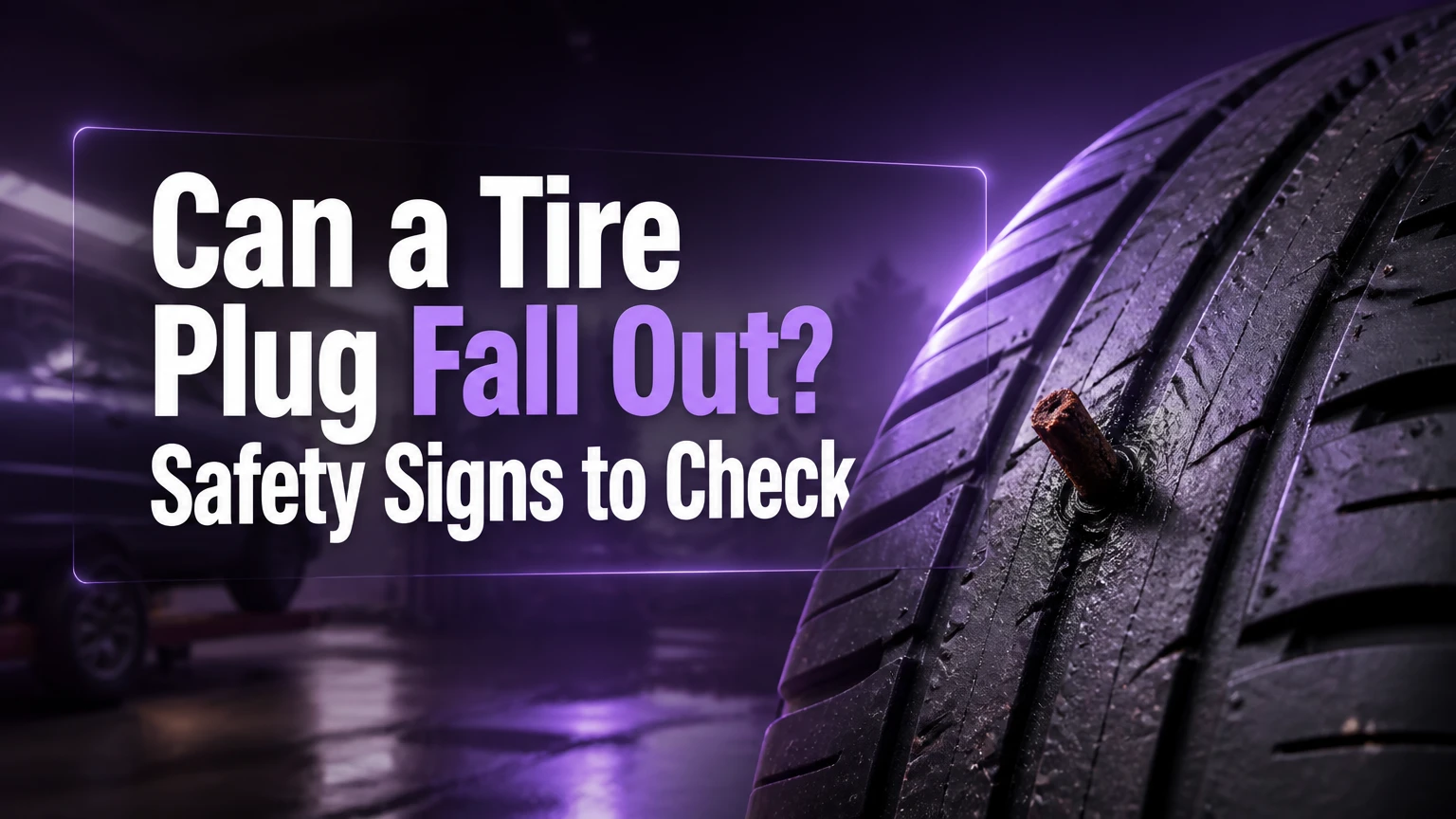
Yes, a tire plug can fall out, loosen, or begin leaking, especially when the puncture is too large, poorly prepared, or located near the shoulder. A properly installed external plug may hold temporarily, but it is not a reliable guarantee of a permanent repair. Stop driving if pressure drops, bubbles appear, the plug visibly moves, or vibration begins.
Key Facts at a Glance
- A tire plug can be displaced by tread flex, heat, contamination, an oversized puncture, or incorrect installation.
- An external string plug repairs the puncture channel from the outside but does not inspect or seal the tire’s inner liner.
- The commonly cited maximum repairable puncture is 1/4 inch, or 6 mm, within the central tread area.
- A puncture in the sidewall or shoulder is generally not repairable with a plug or patch.
- A professional combination repair uses a rubber stem and inner patch after the tire is removed for inspection.
- A TPMS warning, continuing bubbles, visible plug movement, vibration, or repeated pressure loss means the tire needs immediate evaluation.
Can a Tire Plug Fall Out While Driving?
A tire plug can fall out while driving, although gradual loosening and air leakage are more common than complete ejection. The risk rises when the plug was inserted without properly preparing the puncture, the hole exceeds the repair kit’s specification, or the repair sits in a flexing shoulder rather than the central tread.
A string plug is held mainly by compressed rubber, friction, and the plug’s enlarged material inside the puncture path. Rubber cement can aid installation and sealing, but ordinary roadside cement does not transform an external plug into an internally inspected, manufacturer-approved repair. Road heat, repeated flexing, braking forces, and high-speed rotation gradually test the repair.
A plug that has moved outward, split, hardened, or developed a wet ring around its base should be treated as failed. Do not push it farther into the tire or install another plug beside it without an internal inspection.
What does a loose plug look like?
A loose plug may protrude farther than it did after installation, lean to one side, show cuts, or appear dry and frayed. Soapy water around the plug can reveal a stream of bubbles, while a pressure gauge can confirm a slow loss that may not be visible.
A small amount of plug material above the tread is not automatically a failure. The important indicators are movement, bubbling, pressure loss, or damage around the puncture.
How Does a Tire Plug Stay in?
A tire plug stays in through mechanical interference rather than a dependable inner-liner seal. The reamed puncture grips the oversized rubber cord, the inserted plug folds or mushrooms inside the casing, and tire pressure presses the surrounding rubber against the plug.
The repair depends on several variables:
- Puncture geometry: A clean, narrow nail hole holds a plug better than a torn or irregular opening.
- Tire preparation: The reamer must clear debris and create a suitable channel without excessively enlarging the hole.
- Insertion depth: The plug must pass far enough into the casing to anchor correctly.
- Rubber compatibility: Plug material, cement, tread rubber, and temperature affect adhesion.
- Tire movement: The tread flexes constantly, particularly during cornering and acceleration.
The inner liner is a separate consideration. An external plug may stop air from escaping through the tread, but it does not allow a technician to determine whether the tire was driven underinflated or whether the inner liner and belts remain sound.
Why can heat and speed loosen a plug?
Heat softens and expands tire materials while changing the stiffness of the plug and surrounding tread. Sustained highway speed increases casing temperature and cyclic deformation, so a marginal repair can leak faster after a long drive than during a stationary soapy-water test.
Centrifugal force is usually not the only cause of failure. Poor preparation, an unsuitable puncture location, and underinflation generally matter more, but speed increases the consequences of every weakness.
Which Tire Plug Types Fail Most Easily?
Screw-in plugs and poorly installed string plugs have the highest practical risk of displacement. A professional combination repair has the strongest design because its stem seals the puncture channel while its inner patch seals against the liner.
| Repair type | Installation location | Typical role | Main limitation |
|---|---|---|---|
| String or rope plug | Outside of mounted tire | Emergency roadside repair | No internal inspection or liner patch |
| Self-vulcanizing cord | Outside of mounted tire | Emergency repair for compatible tires | Depends on correct cement and preparation |
| Screw-in plug | Directly in puncture | Short-distance emergency measure | Can strip, tear rubber, or back out |
| Combination patch-plug | Stem through tire, patch inside | Professional permanent repair | Requires demounting and internal inspection |
A mushroom-style plug is not identical to a basic rope plug. The mushroom repair has a stem and an umbrella-shaped patch that are installed from inside the tire, allowing the patch to seal the inner liner. Product names vary, so the installation method matters more than the word “mushroom” on the package.
Where Can a Tire Be Plugged?
A tire can generally be considered for repair only when the puncture lies in the central tread area, remains within the manufacturer’s size limit, and the casing has not suffered internal damage. The shoulder, sidewall, bead area, and transition zones are normally excluded because they flex or carry load differently.
| Puncture location | Typical repair decision | Why |
|---|---|---|
| Center tread | Inspect for combination repair | Lowest flex and most predictable casing geometry |
| Outer tread near shoulder | Usually reject | Increasing flex and changing belt curvature |
| Shoulder | Reject | High cornering movement and heat |
| Sidewall | Reject | Structural flexing and load-bearing damage |
| Bead or rim-contact area | Reject or replace | Airtight seating and carcass integrity may be compromised |
The U.S. Tire Manufacturers Association and major tire manufacturers commonly limit repairs to the tread area and punctures no larger than 1/4 inch, or 6 mm. Manufacturer instructions and the tire’s construction control the final decision, especially for run-flat, self-sealing, high-load, and specialty tires.
Can a sidewall puncture be repaired with a plug?
A sidewall puncture should not be repaired with a plug. The sidewall bends repeatedly as the tire rotates, and a plug cannot restore the casing cords or reproduce the tire’s designed sidewall structure.
A sidewall repair kit may temporarily stop air loss in an emergency, but that action does not make the tire roadworthy. Replace the tire or follow the vehicle and tire manufacturer’s emergency procedure.
How Large Can a Repairable Puncture Be?
The common maximum for a repairable passenger-tire puncture is 1/4 inch, or 6 mm, in the repairable tread zone. A larger opening, elongated tear, multiple adjacent punctures, or damage from a sharp object can exceed the design limits of a plug and require tire replacement.
Measure the actual injury after removing the object and inspecting the casing. A nail’s shaft diameter does not always represent the full damage because the object may have torn belts or enlarged the entry channel while the tire was driven.
A plug kit’s own instructions may specify a smaller limit. The lower value controls. Do not enlarge a puncture simply to make a particular plug fit.
How Long Can a Plugged Tire Last?
An external tire plug has no universal safe mileage or lifespan. A roadside plug may hold for the remaining life of a tire, or it may begin leaking on the next trip; manufacturers and repair standards therefore do not justify promising figures such as 15,000 or 25,000 miles for every installation.
A professional tire shop normally evaluates the tire from the inside, checks for low-pressure damage, and installs a repair that follows the tire maker’s requirements. Even then, the repair is subject to the tire’s age, tread wear, load rating, speed rating, and overall condition.
| Situation | Typical advice | Reasonable driving scope |
|---|---|---|
| Fresh center-tread plug, stable pressure | Seek professional inspection | Short trip to a tire shop |
| Plug with slow bubbling | Avoid normal driving | Inflate only if safe, then arrange service |
| Plug in shoulder or sidewall | Replace tire | Do not drive on the repair |
| Tire driven flat or severely underinflated | Internal inspection or replacement | No highway travel before evaluation |
These are safety decisions, not mileage warranties. A tire that loses measurable pressure overnight has already provided evidence that the repair is not holding.
Can You Drive on a Plugged Tire?
You can drive a short, controlled distance on a stable external plug only to reach a tire professional, provided the puncture is in the central tread and the tire maintains the correct pressure. Avoid highway speeds, heavy loads, long distances, aggressive cornering, and towing until the repair has been evaluated.
Check pressure with a reliable gauge before leaving and compare it with the vehicle placard, not the maximum pressure molded into the sidewall. Recheck pressure after the short trip if conditions allow.
Do not drive on a plugged tire when:
- The TPMS warning remains active after inflation.
- Soapy water produces continuing bubbles.
- The plug is visibly moving, torn, or nearly ejected.
- The tire has a sidewall, shoulder, bead, or belt-area injury.
- The tire was driven flat or below safe pressure.
- The steering wheel vibrates or the vehicle pulls after the puncture.
- The tire is hot, overloaded, or carrying a trailer.
Track use and sustained high-speed driving are inappropriate for a temporary external plug. Tire repairs can also conflict with a tire manufacturer’s warranty or speed and load recommendations.
What Makes a Tire Plug Fall Out?
A tire plug usually comes out because the puncture channel cannot hold it under repeated movement, or because the repair was inserted into a damaged structure. The most common failure begins before the plug enters the tire.
| Failure cause | Visible or measurable symptom | Correct response |
|---|---|---|
| Hole not reamed or cleaned | Plug slides in too easily or leaks | Professional removal and inspection |
| Puncture too large or torn | Plug does not fill the channel | Replace tire or follow shop assessment |
| Incorrect insertion angle | Plug leans or leaves exposed gaps | Stop driving and have repair assessed |
| Shoulder or sidewall location | Repeated pressure loss during cornering | Replace tire |
| Tire driven underinflated | Vibration, dust, heat damage inside | Demount for internal inspection |
| Contaminated or aged plug | Cracking, hardening, bubbling | Replace repair or tire as appropriate |
One counterintuitive point matters: a plug that is difficult to insert is not necessarily safer. Excessive force can damage belts, enlarge the injury, or leave a torn channel that grips the plug unevenly.
Another practitioner rule is to inspect the puncture’s entry angle. Pulling out a screw and reaming at a different angle can create a larger internal path than the original object made.
What Should You Do If a Plug Is Leaking?
If a plugged tire is leaking, stop driving normally, move to a safe location, and measure the pressure. A plug that produces bubbles or loses pressure needs professional evaluation, not another external cord pushed into the same hole.
Use this sequence:
- Park safely away from traffic and let the tire cool.
- Check pressure with a gauge.
- Apply soapy water around the plug and nearby tread.
- Photograph any bubbles, exposed plug, tread damage, or sidewall injury.
- Inflate only to the vehicle placard pressure if the tire is structurally safe.
- Drive slowly to a tire shop only when pressure remains stable and the puncture is in the repairable tread.
- Use a spare or roadside service when pressure continues falling.
Do not remove a leaking plug on the roadside unless a tire professional instructs you to do so. Removing the plug can turn a slow leak into a rapid deflation.
Is vibration after plugging dangerous?
New vibration after a tire plug requires prompt inspection because it may indicate imbalance, belt damage, a separated tread, or damage caused by driving underinflated. The plug itself is rarely enough to explain a significant new vibration.
Stop driving at highway speed, inspect the tire visually, and have the wheel balanced and the casing examined internally. A vibration combined with heat, bulging, or pressure loss justifies using the spare instead of driving to a shop.
Is a Patch Better Than a Plug?
A professional combination patch-plug is generally preferable to an external plug for a permanent passenger-tire repair. The combination repair seals the puncture channel with a stem and seals the inner liner with a patch after the tire has been removed and inspected.
An internal patch alone can leave the puncture channel open to moisture and contamination. A plug alone cannot reveal whether the tire’s inner liner was damaged by underinflation. The combination repair addresses both limitations.
| Criterion | External plug | Internal patch | Combination patch-plug |
|---|---|---|---|
| Tire removal | No | Yes | Yes |
| Inner-liner inspection | No | Yes | Yes |
| Puncture-channel seal | Partial or product-dependent | Limited | Yes |
| Typical shop labor | 5-15 minutes | 20-35 minutes | 25-45 minutes |
| Typical U.S. price | $5-$20 DIY kit | $20-$40 | $25-$60 |
| Best use | Reach a repair facility | Selected internal repairs | Approved permanent repair |
The exact method depends on tire design, manufacturer guidance, local shop policy, and the injury location. A tire professional may reject a tire even when the hole is small if the casing has been driven flat or has another repair too close to it.
Can Multiple Tire Repairs Be Safe?
Multiple repairs can be safe only when each injury meets the tire manufacturer’s limits, remains properly separated, and does not overlap an earlier repair. A universal rule of exactly two repairs or exactly six inches of spacing does not replace an internal inspection.
Many repair guidelines use approximately 6 inches of separation as a practical minimum, but the tire maker’s instructions and the repair shop’s policy control. Two punctures close together may behave like one large damaged area, especially if the rubber between them is torn.
Do not stack plugs, patch over an unknown external plug, or repair a puncture that intersects an old repair. The tire must be demounted so the technician can identify the full injury pattern.
How Should a Tire Plug Be Inspected?
A tire plug should be inspected for location, pressure retention, visible movement, surface damage, and signs of internal casing stress. A complete inspection requires removing the tire from the wheel because the external tread view cannot show liner abrasion, belt separation, or rubber dust.
A useful roadside screening check takes only a few minutes:
- Confirm the plug remains centered and intact.
- Look for cuts, fraying, or a gap at its base.
- Apply soapy water and watch for bubbles for at least 30 seconds.
- Measure cold pressure and compare it with the door-jamb placard.
- Check for bulges, exposed cords, unusual tread wear, and foreign objects.
- Note vibration or pulling during any short, low-speed movement.
The test is not proof of permanent safety. A plug can pass a stationary leak test and fail later when the casing heats and flexes.
How Much Does a Tire Repair Cost?
A typical U.S. tire repair costs about $20-$60 at a shop, while a consumer plug kit commonly costs $5-$20. Replacement costs vary widely by tire size, vehicle class, brand, run-flat construction, and local labor rates.
| Service or item | Typical U.S. cost | Typical time |
|---|---|---|
| Basic rope-plug kit | $5-$20 | 5-15 minutes |
| Shop inspection and repair | $20-$40 | 20-35 minutes |
| Combination patch-plug | $25-$60 | 25-45 minutes |
| Passenger tire replacement | $100-$350 per tire | 30-90 minutes |
A low repair price is not a reason to skip demounting when the tire may have been driven underinflated. Internal damage can make a cheap repair unsafe and turn a temporary leak into a sudden tire failure.
FAQ
Can rain make a tire plug fall out?
Rain alone usually does not eject a properly seated plug, but water and road contamination can enter an inadequately sealed puncture channel. Moisture is more concerning when the repair leaks, the tire contains steel belts, or the plug has begun to loosen. Treat bubbling or pressure loss after wet driving as a failed repair signal.
Should you replace a tire plug that sticks out?
Do not replace or trim a protruding plug without checking whether it is leaking or moving. A small amount of material above the tread can be normal after installation, while a plug that has migrated outward may be losing its anchor. A tire shop should inspect the repair before anyone cuts or pushes it.
Can cold weather cause a tire plug to leak?
Cold temperatures reduce tire pressure and can stiffen plug and tread rubber, exposing a marginal seal. Temperature-related pressure loss should affect all tires similarly, but bubbles at one plug identify a repair problem. Inflate to the vehicle placard specification when cold and arrange inspection if that tire continues losing pressure.
Can you put a new plug beside an old plug?
You should not install a new plug beside an old plug without professional inspection. Closely spaced punctures can overlap inside the casing, and two plugs do not restore damaged belts or an injured inner liner. A shop may install a combination repair when the injuries meet spacing and size requirements, or it may recommend replacement.
Does tire sealant prevent a plug from falling out?
Liquid tire sealant may slow some leaks, but it does not anchor a displaced plug or repair casing damage. Sealant can also complicate inspection, affect pressure sensors, and conflict with tire manufacturer instructions. Use it only when the product and vehicle manufacturer permit it, and still have the tire professionally evaluated.
The Bottom Line
A tire plug can fall out or begin leaking, so a stable plug is not proof that the tire is permanently safe. Use an external plug only as a short-distance emergency measure when the puncture is small and centered in the tread, then have the tire demounted and inspected. If you notice a TPMS warning, bubbles, pressure loss, vibration, or plug movement, stop driving and use the spare or roadside service. When asking “can a tire plug fall out,” the practical answer is yes, and the safest response is to replace the temporary repair with a manufacturer-compliant professional repair or a new tire.