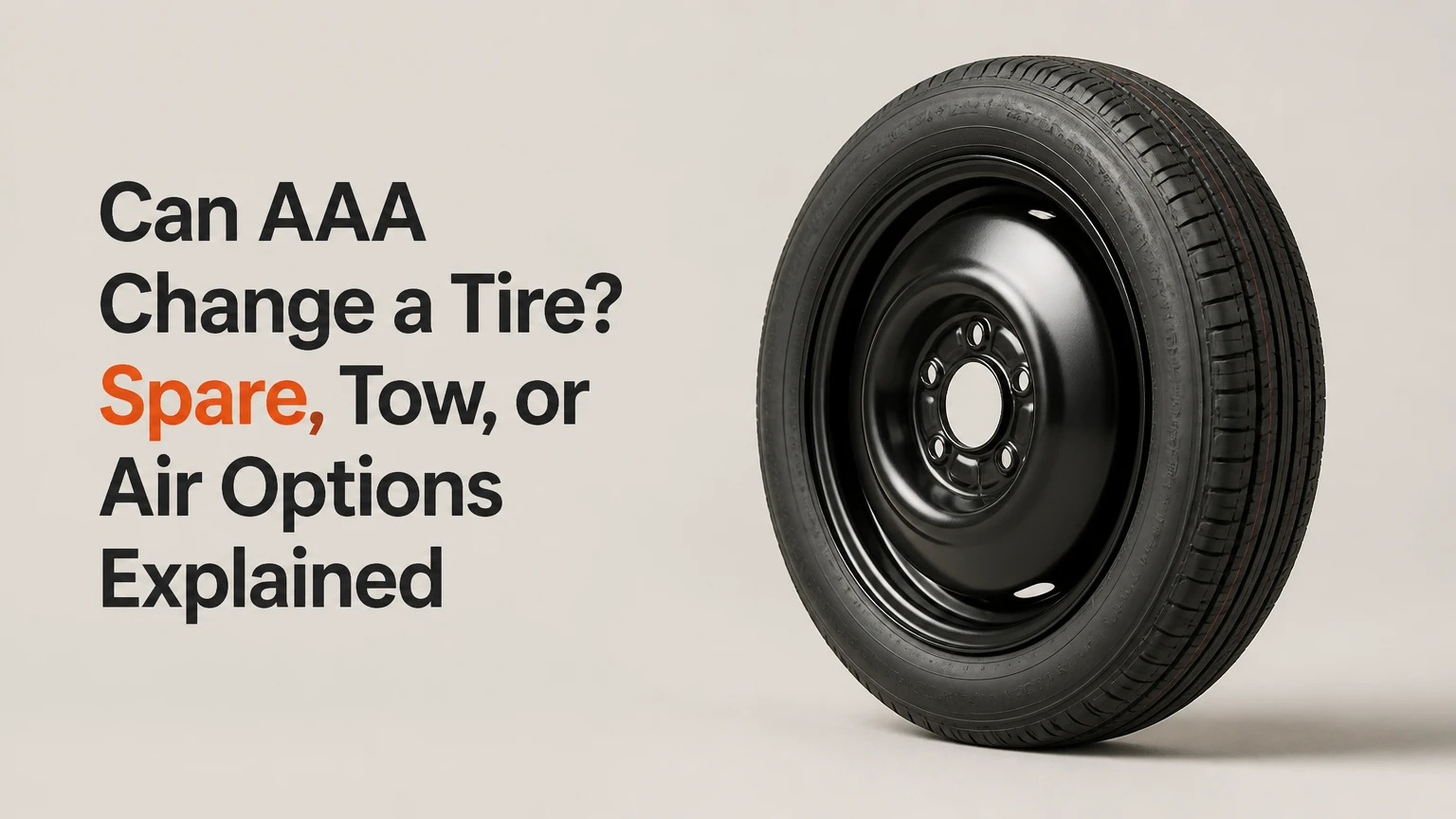
Yes, AAA can change a flat tire by removing the damaged wheel and installing your vehicle’s usable spare tire. AAA roadside technicians generally do not patch or permanently repair punctures at the roadside; if no safe spare is available, AAA may inflate the tire temporarily or tow the vehicle to a tire shop.
Key Facts at a Glance
AAA flat-tire service normally means installing your vehicle’s inflated spare tire.
AAA usually does not perform permanent puncture repairs or tire replacements at the roadside.
A missing, damaged, or inaccessible spare can change the service outcome to a tow.
A temporary “donut” spare requires the speed and distance limits printed on its sidewall or in the owner’s manual.
A wheel-lock key, accessible trunk, and properly inflated spare can determine whether the change succeeds.
AAA membership benefits, towing mileage, pricing, and immediate-service rules vary by regional AAA club.
What Does AAA Actually Do for a Flat Tire?
AAA’s flat-tire service is a roadside assistance benefit, not a mobile tire-shop appointment. A technician typically secures the vehicle, removes the flat wheel, and installs an inflated spare that belongs to the vehicle. If the tire only needs air and appears safe, the technician may inflate it instead.
AAA generally does not plug, patch, mount, balance, or replace a damaged tire at the roadside. Those jobs require tire-repair equipment, inspection of the tire’s internal structure, and often a shop environment. A nail in the tread may be repairable, while a sidewall cut, shredded tread, or tire driven while flat usually requires replacement.
The exact response depends on the vehicle, location, membership terms, and contractor equipment. AAA’s regional clubs describe flat-tire assistance differently, so the dispatcher may confirm whether a spare installation or tow is available before sending help.
AAA service outcomes by tire situation
| Vehicle situation | Likely roadside action | Likely final destination | Main limitation |
|---|---|---|---|
| Inflated full-size spare | Remove flat and install spare | Tire shop for inspection | Damaged tire still needs evaluation |
| Inflated temporary spare | Install donut spare | Tire shop or dealer | Speed and distance limits apply |
| Low tire with no visible damage | Add air and check pressure | Nearby tire facility | Inflation is not a repair |
| Punctured tread | Possibly add air if safe | Tire repair shop | AAA usually does not patch roadside |
| Sidewall tear or shredded casing | Tow vehicle | Tire retailer or dealer | Do not drive on the damaged tire |
| No spare in the vehicle | Tow vehicle | Suitable repair facility | Inflator kit may not restore safe operation |
How Do You Request AAA Tire Service?
Request AAA roadside assistance through the AAA Mobile app or by calling 1-800-AAA-HELP, which is 1-800-222-4357 in the United States and Canada. Give the dispatcher the vehicle’s exact location, travel direction, problem type, vehicle make and model, and whether the vehicle has a usable spare.
The location matters more than many drivers expect. A service truck needs a safe approach and enough room to position a jack or tow equipment. Provide a highway route, exit number, mile marker, GPS pin, business address, or visible landmark, then update AAA if the vehicle moves.
Tell the dispatcher about a locked wheel, inaccessible trunk, low spare, electric vehicle, lifted truck, trailer, narrow shoulder, or hazardous traffic. Early disclosure can prevent a technician arriving with the wrong expectation or equipment.
What information should you provide?
- Exact location: Include road name, direction, exit, mile marker, or GPS coordinates.
- Vehicle identity: State the year, make, model, color, and license plate.
- Tire condition: Describe a puncture, sidewall damage, low pressure, missing tire, or wheel damage.
- Spare status: Confirm whether the spare exists, is inflated, and can be reached.
- Access problems: Mention wheel locks, blocked cargo areas, underground garages, or restricted roads.
- Safety conditions: Report traffic exposure, darkness, extreme weather, or a vehicle partly in a travel lane.
AAA’s app may provide dispatch updates and location tracking, but availability and features depend on the local club and dispatch network. Keep your phone charged because the technician may call for directions.
How Long Does AAA Take to Change a Tire?
A typical AAA response can take 20-60 minutes, while severe weather, holiday demand, remote roads, and major traffic incidents can extend the wait beyond two hours. Once the technician arrives, a straightforward spare-tire installation often takes about 15-30 minutes, assuming the spare and wheel-lock key are accessible.
Published timing is not a guarantee. J.D. Power’s roadside-assistance guidance identifies location, weather, demand, and service availability as major response-time variables. A flat on an urban side street may receive faster service than a vehicle on a rural interstate, even when both requests enter the system at the same time.
The fastest completion occurs when the vehicle is on stable ground, the trunk opens, the spare has air, the wheel-lock key is present, and the flat wheel is not seized to the hub. A corroded wheel, missing key, or unusual vehicle height can turn a tire change into a tow.
Typical timing by service condition
| Service condition | Typical arrival range | Typical on-site time | Main delay |
|---|---|---|---|
| Urban road, usable spare | 20-60 minutes | 15-25 minutes | Dispatch demand |
| Rural highway, usable spare | 45-120 minutes | 20-35 minutes | Distance and contractor availability |
| Flat spare needing inflation | 30-90 minutes | 20-40 minutes | Spare condition |
| Missing spare or unsafe damage | 30-120 minutes | 20-45 minutes | Tow-truck availability |
| Snow, flood, or major storm | 60-180+ minutes | 20-60 minutes | High call volume and road access |
These are typical planning ranges, not AAA service guarantees. Ask the dispatcher for the current estimated arrival time and whether the request is classified as a tire change or tow.
How Much Does AAA Charge for Tire Service?
For an active AAA member, an eligible flat-tire service call is generally included in the membership’s roadside benefits, but the member’s club rules and service limits control. New membership may cost roughly $60-$170 per year, depending on region and Classic, Plus, or Premier tier, while nonmember or immediate-join requests can involve enrollment charges, waiting periods, or market-rate fees.
AAA is organized through regional motor clubs rather than one uniform national benefit schedule. Towing mileage, service-call limits, household coverage, guest use, and restrictions after joining during a breakdown can therefore differ by state and club.
The fee for a replacement tire, tire repair, wheel, valve stem, alignment, or shop labor is separate from roadside assistance. AAA may transport the vehicle, but the destination shop sets repair and replacement prices.
Typical membership and roadside cost factors
| Cost category | Typical figure or rule | What it covers | Qualification |
|---|---|---|---|
| Classic membership | $60-$75 per year | Basic roadside benefits | Regional pricing varies |
| Plus membership | $95-$125 per year | Higher towing allowance in many clubs | Confirm local terms |
| Premier membership | $125-$170 per year | Highest tier benefits in many clubs | Limits vary by club |
| Member tire service | $0 roadside charge in eligible cases | Spare installation or assistance | Active membership required |
| Replacement tire | $80-$400+ per tire | Tire product and shop labor | Size, brand, and vehicle determine price |
| Immediate or nonmember request | $75+ enrollment or market-rate possibility | Depends on local policy | Ask before authorizing service |
Do not assume that purchasing membership after the flat guarantees immediate free service. Some AAA clubs apply a waiting period, charge a service fee, or limit benefits for a breakdown already in progress.
What Happens if You Have No Spare Tire?
If the vehicle has no usable spare, AAA will generally arrange a tow rather than install an unsafe substitute. The technician may inflate a low tire or use an approved vehicle inflation kit when conditions permit, but sealant and compressor kits cannot repair every puncture and cannot fix sidewall damage.
AAA reports that many newer vehicles omit spare tires to reduce weight and increase cargo space. Instead, manufacturers may supply a compressor and sealant kit, run-flat tires, or no emergency tire equipment. Check the owner’s manual before using sealant because some tire-pressure monitoring systems and tire shops have restrictions.
A tow destination also matters. Basic, Plus, and Premier plans commonly have different mileage allowances, but exact limits vary by local club. AAA’s club guidance often describes Classic towing as shorter than Plus coverage, while Premier plans may provide one longer tow per membership year.
Equipment that changes the outcome
| Equipment or condition | Can the technician use it? | Likely result | Driver’s check |
|---|---|---|---|
| Full-size spare with 60 psi | Usually yes | Spare installation | Check pressure monthly |
| Donut spare with 60 psi | Usually yes | Temporary spare installation | Read sidewall speed limit |
| Compressor and sealant kit | Sometimes | Temporary inflation or tow | Check expiration date |
| Run-flat tire | Sometimes | Limited drive or tow | Follow manufacturer distance limit |
| Wheel-lock key | Usually required | Wheel removal possible | Store key with lug tools |
| No jack point or specialty wheel | Depends on vehicle | Tow may be safer | Consult owner’s manual |
A tire inflator kit is not equivalent to a spare tire. Sealant may fail on a large puncture, a damaged valve, a separated tread, or a cut sidewall, and it can complicate later tire inspection.
Which Problems Can Stop the Tire Change?
A missing wheel-lock key, seized lug nuts, damaged jack point, inaccessible spare, or badly damaged wheel can prevent a normal roadside tire change. AAA may attempt a safe workaround, but technicians should not use destructive methods that could damage the wheel or vehicle without appropriate authorization and equipment.
Wheel locks use a unique key socket instead of a standard lug-nut socket. The key is often stored beside the jack, inside the glove compartment, or in the center console. If it is absent, a tire shop may remove the lock with specialized tools, but roadside contractors may choose towing instead.
A spare tire can also appear usable while being unsafe. Rubber ages, pressure falls, and a compact spare may have a lower speed rating than the normal tire. Tire manufacturers commonly recommend checking spare pressure during routine maintenance, and the vehicle placard or owner’s manual supplies the correct pressure.
Common failure modes and the correct response
| Failure mode | Why it matters | Immediate response | Likely AAA outcome |
|---|---|---|---|
| Missing wheel-lock key | Standard socket cannot remove lock | Search glove box and spare well | Attempt or tow |
| Flat spare | Spare cannot support vehicle | Tell dispatcher its pressure | Inflate if sound or tow |
| Corroded wheel hub | Wheel may remain stuck after lugs loosen | Do not strike wheel dangerously | Extra work or tow |
| Damaged sidewall | Air will escape immediately | Keep vehicle stationary | Tow to tire shop |
| Spare buried under cargo | Technician cannot safely access it | Clear trunk if location permits | Delay or tow |
| Bent wheel | Replacement tire may not seal | Do not drive on rim | Tow and wheel inspection |
A common practitioner mistake is checking the spare only after a breakdown begins. A five-minute monthly inspection of pressure, corrosion, jack tools, and wheel-lock location prevents several avoidable tow outcomes.
Can AAA Change a Tire on a Highway?
AAA can often provide roadside assistance on a highway, but a narrow or exposed shoulder may be too dangerous for a conventional tire change. Move the vehicle as far from traffic as possible without driving on a destroyed tire, activate hazard lights, and tell the dispatcher which direction traffic is moving.
The safest waiting position depends on the road design. If the vehicle is fully outside active lanes and a barrier is available, remain behind the barrier or well away from traffic. If leaving the vehicle requires crossing lanes or walking near fast traffic, stay belted inside with doors locked unless emergency personnel direct otherwise.
AAA technicians use warning equipment and trucks, but a service vehicle does not eliminate traffic risk. The Federal Highway Administration treats roadside incidents as high-risk environments because passing vehicles can strike disabled vehicles, responders, and equipment.
Safe waiting priorities
- Call 911 first if the vehicle blocks a travel lane, someone is injured, or a crash occurred.
- Use hazard lights, especially at night, in rain, or near a curve.
- Do not stand between the vehicle and moving traffic.
- Do not attempt a DIY change on a narrow interstate shoulder.
- Tell AAA about a child, pet, medical condition, or hazardous cargo in the vehicle.
- Keep the spare, jack, and wheel-lock key inside until the technician arrives.
The right decision may be a tow even when a spare is available. A tow truck can relocate the vehicle to a safer area before the tire work begins.
Should You Change the Tire Yourself?
A driver should change a tire independently only when the vehicle is on stable, level ground away from traffic, the correct jack and tools are present, and the driver can follow the owner’s manual. DIY work may take 15-30 minutes, but a roadside shoulder, damaged jack point, or heavy vehicle changes the risk calculation.
AAA’s own driver guidance explains the standard process: secure the vehicle, loosen lug nuts before lifting, use the manufacturer’s jack points, install the spare, and tighten the lug nuts in a star pattern. Never place any part of your body under a vehicle supported only by an emergency jack.
A DIY change also has limits. The compact jack supplied with a sedan is not automatically suitable for a loaded SUV, trailer, or uneven gravel shoulder. A torque wrench is the best tool for final lug tightening, although the technician or tire shop should verify torque if the emergency kit lacks one.
AAA compared with other solutions
| Option | Typical direct cost | Typical time | Best condition | Main weakness |
|---|---|---|---|---|
| AAA member service | $0 for eligible call | 35-150 minutes total | Unsafe roadside or no tools | Wait and membership limits |
| DIY spare change | $0 after equipment purchase | 15-30 minutes | Level, protected location | Injury and traffic exposure |
| Insurance roadside add-on | $10-$50 per year typical | 30-150 minutes | Existing policy coverage | Claim and dispatch rules vary |
| Pay-per-use roadside | $75-$150+ per call typical | 30-150 minutes | One-time need | Higher incident cost |
| Tire-shop mobile service | $100-$300+ before tire | 30-120 minutes | Repair or replacement at location | Limited hours and coverage |
Insurance roadside assistance may not automatically count as an insurance claim, but insurers and policies differ. Verify that detail before choosing a provider based on premium impact.
What Should You Do After AAA Leaves?
After AAA installs a spare, drive directly to a tire shop, dealership, or approved repair facility for inspection. A compact spare is an emergency replacement, not a normal long-term tire, and the original tire may need repair, replacement, or internal inspection.
Follow the spare’s printed speed and distance limits rather than relying on a generic rule. Many compact spares carry a 50 mph limit, but the sidewall and owner’s manual control; some vehicles specify a shorter distance or prohibit certain axle positions.
Ask the tire shop to inspect the puncture location, tread depth, sidewall, wheel, valve stem, and tire-pressure monitoring system. A tread puncture within the repairable area may be professionally repaired, while shoulder and sidewall damage generally requires replacement under industry repair standards.
Post-installation checklist
- Confirm that every lug nut is present and visibly seated.
- Check spare pressure against the sidewall or vehicle manual.
- Reset or monitor the TPMS as the vehicle manufacturer directs.
- Drive below the spare’s posted limit.
- Avoid hard cornering, sudden braking, heavy loads, and long highway trips.
- Visit a tire facility as soon as practical.
- Have the original tire and wheel inspected before reinstalling them.
Do not store a temporary spare permanently in place. Its smaller diameter can alter handling, braking balance, drivetrain behavior, and electronic stability-control performance.
Does AAA Cover Every Vehicle and Location?
AAA roadside assistance is widely available in the United States and Canada, but coverage is administered through regional clubs and contracted service providers. Service may differ for motorcycles, RVs, commercial vehicles, trailers, off-road locations, rental cars, rideshare vehicles, and vehicles parked in restricted facilities.
A local AAA club determines membership pricing, covered vehicles, service-call limits, towing miles, and rules for passengers or household members. The AAA membership card and local club terms are more authoritative than a national estimate.
Before a long trip, verify four details: the vehicle category, the membership’s towing distance, the number of annual calls, and whether a breakdown after immediate enrollment is restricted. The same AAA name can represent different club benefits in neighboring states.
The Bottom Line: Can AAA Change a Tire?
AAA can change a tire when “change” means removing a flat tire and installing an accessible, inflated spare. AAA usually does not permanently repair a puncture roadside, and the service normally becomes inflation assistance or towing when the vehicle has no safe spare, a missing wheel-lock key, severe wheel damage, or an unsafe location.
Check the spare, wheel-lock key, jack, and tire pressure before a breakdown occurs. If you are already stranded, move away from traffic when safe, request AAA through the app or 1-800-222-4357, describe the vehicle accurately, and confirm the local club’s service and towing terms.
For most drivers, the deciding factor is not whether AAA owns a tire-changing machine. The deciding factor is whether the vehicle carries a usable spare and whether the roadside location permits safe work.
Frequently Asked Questions
Does AAA change a tire without a membership?
AAA may accept nonmember or immediate-join requests in some regions, but the caller may face an enrollment charge, a waiting period, or a market-rate service fee. Membership rules are local, so ask for the total price and eligibility before authorizing dispatch. A membership purchased after a breakdown does not universally provide immediate free service.
Can AAA put air in a tire instead of changing it?
Yes, AAA may inflate a low tire when the tire appears intact and can safely reach a repair facility. Air does not fix a puncture, damaged valve, sidewall cut, or separated tread. If pressure drops again or the tire shows visible damage, stop driving and request a tow rather than repeatedly adding air.
Will AAA change a tire in a parking garage?
AAA may assist in a parking garage if the vehicle is accessible and the contractor can safely use the required equipment. Low ceilings, tight turns, gated access, poor ventilation, and insufficient jack clearance can prevent service. Give the dispatcher the garage level, clearance height, gate instructions, and exact parking space.
Does AAA change tires on electric vehicles?
AAA can assist many electric vehicles, but the correct procedure depends on the model. Some EVs have no spare, special lift points, heavy curb weight, or manufacturer-specific towing requirements. Tell the dispatcher the EV’s make and model, avoid improvised lifting, and follow the owner’s manual if a flat-tire kit is supplied.
Can AAA change a tire if the lug nuts are stripped?
AAA may attempt removal if its technician has suitable tools, but stripped or seized lug nuts can require specialized extraction equipment. If roadside removal risks wheel or stud damage, towing is the safer outcome. Do not keep driving to loosen the nuts, because the wheel can separate or the tire can fail further.
How far can you drive on a AAA-installed spare?
Drive only within the spare tire’s printed speed and distance limits. Many temporary spares specify a maximum of 50 mph, but the manufacturer may set a different limit. Avoid extended travel, heavy loads, and high-speed roads, then have the original tire repaired or replaced at the first practical opportunity.


