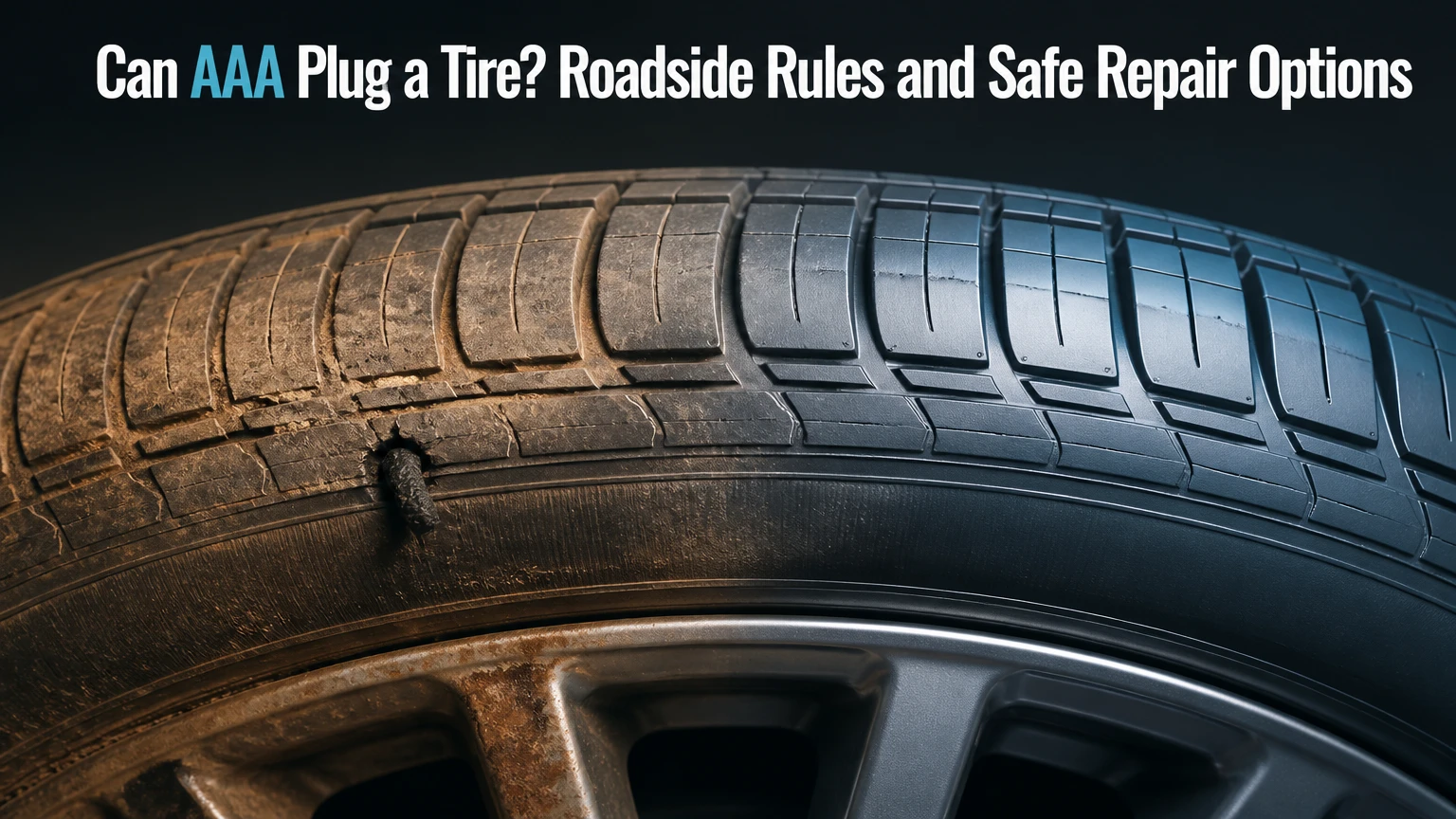
AAA generally does not include tire plugging or patching in standard roadside assistance. For a flat tire, AAA typically installs a usable spare or tows the vehicle to a repair facility, while an AAA Car Care Center or other approved shop may perform an inspected internal repair. Local AAA club policies and contractor capabilities can differ.
Key facts at a glance
AAA roadside technicians typically change a flat tire for a usable spare or arrange a tow.
A roadside tire plug is not the same as a professional internal plug-patch repair.
A puncture in the center tread may be repairable if the tire was not driven flat.
Sidewall and shoulder punctures generally require tire replacement.
AAA membership usually covers eligible roadside service, but shop repairs and replacement tires cost extra.
Exact service rules, mileage limits, and prices vary by AAA club, membership tier, and location.
Can AAA Plug a Tire During a Roadside Call?
AAA usually does not officially plug or patch a tire at the roadside. Standard AAA roadside tire service is designed to install the vehicle’s usable spare, inflate it to a safe pressure, or tow the vehicle when a spare is unavailable or unsafe.
The distinction matters because a tire cannot be safely assessed from the outside alone. The technician needs to know whether the tire was driven underinflated, whether the puncture damaged steel belts, and whether the injury lies in the repairable tread area. A quick external plug cannot answer those questions.
Some independent roadside contractors may carry a plug kit and may offer an informal temporary repair. That action is not a guaranteed AAA benefit, may not be available in every territory, and may lack a workmanship warranty. Ask the dispatcher what the local provider is authorized to do rather than relying on reports from another state.
What does AAA do for a flat tire?
AAA’s normal roadside response follows a short decision path:
- The technician locates and evaluates the flat tire.
- The technician checks whether the vehicle has a usable spare, jack, and locking-wheel-nut key.
- If the spare is safe, the technician installs it and verifies inflation.
- If no safe spare exists, AAA arranges towing under the member’s plan terms.
- A repair shop dismounts and inspects the damaged tire before deciding whether to repair or replace it.
A “usable spare” excludes a flat, damaged, incorrectly sized, severely aged, or missing temporary spare. A compact spare also has speed and distance restrictions printed on its sidewall, commonly a maximum of 50 mph and approximately 50 miles, although the vehicle manufacturer’s instructions control.
What Happens If There Is No Usable Spare?
When a vehicle lacks a safe spare, AAA normally provides towing rather than an external puncture repair. Many modern vehicles use tire-inflation kits, run-flat tires, or tire mobility systems instead of a spare, but those alternatives do not automatically change AAA’s roadside policy.
Tell the dispatcher about the vehicle type before arrival. A Tesla, BMW with run-flat tires, commercial van, lifted truck, or all-wheel-drive vehicle may require different equipment or towing procedures. An AWD vehicle may need all four wheels off the ground if the manufacturer prohibits prolonged driving with one temporary spare.
Where will AAA tow a flat-tire vehicle?
AAA towing destinations depend on the membership plan, local club rules, and available providers. A plan may offer a defined number of roadside service miles, while a longer tow can create an additional per-mile charge.
The destination may be a nearby AAA Approved Auto Repair facility, an AAA Car Care Center, a tire dealer, or another location allowed by the plan. Confirm these points with the dispatcher:
- Included towing distance and excess-mileage price
- Whether the destination must be open
- Whether the vehicle can be taken to a preferred tire shop
- Whether storage, after-hours, or toll charges apply
- Whether a second tow is excluded from the same service call
AAA roadside assistance does not normally include the cost of a replacement tire, wheel, valve stem, tire-pressure sensor, or shop labor.
Can an AAA Shop Repair a Puncture?
An AAA Car Care Center or AAA Approved Auto Repair facility may repair an eligible puncture after removing the tire from the wheel. The facility decides between repair and replacement after examining the inner liner, tread injury, tire age, tread condition, and manufacturer restrictions.
A proper repair uses an industry-recognized combination repair, often called a plug-patch. The plug fills the puncture channel, and the internal patch seals the inner liner. The tire is then remounted, inflated, checked for leaks, and normally balanced if the wheel was disturbed.
The U.S. Tire Manufacturers Association states, “Proper tire repair includes a complete inspection of the inside of the tire.” That principle explains why a roadside string plug cannot be treated as equivalent to an in-shop repair.
How does a professional plug-patch repair work?
A tire technician normally performs these actions:
- Remove the wheel and dismount the tire. The tire machine separates the tire from the rim without damaging the bead.
- Inspect the interior. The technician looks for abrasion, rubber dust, liner separation, exposed cords, and heat damage from underinflation.
- Prepare the puncture. The injury is cleaned and prepared according to the repair-material manufacturer’s instructions.
- Apply the combination repair. A repair unit with a stem and internal patch seals both the puncture path and the inner liner.
- Roll and seal the patch. The technician removes trapped air and applies the required inner-liner sealant.
- Inflate and leak-test the tire. The repaired area, valve stem, bead, and entire tire are checked.
- Remount and balance the assembly. The wheel returns to the vehicle with the correct torque and pressure.
A professional repair commonly takes 30-60 minutes when the shop is ready to begin. Waiting time, tire-machine availability, and replacement-tire sourcing can extend the visit.
What Is a Tire Plug?
A tire plug is a sticky rubber repair cord inserted from the outside into a small tread puncture. The cord occupies the hole and creates friction and adhesion, but an external plug does not permit inspection of the tire’s internal structure.
A plug kit usually contains a reaming tool, insertion tool, rubber cords, and cement. The emergency procedure involves removing the puncturing object, preparing the channel, inserting the cord, trimming excess material, inflating the tire, and checking for bubbles with soapy water.
External plugging has a legitimate limited use: reaching a repair facility after a simple tread puncture when no safer option exists. It is a poor substitute for professional inspection, particularly when the tire lost most of its air or the vehicle traveled on it while flat.
Is a plug-patch repair better than a plug?
A plug-patch repair is generally the preferred repair for an eligible puncture because it seals the puncture channel and the tire’s inner liner. An external plug is faster, but it can hide internal damage and may leak if the channel is contaminated, angled, oversized, or improperly prepared.
| Repair method | Typical time | Typical price | Appropriate use | Main limitation |
|---|---|---|---|---|
| External string plug | 10-20 minutes | $10-$25 DIY kit | Emergency travel to a shop | No internal inspection |
| Internal patch only | 30-60 minutes | $20-$45 | Limited shop-approved cases | Does not fill the puncture channel |
| Internal plug-patch | 30-60 minutes | $30-$70 | Eligible permanent tire repair | Requires dismounting and inspection |
| Tire replacement | 45-120 minutes | $100-$500+ per tire | Structural damage or nonrepairable injury | Higher cost and possible tire matching |
The exact price depends on tire size, region, tire-pressure monitoring hardware, shop policy, and whether balancing is included. A shop may refuse a repair even when the puncture appears small.
Which Punctures Can Be Repaired?
A puncture is usually repairable only when it is small, isolated, and located in the central tread, with no evidence that the tire was driven while significantly underinflated. Tire manufacturers and repair organizations commonly use a maximum injury size near 1/4 inch, or 6 millimeters, but the manufacturer’s limit controls.
A practical inspection uses more than diameter. The technician also checks the injury angle, distance from the tread edge, remaining tread, previous repairs, tire age, speed rating, and internal condition.
| Inspection factor | Common repair threshold | Replacement concern |
|---|---|---|
| Puncture diameter | Up to about 1/4 inch, 6 mm | Larger or irregular hole |
| Injury location | Crown or center tread | Sidewall, shoulder, or edge |
| Remaining tread | Above 2/32 inch minimum | At or below 2/32 inch |
| Flat driving | No visible inner abrasion | Rubber dust, exposed cords, heat marks |
| Previous repairs | Manufacturer-approved spacing | Overlapping or crowded repairs |
| Tire condition | No bulges, cracks, or separation | Age damage or structural defect |
The often-repeated “1/2-inch from the edge” rule is not universal. Some manufacturers define the repairable crown differently, so a technician should measure the injury against the actual tread design and the tire maker’s instructions.
When must a tire be replaced?
A tire generally must be replaced when the injury affects the sidewall or shoulder, exceeds the approved repair size, reaches belts or cords, or follows driving while flat. Replacement is also the normal outcome for a tire with a bulge, tread separation, severe cracking, exposed cords, bead damage, or incompatible previous repairs.
A tire with only 2/32 inch of tread remaining is legally worn out in many jurisdictions and has reduced wet-weather performance. The legal minimum does not make a worn tire a sensible repair candidate. Tire manufacturers may recommend replacement sooner based on tread condition, age, or damage.
Run-flat tires require special attention. Some run-flat manufacturers permit repair after a low-pressure event, while others prohibit it because internal damage may be invisible. The tire sidewall, vehicle manual, and manufacturer service policy determine the answer.
How Much Does AAA Tire Help Cost?
For an eligible member, the roadside visit for a spare-tire change or covered tow is commonly included, but membership fees, plan restrictions, excess mileage, and non-covered services still apply. AAA membership prices vary by regional club and tier, so published national ranges should be treated as typical rather than guaranteed.
Typical U.S. planning figures are:
| Expense | Typical range | What determines the final amount |
|---|---|---|
| AAA membership | $65-$165 per year | Club, tier, enrollment promotion |
| Covered roadside visit | $0 service charge | Eligibility and plan terms |
| Extra towing mileage | About $4-$15 per mile | Regional contractor and tier |
| Professional puncture repair | $30-$70 | Shop, tire size, balancing |
| Replacement passenger tire | $100-$300 each | Brand, size, speed rating |
| Replacement specialty tire | $300-$500+ each | Run-flat, EV, performance design |
A newly purchased membership may have a waiting period or an immediate-service fee for a pre-existing breakdown. Do not assume that paying for membership after the puncture guarantees free service. Ask AAA for the exact charge before dispatch.
AAA roadside service and AAA shop service are separate transactions. Membership can cover the roadside response, while the repair facility bills separately for labor and parts.
How Long Does AAA Tire Service Take?
A spare-tire installation commonly takes 20-40 minutes after the technician arrives, while a tow can take 30 minutes to several hours depending on traffic, weather, location, and demand. An in-shop puncture repair usually takes 30-60 minutes once the vehicle reaches the service bay.
A roadside plug, when an independent contractor offers one, may take 10-20 minutes, but speed does not make it equivalent to an inspected repair. A replacement tire can take 45-120 minutes if the correct tire is in stock; ordering an uncommon size can take a day or longer.
| Situation | Service action | Typical duration after arrival |
|---|---|---|
| Usable spare in vehicle | Install and inflate spare | 20-40 minutes |
| No spare near a city | Tow to open repair shop | 30-120 minutes |
| Simple in-shop puncture | Dismount and plug-patch | 30-60 minutes |
| Tire not in stock | Order and install replacement | 1 day or more |
| Highway shoulder in bad weather | Wait for safe recovery | Highly variable |
These are planning ranges, not AAA response guarantees. Busy holiday weekends and remote roads can change the timeline substantially.
Can You Drive After a Tire Plug?
Drive only far enough to reach a tire professional after an external plug, and avoid highway speed until the repair has been inspected. A professional plug-patch repair can be used according to the tire manufacturer’s instructions, provided the tire passed internal inspection and the repair was installed correctly.
Before moving after any repair, verify that the tire holds the vehicle manufacturer’s cold inflation pressure. Check the pressure again after several miles and the next morning. A tire that loses measurable pressure needs immediate inspection.
Do not drive on a tire with a visible sidewall injury, repeated pressure loss, exposed cords, a bulge, or a plug that is pulling out. Do not use a compact spare beyond its speed or distance rating. A tire pressure monitoring system warning also requires a gauge check because TPMS sensors report pressure, not structural safety.
What Should You Do Before AAA Arrives?
Move the vehicle away from traffic only if the tire still holds enough pressure for a safe, controlled movement. Otherwise, stop on the shoulder, turn on hazard lights, exit on the side away from traffic when safe, and wait behind a barrier rather than standing beside the vehicle.
Give AAA precise information:
- Highway, street, direction of travel, and nearest exit or mile marker
- Vehicle year, make, model, color, and license plate
- Whether the vehicle has a spare, locking lug nuts, or run-flat tires
- Number of passengers and any accessibility or safety concerns
- Whether the vehicle is in a travel lane, shoulder, parking lot, or driveway
Do not remove a nail or screw before the technician arrives if the tire still contains air. The object may be slowing the leak, and removing it can make the vehicle harder to move safely.
What should a road-trip driver carry?
A spare tire, correctly sized jack, lug-nut key, wheel chock, tire-pressure gauge, and 12-volt compressor provide more useful preparation than relying on a roadside plug alone. A plug kit can be reasonable for remote off-road travel, but it should support a trip to professional service rather than replace it.
Electric vehicles and cars with tire sealant kits need extra planning. Sealant can contaminate a TPMS sensor, have a limited shelf life, and fail on a large or sidewall injury. Check the vehicle manual before using it.
Why Does a Repaired Tire Keep Losing Air?
A repaired tire that continues losing air may have a failed repair, a second puncture, bead leakage, valve-stem damage, wheel corrosion, or hidden internal damage. Pressure loss of even 2-5 psi per day is not normal after a correctly completed repair.
A technician should test the entire wheel assembly, not only the repair site. Submerging or spraying the inflated tire with soapy water can identify bubbles, but internal damage still requires dismounting.
Common failure patterns include:
- Bubbles at the repair: The plug or patch did not seal correctly.
- Bubbles at the valve stem: The valve core, stem, or TPMS service kit leaks.
- Bubbles at the bead: Corrosion, dirt, or a bent wheel prevents sealing.
- No outside leak: The tire may have internal separation or damage from flat driving.
- Pressure changes with temperature: Cold weather lowers pressure, but it does not explain a persistent leak.
Do not add another external plug beside a leaking plug. Remove the tire for inspection and follow the tire manufacturer’s repair limits.
Common AAA Tire-Service Mistakes
Assuming every AAA contractor offers identical repairs
AAA operates through regional clubs and contracted providers. One contractor may carry a tire plug kit, while another is authorized only to change a spare or tow. Treat the membership benefit, not a driver’s informal practice, as the reliable service baseline.
Driving too far on a temporary spare
A compact spare is an emergency mobility device, not a full replacement tire. Its sidewall commonly limits speed to 50 mph and distance to about 50 miles, but the printed limit and owner’s manual take priority.
Repairing a shoulder puncture because it looks small
The shoulder flexes heavily during cornering, so a small-looking injury can compromise the transition between tread and sidewall. Professional repair standards generally exclude shoulder and sidewall injuries.
Ignoring all-wheel-drive matching
Some AWD systems require closely matched tire circumference. Replacing one tire with a significantly different tread depth can stress the driveline, so the shop may recommend replacing a pair or all four tires.
Treating a sealant canister as a tire repair
A mobility sealant may temporarily close a small tread puncture, but it does not restore damaged belts or make a sidewall injury safe. Tell the shop if sealant was used because it affects inspection and cleanup.
What Is the Safest Choice in Each Situation?
| Driver situation | Best immediate action | Repair decision |
|---|---|---|
| Nail in center tread, tire still inflated | Call AAA or inflate cautiously | Shop plug-patch after inspection |
| Sidewall cut on a city street | Stop and request roadside help | Replace the tire |
| No spare on a rural road | Stay safe and request a tow | Inspect at an equipped shop |
| Tire driven flat for several miles | Do not continue driving | Replace unless inspection proves safe |
| Performance or run-flat tire | Follow tire-maker policy | Use an authorized tire specialist |
| AWD vehicle with one damaged tire | Check manual before replacement | Match tread depth and circumference |
AAA is most useful for safe recovery. A tire shop is the appropriate authority for deciding whether the tire itself can return to service.
Frequently Asked Questions
Does AAA replace a damaged tire?
AAA roadside assistance typically does not include a new tire. AAA may install a usable spare or tow the vehicle to a tire shop, where the member pays for a replacement tire, mounting, balancing, valve service, and applicable disposal fees.
Will AAA bring me a new tire?
Some local AAA programs or mobile partners may offer limited tire delivery or replacement services, but availability is location-specific and should not be assumed. Ask the dispatcher whether a replacement tire can be sourced for the vehicle’s exact size and whether payment is required at the roadside.
Can I plug a tire near the sidewall?
A puncture in the sidewall or shoulder should not be plugged. Those areas flex more than the center tread, and an external repair cannot restore damaged casing structure. Request a spare-tire installation or tow instead of attempting a sidewall repair.
Does AAA cover a flat tire caused by a nail?
AAA generally covers the eligible roadside response, such as installing a spare or towing, regardless of whether a nail caused the puncture. Membership does not normally pay for the tire repair or replacement itself, and service limits still apply.
How many times can one tire be repaired?
There is no universal number that applies to every tire. Manufacturers commonly restrict the number and spacing of repairs, and repairs must not overlap or compromise the tire’s structure. A technician should inspect the tire and consult the manufacturer before approving another repair.
Should I remove a nail before calling AAA?
Leave a nail or screw in place if the tire remains stable and you are waiting for roadside assistance. Removing the object can accelerate air loss. If the tire is already flat, do not handle it in traffic; move away from the roadway and wait for the technician.
The Bottom Line
Can AAA plug a tire? Usually not as part of standard roadside assistance. AAA generally installs a usable spare or arranges a tow, while an AAA Car Care Center or qualified tire shop may perform a permanent plug-patch repair after dismounting and inspecting the tire. For a sidewall injury, oversized puncture, damaged casing, or tire driven flat, replacement is the safer outcome.


