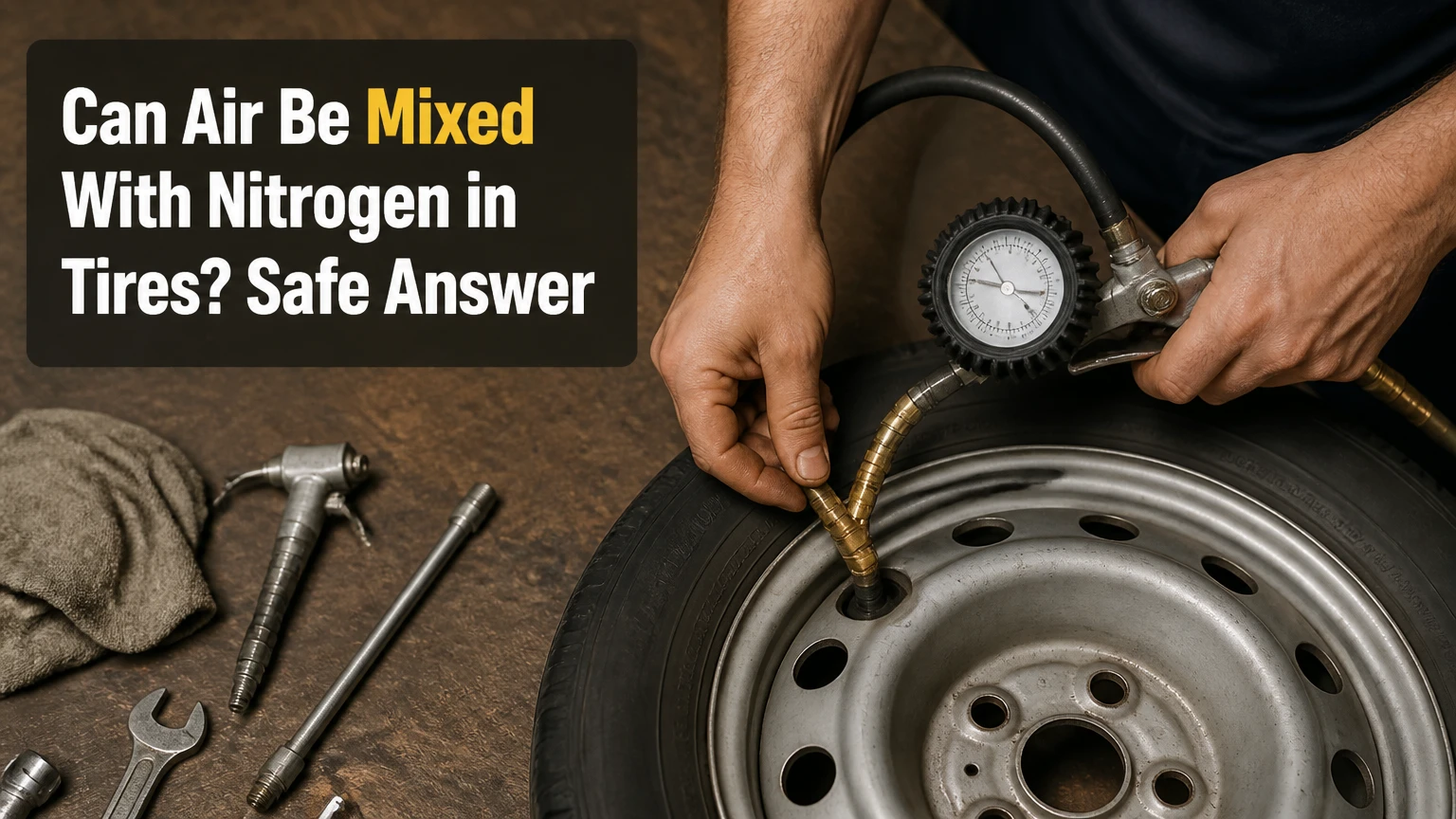
Yes, air can be mixed with nitrogen in tires safely. Regular compressed air does not react dangerously with nitrogen, damage the tire, harm the wheel, or interfere with TPMS. If a nitrogen-filled tire is underinflated, add ordinary air until it reaches the vehicle manufacturer’s recommended cold pressure; gas purity is less important than correcting low pressure.
Key Facts at a Glance
- Ordinary atmospheric air contains approximately 78% nitrogen, 21% oxygen, and about 1% argon, carbon dioxide, and other gases.
- Adding compressed air lowers the nitrogen percentage, but it does not create a hazardous chemical mixture.
- Nitrogen-filled tires still lose pressure and require at least monthly inspection.
- The recommended cold PSI is printed on the driver’s door-jamb label or in the owner’s manual, not on the tire sidewall.
- Nitrogen cannot compensate for a puncture, leaking valve core, damaged wheel, or bead leak.
- A nitrogen purge is optional after an air top-off and is not required to make the tire safe to drive.
Can Air Be Mixed With Nitrogen in Tires?
Compressed air and nitrogen can occupy the same tire without an explosion, toxic reaction, or mechanical incompatibility. The result is simply a gas mixture with more oxygen, argon, and water vapor than the tire had before the air was added.
The immediate safety decision is straightforward: inflate an underinflated tire with whatever clean, dry air or nitrogen is available. NHTSA states, “Underinflation is the leading cause of tire failure,” so delaying inflation to locate nitrogen creates a greater risk than temporarily reducing gas purity.
Mixing changes performance only in proportion to the amount of air introduced. For example, a tire containing 30 PSI of 95% nitrogen that receives a small 2 PSI air top-off remains mostly nitrogen, although its exact final composition depends on temperature, pressure, and how much gas was removed first.
No special valve, tire compound, or TPMS sensor is required for the mixture. Green valve caps may identify a nitrogen service program, but the cap color does not prove the gas concentration inside the tire.
What Happens Inside the Tire?
Nitrogen and compressed air mix uniformly inside the tire chamber. The pressure depends primarily on the amount of gas, tire volume, and absolute temperature, while gas composition affects moisture content, oxidation, and permeation to a smaller degree.
Air is not a separate layer beneath nitrogen. A tire that receives air after nitrogen contains one blended atmosphere, not two gases stacked by density. Normal driving, flexing, and temperature changes distribute the gases through the cavity.
A small air top-off usually has a minor effect. A complete deflation followed by an air refill replaces the nitrogen advantage almost entirely, although the tire remains safe and serviceable.
Why Does the Gas Mixture Matter?
Nitrogen inflation is used because commercial nitrogen is usually dry and contains a high nitrogen concentration, not because nitrogen is a fundamentally different pressure-producing substance. Standard compressed air also contains mostly nitrogen, so the practical distinction is dryness and gas-handling consistency.
Commercial systems commonly advertise nitrogen purity between 93% and 99.9%, depending on the generator, storage method, and service standard. There is no universal automotive rule stating that every tire must reach exactly 93% nitrogen before any benefit exists. A higher concentration reduces oxygen and moisture, but real-world gains depend on tire construction, leakage paths, climate, and maintenance.
Is Nitrogen Molecule Size the Main Reason for Slower Leakage?
Molecule size is not a reliable standalone explanation for nitrogen’s slower pressure loss. Nitrogen, N₂, has a molecular mass of approximately 28, while oxygen, O₂, has a molecular mass of approximately 32, so the common claim that nitrogen molecules are larger than oxygen molecules is inaccurate.
Tire pressure can decline through several routes:
- Gas permeates through the rubber.
- Air escapes around the valve core or valve stem.
- A puncture releases gas rapidly.
- A wheel bead or rim develops a leak.
- Temperature changes alter the measured pressure.
Dry nitrogen can reduce oxidation and moisture-related variability, particularly in heavy-duty, stored, or high-temperature applications. For ordinary passenger vehicles, however, the difference in monthly pressure retention is generally modest compared with a slow puncture or seasonal temperature change.
Does Moisture Make Air Pressure Unpredictable?
Moisture can affect pressure behavior, but the AI Overview overstates the effect for normal passenger-car use. Properly maintained service compressors can supply relatively dry air, while poorly maintained systems may deliver more water vapor; the actual amount varies with climate, compressor design, tank drainage, and filtration.
Water vapor can condense inside a cool tire and vaporize when heated. Yet tire pressure naturally rises as the tire warms even with perfectly dry nitrogen. The ideal-gas relationship, approximately expressed as pressure changing with absolute temperature at constant volume, governs both gases.
Dry nitrogen offers more consistent thermal behavior in specialized applications because its moisture content is controlled. That does not mean ordinary air creates dangerous pressure spikes during normal driving.
How Do Air and Nitrogen Compare?
Standard air is the practical choice for most drivers because it is widely available, inexpensive, and already mostly nitrogen. Nitrogen offers a narrower benefit: dry, controlled inflation that may reduce slow permeation and oxidation over long service intervals, but it does not remove the need for pressure checks.
| Criterion | Compressed air | Commercial nitrogen | Mixed air and nitrogen |
|---|---|---|---|
| Typical nitrogen content | 78% | 93%-99.9% | Usually 78%-95% |
| Oxygen content | About 21% | Commonly below 7% | Between air and nitrogen levels |
| Moisture content | Varies by compressor | Usually very low | Depends on the air added |
| Availability | Gas stations, shops, home compressors | Selected tire centers and fleets | Available after any top-off |
| Typical top-off price | Free-$2 per vehicle | $0-$7 per tire | Same as the gas used |
| TPMS compatibility | Compatible | Compatible | Compatible |
| Recommended pressure checks | Monthly and before trips | Monthly and before trips | Monthly and before trips |
| Best fit | Daily passenger vehicles | Fleets, storage, specialized use | Emergency or routine maintenance |
Does Nitrogen Keep Pressure Longer?
Nitrogen may lose pressure more slowly through the tire casing than humid compressed air, but the size of the benefit varies and is often overstated in consumer marketing. A tire’s valve, bead, wheel, and puncture condition usually matter more than whether the inflation gas is 80% or 99% nitrogen.
Some commercial sources describe air loss near 1-2 PSI per month and nitrogen loss near 0.5-1 PSI per month, but those figures are typical estimates, not a universal engineering specification. Tire age, temperature, rubber construction, wheel condition, and measurement accuracy can produce larger differences.
A cold-weather change can easily alter pressure by several PSI without any meaningful gas leakage. For that reason, a nitrogen-filled tire that is 4 PSI low still needs immediate attention.
Does Nitrogen Improve Fuel Economy?
Correct tire pressure improves rolling resistance and can support fuel economy; nitrogen itself usually produces little measurable financial return for a private passenger vehicle. The U.S. Department of Energy’s fueleconomy.gov identifies proper inflation as a way to improve fuel economy, but the benefit comes from maintaining the specified pressure.
A driver who pays for nitrogen but neglects monthly checks gains less than a driver who uses free air and maintains the correct PSI. Nitrogen does not make an underinflated tire acceptable.
What Should You Do When Pressure Is Low?
Add air immediately when a nitrogen-filled tire shows low pressure. Use the vehicle’s cold-pressure specification, inflate all four tires under comparable conditions, and inspect the low tire for a puncture if the pressure dropped suddenly or repeatedly.
Step 1: Check the Tire Cold
Measure pressure before driving, or after the vehicle has been parked for at least three hours. Do not reduce pressure from a hot tire to match the door-jamb label, because the reading includes temporary heat-related expansion.
Step 2: Find the Correct PSI
Use the driver’s door-jamb placard or owner’s manual. A typical passenger vehicle may specify 32-36 PSI, but the correct value belongs to the vehicle, axle, and load configuration.
Step 3: Add Clean Compressed Air
Connect a calibrated inflator and add air to the specified cold PSI. A gas-station compressor, workshop compressor, or portable 12-volt inflator is suitable if the equipment has a compatible chuck and accurate gauge.
Step 4: Recheck the Reading
Remove the chuck, wait briefly, and measure again with a reliable gauge. Replace the valve cap, then reset the TPMS only after all tires have the correct pressure if the vehicle requires a reset procedure.
Step 5: Investigate Repeated Loss
A tire that loses more than about 2 PSI between monthly checks deserves inspection, especially if the loss affects one tire. Tire technicians can test the tread, valve stem, valve core, wheel lip, and bead with soapy water or an immersion tank.
The success checkpoint is stable pressure after the tire cools. A nitrogen top-off is unnecessary if the tire remains properly inflated.
Will Mixing Damage TPMS or Wheels?
Mixing air and nitrogen does not damage TPMS sensors, aluminum wheels, steel wheels, tire liners, or ordinary valve hardware. TPMS measures pressure, and direct sensors generally measure temperature as well; neither sensor requires a particular gas composition to function.
The relevant risks are mechanical. Moisture in compressed air can contribute to corrosion over long periods, especially inside steel wheels or heavy-duty assemblies, but a normal air top-off does not suddenly corrode a rim. A damaged valve, cracked wheel, or bead leak presents a more immediate concern.
Can Air Cause a TPMS Warning?
Air can cause a TPMS warning only indirectly, by failing to restore the tire to the vehicle’s threshold pressure or because the warning system needs recalibration. TPMS does not normally identify whether the cavity contains air, nitrogen, or a mixture.
After inflation, drive according to the vehicle manufacturer’s reset instructions. Some systems relearn automatically after several minutes of driving, while others require a dashboard command or scan tool.
How Is a Tire Converted Back to Nitrogen?
A tire can be returned to a high-nitrogen mixture by removing its current contents and refilling it with dry nitrogen, but a purge is a performance preference rather than a safety repair. A tire shop typically removes the valve core or uses a nitrogen service machine, evacuates or deflates the tire, and refills it to the specified pressure.
Repeated purge cycles can lower residual oxygen and moisture, but ordinary tire-service equipment cannot guarantee absolute purity. The process also consumes nitrogen and takes longer than a top-off.
| Service action | Typical time | Typical retail price | Required for safety? | Result |
|---|---|---|---|---|
| Add air to one low tire | 1-3 minutes | $0-$2 | Yes, if pressure is low | Correct pressure |
| Add nitrogen to one tire | 1-5 minutes | $0-$7 | No, if air is available | Higher nitrogen content |
| Deflate and refill one tire | 5-10 minutes | $5-$15 | No | Mostly fresh nitrogen |
| Four-tire nitrogen purge | 15-30 minutes | $20-$40 | No | Reduced residual air |
| Leak diagnosis and repair | 20-60 minutes | $15-$35 inspection, repair varies | Yes, for repeated loss | Addresses the actual leak |
Retail prices vary by region and whether nitrogen is included with a tire purchase, road-hazard plan, or fleet contract. Paying $20-$40 for a full-set purge is difficult to justify for a commuter who can check pressure monthly.
Which Drivers Benefit From Nitrogen?
Nitrogen is most defensible for vehicles exposed to long storage, heavy loads, repeated heat cycles, or strict pressure consistency. Standard air is usually the better value for daily passenger vehicles because regular maintenance provides most of the practical safety benefit.
Daily City Drivers
Use compressed air and check pressure monthly. Short trips do not create a special nitrogen requirement, and city driving makes accessible inflation more valuable than a modest reduction in permeation.
Highway Commuters and Road-Trippers
Nitrogen may reduce moisture-related variation during repeated long trips, but correct cold PSI matters more. Carry a tire gauge and inflator plan because highway travel increases the consequence of an unnoticed leak.
Fleets, RVs, and Trailers
Nitrogen can make sense when vehicles sit for weeks, carry high loads, or require consistent maintenance records. Fleet operators should still inspect pressure before every trip, because nitrogen does not reveal or prevent a puncture.
Track-Day Vehicles
Racing teams often use dry nitrogen because predictable gas conditions help repeat setup measurements during severe heat cycles. Track use is different from public-road commuting, and the tire manufacturer’s hot-pressure procedure remains the governing instruction.
Stored and Seasonal Vehicles
Dry gas can limit moisture exposure during long storage, but storage pressure, load support, tire age, sunlight, and flat-spot prevention also matter. A vehicle that sits for six months still needs a pre-drive inspection before returning to the road.
Where Can You Get Air or Nitrogen?
Compressed air is available from most tire shops, service stations, repair garages, and portable inflators. Nitrogen is more commonly available at tire retailers, dealerships, commercial fleet facilities, and motorsport service centers.
Ask a shop whether nitrogen is included with tire installation, whether top-offs are free, and whether the equipment has a purity monitor. A green cap alone cannot verify purity, and a nitrogen generator that lacks maintenance can deliver inconsistent results.
What Is the Best Alternative to Nitrogen?
A calibrated digital gauge and a reliable portable compressor are the best alternative for most drivers. The combination allows pressure correction at home, before a road trip, or after a seasonal temperature change without waiting for a nitrogen station.
A tire-pressure monitoring system is another useful layer, not a replacement for measurement. TPMS commonly warns after pressure has fallen substantially below the recommended level, so visual inspection and a handheld gauge can detect a problem earlier.
Common Mistakes and Expert Rules
Mistake 1: Driving to Find Nitrogen
Driving a low tire to a specialty shop increases heat buildup and flexing. Add ordinary air at the nearest safe location first, then decide whether a later nitrogen refill has any value.
Mistake 2: Using the Sidewall PSI
The maximum pressure molded into the tire sidewall is not the vehicle’s normal operating recommendation. Set pressure from the door placard, which accounts for the vehicle’s weight distribution and approved tire fitment.
Mistake 3: Checking Only When the TPMS Light Appears
TPMS is a warning system, not a precision maintenance schedule. Monthly checks and pre-trip inspections catch pressure loss before the dashboard warning threshold is reached.
Mistake 4: Blaming Gas Purity for a Fast Leak
A tire that loses 5 PSI overnight almost certainly needs a puncture, valve, bead, or wheel inspection. Nitrogen will not seal the leak.
Mistake 5: Assuming Nitrogen Is Maintenance-Free
Nitrogen reduces neither road hazards nor seasonal temperature effects. Every tire still needs pressure checks, tread inspection, valve-cap protection, and attention to abnormal vibration or handling.
The practitioner rule is simple: pressure correctness outranks gas purity. A properly inflated air-filled tire is safer than an underinflated nitrogen-filled tire.
FAQ
Can I mix nitrogen and air after changing a tire?
Yes. A replacement tire can be inflated with compressed air even if the other tires contain nitrogen. Matching the recommended cold PSI across the axle matters more for handling and safety than matching the gas composition.
Should I let air out before adding nitrogen?
No routine air release is necessary for a top-off. Deflating first wastes pressure and creates an opportunity for contamination; a shop may perform a controlled purge when a customer specifically wants a higher nitrogen concentration.
Does cold weather affect nitrogen-filled tires?
Yes. Nitrogen-filled tires still show lower pressure in cold weather because gas temperature falls. Check pressure cold and adjust to the door-jamb specification rather than relying on the gas type or TPMS warning light.
Can I use a home compressor on nitrogen tires?
Yes, provided the compressor has a suitable tire chuck and its gauge is reasonably accurate. Drain compressor moisture periodically, keep the valve clean, and verify the final reading with a separate digital gauge.
How often should nitrogen tires be refilled?
Check nitrogen-filled tires monthly and before long journeys, then refill whenever pressure is below specification. A slower leakage rate does not establish a fixed refill interval because punctures, valves, temperature, and wheel condition vary.
Is nitrogen worth paying for on a normal car?
Usually, nitrogen is not worth a substantial recurring fee for a normal commuter car. Free or inexpensive compressed air, a dependable gauge, and monthly checks deliver the main safety benefit; nitrogen becomes more reasonable for fleets, storage, heavy loads, or specialized heat-cycle control.
The Bottom Line
Can air be mixed with nitrogen in tires? Yes, safely. Add ordinary compressed air whenever a nitrogen-filled tire is low, set the pressure from the vehicle’s door placard, and investigate repeated pressure loss. Mixing dilutes the dry nitrogen environment, but it does not create a chemical hazard or damage TPMS, tires, or wheels.
A purge and nitrogen refill can restore a higher nitrogen concentration later, although most daily drivers do not need that expense. Correct pressure, regular inspections, and prompt leak repair matter more than whether the tire contains air, nitrogen, or a mixture.