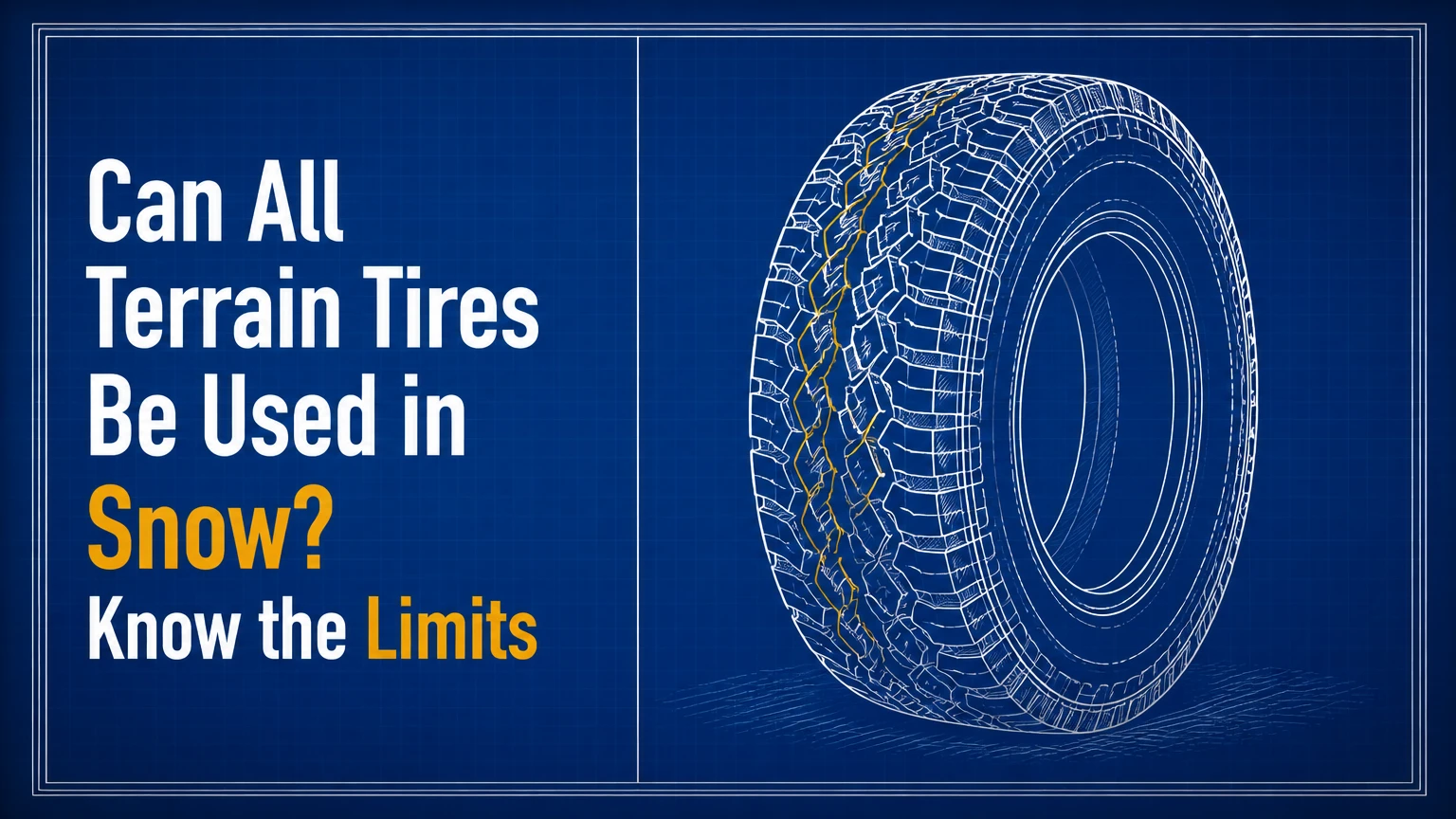
Yes, all-terrain tires can be used in snow, but their safety and traction depend on the tire’s compound, tread design, certification, tread depth, and road surface. A 3PMSF-rated all-terrain tire is suitable for many snowy roads, while a dedicated winter tire remains the better choice for frequent ice, packed snow, very low temperatures, or emergency braking.
Key facts at a glance
M+S means Mud and Snow tread geometry, but it does not require a standardized snow-traction test.
3PMSF means the tire passed a regulated severe-snow traction test, but it does not certify ice braking.
All-terrain tires usually outperform highway all-season tires in loose snow and unplowed conditions.
Dedicated winter tires usually stop and corner more effectively on packed snow and ice.
AWD and 4WD improve acceleration and climbing traction, but they do not create extra braking grip.
Replace or seriously reconsider winter use when usable tread approaches 6/32 inch, especially for deep or packed snow.
What Are All-Terrain Tires Designed to Do?
All-terrain tires are hybrid tires for SUVs, pickups, vans, and light trucks that divide their design priorities between paved roads and loose surfaces. Their tread normally has larger blocks, wider grooves, reinforced construction, and stronger sidewalls than a highway all-season tire.
The word terrain describes the surface, not the season. An all-terrain tire may be designed for gravel, dirt, mud, sand, and rocky trails without having a winter-ready rubber compound. Some A/T tires are quiet commuter tires with closely spaced tread blocks, while others are aggressive tires built for deep ruts and unplowed trails.
The tire’s intended use also affects its load range. A Load Range E pickup tire may carry more weight and resist trail damage, but its stiff casing can reduce ride comfort and sometimes reduce grip on uneven icy pavement. Vehicle weight, suspension setup, wheel size, and tire pressure all change the result.
How does an all-terrain tire gain traction in snow?
An all-terrain tire gains snow traction from tread voids, block edges, sipes, and the ability to retain or eject loose snow. The tread blocks press into unpacked snow, while grooves provide channels for snow and slush to leave the contact patch.
Snow-on-snow friction is part of the mechanism. Compacted snow in a tread groove can grip other snow more effectively than bare rubber grips a slick, polished surface. Block edges also generate mechanical resistance as they push against loose snow.
Open voids help in deep snow, but they are not universally beneficial. Very large gaps reduce the amount of rubber touching a hard road, which can hurt braking on packed snow or ice. Tread blocks that move excessively can also feel vague during steering corrections.
Sipes are narrow cuts in tread blocks. Sipes create additional edges and help manage thin water films on cold surfaces, but A/T tires generally use fewer or less-dense sipes than winter tires because dense siping can weaken blocks during heavy towing or off-road use.
Which Marking Shows That an A/T Tire Is Suitable for Severe Snow?
The Three-Peak Mountain Snowflake, or 3PMSF, is the most useful sidewall marking for identifying an all-terrain tire with tested severe-snow traction. The symbol shows a snowflake inside a three-peaked mountain and indicates that the tire passed a standardized snow-traction procedure.
The test is associated with ASTM F1805 in North America and measures longitudinal traction on medium-packed snow against a reference tire. The exact regulatory language varies by market, so a 3PMSF symbol should be treated as evidence of a minimum severe-snow performance level, not as a ranking of all winter conditions.
A 3PMSF tire can still perform poorly on glare ice. The certification does not fully test emergency braking, lateral cornering, wet freezing pavement, or every temperature range. Two 3PMSF A/T tires can therefore feel very different in a mountain pass or an icy urban intersection.
Is an M+S tire the same as a winter tire?
No. The M+S marking does not make an all-terrain tire equivalent to a winter tire. M+S generally identifies a tread pattern with enough grooves and open area to provide better mud and loose-snow performance than a conventional ribbed design, but it does not require a standardized winter traction test.
The often-repeated claim that M+S requires at least 25% open tread area is not a universal definition that makes every M+S tire comparable. Tire manufacturers and regulators use particular criteria, and the marking alone says little about the rubber compound, ice grip, or braking distance.
Use the sidewall markings in this order:
- Confirm the tire has M+S, MS, or M/S if local regulations require that designation.
- Look for the 3PMSF symbol when regular snow and severe winter roads are expected.
- Check the manufacturer’s technical data for compound, siping, and winter-use positioning.
- Inspect tread depth and tire age before relying on the tire in a storm.
How Do Different A/T Tread Styles Behave in Snow?
A/T tread styles trade deep-snow mobility against packed-road stability. On-road-biased A/T tires normally offer better steering precision and wet-road behavior, while aggressive A/T and rugged-terrain tires displace more loose snow but can feel less secure on polished pavement.
| Tire style | Typical tread features | Strongest winter use | Main limitation |
|---|---|---|---|
| Highway-biased A/T | 10-12 mm tread, close center ribs, moderate siping | Cleared roads, slush, light snow | Limited flotation in deep snow |
| Severe-snow A/T | 12-16 mm tread, 3PMSF, staggered blocks, high sipe count | Mixed commuting and unplowed roads | Longer ice braking than winter tires |
| Aggressive A/T | 14-18 mm tread, open shoulders, large voids | Powder, trail snow, soft shoulders | Reduced packed-road contact area |
| Rugged-terrain R/T | 13-17 mm tread, reinforced shoulders, sparse outer siping | Deep off-road snow over rough ground | Less predictable on icy pavement |
An on-road-biased tire such as the Continental TerrainContact A/T is designed to retain highway manners while adding loose-surface traction. A severe-snow model such as the Falken Wildpeak A/T4W or BFGoodrich All-Terrain T/A KO3 may provide more open-tread capability, but the exact size and load rating still matter.
Rugged-terrain tires occupy the space between A/T and mud-terrain tires. The Nitto Ridge Grappler, for example, is often selected for trail strength and deep-surface traction, but a tire without 3PMSF certification should not be assumed to provide winter-road performance simply because its lugs look aggressive.
Are aggressive all-terrain tires better in deep snow?
Aggressive all-terrain tires are often better in loose, deep snow because their larger voids maintain a path through the snow and resist becoming packed with debris. That advantage applies most clearly when the vehicle is moving through unplowed snow rather than stopping on a hard, icy intersection.
Deep lugs do not automatically shorten stopping distance. A packed road rewards flexible rubber, many usable edges, and stable tread contact. An aggressive tire can dig down through soft snow, then lose grip when its tall blocks meet a smooth frozen surface.
The practical choice depends on the snow profile. A driver who travels a plowed highway and occasionally reaches a snowy trail may prefer a tightly spaced, 3PMSF-rated A/T. A forestry worker crossing unplowed access roads may accept more road noise and weaker ice behavior for deeper voids and stronger casing construction.
Are 3PMSF All-Terrain Tires as Good as Dedicated Winter Tires?
Dedicated winter tires are generally better than 3PMSF all-terrain tires on packed snow, ice, freezing rain, and cold pavement. A 3PMSF A/T tire is a compromise that offers year-round utility and stronger loose-surface performance, but it usually cannot match a winter tire’s flexible compound and dense siping.
| Condition | 3PMSF A/T tire | Dedicated winter tire | Practical winner |
|---|---|---|---|
| Fresh powder, 4-8 inches | Strong flotation, 12-16 mm tread typical | Good flotation, 9-12 mm tread typical | A/T for trail access |
| Packed snow at 20-30 mph | Moderate braking, stable casing | Shorter braking, more biting edges | Winter tire |
| Glare ice below 20°F | Limited adhesion, moderate siping | Soft compound, dense siping | Winter tire |
| Cold wet pavement at 35°F | Predictable, firmer steering | Strong grip, softer response | Slight winter advantage |
| Dry pavement at 60°F | Better wear and handling | Faster wear, softer handling | A/T tire |
| Year-round ownership | One tire set, no storage | Seasonal change required | A/T tire |
The Rubber Association of Canada and Transport Canada both distinguish winter tires from all-season designs by winter compound and performance rather than tread appearance alone. NHTSA summarizes the basic safety principle this way: “Tires are the only thing connecting your vehicle to the road.” Drivetrain capability cannot compensate for a tire compound that has limited cold-surface grip.
The 7°C, or 45°F, guideline is useful but often oversimplified. Standard all-season and many A/T compounds do not suddenly become plastic at 7°C. Winter compounds normally retain more flexibility below that temperature, while warm-weather driving increases their wear and soft handling.
What is the difference between snow traction and ice traction?
Snow traction comes mainly from tread edges, voids, and the tire’s ability to press into or clear loose material. Ice traction depends more heavily on compound flexibility, microscopic surface conformity, siping, and controlled contact pressure.
That distinction explains why a rugged A/T tire can climb a snowy trail but slide at a city stop sign. The trail may provide deformable snow for the tread blocks to penetrate, whereas polished ice offers almost no mechanical keying.
No conventional tire eliminates ice risk. Studded tires, where legal, can improve grip on certain icy surfaces, but they create road wear, noise, and legal restrictions. Tire chains or approved traction devices can provide a larger improvement in severe conditions when the vehicle, clearance, and local law permit their use.
Can All-Terrain Tires Be Used in Snow on an AWD or 4WD Vehicle?
All-terrain tires can be used in snow on an AWD or 4WD vehicle, but the drivetrain mainly improves acceleration and climbing, not braking or cornering. A four-wheel-drive vehicle with weak cold-weather tires can still lock its wheels or slide through a turn.
AWD distributes engine torque among driven wheels when traction varies. 4WD can improve forward movement in deeper snow, especially with low range on suitable off-road terrain. Neither system changes the coefficient of friction between the tire and an icy road during braking.
Drivers often overestimate drivetrain capability after feeling strong acceleration. The vehicle may pull away from a stop while carrying insufficient grip for a controlled emergency stop. Reduce speed before the corner, leave at least six to ten seconds of following distance in poor conditions, and avoid abrupt steering or throttle inputs.
What Tread Depth and Tire Age Matter in Winter?
A tire approaching 6/32 inch of remaining tread deserves serious winter replacement consideration, although 6/32 inch is not an absolute legal minimum in every jurisdiction. The legal wear limit is commonly 2/32 inch, but a tire near that limit has much less capacity to store and evacuate snow.
Use a tread-depth gauge across the inner, center, and outer grooves. Uneven readings can indicate alignment, inflation, worn suspension components, or irregular rotation intervals. A tire with 8/32 inch in the center but 4/32 inch on an edge is not a reliable winter tire.
| Inspection item | Replace or investigate at | Why it matters |
|---|---|---|
| Tread depth | 6/32 inch for winter planning | Less snow storage and edge height |
| Legal wear bars | 2/32 inch in many U.S. jurisdictions | Typical minimum legal threshold |
| Tire age | 6 years for professional inspection | Rubber, ozone, and heat degradation |
| Visible damage | Any sidewall bulge or exposed cord | Structural failure risk |
| Pressure loss | More than 2 psi per month | Possible puncture or valve problem |
Tire age is identified by the final four digits of the DOT code. The first two digits indicate the production week, and the final two indicate the year. A tire marked 3522 was produced in the 35th week of 2022.
Cold air lowers pressure. Set each tire to the vehicle manufacturer’s door-placard pressure when the tire is cold, not to the maximum pressure molded into the sidewall. Do not deliberately underinflate for public-road snow driving, because heat buildup, steering response, and bead security can suffer.
How Much Do Snow-Capable A/T Tires Cost?
Snow-capable A/T tires typically cost $150-$350 per tire, or $600-$1,400 for four tires before mounting, balancing, taxes, and disposal fees. Large Load Range E sizes, 20-inch fitments, and premium 3PMSF models often sit at the high end of that range.
A dedicated winter setup adds wheels, seasonal mounting or storage, and a second tire purchase, but it may preserve the A/T set for summer trail use. Typical seasonal service costs range from $80-$180 per change, while tire storage commonly costs $60-$150 per season.
| Purchase choice | Typical tire cost | Typical four-tire total | Typical service need |
|---|---|---|---|
| Budget M+S A/T | $120-$180 each | $480-$720 | Rotation every 5,000-7,500 miles |
| Premium 3PMSF A/T | $180-$350 each | $720-$1,400 | Rotation every 5,000-6,000 miles |
| Studless winter tire | $140-$300 each | $560-$1,200 | Seasonal installation twice yearly |
| Winter tire plus steel wheels | $700-$1,500 package | $700-$1,500 | Storage and seasonal pressure checks |
Mileage warranties of 50,000-70,000 miles are common for some premium A/T products, but warranty mileage is not a guaranteed lifespan. Alignment, towing, tire rotations, gravel use, heat, underinflation, and compound aging can reduce actual service life.
What Are the Most Common Winter A/T Mistakes?
The most common mistakes are treating M+S as a winter certification, relying on AWD to stop, using mismatched tires, and ignoring pressure or tread wear. Each error reduces the tire’s available grip before a driver notices a problem.
- Buying by appearance alone: Large lugs suggest deep-snow capability but reveal nothing about ice compound or 3PMSF status.
- Mixing different tire types: Install the same model and size on all four wheels unless the vehicle manufacturer specifies another arrangement. AWD systems can react poorly to significant rolling-circumference differences.
- Reducing pressure excessively: Lower pressure may help on private off-road terrain, but public-road use requires the door-placard setting.
- Adding unsafe ballast: Pickup owners sometimes add 100-200 pounds over the rear axle, but cargo must be secured and remain within the truck’s payload rating.
- Ignoring chains: In mountain regions, chain requirements can apply even to 4WD vehicles with 3PMSF tires.
- Braking late: Test grip gently in a safe area, then increase following distance before traffic becomes dense.
A practitioner rule is to evaluate the worst road you must safely drive, not the average road you usually see. One icy commute during a freezing-rain event can outweigh months of quiet operation on dry pavement.
When Should You Choose Winter Tires Instead?
Choose dedicated winter tires when winter includes frequent ice, hard-packed snow, freezing rain, mountain passes, temperatures well below freezing, or long periods of unplowed public-road travel. Choose 3PMSF A/T tires when one tire set must cover commuting, towing, gravel, and occasional snow without seasonal replacement.
Choose 3PMSF A/T tires if:
- Your route is usually plowed within several hours.
- You regularly drive gravel, forest roads, construction sites, or trails.
- Snow is often loose rather than polished and packed.
- You need a single year-round tire set.
- You accept longer ice braking than a winter tire provides.
Choose dedicated winter tires if:
- Your commute includes untreated roads or frequent black ice.
- You drive early mornings before road crews clear snow.
- Your region has sustained temperatures below 20°F.
- You carry passengers and cannot avoid steep grades.
- Winter collision avoidance matters more than trail durability.
A separate winter set is especially sensible for a heavy SUV or pickup that travels at highway speed in snow. Vehicle mass increases energy that the tires must dissipate during braking; it does not create additional tire-road friction.
What Should You Do Before Driving an A/T Tire in Snow?
Before driving, verify the 3PMSF symbol, measure tread depth, set cold pressure, inspect for damage, and confirm that all four tires match in size and similar wear. The check takes about 15 minutes and can identify limitations that no electronic traction system can correct.
Use this practical sequence:
- Read the sidewall: Record M+S and 3PMSF markings, size, load index, and DOT production date.
- Measure the tread: Check three locations across each tire and record the lowest reading.
- Set pressure cold: Use the vehicle placard, then recheck after a major temperature change.
- Inspect the casing: Look for cuts, bulges, exposed cords, embedded objects, and sidewall cracking.
- Test gently: In an empty, legal area, apply moderate braking at low speed to learn whether ABS activates immediately.
- Prepare equipment: Carry a properly sized traction device, gloves, shovel, flashlight, and a tire inflator when local conditions warrant them.
- Change technique: Reduce speed, increase spacing, brake in a straight line, and avoid cruise control on slippery roads.
Chains are not interchangeable with any tire certification. Check the owner’s manual for permitted axle positions and clearance, then follow local chain-control rules. Some vehicles cannot accept chains on certain wheel sizes because suspension or body components sit too close to the tire.
FAQ
Can M+S all-terrain tires handle a normal snowstorm?
M+S all-terrain tires can handle a light or moderate snowstorm when they have adequate tread, correct pressure, and a cautious driver. The marking does not confirm severe-snow traction, so performance on packed snow and ice may be substantially weaker than a 3PMSF or dedicated winter tire.
Are all-terrain tires better than all-season tires in snow?
Many all-terrain tires are better than conventional all-season tires in loose snow because wider voids and larger tread blocks provide more snow-clearing capacity. A heavily siped all-season tire can still outperform an aggressive A/T on cold wet pavement or ice, so the comparison requires the specific tire models.
Can I use all-terrain tires year-round?
Yes, most all-terrain tires are designed for year-round use, including warm summer roads. Year-round use is practical when the tire has suitable speed and load ratings, but aggressive tread may create more noise, reduce fuel economy, and offer less ice grip than a seasonal winter setup.
Are rugged-terrain tires safe on icy roads?
Rugged-terrain tires can be used on icy roads only with appropriate speed and caution, but their large blocks and limited siping often provide less ice control than winter or mild A/T tires. A rugged-terrain tire without 3PMSF certification should not be selected specifically for severe winter commuting.
Does lowering tire pressure improve snow traction?
Lowering pressure can increase footprint length on private off-road terrain, but it is not a general public-road snow solution. Use the vehicle manufacturer’s cold-pressure recommendation on paved roads, because underinflation can reduce stability, increase heat, damage the tire, and interfere with handling.
Do I need snow tires if my vehicle has 4WD?
You may still need winter tires with 4WD when roads are icy, packed, steep, or frequently untreated. Four-wheel drive improves forward traction, while winter tires improve braking and cornering grip. The appropriate choice depends on road conditions, local laws, driving frequency, and the consequences of losing control.
The Bottom Line
All-terrain tires can be used in snow, especially when they have the 3PMSF symbol, healthy tread, correct pressure, and a tread design suited to the conditions. A 3PMSF A/T tire is a strong year-round compromise for mixed pavement, gravel, trails, and occasional snowfall.
The answer to can all terrain tires be used in snow changes when ice, packed snow, freezing rain, severe cold, or frequent untreated roads define the journey. In those conditions, dedicated winter tires provide the more dependable braking and cornering reserve, regardless of whether the vehicle uses AWD or 4WD.