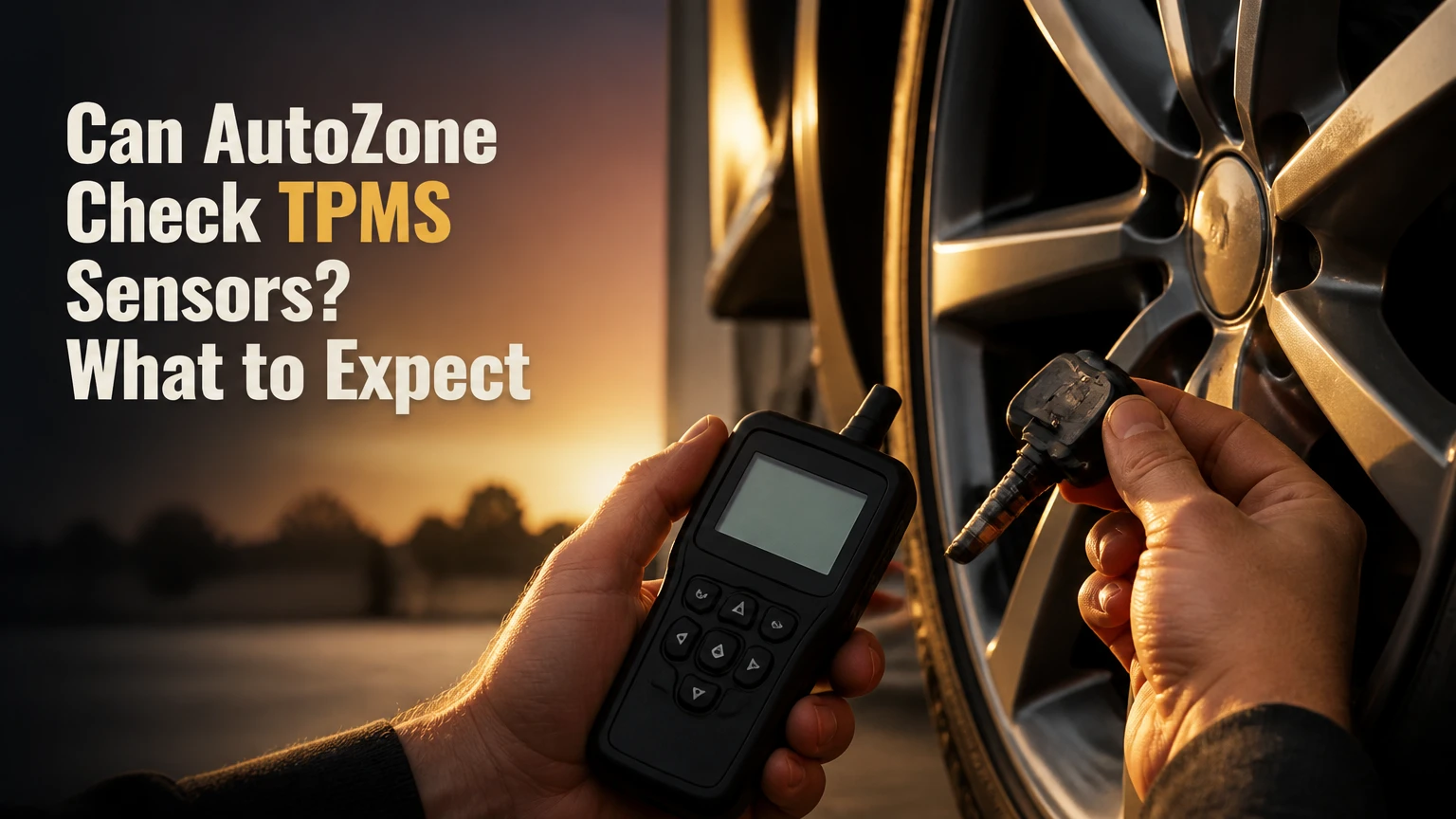
Yes, AutoZone may check TPMS sensors at participating stores, and the diagnostic service is generally free, but capability varies by location and vehicle. An associate may read vehicle codes with Fix Finder or use a handheld TPMS tool on each wheel. AutoZone normally does not dismount tires, install sensors, program universal sensors, or complete every vehicle-specific relearn.
Key Facts at a Glance
- AutoZone’s free Fix Finder scan can retrieve available vehicle diagnostic trouble codes, but an OBD scan alone does not prove that each wheel sensor works.
- A handheld TPMS tool can test a direct sensor near the valve stem without removing the tire, if the store has the equipment and staff availability.
- A steady yellow TPMS light usually indicates low pressure; a flashing light followed by a steady light usually indicates a system fault.
- AutoZone sells direct-fit and programmable TPMS sensors, but installation requires tire dismounting and sensor service equipment.
- Typical replacement cost is $30-$80 for one sensor, plus approximately $25-$60 per wheel for installation, balancing, and relearn labor.
- Indirect TPMS vehicles use ABS wheel-speed data rather than tire-mounted pressure transmitters, so a handheld valve-stem scan is not applicable.
Can AutoZone Check TPMS Sensors?
AutoZone can often check a vehicle’s TPMS fault codes and may be able to test individual direct TPMS sensors with a wireless diagnostic tool. The service is commonly free, but AutoZone does not publish one universal promise that every store can perform the same sensor-level test on every vehicle. Call the specific store before driving there.
The distinction matters. A code reader connected beneath the dashboard examines the vehicle computer and its stored faults. A TPMS activation tool communicates with a radio sensor inside a wheel. Those tests answer different questions.
For example, an OBD scan might report a missing right-front sensor ID, while a wheel tool determines whether the sensor actually transmits pressure and temperature. Conversely, a sensor can transmit correctly while the vehicle has a receiver, wiring, antenna, or relearn problem.
How to Prepare for an AutoZone Visit
Bring the vehicle, the key, and the exact year, make, model, engine, and trim. TPMS hardware and relearn procedures can differ between two versions of the same model year.
Ask the associate two specific questions:
- Can this location perform an individual TPMS sensor activation test?
- Can the location read TPMS-related codes with Fix Finder?
A store may offer a free code scan but lack a trained associate or compatible handheld tool for a complete wheel-by-wheel test. Store hours, queue length, weather, and parking-lot access also affect availability. AutoZone’s official Fix Finder page should be treated as the current reference for its diagnostic-service scope, while the store remains the authority on equipment available that day.
How Does AutoZone Test a TPMS Sensor?
AutoZone TPMS diagnosis usually combines the dashboard symptom, tire-pressure verification, an electronic vehicle scan, and, where available, a wireless test at each wheel. A complete check commonly takes 5-15 minutes when the vehicle is accessible and no tire removal is required.
1. Check the Actual Tire Pressure
Measure all tires, including the spare if the vehicle monitors it, with a manual gauge. Set pressure to the number on the driver-door placard, not the maximum pressure molded into the tire sidewall.
A TPMS warning can result from a pressure change of roughly 25% below the vehicle’s recommended cold pressure, although the exact threshold and warning behavior vary by vehicle. The U.S. National Highway Traffic Safety Administration requires TPMS on most passenger vehicles under 10,000 pounds manufactured after September 1, 2007, but the system does not replace manual pressure checks.
The National Highway Traffic Safety Administration states, “TPMS is not a substitute for manually checking tire pressure.” That rule remains important because a warning system can fail, lose communication, or react after a tire has already become dangerously underinflated.
2. Inspect the Warning-Light Pattern
A steady horseshoe-shaped symbol with an exclamation point usually means the system has detected low pressure. A symbol that flashes for approximately 60-90 seconds at startup and then remains illuminated usually means a TPMS malfunction.
The pattern is not perfectly universal. Some vehicles display text messages, a separate tire icon, or a service warning. A flashing light does not identify a dead sensor by itself; it identifies a system condition that requires diagnosis.
3. Scan the Vehicle Computer
A Fix Finder or comparable OBD-II scan can retrieve stored or active fault information from supported modules. Depending on the vehicle, the scan may identify a missing sensor ID, receiver communication fault, low sensor battery indication, or an issue associated with the body control module.
The OBD connector is normally below the steering column. The scan does not inflate a tire, wake a dormant sensor, measure tread, or establish that a valve stem is not leaking. It also may not access manufacturer-specific TPMS data as deeply as a professional tire-service scanner.
4. Activate Each Wheel Sensor
For a direct TPMS vehicle, an associate places a compatible handheld tool beside each valve stem and sends an activation signal. A responsive sensor may return its identification number, radio frequency, pressure, temperature, and battery condition, depending on the tool and vehicle.
The scanner does not need the tire removed because the radio transmitter sits inside the wheel near the valve stem. The tool can often identify a dead or nonresponsive sensor before a shop breaks the tire bead.
5. Compare the Results
A useful diagnosis compares the manual pressure reading, sensor-reported pressure, vehicle code, and wheel position. If the tool sees a sensor but the vehicle reports a missing ID, the likely problem may be registration, relearn, receiver communication, or an incorrect sensor assignment rather than a dead transmitter.
If no signal appears, possible causes include a depleted sealed battery, incorrect activation procedure, damaged sensor, wrong frequency, shielding from a wheel, or a tool-compatibility issue. “No response” is evidence of a communication problem, not automatic proof that the sensor battery is dead.
Which TPMS System Does Your Vehicle Use?
Direct TPMS uses a pressure sensor mounted inside each wheel, while indirect TPMS estimates pressure through ABS wheel-speed data. A direct system can usually be tested at the valve stem; an indirect system requires vehicle-level diagnosis and a pressure reset or calibration procedure instead.
| TPMS type | Hardware location | Measurement method | Typical service action |
|---|---|---|---|
| Direct, rubber snap-in | Inside wheel at valve stem | Pressure and temperature transmitter | Activate, replace, and relearn sensor |
| Direct, aluminum clamp-in | Inside wheel at metal valve stem | Pressure and temperature transmitter | Replace sensor seal, nut, core, and relearn |
| Indirect, ABS-based | No pressure transmitter in tire | Compares wheel-speed rotation | Inflate tires, then perform calibration/reset |
| Hybrid system | Wheel transmitters plus ABS logic | Combines pressure and rotational data | Follow vehicle-specific scan and relearn procedure |
Direct systems commonly operate at 315 MHz in North America or 433 MHz in many other markets, but frequency alone does not confirm compatibility. The sensor’s protocol, ID format, valve design, and vehicle application must also match.
Indirect TPMS can still produce a TPMS fault code. It simply does not contain four pressure transmitters for a handheld tool to ping. This is one reason a store should identify the vehicle system before recommending a replacement part.
What Does AutoZone Not Usually Do?
AutoZone generally does not remove tires from wheels, install a sensor inside the tire, program a blank universal sensor for a specific vehicle, or guarantee completion of a manufacturer-specific TPMS relearn. Those services require tire-changing equipment, sensor programming capability, vehicle access, or all three.
The word “program” causes confusion because TPMS service uses several different operations:
| Operation | Meaning | Typical provider | Tire removal required |
|---|---|---|---|
| Activate | Wake a dormant sensor and read its transmission | Parts store or tire shop | No |
| Program | Write vehicle application data to a blank sensor | Tire shop or TPMS tool owner | No |
| Install | Remove the tire bead and fit the sensor | Tire shop | Yes |
| Relearn | Register sensor ID and wheel position with vehicle | Vehicle, scan tool, or driving procedure | Usually no |
| Calibrate | Teach an indirect system its correct baseline | Driver or repair shop | No |
A direct-fit sensor may arrive configured for a listed application, but “direct-fit” does not always mean “ready to drive.” The vehicle may still need an auto-learn, stationary relearn, or OBD-assisted registration.
Universal programmable sensors require a compatible engineering tool. Cloning the original sensor ID can simplify relearn on some vehicles, but the replacement still must transmit the correct protocol and be physically installed correctly.
What Does TPMS Diagnosis and Repair Cost?
A free store scan costs $0, while a typical installed replacement sensor costs approximately $55-$140 per wheel before taxes, depending on the part, tire size, valve design, shop rate, balancing, and relearn procedure. These are typical U.S. consumer ranges, not guaranteed AutoZone or repair-shop prices.
| Service or part | Typical price | Typical time | Main price variable |
|---|---|---|---|
| AutoZone code scan | $0 | 5-15 minutes | Store equipment and queue |
| Direct-fit replacement sensor | $30-$80 | 15-30 minutes installed | Vehicle application and brand |
| Universal programmable sensor | $25-$70 | 20-40 minutes installed | Programming and compatibility |
| Tire dismount and sensor installation | $25-$60 per wheel | 30-60 minutes | Shop labor and wheel size |
| Four-sensor replacement | $180-$500 | 1-2 hours | Parts, mounting, balancing, relearn |
A tire shop may bundle installation, valve-service parts, balancing, and relearn into one quote. Ask whether the estimate includes a replacement rubber grommet or aluminum seal, valve core, mounting, balance correction, disposal fees, and warranty.
A sensor battery is normally sealed and not economically replaceable. Typical battery life is 5-10 years, but heat, mileage, sensor design, and time spent transmitting affect the result. If four original sensors are the same age and one battery has failed, replacing all four can reduce repeated tire-service charges, although replacing only the failed unit is reasonable when the remaining sensors test healthy.
Should You Replace One Sensor or All Four?
Replace one TPMS sensor when one unit has failed and the other sensors respond, report plausible pressure, and have sufficient remaining battery life. Consider replacing all four when the sensors are 8-10 years old, several are intermittent, the tires are already off the wheels, or repeated labor would cost more than preventive replacement.
| Situation | Sensible choice | Reason | Extra check |
|---|---|---|---|
| One sensor fails at 3 years | Replace one | Remaining battery life is likely substantial | Inspect stem and seal |
| One sensor fails at 9 years | Consider four | Other batteries may fail soon | Compare total labor |
| Four new winter wheels | Install four compatible sensors | Vehicle needs four recognized IDs | Confirm frequency and protocol |
| Sensor works but leaks | Replace seal kit or sensor | Valve hardware can leak separately | Perform submerged leak test |
| Light appears after tire rotation | Relearn or drive procedure | Wheel positions may have changed | Follow owner’s manual |
| No sensor signal at every wheel | Diagnose vehicle system | Receiver or module fault is possible | Scan module and wiring |
Expert rule of thumb: do not condemn a sensor solely because the warning remains after adding air. First drive or calibrate according to the owner’s manual, then test the sensor and vehicle communication.
Why Does the TPMS Light Stay On After Inflation?
The TPMS light can remain on after inflation because the vehicle has not completed its relearn cycle, a sensor is not transmitting, the pressure was set incorrectly, or the warning concerns a system fault rather than low pressure. Correct cold pressure is the first step, not the final diagnosis.
Cold temperatures commonly reduce tire pressure by about 1 psi for every 10°F temperature drop, although the exact change depends on tire temperature and ambient conditions. A pressure warning after an overnight freeze may be genuine and should be corrected before driving normally.
Do not intentionally drive for 10 minutes to make a warning disappear. Driving can allow some systems to update, but it does not repair a leak or a dead sensor. Check for punctures, inspect valve stems, set all tires cold, and use the specified reset or relearn procedure.
A flashing light followed by a steady light usually points to a malfunction. Causes include a low sensor battery, an unregistered replacement, a broken valve-stem sensor, a damaged receiver, or a sensor from the wrong vehicle application.
How Can You Prepare for an AutoZone TPMS Check?
Prepare by measuring tire pressure, recording the warning-light pattern, checking for visible tire damage, and bringing precise vehicle information. A prepared visit makes the free scan more useful because the associate can compare electronic results with physical symptoms.
Use this checklist:
- Record whether the light is steady or flashes at startup.
- Measure all tire pressures when the tires are cold.
- Note recent tire rotation, tire replacement, wheel damage, or seasonal-wheel installation.
- Bring the vehicle identification number if a parts lookup is uncertain.
- Ask whether the store has an individual TPMS activation tool.
- Request the exact wheel position and fault code, not only a general “sensor problem.”
- Photograph or retain the scan result before buying parts.
A recent tire installation is especially relevant. Tire mounting can damage a sensor, bend an aluminum stem, or leave a valve seal leaking. A TPMS scan can identify communication, but a tire shop must inspect the physical assembly if the tire loses air.
What Can a Scan Prove, and What Can It Miss?
A TPMS scan can show whether a compatible direct sensor responds and can reveal certain vehicle fault codes, but it cannot certify tire safety or diagnose every mechanical cause of a warning. The scan does not replace a pressure gauge, leak inspection, tire inspection, or vehicle-specific relearn.
A sensor may respond while its valve stem leaks. A sensor may report pressure while its ID is assigned to the wrong wheel. A vehicle may reject a correct sensor because the replacement uses an incompatible protocol. A damaged receiver may make several healthy sensors appear absent.
The most reliable sequence is:
- Confirm actual pressure with a gauge.
- Inspect tread, sidewalls, valve stems, and punctures.
- Activate each direct sensor.
- Compare sensor IDs and reported pressure with the vehicle module.
- Install the correct replacement if required.
- Complete the prescribed relearn.
- Verify the warning disappears after the system’s test drive or calibration.
This sequence prevents a common waste of money: replacing a sensor when the real fault is a slow puncture or an incomplete registration.
AutoZone Versus a Tire Shop
AutoZone is the better first stop when the goal is a free preliminary scan, part lookup, or confirmation that a direct sensor responds. A tire shop is the better destination when the vehicle needs tire dismounting, sensor programming, physical leak inspection, balancing, or a guaranteed relearn.
| Decision factor | AutoZone check | Full-service tire shop |
|---|---|---|
| Diagnostic price | Typically $0 | $0-$100, depending on shop |
| Wheel sensor activation | Available at some stores | Standard service capability |
| Tire dismounting | Generally unavailable | Available |
| Sensor installation | Generally unavailable | Available |
| Universal sensor programming | Location-dependent and often unavailable | Common with TPMS service tools |
| Vehicle relearn | Not guaranteed | Usually included or available |
| Best use case | Identify likely fault before repair | Complete diagnosis and repair |
AutoZone is not a substitute for a tire shop when the tire is losing air, the wheel is damaged, or the vehicle needs immediate roadworthiness verification. A parts-store scan is also a poor choice for a commercial vehicle, unusual aftermarket wheel, or complex hybrid TPMS system unless the store confirms compatibility.
For a simple steady light caused by low pressure, neither business should sell a sensor before the tires are checked. A pressure gauge and visual inspection may resolve the issue without electronic parts.
Common TPMS Mistakes and Better Fixes
Buying the Wrong Frequency
A 315 MHz sensor is not automatically interchangeable with a 433 MHz sensor. Confirm the vehicle application, market, protocol, and part number through the manufacturer catalog or a professional application database.
Treating Direct-Fit as Fully Installed
Direct-fit describes physical and application compatibility. The vehicle may still require sensor ID registration, a relearn drive, or a scan-tool procedure after installation.
Reusing Old Valve Hardware
A working electronic sensor can still leak through an aged rubber grommet, valve core, or aluminum sealing washer. Replace the service kit whenever the tire is dismounted, following the sensor manufacturer’s torque specification.
Resetting Before Correcting Pressure
A reset stores a baseline or registers IDs; it does not remove air from an overinflated tire or repair a puncture. Set cold pressure first, then reset or relearn.
Replacing Every Sensor Automatically
Four-sensor replacement makes sense when age and labor favor prevention, but it is unnecessary when one recent sensor has failed and the other three pass a communication and battery check.
Ignoring the Spare Tire
Some vehicles monitor the spare, while others do not. Consult the owner’s manual before assuming that four wheel checks cover every transmitter.
Which Alternative Is Best for Your Situation?
Choose AutoZone first when you want a no-cost indication of whether the vehicle has TPMS-related codes or whether a direct sensor responds. Choose an independent tire shop for the lowest-complexity complete repair, especially if one visit should include dismounting, installation, balancing, and relearn.
Choose a dealership when the vehicle has a proprietary TPMS procedure, unusual wheel electronics, repeated receiver faults, or a warranty concern. Choose a DIY TPMS tool only when you understand sensor protocols, tire-service safety, programming limits, and the vehicle’s relearn method.
A tire should not be removed from a wheel without appropriate tire-changing equipment. Valve-stem sensors sit inside the bead area, and careless dismounting can damage both the sensor and the tire.
Frequently Asked Questions
Can AutoZone reset a TPMS light after adding air?
AutoZone may explain the reset procedure or identify a related code, but a reset is vehicle-specific and is not guaranteed as a standard store service. Some vehicles reset through a dashboard menu, some require a dedicated button, and others relearn automatically after driving. Set cold pressures first and follow the owner’s manual.
Can I drive with a TPMS light on?
Drive only far enough to reach a safe inspection point after checking tire pressure and visible damage. A steady light may indicate underinflation, while a flashing light suggests a system fault that can hide a pressure loss. Do not rely on the warning light to confirm that the tire is safe.
How long does a TPMS sensor replacement take?
A single sensor replacement typically takes 30-60 minutes at a tire shop when the wheel is accessible and no complications occur. The tire must be partially or fully dismounted, the sensor installed, the wheel rebalanced if necessary, and the sensor ID registered or relearned.
Can a tire-pressure sensor be tested without removing the tire?
Yes, a direct TPMS sensor can usually be activated through the tire sidewall near the valve stem. A no-response result does not identify the exact failure because the sensor, frequency, tool, receiver, or application may be wrong. Physical leaks and internal damage still require tire inspection.
Do new tires require new TPMS sensors?
New tires do not automatically require new TPMS sensors. A shop can usually transfer compatible sensors after replacing the valve service parts, but sensors with depleted batteries, damaged stems, or corroded hardware should be replaced while the tire is already off the wheel.
Will a TPMS sensor work after changing wheels?
A sensor will work after a wheel change only if its frequency, protocol, valve design, and vehicle registration are compatible. A second wheel set may require four additional sensors and a separate relearn. Some vehicles support multiple wheel sets, while others store only one sensor set at a time.
The Bottom Line
Can AutoZone check TPMS sensors? Often, yes: participating stores may provide a free code scan and, when equipped, a wheel-by-wheel wireless test for direct sensors. The check can narrow the fault to a tire sensor or vehicle communication problem, but AutoZone generally is not the complete installation and relearn provider.
Check tire pressure before buying parts, confirm the store’s equipment by phone, and record the exact fault and wheel position. If the vehicle needs a sensor installed, programmed, physically inspected, or relearned, use a tire shop or repair facility equipped for TPMS service.