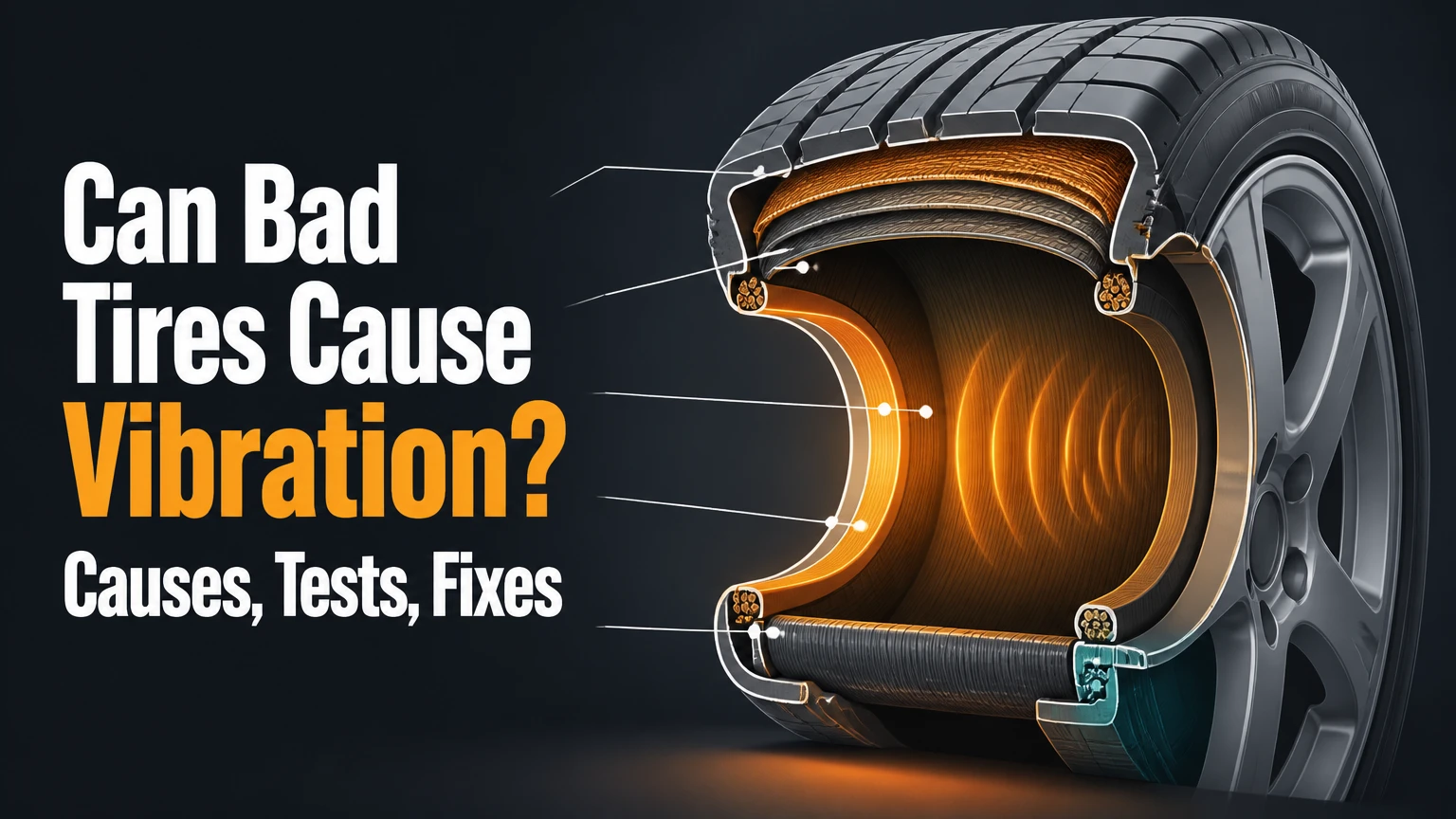
Bad tires can cause vehicle vibration when they are out of balance, out of round, unevenly worn, underinflated, damaged internally, or improperly mounted. Tire vibration usually changes with road speed and may appear in the steering wheel, seat, floor, or body. However, braking-only and acceleration-only shaking often points to brakes or drivetrain parts instead.
Key Facts at a Glance
- An unbalanced tire and wheel assembly commonly causes shaking that increases with speed, especially around 50-70 mph (80-113 km/h).
- A front tire problem is more likely to be felt through the steering wheel, while a rear tire problem often reaches the seat or floor.
- Wheel alignment usually corrects pulling and abnormal wear, but balancing or tire replacement usually addresses tire-related vibration.
- A sidewall bubble, exposed cord, belt separation, or cut cannot be safely repaired with wheel weights.
- Road-force balancing can identify stiffness and tire-to-wheel mismatch that ordinary spin balancing may miss.
- A vibration that starts suddenly after a pothole, curb strike, or tire installation deserves prompt inspection.
Can Bad Tires Cause Vibration?
Yes, bad tires can cause vibration because a rotating tire and wheel generate changing forces when their mass, shape, or stiffness is uneven. The most common example is an unbalanced assembly, but a bent wheel, tire runout, irregular tread wear, slipped internal belt, or poor bead seating can produce similar shaking.
A tire does not need to be visibly bald to create vibration. A tire with adequate tread can still have a stiff section, internal damage, or a heavy spot that becomes noticeable at highway speed. Conversely, severe tread wear may create noise and reduced grip without producing a strong steering-wheel shake.
The vibration pattern provides the first useful clue. A shake that follows vehicle speed usually begins with the tire, wheel, hub, or axle rotating at road speed. A shake that occurs only while braking or accelerating belongs to a different diagnostic pathway and should not automatically be blamed on tires.
The National Highway Traffic Safety Administration describes tires as “the only part of your vehicle that make contact with the road,” which explains why tire defects affect steering, ride quality, braking, and stability at the same time.
How Does a Tire Create a Vibration?
A tire creates vibration when its rotating assembly applies a repeating force to the hub instead of rolling smoothly. An imbalance produces a radial force once per revolution, while an out-of-round tire moves the hub vertically and a lateral defect pushes the assembly side to side.
At 100 km/h, a typical passenger-car tire rotates roughly 800-900 times per minute, depending on its diameter. A small defect therefore repeats hundreds of times each minute, and suspension components can transmit or amplify that force through the steering column, seat mounts, and vehicle body.
Wheel balancing corrects mass distribution. It does not correct every shape or stiffness problem. A machine can report acceptable balance while the tire still produces a road-speed shake because the tire has excessive radial force variation or the wheel has measurable runout.
The practical distinction matters: balance concerns where weight is distributed, runout concerns whether the assembly is round or straight, and radial force variation concerns how much the tire deflects under load.
Which Tire Problems Cause Shaking?
The most common tire-related causes are imbalance, irregular wear, out-of-roundness, structural damage, and mounting errors. Each fault creates a different combination of speed, location, noise, and visual evidence.
| Tire or wheel fault | Typical symptom | Usual inspection or remedy |
|---|---|---|
| Wheel-tire imbalance | Steering or seat shake at 50-70 mph (80-113 km/h) | Spin balance, then verify weights and wheel condition |
| Radial runout or out-of-round tire | Wobble, hop, or thump from 15-40 mph (24-64 km/h) | Measure runout; replace tire or repair wheel if permitted |
| Cupped or feathered tread | Roaring noise and repeating vibration at 25-65 mph (40-105 km/h) | Inspect suspension, alignment, rotation history, and tire wear |
| Internal belt separation | Sudden thump, pull, bulge, or worsening shake | Remove tire from service and replace it |
| Bent wheel or bead seating fault | Persistent vibration after balancing | Check wheel flange, bead seating, hub mounting, and runout |
| Mud, snow, or debris inside rim | New vibration after off-road or winter driving | Clean the wheel barrel and recheck balance |
Can worn tires make a car shake?
Worn tires can make a car shake when the tread has cupped, developed high and low spots, or worn unevenly across its width. Ordinary tread wear alone does not guarantee vibration, but irregular wear changes the tire’s effective rolling radius and road contact, producing a repeating thump or buzz.
Cupping often indicates a second problem rather than a tire-only failure. Worn shock absorbers, loose suspension bushings, incorrect toe settings, poor tire pressure, or neglected rotation can allow the tread to alternately unload and strike the road.
Run a hand lightly across the tread, from the inner shoulder toward the outer shoulder, with the vehicle parked safely. A sawtooth pattern, hills and valleys, or smooth dips confirms irregular wear, but a physical inspection remains necessary because touch cannot reveal belt separation or casing damage.
Can a tire bubble cause vibration?
A tire bubble can cause vibration because the sidewall or tread casing has lost its structural integrity and no longer maintains a uniform shape under load. A bubble usually follows an impact with a pothole or curb, and the damaged tire must be replaced rather than balanced or patched.
A bulge is a stop-driving warning when it is on the sidewall or shoulder. Internal cords may be broken even if air pressure remains normal. The tire can fail later under heat, speed, or load, so reducing speed does not make the damaged tire safe for continued use.
Where Will You Feel a Bad-Tire Vibration?
The location of vibration identifies the likely axle, but it does not prove the exact failed part. Front tire and wheel problems commonly reach the steering wheel, while rear problems more often appear through the seat, floor, or rear body structure.
| Where vibration is felt | More likely causes | Important exceptions |
|---|---|---|
| Steering wheel | Front imbalance, front runout, bent front wheel, worn tie-rod part | Front brake rotor or hub can create similar symptoms |
| Seat cushion | Rear imbalance, rear tire cupping, rear wheel damage | Driveline vibration can also reach the seat |
| Floorboard | Rear tire issue, driveshaft, exhaust contact, rear suspension | Front tire vibration can travel through the body |
| Brake pedal | Brake rotor thickness variation or caliper issue | Tire defects rarely occur only during pedal application |
| Whole vehicle under throttle | Inner CV joint, driveshaft, engine mount | Tire vibration can intensify with speed, even off-throttle |
| Body at one road surface | Tire tread pattern, road surface, suspension response | A road seam can briefly imitate a mechanical fault |
A smooth steering wheel does not clear the rear tires. Rear imbalance can produce a serious seat or floor vibration while leaving the steering wheel relatively calm.
What Does the Speed Pattern Tell You?
A speed-dependent vibration usually implicates a rotating tire, wheel, hub, or axle, while a vibration tied to braking or acceleration points toward a different system. The speed at which shaking begins is more useful than the engine rpm at which it begins.
| Pattern during a road test | Most likely area | First diagnostic action |
|---|---|---|
| Begins at 50-70 mph and follows road speed | Tire-wheel imbalance or runout | Inspect all four assemblies and balance them |
| Strongest at 20-40 mph with visible wobble | Out-of-round tire or bent wheel | Measure radial and lateral runout |
| Appears only when braking from 45 mph or higher | Brake rotor, hub, or caliper | Inspect brake components and hub face |
| Appears only during acceleration | Inner CV joint, driveshaft, engine mount | Test drivetrain under load |
| Appears on one rough road surface | Tire tread, suspension, or pavement interaction | Repeat on a smooth road at the same speed |
| Started after parking in freezing weather and fades | Temporary flat spot | Drive gently and reassess after warming |
| Occurs immediately after tire installation | Balance, bead seating, wrong wheel hardware | Return to the installer for reinspection |
A shake that starts at one speed and fades at a higher speed can still be an imbalance issue. Resonance may make the vibration most noticeable within a narrow range, so disappearance above that range does not prove the tires are sound.
Are Tires or Wheel Alignment Causing the Vibration?
Tires and wheels usually cause a direct speed-related shake, while wheel alignment usually causes pulling, an off-center steering wheel, or uneven tread wear. Alignment can contribute indirectly by creating cupping or feathering, but alignment alone rarely removes a vibration caused by an unbalanced or damaged assembly.
| Diagnostic finding | Balance or tire issue | Alignment issue |
|---|---|---|
| Steering wheel shakes at 60 mph | Common | Uncommon as a direct cause |
| Vehicle pulls left or right | Possible if tire conicity differs | Common |
| Steering wheel sits off-center | Unlikely | Common |
| Feathered tread edges | Possible consequence | Common contributor |
| Unequal toe or camber readings | No | Direct finding |
| Vibration only during braking | Unlikely | Unlikely; inspect brakes first |
| Vibration fixed after wheel weights | Common | Not an alignment repair |
A vehicle may need both services. For example, excessive toe can wear the front tires into a feathered pattern, and the worn tires can then continue vibrating after the alignment is corrected.
How Are Bad Tires Tested?
A reliable diagnosis starts with basic safety checks, followed by tire and wheel measurements, then a road-force test or chassis inspection if the first repair fails. Technicians should not replace expensive parts before confirming tire pressure, wheel attachment, tread condition, and wheel runout.
Step 1: Check pressure and visible condition
Set all tires to the vehicle manufacturer’s cold inflation specification on the driver-door label, not the maximum pressure molded into the sidewall. Inspect for nails, cuts, exposed cords, bulges, missing balance weights, damaged valve stems, and tread objects.
Confirm that lug nuts are present and properly tightened with a torque wrench. A loose wheel can create vibration and severe safety risk.
Step 2: Identify the operating condition
Record whether the shake changes with speed, braking, throttle, turning, road surface, or vehicle load. A technician can narrow the fault faster when the report states, for example, “rear-seat vibration from 55-65 mph while coasting.”
Do not conduct an aggressive test drive with a bulged, leaking, or visibly damaged tire. Use a professional inspection instead.
Step 3: Perform a standard spin balance
A spin balancer measures imbalance and indicates where corrective weights should be installed. Standard balancing is fast and often solves a vibration caused by a missing weight, tire replacement, or accumulated imbalance.
A balanced machine reading does not certify tire safety. The tire still requires inspection for separation, runout, irregular wear, and correct bead seating.
Step 4: Measure runout and mounting accuracy
A technician can use a dial indicator to measure radial and lateral runout at the wheel and tire. Typical passenger-car shop targets are often around 0.030-0.050 inch (0.76-1.27 mm), but the vehicle and tire manufacturer’s limits control.
The hub face and wheel mounting surface also matter. Rust between the hub and wheel, an incorrect centering ring, or an improperly seated bead can produce vibration even when the tire itself is undamaged.
Step 5: Use road-force balancing when needed
Road-force equipment presses a roller against the tire to simulate load while measuring force variation and tire-wheel assembly behavior. The technician can identify a stiff tire section, excessive radial force, or a tire and wheel that should be rotated relative to one another.
Road-force balancing is most useful when ordinary balancing is correct but the highway vibration remains. It is diagnostic equipment, not a repair for a separated belt, cracked wheel, or badly worn tire.
Standard Balance or Road-Force Balance: Which Is Better?
Standard spin balancing is the correct first test for most ordinary imbalance, while road-force balancing is the better next test for a persistent vibration or difficult tire-wheel assembly. Road-force equipment costs more and cannot make a structurally unsafe tire serviceable.
| Feature | Standard spin balance | Road-force balance |
|---|---|---|
| Main measurement | Rotational mass imbalance | Imbalance plus loaded force variation |
| Typical service time | 30-45 minutes for four wheels | 45-90 minutes for four wheels |
| Typical U.S. price | $15-$35 per wheel | $25-$60 per wheel |
| Detects missing weights | Yes | Yes |
| Detects stiff tire sections | Usually no | Yes |
| Measures loaded tire behavior | No | Yes |
| Repairs belt separation | No | No |
| Best use | First-line vibration repair | Persistent or sensitive highway vibration |
Road-force readings should be interpreted by a trained technician, because target limits vary by tire size, vehicle, and manufacturer. A generic “under 26 pounds” rule is not universal, and some vehicles require considerably tighter control for an acceptable ride.
What Repairs Actually Fix Tire Vibration?
The correct repair depends on whether the fault is imbalance, wear, mounting, wheel damage, or structural failure. Adding weights fixes uneven mass distribution, but replacement is the only safe solution for a bubble, exposed cord, or internal belt separation.
| Confirmed fault | Correct repair | Typical time | Typical cost |
|---|---|---|---|
| Simple imbalance | Remove and reinstall weights | 30-45 minutes | $40-$140 for four wheels |
| Persistent force variation | Road-force balance or tire-wheel match | 45-90 minutes | $100-$240 for four wheels |
| Bent alloy or steel wheel | Professional wheel repair or replacement | 1-3 hours | $100-$500 per wheel |
| Cupped tread with usable tire | Correct pressure, alignment, suspension, and rotation | 1-3 hours | $100-$600, excluding tire |
| Damaged or separated tire | Replace tire, inspect companion axle | 1-2 hours | $100-$450 or more per tire |
| Brake-related vibration | Brake inspection, rotor or caliper service | 1-3 hours | $250-$900 per axle |
Prices are typical U.S. independent-shop ranges in 2025, not fixed rates. Tire size, run-flat construction, wheel material, local labor, taxes, and vehicle design can change the total substantially.
Replacing one tire may be acceptable on a two-wheel-drive vehicle when tread depth and tire model remain compatible, but all-wheel-drive vehicles can require matched circumference. The owner’s manual and tire manufacturer’s guidance should control.
Can New Tires Cause Vibration?
New tires can cause vibration when the assembly was not balanced correctly, the bead did not seat evenly, the wheel is bent, a shipping flat spot persists, or the tire has excessive force variation. A new tire is not automatically a correctly installed tire.
Return to the installer promptly if vibration begins immediately after installation. Ask the shop to verify cold pressure, lug torque, balance weights, bead seating, wheel runout, and tire-to-wheel matching before authorizing unrelated suspension work.
A small temporary flat spot may occur after a vehicle sits for hours in cold weather, especially with performance tires. The vibration generally reduces as the tire warms during normal driving. Persistent shaking after several miles requires inspection rather than repeated high-speed driving.
When Is a Vibrating Tire Unsafe?
A vibrating tire is unsafe to drive when the vibration is sudden or severe, the tire has a bulge, exposed cord, tread separation, rapid air loss, deep cut, or visible distortion. Stop in a safe location, avoid hard braking, and arrange roadside assistance when structural damage is possible.
Use this safety triage:
- Stop driving immediately: sidewall bubble, torn tread, exposed steel, strong pull, scraping, tire-pressure warning, or worsening thumping.
- Drive only a short distance to inspection: mild vibration after a suspected lost balance weight, provided pressure and tire condition are normal.
- Schedule prompt service: recurring highway shake, cupped tread, steering-wheel oscillation, or vibration after a pothole.
- Do not “fix” damage with weights: weights alter mass distribution but cannot restore broken internal cords.
Tires older than six years are not automatically defective. Tire aging depends on storage, climate, load, inflation, ultraviolet exposure, and manufacturer guidance. The Tire Industry Association and several tire manufacturers recommend professional inspection after five years of service, while some manufacturers advise replacement around ten years regardless of tread; the date code and vehicle-maker instructions should be checked.
What Mistakes Cause a Wrong Diagnosis?
The most expensive diagnostic mistake is treating every shake as an alignment problem. Alignment changes wheel angles, but it cannot restore a missing balance weight, round a deformed tire, or repair a broken belt.
Common errors include:
- Balancing a damaged tire: A machine may accept the weight correction while the casing remains unsafe.
- Checking only the front axle: Rear imbalance often reaches the seat and floor instead of the steering wheel.
- Ignoring lug torque and hub corrosion: Uneven wheel mounting can imitate tire imbalance.
- Replacing suspension parts first: Confirm tire pressure, tread, balance, and runout before installing control arms or hubs.
- Using the sidewall maximum pressure: The correct cold pressure is normally listed on the vehicle placard.
- Assuming tread depth proves tire health: Internal separation and casing damage can exist beneath apparently adequate tread.
- Testing only on one road: Pavement grooves and concrete seams can create a temporary, speed-specific response.
A useful practitioner rule is to reproduce the symptom before replacing parts. A clear speed threshold and operating condition often prevents a brake, alignment, or drivetrain repair from being charged to a tire problem.
How Can You Isolate the Vibration Safely?
Start with a stationary inspection, then use a controlled road test only when the tires show no safety defect. Change one condition at a time, because braking, throttle, steering angle, and road surface each provide different diagnostic evidence.
- At a steady speed, note whether the vibration follows vehicle speed.
- Coast briefly on a smooth, safe road and observe whether the shake remains.
- Apply the brakes lightly only if the vehicle is stable and traffic conditions permit.
- Compare acceleration with steady-speed cruising to separate drivetrain vibration.
- Note whether steering-wheel movement differs from seat or floor movement.
- Check whether the symptom began after a pothole, curb impact, tire installation, rotation, or long storage period.
Do not weave through traffic, exceed posted limits, or continue testing after a tire-pressure warning. Professional equipment provides better evidence than a risky road experiment.
The Bottom Line
Can bad tires cause vibration? Yes, especially when a tire is unbalanced, out of round, irregularly worn, improperly mounted, or structurally damaged. A speed-dependent shake warrants tire and wheel inspection first, while braking-only and acceleration-only symptoms usually require brake or drivetrain diagnosis.
Begin with pressure, visible damage, tread condition, lug torque, and a standard balance. Escalate to runout measurement and road-force balancing when the vibration persists. Replace any tire with a bulge, exposed cord, or suspected belt separation, because wheel weights cannot make structural damage safe.
Frequently Asked Questions
Can low tire pressure cause vibration?
Low tire pressure can cause vibration when the tire flexes excessively, develops heat, or suffers casing damage, but pressure alone more often causes handling changes and pulling than a rhythmic highway shake. Set pressure cold according to the vehicle placard, then inspect the tire for sidewall damage, uneven wear, and air leakage before driving at speed.
Can tire rotation cause vibration?
Tire rotation can reveal or create a noticeable vibration when a previously masked imbalance moves to another axle, a balance weight is lost, or a tire with irregular wear changes position. Rotation itself does not normally damage a tire. If shaking begins immediately afterward, have all four wheels rechecked for balance, pressure, lug torque, and mounting direction.
Why does my car vibrate only at 60 mph?
A vibration that appears near 60 mph commonly results from wheel-tire imbalance, radial runout, or tire force variation because rotating forces become more noticeable at a particular speed range. The exact threshold varies by tire diameter and vehicle resonance. A technician should inspect every wheel rather than balancing only the axle felt through the steering wheel.
Can bad tires cause vibration when braking?
Bad tires can worsen instability during braking, but a vibration that occurs only when the brake pedal is applied more commonly indicates brake rotor thickness variation, a sticking caliper, hub runout, or loose suspension hardware. Tire vibration usually continues while coasting at the same road speed. Brake-only shaking deserves a brake and hub inspection.
Should I replace all four tires if one is bad?
Replacing all four tires is not always necessary, but axle matching and drivetrain requirements matter. Two-wheel-drive vehicles may accept one replacement when the new tire matches size, type, and tread characteristics. Many all-wheel-drive vehicles require closely matched rolling circumference. Follow the vehicle owner’s manual and the tire manufacturer’s replacement guidance.


