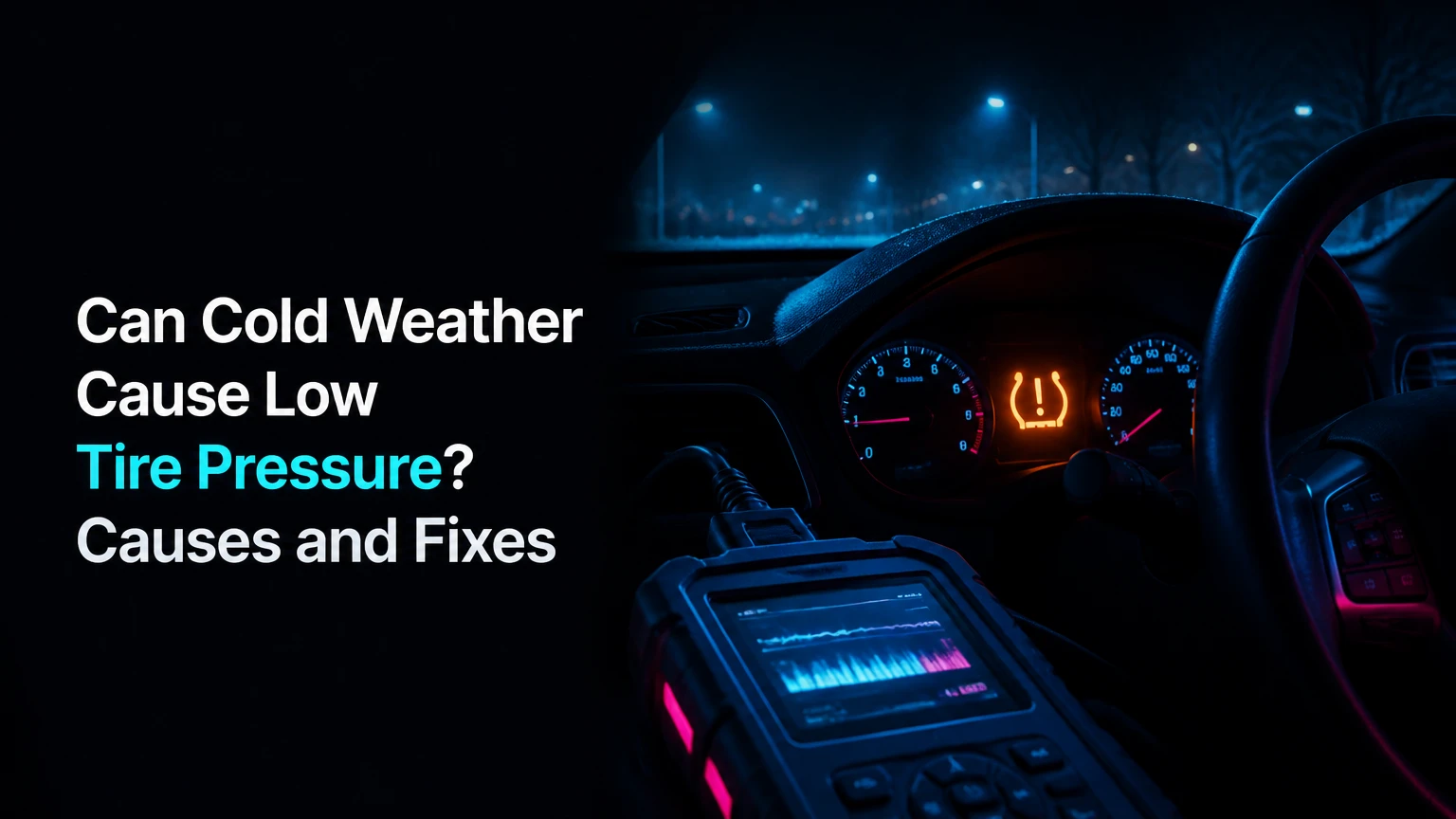
Yes, cold weather can cause low tire pressure because cooling reduces the pressure of the air sealed inside a tire. A typical tire may lose about 1 PSI for each 10°F decrease in temperature, although the exact change depends on starting pressure, tire temperature, and measurement conditions. No air needs to escape for the gauge reading to fall.
Key Facts at a Glance
- A 10°F temperature drop typically lowers a passenger-car tire reading by about 1 PSI.
- Tire pressure changes when the gas temperature changes, even if the tire has no leak.
- The correct inflation target is the vehicle manufacturer’s cold-pressure specification on the driver-door placard.
- The maximum PSI molded into a tire sidewall is not the recommended pressure for most vehicles.
- TPMS warnings commonly appear when a tire is substantially below its specified pressure, but the exact threshold varies by vehicle.
- Nitrogen does not eliminate winter pressure changes because nitrogen obeys the same gas laws as ordinary air.
Can Cold Weather Cause Low Tire Pressure?
Cold weather can cause low tire pressure without creating a puncture or releasing air. When a parked tire cools from a warm afternoon to a cold morning, the air inside loses temperature and exerts less pressure against the tire’s inner surfaces. The tire still contains nearly the same amount of gas.
The familiar rule is approximately 1 PSI for every 10°F change. Some tires show closer to 1.5 or 2 PSI per 10°F under certain conditions, but that larger figure should be treated as a rough estimate, not a guaranteed constant. Tire construction, gauge differences, initial pressure, and the temperature of the tire itself affect the result.
A cold-weather warning still deserves attention. Temperature may explain why the warning appeared, but underinflation remains a safety problem whether the cause is seasonal cooling or a leak.
Why Does Cold Air Lower PSI?
Cold air lowers tire PSI because a sealed gas occupies a fixed tire volume while its absolute pressure changes with absolute temperature. The relationship is described by the ideal-gas approximation, commonly written as P₁/T₁ = P₂/T₂, where temperature must be measured in kelvins and pressure must be absolute rather than gauge pressure.
A tire gauge reports pressure above atmospheric pressure. Therefore, a correct calculation converts 32 PSI gauge pressure to approximately 46.7 PSI absolute by adding 14.7 PSI. For example, a tire at 32 PSI and 70°F, or 294.3 kelvins, would read about 29.7 PSI at 30°F, or 272.0 kelvins, assuming constant volume and full thermal equilibrium.
That calculation predicts a drop of about 2.3 PSI across 40°F, or approximately 0.6 PSI per 10°F. Real-world readings often differ because a tire flexes, warms in sunlight, and does not instantly reach the surrounding air temperature.
How Does a Tire Cool Overnight?
A tire cools toward the temperature of its surroundings while the vehicle is parked. The wheel, rubber, air inside the tire, pavement, and nearby air exchange heat at different rates, so a dashboard temperature is not a precise substitute for tire temperature.
The gas does not literally vanish or undergo a dramatic collapse. Lower molecular energy produces fewer and less forceful collisions with the inner liner, which reduces measured pressure. The mass of air remains almost unchanged unless a leak is present.
How Much PSI Falls With Temperature?
The following estimates use the practical rule of approximately 1 PSI per 10°F. Actual results can vary by roughly several tenths of a PSI because of tire temperature and measurement technique.
| Temperature change | Typical pressure change | Example from 35 PSI | Likely TPMS effect |
|---|---|---|---|
| 10°F decrease | About 1 PSI lower | 35 to 34 PSI | Usually no warning |
| 20°F decrease | About 2 PSI lower | 35 to 33 PSI | Possible on sensitive systems |
| 30°F decrease | About 3 PSI lower | 35 to 32 PSI | Warning possible |
| 40°F decrease | About 4 PSI lower by rule of thumb | 35 to 31 PSI | Noticeable underinflation |
| 50°F decrease | About 5 PSI lower | 35 to 30 PSI | High likelihood of warning |
The ideal-gas example above produces about 2.3 PSI for a 40°F drop from 70°F to 30°F because it uses absolute pressure correctly. The popular 1-PSI-per-10°F rule is a field estimate, not a precise physical law.
What Tire Pressure Should You Use in Winter?
Use the vehicle manufacturer’s recommended cold inflation pressure, not a winter-specific number invented from the tire sidewall. The specification normally appears on the driver-side doorjamb placard, fuel-filler flap, glove-box label, owner’s manual, or manufacturer’s service information.
The placard may list different pressures for front and rear axles, normal and loaded conditions, or temporary spare tires. Follow those distinctions. A vehicle requiring 35 PSI cold should be returned to 35 PSI when measured cold, even if winter weather previously reduced the reading.
The sidewall number identifies the tire’s maximum permitted inflation pressure under specified conditions. It does not account for the vehicle’s suspension, load distribution, steering calibration, or original-equipment tire size.
Should You Add Extra PSI Before Winter?
Do not routinely add 2 or 3 PSI above the door-placard value unless the vehicle manufacturer or tire professional gives a specific instruction. Cold-pressure specifications already account for normal environmental changes because the target is defined at the tire’s current cold condition.
A heated garage creates a special situation. A tire filled to its correct pressure in a 65°F garage may read lower outside at 10°F. That pressure change is real, so check the tire outdoors after it has stabilized and adjust it to the placard specification. Do not compensate by guessing an elevated target while the tire is warm.
How Should You Check and Inflate Tires in Cold Weather?
Check all four tires with a reliable gauge before driving, then inflate each tire to the door-placard specification. The practical process takes about 10 minutes with a hand gauge and compressor, and the most important variable is whether every tire has reached a similar cold temperature.
- Park for at least three hours. Overnight parking provides the most consistent reading. If necessary, measure before driving more than one mile.
- Find the vehicle specification. Record the required front and rear PSI from the driver-door placard.
- Remove the valve cap and measure each tire. Press the gauge squarely onto the valve stem to prevent an audible leak during measurement.
- Add or release air in small increments. Add air until the cold reading matches the placard value, then recheck the gauge.
- Inspect the valve and tread. Look for nails, cuts, bulges, cracked rubber, or a damaged valve stem.
- Replace valve caps and drive normally. If the vehicle requires a TPMS relearn or reset, follow the owner’s manual procedure.
You will know the inflation step worked when the measured cold PSI matches the specified value and the TPMS warning clears after the vehicle completes its monitoring cycle. A common mistake is inflating to the sidewall maximum or checking one tire instead of comparing all four.
Can You Measure Tires After Driving?
You can measure a warm tire to identify a major pressure problem, but you should set final inflation only when the tire is cold. Friction, flexing, sunlight, and braking heat can raise a tire’s internal pressure, sometimes by several PSI.
Never release air from a warm tire simply to make its gauge reading match the cold placard value. After the tire cools, the pressure may become too low. If a warning light appears during a trip, check the tire as soon as practical, avoid high speed, and confirm the final setting later when cold.
Does TPMS Warn About Every Cold-Weather Pressure Drop?
TPMS does not warn about every pressure change because the system has a programmed warning threshold and a measurement tolerance. In the United States, Federal Motor Vehicle Safety Standard 138 requires a low-pressure warning system on covered passenger vehicles, but the exact operating behavior depends on the vehicle’s calibration and sensor design.
Many direct TPMS systems use a sensor inside each wheel to measure pressure and temperature. Indirect systems infer pressure changes from wheel-speed differences through the anti-lock braking system. A warning may also require the vehicle to move before the system updates.
NHTSA states, “Underinflation is the leading cause of tire-related crashes.” The warning light is therefore a prompt to measure pressure, not permission to keep driving until the light becomes urgent.
| Dashboard and gauge pattern | Most likely explanation | Correct response |
|---|---|---|
| Four tires are 1-3 PSI low after a cold front | Seasonal temperature change | Inflate cold tires to placard PSI |
| One tire is 5 PSI lower than the others | Puncture, valve, bead, or wheel problem | Inspect immediately and test for leakage |
| Gauge shows low PSI and TPMS is illuminated | Actual underinflation | Add air, then investigate the cause |
| Gauge shows normal PSI but warning remains | Delayed update, reset need, or sensor fault | Drive according to the manual or seek service |
| Warning flashes, then stays on | Possible TPMS system malfunction | Have the system scanned and serviced |
| Warning returns after one day | Ongoing leak or incorrect reset | Recheck cold PSI and arrange inspection |
A TPMS sensor may also struggle in severe cold when its battery is near the end of its service life. A normal gauge reading does not automatically prove the sensor is accurate, especially if the gauge itself is damaged or poorly calibrated.
Is One Low Tire Different From Four Low Tires?
One low tire usually points to a mechanical leak, while all four tires showing a similar modest reduction more strongly suggests a temperature change. The pattern is useful for triage, but it does not replace a leak inspection because multiple leaks or inaccurate measurements can produce misleading patterns.
Inspect the tire that differs most from the others first. Common leak sources include a tread puncture, leaking valve core, cracked valve stem, corrosion between the wheel bead and tire, and damage from a pothole.
How Do You Find a Slow Tire Leak?
Find a slow leak by measuring the tire cold, recording the result, and applying soapy water to likely leak points. Mix dish soap with water, wet the valve stem, valve core, bead area, and tread, then watch for bubbles that grow continuously rather than foam that remains from application.
A professional shop can submerge the wheel, inspect the bead, or use a tire-pressure decay test. Do not remove a nail or screw before a tire technician evaluates it because the object may be limiting the air loss.
Do not use a sealant as a permanent answer unless the vehicle and tire manufacturer permit that product. Some sealants interfere with TPMS sensors and complicate later repairs.
Air or Nitrogen: Which Is Better in Cold Weather?
Ordinary compressed air is the sensible choice for most drivers because nitrogen tires still lose pressure when they cool. Nitrogen can reduce moisture content and may diffuse through rubber somewhat differently, but it does not provide immunity from ambient-temperature pressure changes.
Ordinary shop air already contains about 78% nitrogen. The remaining mixture is mainly oxygen, with variable water vapor. Commercial tire nitrogen may be around 93-99% nitrogen, depending on the generator and service process.
| Attribute | Compressed air | Nitrogen fill |
|---|---|---|
| Main gas content | Approximately 78% nitrogen | Commonly 93-99% nitrogen |
| Cold-weather pressure response | Changes with temperature | Changes with temperature |
| Availability | Gas stations, shops, portable compressors | Selected tire shops and fleets |
| Typical consumer cost | Free-$2 per inflation session | About $30-$100 for a four-tire conversion |
| Maintenance practicality | Easy to top off anywhere | Requires a compatible supply |
| Best use case | Daily vehicles and emergency correction | Fleet, racing, or moisture-control applications |
Nitrogen is not a worthwhile winter fix for a tire that has a puncture, damaged valve, or incorrect cold pressure. Keeping any tire properly inflated matters more than choosing the gas mixture.
What Are the Costs and Tools for Winter Pressure Checks?
A basic winter pressure kit typically costs $10-$60 and includes a gauge, valve caps, and a compact 12-volt compressor. Gas-station air may cost nothing or a few dollars, while professional leak diagnosis commonly costs more and varies by region and repair complexity.
| Item | Typical price | Time required | Useful specification |
|---|---|---|---|
| Pencil tire-pressure gauge | $3-$8 | 1 minute per tire | Common range up to 50 PSI |
| Digital gauge | $15-$35 | 1 minute per tire | Resolution often 0.1 PSI |
| 12-volt compressor | $25-$60 | 3-10 minutes per tire | Check maximum PSI and duty cycle |
| Gas-station air pump | $0-$2.50 | 5-15 minutes | Timed operation is common |
| Leak inspection | $20-$50 typical | 15-45 minutes | Price varies by shop and region |
| TPMS sensor replacement | $50-$150 per wheel typical | 30-90 minutes | Includes sensor, labor, and relearn in some shops |
A gauge is more useful than a nitrogen conversion for routine maintenance because it reveals the actual pressure at home. Keep the compressor for emergencies, but do not depend on an inexpensive unit as the only tool for a visibly damaged tire.
What Cold-Weather Situations Cause Confusion?
Cold weather creates several misleading readings because tire temperature, pavement temperature, sunlight, altitude, and measurement timing do not always match the reported outdoor temperature. A tire parked on dark pavement in sunlight can read differently from a tire parked in shade, even on the same vehicle.
Heated Garage to Freezing Street
A tire inflated in a 65°F garage may lose roughly 5 PSI by the time its temperature approaches 15°F under the common field rule. Check the tires after outdoor cold soak and correct them to the placard value rather than adding an arbitrary winter premium indoors.
Overnight Warning After a Warm Day
A warning that appears after a sharp overnight drop may be temperature-related, but the tire is still below its intended operating pressure. Measure all four tires before driving normally. If one tire is substantially lower, treat the event as a possible leak.
Altitude Change
Altitude changes the relationship between gauge pressure and atmospheric pressure. A standard gauge reads pressure relative to local atmosphere, while the tire’s absolute pressure includes atmospheric pressure, so a large elevation change can alter readings modestly even without a temperature change.
Seasonal Tire Installation
Winter tires should be inflated to the vehicle or tire manufacturer’s specified cold pressure for that tire size and load. Check pressure after installation, verify that the TPMS sensors are compatible, and recheck after the first cold night because mounting work can disturb a valve or bead.
How Often Should You Check Tire Pressure in Winter?
Check tire pressure monthly under ordinary conditions and weekly during rapid temperature swings, severe freezing weather, or after installing seasonal tires. A monthly check is a baseline, not a substitute for checking after a TPMS warning, pothole impact, tire repair, or visible change.
A typical tire can lose approximately 1-1.5 PSI per month through gradual air permeation and minor system losses, although the amount varies with tire age, construction, temperature, valve condition, and wheel integrity. Seasonal cooling can add several PSI to that normal loss.
Experienced technicians use the tire-to-tire comparison as an early warning tool. If three tires are within 1 PSI and one is down 4 PSI, weather alone is an unlikely explanation.
Is It Safe to Drive With Low Tire Pressure?
Driving with low tire pressure is unsafe when the pressure is substantially below specification, the tire is visibly deformed, or the tire has sustained damage. Underinflation increases sidewall flexing, heat generation, rolling resistance, steering effort, and the risk of internal tire damage.
If the TPMS light comes on, slow down, avoid abrupt maneuvers, and stop at the nearest safe location to measure pressure. Do not continue driving on a tire that is flat, rapidly losing air, cut, bulged, or separated from the rim.
Inflate a serviceable tire to the placard pressure. If the pressure falls again, use the spare or roadside assistance instead of repeatedly adding air and continuing at highway speed.
The Bottom Line
Can cold weather cause low tire pressure? Yes. Cooling air inside a tire lowers gauge pressure, commonly by about 1 PSI per 10°F, even when no air escapes. Measure every tire cold, use the driver-door placard specification, and treat a single tire that falls faster than its companions as a likely leak.
Cold weather explains the reading, but it does not make underinflation safe. Correcting pressure and finding the underlying fault are separate tasks.
Frequently Asked Questions
Can tires lose pressure overnight in freezing weather?
Yes, tires can read several PSI lower after one cold night if the temperature falls sharply. A 40°F change commonly produces about a 4-PSI field estimate, although an absolute-pressure calculation may produce a smaller value. Measure the tire cold, compare all four readings, and inspect any tire that differs substantially.
Does cold weather cause the TPMS light to come on?
Cold weather can cause the TPMS light to come on when temperature-related pressure loss pushes a tire below the vehicle’s warning threshold. The light does not identify the cause. Measure the tires with a gauge, inflate them to the placard pressure, and investigate if the warning returns.
Should I fill tires to the maximum PSI on the sidewall?
No. The sidewall maximum is a structural limit for the tire under specified conditions, not the vehicle’s normal inflation target. Use the cold PSI printed on the driver-door placard or in the owner’s manual, including different front and rear values when listed.
Will nitrogen prevent low tire pressure in winter?
No. Nitrogen also contracts as temperature falls, so nitrogen-filled tires still show lower pressure in cold weather. Nitrogen may reduce moisture and slow some diffusion-related losses, but ordinary compressed air is easier and cheaper to maintain for most passenger vehicles.
How long should a car sit before checking tire pressure?
Let the car sit for at least three hours, preferably overnight, before setting pressure. The tire should be out of direct sunlight and should not have been driven more than a short distance. Warm readings can be higher and may lead to incorrect pressure adjustments.
Why is only one tire low after a temperature drop?
One low tire usually indicates a slow puncture, leaking valve core, damaged valve stem, bead leak, or wheel damage rather than weather alone. Compare the tire with the other three, apply soapy water to the valve, bead, and tread, and have a tire shop inspect persistent pressure loss.