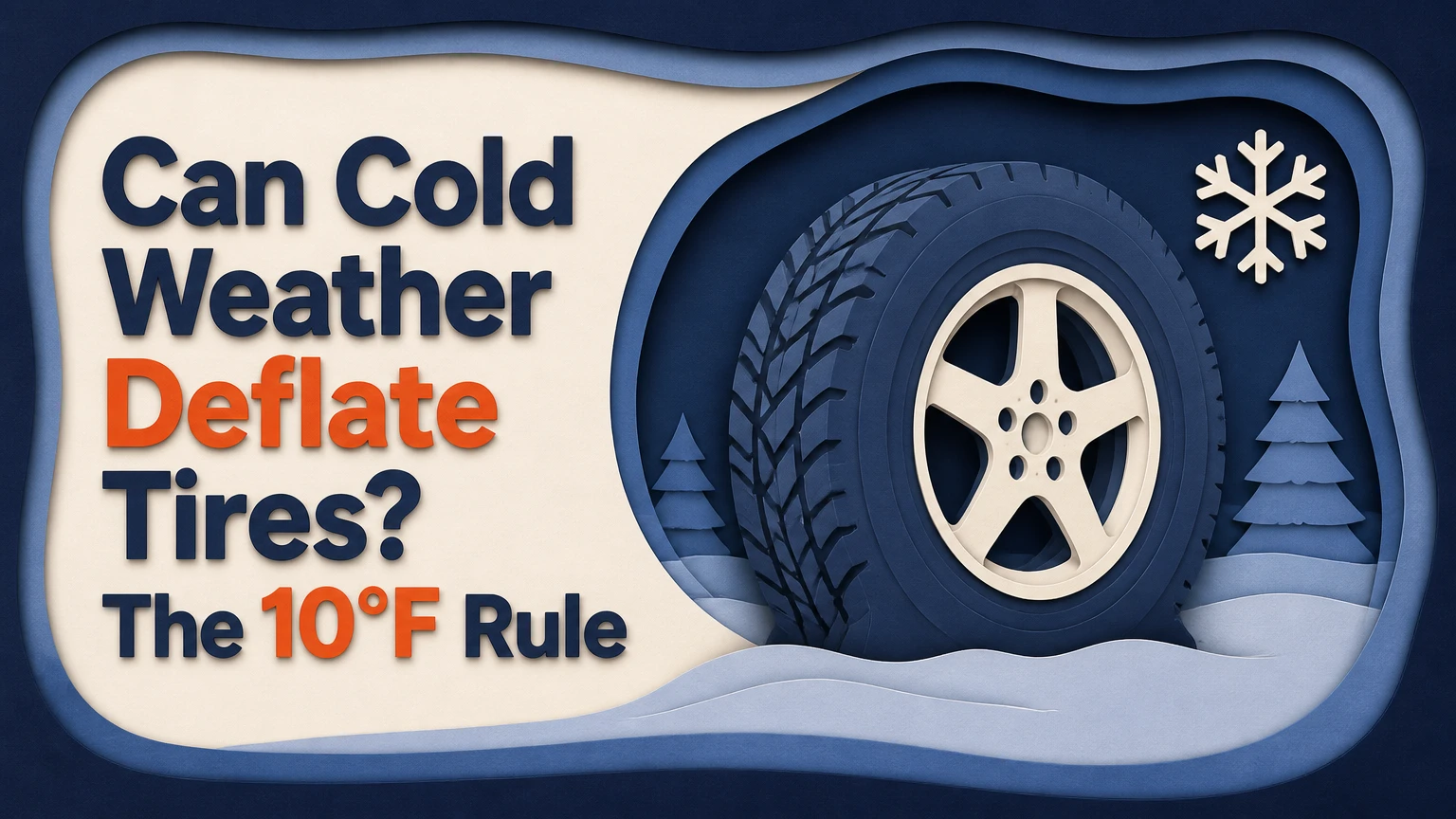
Yes, cold weather can deflate tires by lowering the air pressure inside them. Tire pressure typically falls about 1 pound per square inch (PSI) for each 10°F decrease in tire temperature, although the exact change depends on starting temperature, tire construction, gauge accuracy, and whether the tire has a leak.
Key Facts at a Glance
- A 10°F temperature decrease typically lowers tire pressure by approximately 1 PSI.
- Tire pressure must be measured when the tires are cold, ideally after the vehicle has parked for at least three hours.
- The vehicle manufacturer’s door-jamb placard gives the correct target pressure, not the maximum PSI molded into the tire sidewall.
- A tire-pressure monitoring system (TPMS) warning commonly appears when pressure is about 25% below the prescribed cold pressure on vehicles covered by U.S. regulations.
- Nitrogen and ordinary air respond similarly to temperature changes because both gases obey the same gas laws.
- A single tire that repeatedly loses pressure usually has a puncture, valve problem, wheel leak, or bead-seal fault rather than a weather-only problem.
Why Does Cold Weather Lower Tire Pressure?
Cold weather lowers tire pressure because gas pressure is proportional to absolute temperature when the amount of gas and tire volume remain nearly constant. As the air inside a tire cools overnight, its molecules move less energetically and strike the inner surface less forcefully, so a pressure gauge records a lower value.
The relevant relationship is the Ideal Gas Law, (PV=nRT). In a tire, the amount of gas (n) is nearly fixed, tire volume (V) changes only slightly, and absolute temperature (T) falls. Pressure (P) therefore falls as temperature falls.
The common explanation that air molecules “compress themselves” or “bunch together” is imprecise. Molecules do not shrink, and the tire does not suddenly lose a large amount of volume. The measurable pressure change mainly comes from lower molecular energy and slightly altered tire volume.
NHTSA summarizes the practical rule directly: “For every 10 degrees in temperature change, tire pressure changes about 1 psi.” The agency’s rule is a useful maintenance estimate, not a guarantee for every tire, climate, gauge, or starting pressure.
How Much Pressure Does a Temperature Drop Remove?
A 30°F decrease typically removes about 3 PSI, while a 50°F decrease commonly removes about 5 PSI. The estimate applies to the tire’s temperature, which may differ from the official outdoor air temperature because pavement, sunlight, a warm garage, and recent driving change tire temperature.
| Temperature decrease | Typical pressure change | Example from 35 PSI |
|---|---|---|
| 10°F, 5.6°C | Approximately 1 PSI lower | 34 PSI |
| 20°F, 11.1°C | Approximately 2 PSI lower | 33 PSI |
| 30°F, 16.7°C | Approximately 3 PSI lower | 32 PSI |
| 40°F, 22.2°C | Approximately 4 PSI lower | 31 PSI |
| 50°F, 27.8°C | Approximately 5 PSI lower | 30 PSI |
A tire inflated to 35 PSI in a 70°F shop may read near 30 PSI after reaching thermal equilibrium at 20°F. The actual result can vary because the tire’s internal temperature, construction, pressure gauge, and inflation gas are not identical in every case.
Does Tire Pressure Drop Overnight?
Overnight cooling can lower tire pressure even when the tires were correctly inflated the previous afternoon. A vehicle parked at 65°F may experience a 35°F drop before a 30°F morning, producing a typical pressure decrease of around 3 PSI.
Sunlight can reverse part of the apparent loss. A tire on the sunny side of a vehicle may read higher than a shaded tire, and a tire that has just been driven may read several PSI above its cold baseline. That is why the morning reading after an overnight park is usually the most consistent comparison.
How Should You Check and Inflate Tires in Cold Weather?
Check and inflate tires before driving, using a reliable gauge and the vehicle’s cold inflation specification. The process usually takes 5-10 minutes, costs nothing at many service stations, and succeeds when all four tires match the door-placard target within the gauge’s practical accuracy.
Step 1: Find the Correct Pressure
Read the placard on the driver’s door frame, door edge, fuel-filler flap, or owner’s manual. The placard may list different front and rear pressures, a fully loaded setting, or a compact-spare specification.
Do not use the sidewall maximum as the normal target. The sidewall value is the tire’s maximum permitted inflation pressure under specified conditions, whereas the placard pressure is selected by the vehicle manufacturer for handling, braking, load capacity, comfort, and tire wear.
Step 2: Let the Tires Become Cold
Park for at least three hours, or measure before driving more than about one mile at low speed. “Cold” means the tire has not been warmed substantially by road friction, not that the outdoor air must be below freezing.
Remove the valve cap and press the gauge straight onto the valve stem. A brief hiss is normal, but a long hiss indicates poor gauge placement or a damaged valve core.
Step 3: Measure All Four Tires
Record every reading, including the spare when the vehicle manufacturer requires it. Compare each value with the placard rather than averaging the readings, because one low tire can indicate a developing fault.
| Placard pressure | Typical 25% TPMS threshold | Pressure near warning point | Immediate interpretation |
|---|---|---|---|
| 30 PSI | 7.5 PSI below target | 22.5 PSI | Serious underinflation |
| 32 PSI | 8 PSI below target | 24 PSI | Inflate promptly |
| 35 PSI | 8.75 PSI below target | 26.25 PSI | Warning-level loss |
| 38 PSI | 9.5 PSI below target | 28.5 PSI | Do not ignore |
TPMS thresholds and sensor behavior vary by vehicle. The table illustrates the arithmetic, not a replacement for the vehicle’s dashboard system or service information.
Step 4: Inflate to the Placard Value
Add air in short bursts and recheck after each burst. Inflate a 32-PSI tire until the cold gauge reads approximately 32 PSI, unless the placard specifies another value.
Do not intentionally add 5-10 PSI to “prepare” for a cold snap. Overinflation reduces the tire’s contact patch, can increase center-tread wear, and may make steering and braking feel less stable on cold or wet pavement.
Step 5: Recheck the Warning Light
After correcting pressure, drive according to the owner’s manual. Direct TPMS vehicles may update after several minutes of driving, while indirect systems may require a manual reset or recalibration through the vehicle menu.
A light that remains on after correct inflation requires a second check, not repeated inflation. The sensor may need relearning, the system may have a fault, or one tire may still be losing pressure.
Success checkpoint: all cold tires match their prescribed placard pressures, the valve caps are installed, and the TPMS warning clears through the vehicle’s specified procedure.
What Pressure Should a Car Tire Have in Winter?
Winter tire pressure should equal the vehicle manufacturer’s recommended cold pressure, with no universal winter surcharge. Most passenger vehicles specify approximately 30-36 PSI, but compact cars, SUVs, electric vehicles, performance cars, and heavily loaded vehicles can require different values.
| Vehicle category | Typical cold placard range | Main pressure consideration | Correct reference |
|---|---|---|---|
| Compact passenger car | 30-35 PSI | Low mass and small tire volume | Door placard |
| Midsize sedan | 32-36 PSI | Front and rear values may differ | Door placard |
| Crossover or SUV | 33-39 PSI | Load and rollover-control tuning | Door placard |
| Battery electric vehicle | 36-45 PSI | Higher curb weight and rolling resistance | Door placard |
| Light truck or van | 45-80 PSI | Load range and cargo weight | Placard and load chart |
Cold temperatures can make the tire pressure appear low, but the correct response is to restore the specified pressure. Winter does not automatically justify changing the target. Some manufacturers specify a pressure adjustment for particular tire sizes, loads, or temperature conditions, and those instructions take priority.
Does Cold Weather Deflate Winter Tires More Than All-Season Tires?
Cold weather lowers pressure in winter, all-season, and summer tires according to the same gas-temperature relationship. Tire compound changes affect grip and flexibility, but they do not create a separate pressure law.
Winter tires often use softer compounds and deeper tread blocks, which improve cold-weather traction. Their recommended inflation pressure still comes from the vehicle manufacturer or tire manufacturer for the specific application. A winter tire installed on the same vehicle is not automatically inflated to a higher or lower number unless the approved fitment instructions say so.
Summer tires present a separate safety issue. Their rubber can become stiff in freezing temperatures, reducing traction even when pressure is correct. Correct pressure cannot make a summer tire perform like a winter tire on snow or ice.
Is Nitrogen Better Than Compressed Air in Cold Weather?
Nitrogen does not eliminate cold-weather pressure changes. Dry nitrogen and dry air both lose approximately the same pressure for a given temperature decrease, because the dominant effect is temperature rather than the gas label.
Ordinary shop air contains roughly 78% nitrogen, 21% oxygen, and variable water vapor. Tire-service nitrogen is commonly 93-99% nitrogen, often with less moisture. Dry gas can make pressure behavior slightly more predictable, and nitrogen permeates some rubber compounds more slowly, but routine pressure checks remain necessary.
| Factor | Compressed air | Nitrogen service |
|---|---|---|
| Typical fill cost | Free to $2 per use | Approximately $5-$10 per tire |
| Temperature response | About 1 PSI per 10°F | About 1 PSI per 10°F |
| Availability | Gas stations and garages | Selected tire shops and dealerships |
| Moisture content | Variable | Usually lower |
| Easy roadside top-off | Yes | Usually unavailable |
| Practical check interval | Monthly | Monthly |
Nitrogen can be reasonable for fleets, specialized racing applications, or owners who already receive it during tire service. It is not a reliable substitute for inspecting pressure, and a nitrogen-filled tire can still trigger TPMS during a cold snap.
Does Water Vapor Cause Most Winter Pressure Loss?
Water vapor can influence pressure, but normal seasonal pressure loss is primarily caused by the temperature change of the gas. The moisture effect is often overstated because water vapor condenses as the tire cools, changing gas composition while liquid water occupies little vapor volume.
Professional tire service can reduce moisture by using dried air or nitrogen, particularly in demanding commercial, racing, or corrosion-sensitive applications. For an ordinary passenger vehicle, correcting pressure with a calibrated air pump is usually more valuable than paying for nitrogen.
Why Is One Tire Low When the Other Three Are Fine?
One tire that is substantially lower than the other three usually has a pressure-loss problem rather than a temperature-only problem. Cold weather affects all tires exposed to similar conditions, while a puncture, bent wheel, leaking valve, or bead seal usually affects one tire.
Inspect the tread and sidewall visually, but do not remove a nail or screw before a tire professional examines it. A puncture can seal temporarily around the object and lose air rapidly after removal.
| Symptom | Likely cause | Useful test | Recommended action |
|---|---|---|---|
| All four tires lose 2-4 PSI after a cold front | Temperature change | Compare cold readings | Inflate to placard |
| One tire loses 1 PSI in days | Slow puncture or valve leak | Soapy-water test | Repair or replace |
| One tire loses pressure after mounting | Bead or valve problem | Submerge or inspect bead | Tire-shop inspection |
| Pressure falls rapidly within hours | Major puncture or damage | Visual check only | Spare or roadside service |
| Light stays on with correct pressure | TPMS sensor or relearn fault | Scan system | Service TPMS |
A soapy-water solution applied to the valve stem, tread, and rim edge can reveal bubbles from a leak. Never rely on sealant, a visual inspection, or repeated top-offs when pressure loss is rapid.
Can You Drive With a Cold-Weather TPMS Light On?
Drive only far enough to reach a safe place or inflation source after checking the tires. A steady TPMS light means at least one tire may be underinflated, while a flashing light often indicates a system or sensor fault rather than pressure alone.
Before driving, measure every accessible tire. If a tire is visibly collapsed, substantially below its placard pressure, damaged, or losing air audibly, do not drive on it because the sidewall can overheat and fail.
A TPMS light that disappears after the tires warm up still represents a real pressure deficit. Warm air may raise the measured pressure temporarily, but it does not restore the correct cold inflation condition.
How Often Should You Check Tires in Winter?
Check tire pressure at least once per month and whenever the temperature changes sharply. A practical winter schedule is a monthly check plus an additional inspection after a sustained 20-30°F temperature drop, before a long trip, or after a tire service.
Tires also lose air gradually through normal permeation and small imperfections. A typical passenger tire may lose around 1 PSI per month, although age, tire construction, wheel condition, valve integrity, and ambient temperature alter the rate.
Keep a digital gauge rated for at least 60 PSI in the vehicle, along with a 12-volt inflator if local conditions make service stations inconvenient. Calibrate or compare the gauge periodically because inexpensive gauges can differ by several PSI.
What Are the Most Common Cold-Weather Tire Mistakes?
The most damaging winter tire errors involve using the wrong reference pressure, measuring at the wrong temperature, or treating a warning as a temporary weather nuisance.
- Using the sidewall maximum: The sidewall number is not the vehicle’s normal setting. Use the door placard.
- Checking immediately after driving: Heat raises pressure and hides the cold baseline. Measure before driving.
- Inflating only the tire that looks low: Visual appearance is unreliable, especially with radial tires. Measure all tires.
- Overinflating before a freeze: Extra pressure can reduce the contact patch and alter handling.
- Ignoring one-tire pressure loss: Uneven loss points toward a leak or wheel problem.
- Resetting TPMS without correcting pressure: A reset can conceal a dangerous condition and does not repair a leak.
An experienced tire technician treats pressure trends as diagnostic data. Four tires changing together suggests temperature; one tire changing repeatedly suggests hardware.
How Do Temperature, Altitude, and Sunlight Change Readings?
Temperature, altitude, sunlight, and driving can produce different gauge readings without adding or removing air. A tire measured in a heated garage may read higher than the same tire outdoors, while a sunny sidewall can temporarily gain pressure from solar heating.
Altitude affects absolute pressure inside and outside the tire, so the gauge reading can change when a vehicle travels between low and high elevations. The effect is usually smaller than a major seasonal temperature swing, but mountain travel can make borderline inflation more noticeable.
| Situation | Typical pressure-reading effect | Best practice |
|---|---|---|
| 70°F garage to 20°F outdoors | About 5 PSI lower after cooling | Set pressure at the final cold condition |
| 30-minute highway drive | Often 2-6 PSI higher | Do not bleed hot tires to placard value |
| Direct afternoon sunlight | Temporary localized increase | Compare shaded, cold tires |
| High-altitude travel | Gauge pressure can shift | Recheck at destination |
| Overnight freezing after warm inflation | Lower morning reading | Restore placard pressure cold |
The pressure change after driving is not a reason to release air. Tire manufacturers and vehicle engineers specify cold inflation pressure because hot readings vary with speed, load, road surface, and ambient conditions.
What Should You Do Before a Winter Road Trip?
Before a winter road trip, inspect tread, sidewalls, spare-tire pressure, valve caps, and cold inflation pressure. Complete the check the morning of departure or after the vehicle has been parked for several hours, then confirm that the vehicle’s load matches the placard setting.
Use this checklist:
- Measure all four tires and the spare if fitted.
- Inflate to the placard’s normal or loaded setting.
- Check tread depth and look for cracks, bulges, and embedded objects.
- Confirm that the winter tires match the vehicle’s approved size and load rating.
- Pack a gauge, inflator, flashlight, gloves, and the correct locking-lug key.
- Verify that the TPMS warning is absent after the prescribed drive.
- Check pressure again after reaching the destination if the temperature differs substantially.
Electric vehicles deserve extra attention because their higher curb weight can increase tire load and rolling resistance. Their placard pressure may be higher than a similarly sized gasoline vehicle, so copying a neighboring car’s PSI is unsafe.
Frequently Asked Questions
Can cold weather make a tire look flat without a puncture?
Yes, cold weather can make a properly sealed tire look softer because pressure falls as the internal air cools. Radial tire sidewalls may flex visibly even at an acceptable pressure, so appearance cannot establish inflation. Measure the tire cold with a gauge and compare the result with the door placard.
Does inflating tires in winter prevent the pressure from dropping again?
Inflating tires to the correct cold pressure restores the required starting point, but it cannot prevent another pressure decrease when temperature falls further. A tire set to 35 PSI at 60°F may read near 31 PSI after a large cold drop. Recheck pressure whenever temperatures change sharply.
Should I add one PSI for every 10°F below freezing?
Do not apply a universal adjustment without checking the vehicle manufacturer’s guidance. The 1-PSI-per-10°F rule estimates the pressure change, but the correct target remains the placard’s cold pressure. Add air until the tire reaches that specification under the current cold conditions.
Why does my TPMS light turn off after I drive?
Driving warms the tires and raises their internal pressure, which can move a borderline tire above the TPMS trigger point temporarily. The warning may also clear after sensors transmit updated data. Check and correct cold pressure anyway, because warming does not remove the underlying underinflation.
Can a tire lose air only when the weather is cold?
A tire can leak more noticeably in cold weather even when the leak exists year-round. Rubber, valve seals, and wheel components contract slightly, and a marginal bead or valve may lose air faster. If one tire repeatedly drops more than the others, request a leak test instead of treating the problem as normal winter behavior.
The Bottom Line
Can cold weather deflate tire pressure? Yes. A typical 10°F temperature decrease lowers tire pressure by about 1 PSI, but cold weather should reduce pressure equally across comparable tires rather than make one tire repeatedly lose air.
Measure every tire cold, follow the door-jamb placard, and never use the sidewall maximum as the normal target. Treat a single low tire, rapid pressure loss, visible damage, or persistent TPMS warning as a mechanical problem requiring inspection. Regular checks provide more safety value than deliberately overinflating tires or paying for nitrogen solely to manage winter temperatures.