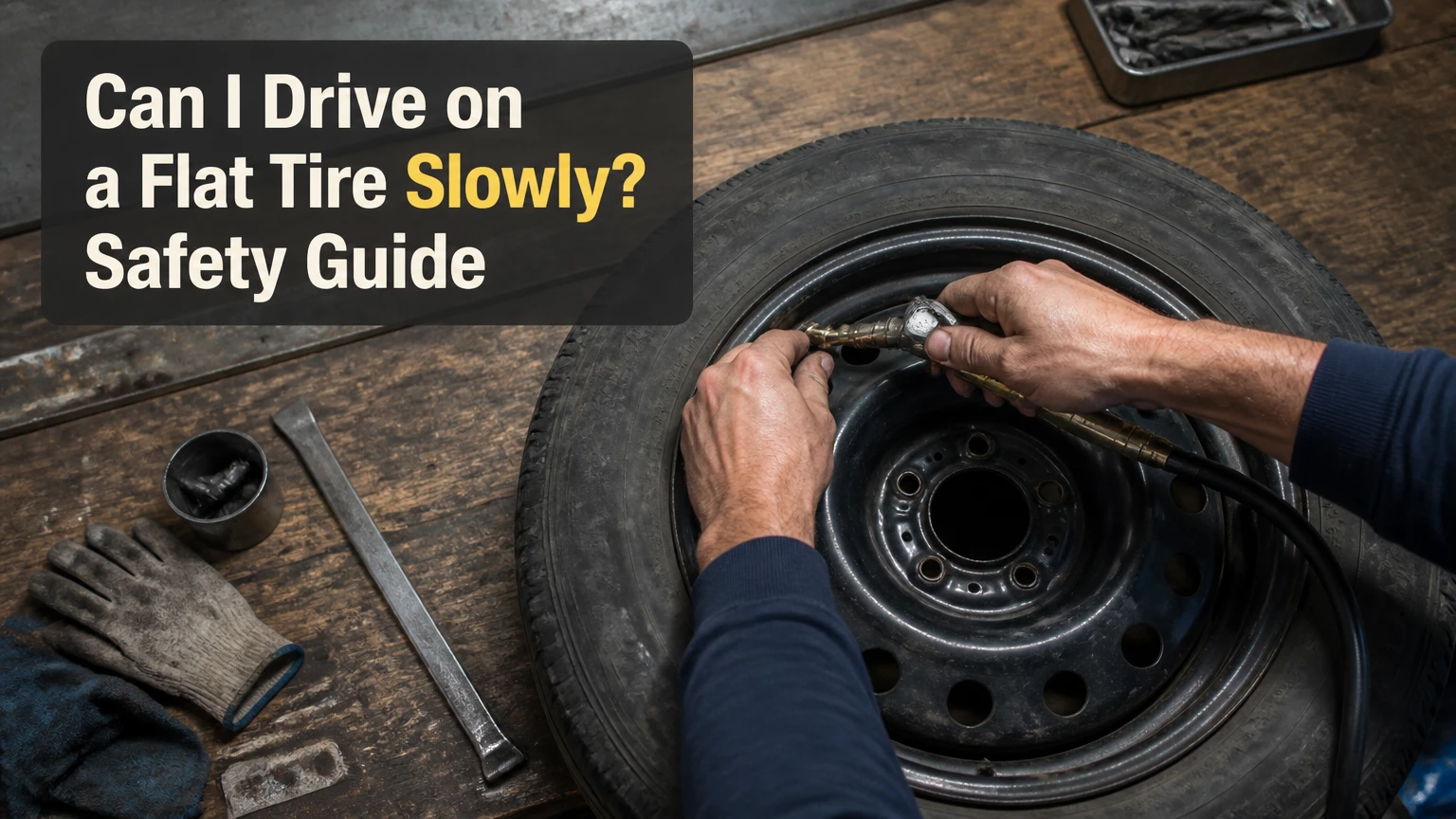
No, you should not drive on a flat tire slowly as a normal way to reach a tire shop. A standard tire at or near 0 PSI can lose steering stability, damage its sidewall and internal belts, destroy the wheel, and become unsafe within a short distance. Move only far enough to reach a safer stopping position when stopping immediately would expose you to greater traffic danger.
Key Facts at a Glance
- A completely deflated standard tire is an emergency condition, not a low-speed driving mode.
- A vehicle may be moved a few feet to clear an active lane, but no universal safe distance exists.
- A certified run-flat tire may commonly support up to 50 miles at 50 mph, subject to the vehicle manual, tire model, load, temperature, and remaining pressure.
- A self-sealing tire usually addresses small tread punctures, not sidewall cuts, bead leaks, or a tire that has already collapsed.
- A temporary spare normally has a speed and distance limit printed on its sidewall or listed in the owner’s manual.
- Tire pressure monitoring systems warn about pressure loss, but they do not certify that a tire is safe to drive.
Can I Drive on a Flat Tire Slowly?
You can move a standard flat tire only when a very short relocation is necessary to escape immediate danger, such as clearing a live traffic lane or reaching the nearest safe shoulder. Drive at walking pace if possible, keep the distance minimal, and stop as soon as the vehicle is protected from moving traffic.
Driving 2 or 3 miles to the next highway exit is not a safe compromise. A flat tire can be ruined before that distance, while the wheel may also suffer impact or abrasion damage. A vehicle with a front flat can pull sharply; a rear flat may feel like a rhythmic thump or loose rear end. Neither symptom gives the driver reliable control.
The safest answer changes only when the tire is specifically engineered for pressure-loss operation. A run-flat tire has reinforced sidewalls or an internal support ring, but its limits are model-specific. A normal radial tire does not gain run-flat capability because the driver reduces speed.
What Does “Flat” Mean?
“Flat” can describe several conditions, and the distinction affects the response. A tire at 28 PSI instead of a placard value of 35 PSI is underinflated; a tire with a visibly collapsed sidewall or 0 PSI is deflated and should not be driven.
| Condition | Typical pressure state | Visible condition | Appropriate action |
|---|---|---|---|
| Correct inflation | 30-40 PSI on many passenger vehicles | Sidewall holds normal shape | Continue driving and check monthly |
| Moderate underinflation | 20-29 PSI | Slightly softened sidewall | Inflate before normal driving |
| Severe pressure loss | 10-19 PSI | Noticeable bulge or steering change | Stop and inspect immediately |
| Complete deflation | 0-5 PSI | Sidewall collapsed or rim appears low | Do not drive, except minimal emergency relocation |
The exact target is printed on the driver-door placard, not on the tire sidewall. The sidewall number is the tire’s maximum permitted cold inflation pressure, not the vehicle’s recommended operating pressure.
Why Does a Flat Tire Become Unsafe So Quickly?
A pneumatic tire uses compressed air to support the vehicle’s load and maintain its designed shape. When a standard tire loses that support, the sidewall folds between the wheel rim and pavement, generating severe flexing, heat, and damage to the rubber, cords, bead, and belt package.
A rotating tire already experiences repeated deformation at the contact patch. With insufficient pressure, the deflection becomes much larger, so the sidewall bends farther on every revolution. Heat builds through hysteresis, the internal energy loss that occurs when rubber flexes and recovers. Speed, vehicle load, ambient temperature, road texture, and distance all increase the rate of damage.
The visible tread may look usable after a short flat drive, while the inside of the sidewall has suffered abrasion or cord damage. That is why a tire professional may reject a tire that can still be inflated and appears intact externally.
Which Parts Can Be Damaged?
| Component | Damage mechanism | Observable symptom | Usual consequence |
|---|---|---|---|
| Sidewall rubber | Folding, scuffing, and heat | Gray abrasion dust or creasing | Tire replacement often required |
| Steel belts | Excessive flex and separation | Bulge, vibration, irregular tread | Structural failure risk |
| Bead area | Rim pressure and movement | Air leak after reinflation | Demounting and inspection required |
| Wheel rim | Rim edge contacts pavement | Bent flange or scrape | Vibration, leak, or wheel replacement |
| TPMS sensor | Impact, sealant, or valve damage | Warning remains after inflation | Sensor or valve-service repair |
| Brake hardware | Road debris or wheel impact | Usually no immediate visible sign | Inspect if wheel or tire was damaged |
The common claim that driving a flat tire directly destroys brake lines is inaccurate. Brake hoses and lines are not normally crushed by the tire sidewall; they can be damaged indirectly by a separated tread, debris, a wheel impact, or a collision. The more immediate risks are loss of control, tire destruction, and wheel damage.
What Should You Do When a Tire Goes Flat While Driving?
When a tire loses pressure in motion, stabilize the vehicle, warn other road users, reduce speed without abrupt inputs, and stop outside the traffic path. The correct priority is occupant safety, not preserving the tire or reaching a preferred destination.
Step 1: Hold the Steering Wheel Firmly
Keep both hands on the wheel and make small steering corrections. A sudden front-tire failure can create a pull, while a rear failure can produce sway or a repeating thump.
Avoid jerking the wheel toward the shoulder. Check mirrors first when traffic permits, because a rapid lane change can cause a collision before the tire itself becomes the main hazard.
Step 2: Turn On the Hazard Lights
Activate hazard warning lights as soon as the pressure loss or tire failure is apparent. Hazard lights help following drivers recognize that the vehicle is slowing abnormally, although they do not replace a safe lane change or adequate visibility.
Do not stop on a blind curve, narrow bridge, railroad crossing, or the apex of a ramp if a safer position is reachable without continued driving.
Step 3: Ease Off the Accelerator
Release the accelerator gradually and allow the vehicle to decelerate. Do not slam on the brakes, because heavy braking can worsen instability, especially when one tire has little or no support.
After speed falls substantially, use gentle braking to reach a shoulder, parking area, emergency bay, or other protected location. The correct distance is the shortest distance that removes the vehicle from immediate danger.
Step 4: Move Only If Stopping Immediately Is More Dangerous
If the vehicle is already on a wide shoulder, stop there. If it is in an active lane, move toward safety at the lowest controllable speed, avoiding potholes, hard steering, and unnecessary distance.
The frequently repeated limits of 20 mph and 200-400 meters are not universal safety specifications for every tire, road, or vehicle. A completely flat standard tire may fail in less distance, so treat those figures as rough emergency ceilings, not permission to continue.
Step 5: Secure the Vehicle
Stop on firm, level ground when possible, select Park or a suitable gear, apply the parking brake, and keep passengers away from traffic. On a highway, remain inside the vehicle with the seat belts fastened when exiting would expose occupants to high-speed traffic.
Call roadside assistance or emergency services if the vehicle remains in a travel lane, the shoulder is too narrow, visibility is poor, or a safe tire change cannot be completed.
How Are Run-Flat Tires Different?
A certified run-flat tire is designed to carry the vehicle temporarily after major pressure loss, unlike a conventional tire. Many self-supporting run-flats use reinforced sidewalls, while support-ring systems use a separate structure inside the tire, but both require the manufacturer’s stated speed and distance limits.
| Tire type | Pressure-loss design | Common published limit | Main restriction | Inspection requirement |
|---|---|---|---|---|
| Standard radial | Air pressure supports load | 0 miles for normal travel | Emergency relocation only | Inspect before reinflation or repair |
| Self-supporting run-flat | Reinforced sidewalls | Often 50 miles at 50 mph | Lower limits with heavy load or damage | Mandatory professional inspection |
| Support-ring run-flat | Internal ring supports load | Model-specific, often 50 miles | Requires matched wheel and tire system | Inspect tire and support ring |
| Self-sealing tire | Sealant closes small tread punctures | No fixed flat-driving allowance | Does not seal sidewall or large cuts | Check pressure and puncture condition |
| Temporary spare | Smaller replacement wheel and tire | Often 50-70 mph maximum | Vehicle-specific distance and handling limits | Replace or restore promptly |
Michelin, Bridgestone, and other manufacturers publish separate run-flat limits for individual products. A driver should read the tire sidewall and owner’s manual rather than apply the familiar 50-mile, 50-mph figure automatically.
Run-flats are not invulnerable. A pothole can damage the wheel, an overloaded vehicle can reduce the allowable distance, and high ambient temperature can accelerate heat buildup. Electronic stability control and handling may also feel different after pressure loss.
Do Self-Sealing Tires Change the Answer?
Self-sealing tires change the answer only when the sealant has successfully closed a small puncture in the tread and the tire retains enough pressure for normal operation. Self-sealing construction does not make a tire safe to drive after a sidewall tear, bead leak, large puncture, or visible collapse.
The sealing layer is intended for limited punctures caused by objects such as nails or screws. It may not seal an irregular hole, a cut near the shoulder, valve failure, or damage caused by driving after pressure loss. The driver should check pressure with a gauge and arrange professional inspection even when the tire appears to hold air.
A self-sealing tire also does not eliminate the need for TPMS. The vehicle can still lose pressure faster than the sealant can close the opening, and the tire may contain internal damage that cannot be diagnosed from the outside.
Is a Slowly Leaking Tire Safer Than a Flat?
A slowly leaking tire is less immediately unstable than a completely flat tire, but it is not safe for routine driving when pressure is below the vehicle placard value. A puncture can worsen suddenly, and underinflation increases sidewall flex, heat, tread wear, and fuel consumption.
If a gauge shows a modest pressure loss and the tire remains structurally shaped, inflate it to the placard pressure and monitor it. A tire that loses more than about 1-2 PSI over a day needs diagnosis rather than repeated top-offs.
Temperature changes also affect readings. Tire pressure changes by roughly 1 PSI for every 10 degrees Fahrenheit change in temperature, although the exact result varies by tire and conditions. Measure pressures cold, before driving, using the same reliable gauge.
Do not reinflate a tire with a visible sidewall bulge, cut, exposed cord, separated tread, or rim damage. Those signs require a spare or professional recovery.
Which Emergency Option Fits the Damage?
A spare tire is the most predictable roadside solution when the tire is replaceable and the vehicle can be safely lifted. An inflator helps with a low tire or small tread puncture, while sealant is a limited temporary measure that may be incompatible with some TPMS sensors and tire-repair procedures.
| Option | Typical time | Typical U.S. cost | Works for | Does not solve |
|---|---|---|---|---|
| Full-size spare | 20-45 minutes | $0 if equipped | Most punctures and flats | Damaged spare, seized lug nuts |
| Temporary spare | 20-45 minutes | $100-$300 replacement | Short trip to a repair facility | Normal long-distance driving |
| 12-volt inflator | 5-15 minutes | $30-$120 | Low pressure or tiny leak | Sidewall cuts, bead failure |
| Tire sealant kit | 10-20 minutes | $10-$30 per use | Small tread punctures | Large holes and sidewall damage |
| Mobile tire service | 30-120 minutes | $75-$250 service call | Most roadside conditions | Severe weather or inaccessible roads |
| Tow truck | 30-180 minutes | $100-$250 typical local tow | Unsafe locations and wheel damage | Immediate arrival guarantee |
A sealant can make later repair more difficult, and some products require the tire to be replaced or cleaned before a shop can inspect it. Read the vehicle manual before using a chemical kit.
When Is a Temporary Spare Safe?
A temporary spare is safe for the limited purpose stated by the vehicle manufacturer. Many compact spares display an 80 km/h or 50 mph maximum, but the owner’s manual may impose a shorter distance, prohibit use on a particular axle, or require disabling a drivetrain mode.
A temporary spare changes tire diameter, grip, and handling. On some four-wheel-drive and all-wheel-drive vehicles, a large diameter mismatch can stress the drivetrain or trigger control-system warnings. Confirm compatibility before installation.
What If the Vehicle Has No Spare Tire?
A vehicle without a spare should use its approved tire mobility kit, compatible inflator, or roadside service rather than driving on the deflated tire. Check whether the kit contains sealant, a compressor, a towing eye, and instructions for the specific vehicle.
Many newer vehicles omit spare tires to reduce weight or increase cargo space. That design choice makes a charged phone, tire-pressure gauge, compressor, and active roadside plan more valuable, especially on rural routes where a service vehicle may take longer to arrive.
Can a Flat Tire Be Repaired?
A puncture in the central tread may be repairable if the tire has not been driven while severely underinflated and the puncture meets the tire industry’s repair criteria. A sidewall or shoulder puncture, exposed cord, bulge, bead damage, or internal abrasion generally requires tire replacement.
A proper repair normally requires removing the tire from the wheel so the interior can be inspected. A plug inserted from outside may temporarily stop air loss, but it does not replace a full internal inspection and combination repair when the tire is suitable.
| Damage location or condition | Typical repair decision | Reason | Required next step |
|---|---|---|---|
| Tread center, small puncture | Often repairable | Repairable zone and limited hole size | Remove, inspect, and repair internally |
| Tread shoulder | Usually replace | High flexing area | Mount a new tire |
| Sidewall cut | Replace | Sidewall carries structural load | Do not plug or patch |
| Visible bulge | Replace | Cord structure has failed | Replace tire and inspect wheel |
| Driven flat for several miles | Often replace | Hidden inner sidewall damage | Professional internal inspection |
| Bent or cracked rim | Repair or replace wheel | Air seal and strength compromised | Wheel inspection before tire use |
The U.S. Tire Manufacturers Association advises that puncture repair depends on puncture size, location, and internal condition, and that a tire should be removed for inspection. That guidance is more reliable than deciding from the hole’s outside appearance.
What Does Flat-Tire Damage Usually Cost?
A simple tread puncture repair commonly costs about $20-$50 in the United States, while replacing one passenger-car tire commonly costs about $100-$350 before premium fitment, taxes, and disposal fees. A damaged alloy wheel can add roughly $150-$600 for repair or $300-$1,500 or more for replacement, depending on size and vehicle.
These are typical consumer ranges, not fixed prices. Run-flat tires, low-profile performance tires, electric-vehicle fitments, luxury wheels, and remote roadside calls often cost more.
| Service or part | Typical U.S. range | Typical time | Main price variable |
|---|---|---|---|
| Tread puncture repair | $20-$50 | 30-60 minutes | Shop policy and tire condition |
| Standard passenger tire | $100-$350 | 45-90 minutes | Size, brand, and load rating |
| Run-flat tire | $180-$500 | 60-120 minutes | Specialized fitment and availability |
| Alloy wheel repair | $150-$600 | 1-3 days | Bend, crack, finish, and wheel size |
| Alloy wheel replacement | $300-$1,500+ | Same day to several days | OEM versus aftermarket wheel |
| Roadside service call | $75-$250 | 30-120 minutes | Membership, distance, and location |
Driving farther to avoid a service fee can convert a repairable puncture into a tire and wheel replacement. That trade-off is especially unfavorable when the vehicle is carrying passengers, cargo, or an expensive low-profile tire.
Which Situations Require Immediate Stopping?
Immediate stopping is required when the vehicle can reach a safe position without crossing dangerous traffic, or when the tire has failed visibly. Rain, darkness, high speed, heavy traffic, narrow shoulders, and a front-tire failure all reduce the margin for controlled relocation.
Stop and request assistance when any of these conditions applies:
- The steering wheel requires continuous correction.
- A tire is visibly off the rim or the wheel contacts pavement.
- A loud flapping sound indicates tread separation.
- Burning-rubber odor or smoke comes from the wheel area.
- The shoulder is narrower than the vehicle.
- The vehicle is on a bridge, in a tunnel, or near a blind curve.
- A tire has a sidewall tear, bulge, exposed cord, or missing tread.
- The vehicle uses an AWD system and the spare size is uncertain.
A tire-pressure warning light alone does not identify the severity of the failure. NHTSA explains that TPMS warns drivers when one or more tires are significantly underinflated, but the system is not a substitute for checking pressure with a gauge.
What If the Flat Happens on a Highway?
On a highway, prioritize separation from moving traffic over tire preservation. Maintain control, activate hazards, reduce speed smoothly, and reach the widest available shoulder without abrupt steering; if the vehicle cannot move safely, call emergency services and remain belted inside.
Place warning devices only when local law permits and only when doing so does not expose you to traffic. Do not stand between the vehicle and the travel lane, and do not attempt a roadside wheel change on a narrow shoulder beside fast-moving vehicles.
What If the Flat Happens in a Driveway or Parking Lot?
A driveway or parking lot usually removes the traffic emergency, so do not drive the vehicle to a tire shop. Inflate only if the tire has no visible structural damage and you need to reposition the vehicle a few feet; otherwise use a spare, mobile technician, or tow service.
A flat on private property also gives you time to photograph the tread, sidewall, valve, and wheel before moving anything. Those images can help a technician distinguish puncture damage from impact or run-flat operation.
Common Mistakes That Increase Damage
The most expensive mistake is treating a safe stopping distance as a safe travel distance. A driver who continues to the next exit may destroy a tire that could have been repaired and may bend the wheel before reaching help.
- Following a fixed 20-mph rule: Speed limits do not account for load, heat, tire construction, or road surface. Use the lowest controllable speed and the shortest necessary distance.
- Trusting a reinflated damaged tire: Air pressure can temporarily hide internal sidewall failure. Have a tire professional remove and inspect it.
- Using sealant for a sidewall tear: Sealant cannot restore missing structural cords. Replace the tire.
- Installing a donut without checking the manual: AWD systems, axle restrictions, and speed limits vary by vehicle.
- Jacking on unstable ground: Soft soil, gravel, steep slopes, or hot damaged asphalt can let the jack shift. Use roadside assistance when the support surface is unsafe.
- Ignoring a spare’s pressure: A spare stored for years may be underinflated or expired. Check it at least during scheduled maintenance and before long trips.
A practical technician’s rule is simple: if the sidewall has touched the pavement while carrying vehicle weight, assume hidden damage until an internal inspection proves otherwise. Reinflation does not reverse heat, abrasion, or cord deformation.
FAQ
Can I Drive a Flat Tire to the Next Exit?
No. Driving a standard flat tire to an exit may require several miles, which can shred the sidewall, damage the belts, and bend the wheel. Move only far enough to escape immediate traffic danger, then stop and call roadside assistance or install a suitable spare.
How Many Feet Can You Drive on a Flat Tire?
There is no guaranteed safe number of feet for a conventional flat tire. A few feet may be necessary to clear a travel lane, but a pothole, sharp turn, heavy load, or damaged sidewall can make even a short movement unsafe. Distance should be minimized rather than calculated as a target.
Can I Drive on a Flat Tire if It Is a Run-Flat?
A certified run-flat can usually be driven temporarily after pressure loss, but only within its tire-specific and vehicle-specific limits. Many products use a 50-mile and 50-mph guideline, yet heat, load, damage, and remaining pressure can reduce that allowance. Read the manual and replace or inspect the tire promptly.
Can I Put Air in a Completely Flat Tire?
You can add air only after checking for a visible puncture, sidewall damage, bead displacement, bulge, or wheel damage. A tire that accepts air is not necessarily safe. If the tire was driven while collapsed, have it removed and internally inspected before normal driving.
Is It Better to Use Tire Sealant or a Spare?
A spare is generally more predictable for a damaged or completely flat tire, while sealant is suitable only for certain small tread punctures and compatible vehicles. Sealant cannot repair sidewall damage, may complicate later service, and may affect some TPMS components or sensor-service procedures.
Should I Change a Flat Tire on the Highway Shoulder?
Change the tire only when the shoulder is wide, level, stable, and separated from traffic, and when you can do so without standing in danger. A narrow shoulder, darkness, high-speed traffic, poor weather, or an unstable jack location favors staying belted inside and calling roadside assistance.
The Bottom Line
The answer to “can i drive on a flat tire slowly” is no for normal travel. A conventional tire should be driven only the minimum distance required to escape immediate danger, because pressure loss can destroy the tire, wheel, and vehicle control long before a repair shop is reached. Stop safely, use a compatible spare or approved mobility kit, and have any driven-flat tire professionally inspected before relying on it.