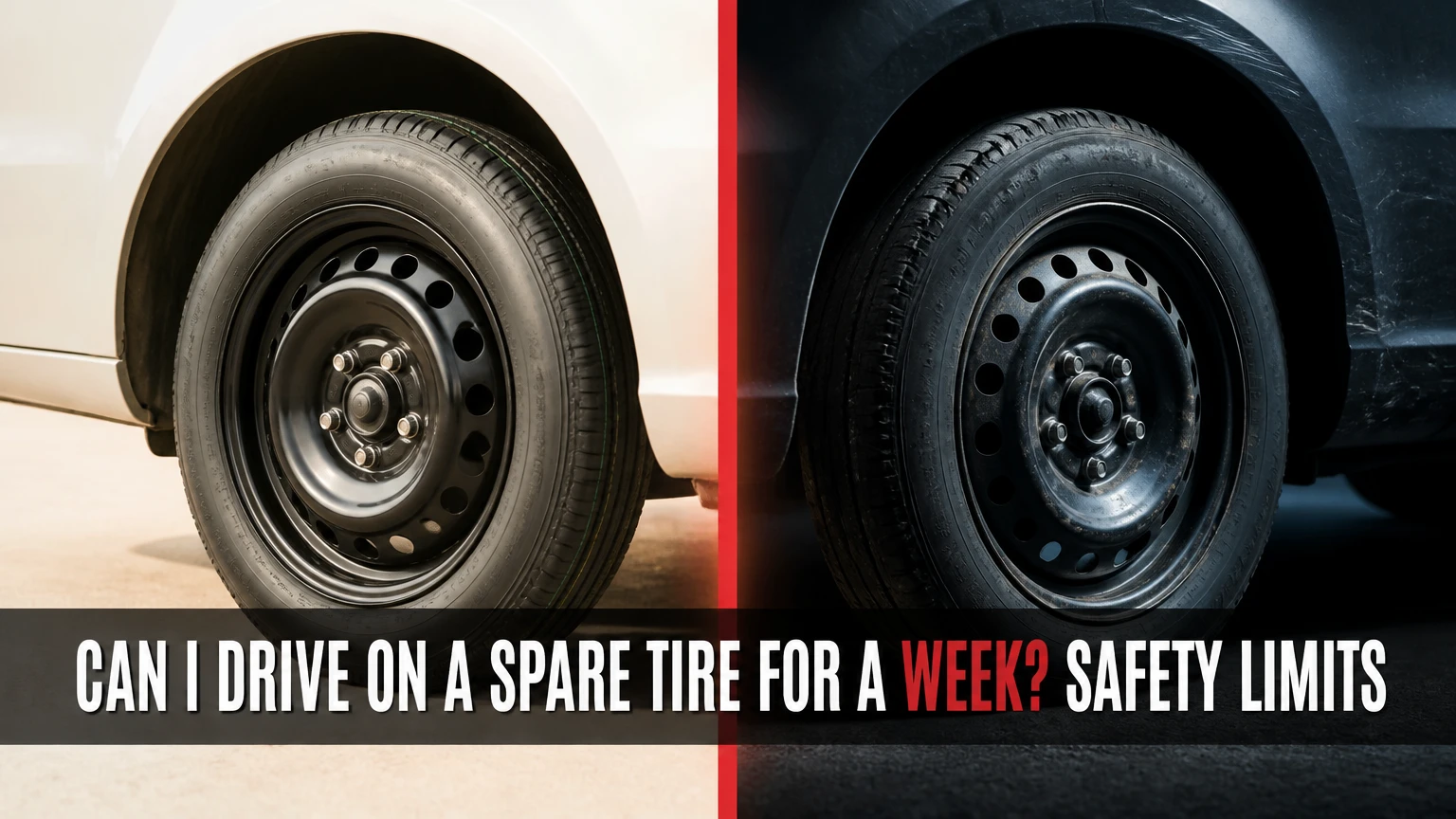
No, most drivers should not drive on a temporary spare tire for a week. A space-saver, or donut, is an emergency tire intended to cover the short trip to a tire shop, commonly with a 50-mile and 50-mph limit, but the vehicle manual and spare sidewall control. A matching full-size spare may be suitable for normal driving, subject to its age, condition, and vehicle requirements.
Key Facts at a Glance
- A temporary donut is normally a short-term emergency tire, not a seven-day replacement.
- The often-cited limit is 50 miles at no more than 50 mph, but some vehicles specify different limits.
- A temporary spare needs the pressure printed on its sidewall or listed in the owner’s manual, not automatically 60 PSI.
- A smaller or differently constructed spare can reduce wet grip, braking performance, cornering stability, and steering precision.
- An AWD or 4WD vehicle may require matching tire circumference and tread depth on all four wheels.
- A full-size matching spare can function like a regular tire only when its size, load rating, speed rating, tread, and age are appropriate.
Can I Drive on a Spare Tire for a Week?
You should not use a temporary spare as your normal tire for a week, even if the car travels only short distances each day. A week of commuting can quickly exceed the spare’s mileage limit, while repeated heat cycles, rain, potholes, highway speeds, and emergency braking increase the safety risk before the calendar reaches seven days.
The correct objective is to drive only far enough to reach a tire repair or replacement facility. Michelin’s consumer guidance describes a temporary spare as a tire for getting to a tire service facility, rather than a substitute for a normal tire. The exact limit comes from the tire and vehicle manufacturer, not from a universal law.
A full-size spare changes the answer. A full-size spare with the same size, load index, speed rating, wheel specification, and comparable tread can often remain installed until the damaged tire is repaired or replaced. A full-size tire that is old, cracked, badly mismatched, or designed for a different axle does not automatically qualify.
Does One Week Matter More Than Mileage?
Mileage, speed, tire condition, and road conditions usually matter more than the number of days. A 10-mile trip on a sound temporary spare is materially different from five 30-mile highway commutes, even though both uses occur within one week.
Treat the spare as expired for the trip when any one limit is reached:
- The sidewall or manual distance limit.
- The sidewall or manual speed limit.
- A warning condition such as vibration, heat, pressure loss, or severe pulling.
- A vehicle-specific restriction for AWD, 4WD, ABS, or traction control.
How Far and How Fast Can You Drive on a Donut?
Most temporary donuts allow about 50 miles total and a maximum of 50 mph, but the printed sidewall and owner’s manual take priority. Some compact spares specify a lower speed, a lower distance, or a requirement to avoid certain roads, so inspect the actual tire before moving the vehicle.
| Spare or mobility system | Common operating limit | What controls the limit | Normal-use suitability |
|---|---|---|---|
| Temporary space-saver donut | 50 miles; 50 mph | Sidewall and vehicle manual | Emergency trip only |
| Smaller temporary spare | 30-50 miles; 50 mph or less | Vehicle manufacturer | Emergency trip only |
| Matching full-size spare | No temporary limit | Tire age, rating, condition | Usually normal driving |
| Nonmatching full-size spare | Shop or manufacturer limit | Diameter, tread, axle, drivetrain | Limited replacement use |
| Run-flat tire | Commonly 50 miles; 50 mph | Run-flat manufacturer and model | Drive to service facility |
The “50/50 rule” is useful as a warning, not as permission to drive exactly 50 miles at 50 mph. A tire at its limit on a hot summer highway has less safety margin than one traveling slowly for a few miles on a dry local road.
Temporary spares also have unusual inflation pressures. A pressure near 60 PSI is common on some donuts, but 60 PSI is not universal. Read the sidewall and check pressure with a reliable gauge while the tire is cold. Never lower a donut to match the 30-35 PSI used by many regular passenger tires.
What Happens if You Exceed the Limit?
Exceeding a temporary spare’s speed or distance limit raises the chance of overheating, tread or casing failure, loss of control, and damage from altered wheel speed. A smaller spare may also trigger ABS, traction-control, or stability-control warnings because the wheel rotates at a different rate.
A differential is designed to permit different wheel speeds while a vehicle turns. It does not automatically “work twice as hard” in every temporary-spare situation, as the common explanation suggests. The risk becomes more serious when the diameter mismatch is large, the driven axle carries the spare, the vehicle has AWD, or the driver continues for many miles.
Why Does a Temporary Spare Change Vehicle Handling?
A temporary spare changes handling because its diameter, width, tread compound, construction, and inflation pressure may differ substantially from the other three tires. The smaller contact patch and harder, narrower design can reduce grip during braking and cornering, while the altered rolling circumference changes wheel-speed signals.
The effect is not a universal 30 percent traction reduction. Grip depends on pavement temperature, water depth, tire compound, load, steering angle, speed, and the other tires’ condition. Still, temporary-spare traction is predictably inferior to a properly matched road tire in wet or evasive-driving conditions.
Drivers commonly notice:
- Slower steering response or a steering wheel that feels uneven.
- Longer stopping distances, especially on wet pavement.
- Reduced cornering stability and earlier tire slip.
- A firmer ride and more impact sensitivity over potholes.
- ABS, TPMS, traction-control, or stability-control warnings.
The narrow tire is not necessarily defective. Its design prioritizes low weight, low storage volume, and temporary mobility rather than the grip and heat capacity required for everyday driving.
Is the Differential Risk the Same on Every Car?
No. A temporary spare on a non-driven axle usually creates less drivetrain stress than the same mismatch on a driven axle, although steering and braking remain affected. AWD systems are the most sensitive because they can continuously compare and distribute torque among axles with different wheel speeds.
Subaru, Audi, BMW, Mercedes-Benz, Honda, Toyota, and other manufacturers publish model-specific requirements for tire circumference, tread depth, or temporary-spare use. The owner’s manual may prohibit a donut on an AWD vehicle, require it only on a particular axle, or instruct the driver to disable a system.
A flashing warning lamp, driveline binding during tight turns, whining, shuddering, or unusual heat warrants stopping safely and arranging assistance. Do not diagnose drivetrain damage by continuing to drive until a noise becomes severe.
What Type of Spare Tire Do You Have?
The spare type determines whether a week is potentially acceptable. Identify the tire from its sidewall markings, dimensions, wheel appearance, and the instructions stored near the jack.
| Tire type | Typical construction | Main advantage | Main restriction |
|---|---|---|---|
| Temporary donut | Narrow, small-diameter emergency tire | Light and compact | Low speed and distance |
| Matching full-size spare | Same approved size and rating as road tires | Normal-size contact patch | Requires inspection and rotation |
| Nonmatching full-size spare | Full-size tire with different tread or model | Stronger than a donut | Diameter and tread mismatch |
| Run-flat | Reinforced sidewall on a normal wheel | Mobility after air loss | Distance, speed, pressure, repair rules |
| Tire repair kit | Sealant and compressor | Avoids wheel change for some punctures | Fails on sidewall or large damage |
A full-size spare is not automatically a matching spare. Compare the complete marking, such as P215/60R16 95H, rather than comparing only the wheel diameter. Load index, speed rating, tire category, and actual circumference also matter.
Run-flat tires require separate handling. Some can be repaired after a pressure-loss event if the manufacturer permits it and the tire was not driven while severely damaged; others require replacement. A run-flat’s 50-mile, 50-mph guidance is common but not universal.
How Old Can an Unused Spare Be?
Inspect an unused spare every time the vehicle receives tire service, and replace it when age, cracking, damage, or the manufacturer’s guidance requires. Rubber ages while stored, so a tire that has never touched the road can still lose strength.
Look for the DOT date code on the sidewall. The final four digits identify the production week and year, such as 2321 for the 23rd week of 2021. NHTSA advises drivers to follow vehicle and tire-maker replacement guidance; many tire professionals recommend close scrutiny after six years and replacement around 10 years, even with visible tread remaining.
Do not use a spare with sidewall cracks, bulges, exposed cords, valve damage, severe corrosion around the bead, or a missing pressure label. Storage in heat, sunlight, moisture, and a vehicle trunk accelerates deterioration.
How Should You Drive on a Temporary Spare?
Drive directly to a tire professional at a reduced pace, after checking inflation, wheel installation, warning lights, and route conditions. Avoid unnecessary mileage, heavy loads, rapid lane changes, hard braking, towing, and cruise control while the temporary spare is installed.
Before Leaving the Parking Area
Use this short inspection:
- Read the spare sidewall and owner’s manual for speed, distance, pressure, and axle instructions.
- Check the cold pressure with a gauge, using the specified value.
- Confirm the lug nuts are properly tightened according to the vehicle’s torque specification.
- Remove the damaged tire, jack, and loose tools from the cargo area.
- Check whether ABS, TPMS, or stability-control warnings appear.
- Choose a route with lower speeds and a nearby repair facility.
Leave substantially more following distance than usual. Keep both hands available for steering, and avoid sudden inputs because the temporary tire can respond differently from the other tires.
Which Routes and Conditions Should You Avoid?
Avoid high-speed highways, heavy rain, standing water, snow, ice, steep mountain roads, rough construction zones, and long rural stretches without tire service. A temporary spare already has less traction and heat capacity, so poor weather can turn a manageable short trip into a recovery situation.
If the only route to a shop requires a highway, use roadside assistance, a mobile tire service, or another vehicle instead of treating the 50-mph limit as a guarantee of safety. The safest alternative is often parking the car and arranging repair.
Can You Put a Donut on the Front Axle?
You cannot assume that a donut is safe on the front axle. The front axle controls steering, much of the braking response, and often engine torque, so a small temporary spare there can produce greater handling and drivetrain effects than the same tire on the rear.
Some front-wheel-drive vehicles instruct owners to move a full-size rear tire to the front and place the temporary spare on the rear. This procedure is vehicle-specific and may not be possible when the spare does not clear a front brake caliper.
Read the manual before changing axle position. Never improvise a front-to-rear swap on an AWD vehicle without confirming the manufacturer’s instructions, because the resulting circumference mismatch can be more damaging than the original placement.
Can You Drive an AWD Vehicle on a Donut?
An AWD vehicle should not be driven on a temporary donut unless the owner’s manual expressly permits that configuration and provides operating limits. AWD systems can react poorly to different tire circumferences, causing clutch-pack wear, driveline binding, overheating, or stability-control intervention.
Check the manual for:
- Maximum permitted tire-circumference difference.
- Maximum tread-depth difference between tires.
- Approved temporary-spare axle position.
- Whether AWD, 4WD, or traction systems require a setting change.
- Whether the spare is prohibited altogether.
A minor circumference difference caused by normal tread wear may be acceptable on one model and unacceptable on another. Tire shops can measure circumference and tread depth, but the manufacturer’s specification remains the deciding authority.
Can You Drive on a Donut in Rain or on the Highway?
You should avoid rain and highways on a temporary donut whenever another transportation option exists. A temporary spare has a narrower tread and different handling characteristics, while standing water, crosswinds, congestion, and abrupt braking reduce the margin available to the driver.
If a short emergency trip is unavoidable, reduce speed below the stated maximum, avoid pooled water, increase following distance, and stop if the car pulls, vibrates, or loses stability. Do not use cruise control, tow a trailer, or carry a heavy cargo load.
A donut is especially unsuitable for a road trip. Remote drivers should arrange a full-size matching spare, roadside coverage, or a mobile repair option before traveling beyond reliable tire-service coverage.
Can the Flat Tire Be Repaired Instead?
A punctured tire can often be repaired when the damage is in the tread, smaller than the repairable limit specified by the tire industry, and the tire was not driven substantially while flat. A puncture in the sidewall or shoulder normally requires replacement, as does structural damage, a separated belt, severe underinflation damage, or excessive age.
A proper repair requires removing the tire, inspecting the inside, and using an approved internal patch-plug repair. An exterior string plug alone is not the same as a complete permanent repair.
| Flat-tire condition | Likely service decision | Typical United States price | Expected timing |
|---|---|---|---|
| Small tread puncture, sound casing | Internal repair | $25-$50 | 30-60 minutes |
| Sidewall cut or bulge | Replace tire | $100-$350+ | Same day if stocked |
| Two-wheel-drive pair mismatch | Replace two tires if needed | $250-$700 | 1-2 hours |
| AWD circumference mismatch | Measure or replace matched set | $400-$1,400+ | Same day to several days |
| Damaged wheel plus tire | Wheel repair or replacement | $150-$800+ | Same day to several days |
Prices vary by tire size, brand, region, mounting, balancing, disposal, taxes, and vehicle. A $25 repair is usually preferable to several days of donut use, but safety determines whether repair is permitted.
What Should You Do If You Need the Car for a Week?
Park the vehicle and use a repair, replacement, roadside, rental, or transit option if the only available tire is a temporary donut. The most economical choice is often a same-day puncture repair, while a rental or rideshare may cost less than repairing a damaged wheel, differential, or transmission.
| Situation | Safer option | Typical cost range | Best decision |
|---|---|---|---|
| Repairable tread puncture | Professional patch-plug repair | $25-$50 | Repair immediately |
| Tire unavailable locally | Order replacement and use transit | $100-$350+ tire | Park until installed |
| Highway commute for five days | Rental, rideshare, or transit | $30-$80 per day typical | Avoid donut commuting |
| Remote area with no shop nearby | Roadside or mobile tire service | $75-$200+ | Reduce exposure time |
| Temporary spare on AWD | Manufacturer-approved repair or towing | $100-$300+ towing | Do not experiment |
A full-size matching spare may cover the waiting period, but verify its age, pressure, load rating, speed rating, and tread. A nonmatching full-size spare can still be unsuitable for prolonged highway use.
When Should You Stop Driving on the Spare?
Stop as soon as the temporary spare loses pressure, develops a bulge, produces vibration, or causes severe pulling, scraping, shuddering, or unusual noise. Stop immediately when a tire-pressure, ABS, traction-control, or stability-control warning combines with changed handling.
Use a safe pull-off rather than stopping in an active traffic lane. After stopping, do not touch a hot tire or wheel with bare skin, because abnormal heat can indicate overload, underinflation, brake contact, or casing failure.
Call roadside assistance when the spare is flat, the wheel is damaged, the lug nuts will not tighten correctly, the spare does not clear the brakes, or the remaining trip exceeds the manufacturer’s limit. Continuing because the tire still appears inflated is not a safety inspection.
What Warning Signs Indicate Drivetrain Stress?
Drivetrain stress can appear as binding, hopping, shuddering, whining, burning odor, or resistance during tight turns. A flashing traction-control or stability-control light can also indicate that the vehicle is detecting wheel-speed differences, although warning lights have multiple possible causes.
Do not assume a warning light proves differential damage. Have the vehicle scanned and inspected, especially if the warning remains after the normal tire is restored. The repair cost for a differential or AWD coupling can reach roughly $1,500-$4,000 in typical cases, depending on the vehicle and failed component.
Can You Use a Tire Repair Kit Instead?
A tire repair kit can work for a small tread puncture when the tire remains mounted, the sealant is compatible with the TPMS, and the vehicle maker permits that method. A compressor restores air; sealant may temporarily close a small hole, but neither repairs sidewall damage or a torn casing.
Check the kit’s expiration date and maximum puncture size. Many sealants require a later tire inspection and may complicate sensor cleaning or tire repair. A repair kit is an emergency mobility option, not a reason to delay professional inspection for a week.
Frequently Asked Questions
Can I drive 10 miles a day on a donut?
Ten miles a day can still exceed the manufacturer’s total-distance limit within several days. A temporary donut commonly allows about 50 miles, so five days of commuting could consume the entire allowance before return trips, errands, detours, and the shop visit are counted.
Is a full-size spare safe for long-distance driving?
A full-size matching spare is generally suitable for longer driving when its size, load index, speed rating, pressure, tread, wheel, and age meet the vehicle specification. A full-size tire with a different circumference or worn, cracked rubber still requires limited use and professional confirmation.
Can I drive with a mismatched tire on one wheel?
A mismatched tire can alter handling, braking, wheel-speed readings, and drivetrain behavior. Matching the tire’s size and load rating is essential, while AWD vehicles may also require closely matched circumference and tread depth. Follow the owner’s manual before driving beyond a tire shop.
Will a donut damage my transmission?
A donut does not automatically damage a transmission, and a short, slow trip on a manufacturer-approved spare is usually the intended use. Damage risk rises with large diameter differences, extended mileage, high speed, AWD operation, heavy loads, and continued driving after binding or overheating symptoms appear.
Should I replace one tire or two?
Replace one tire only when the new tire can be matched safely to the remaining tread and the vehicle manufacturer allows it. Replace two tires when axle pairing, tread-depth difference, or handling balance requires it. AWD vehicles may require measuring all four tires or replacing more than two.
How do I store a spare so it is ready?
Check the spare’s pressure at least when the vehicle receives routine service, inspect the sidewall and tread for cracks, keep the wheel well dry, and confirm that the jack and lug wrench fit. Record the DOT date code, because storage does not stop rubber aging.
The Bottom Line
Can I drive on a spare tire for a week? Not if the tire is a temporary donut, because the common 50-mile and 50-mph limits are designed for reaching a repair facility, not for normal commuting. Check the sidewall and vehicle manual, repair or replace the flat promptly, and keep the car parked when weather, highway travel, AWD restrictions, or distance make the short emergency trip unsafe.