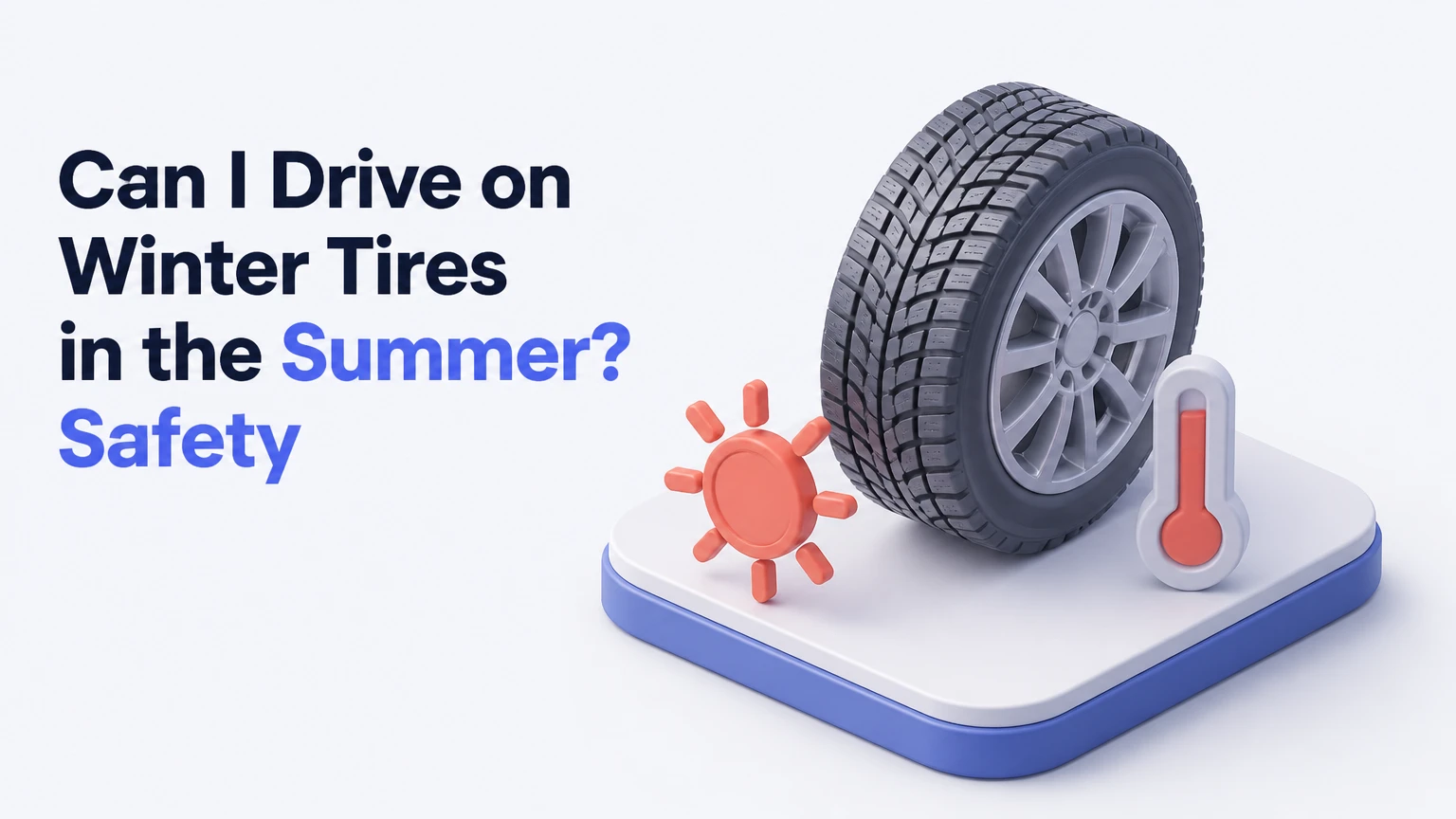
You can physically drive on winter tires in the summer, but dedicated winter tires are not a safe or economical year-round choice. Above roughly 7°C (45°F), their soft compound and flexible tread reduce dry-road steering precision, increase wear, and may lengthen braking distances. Change to appropriate warm-weather tires when temperatures remain above that range.
Key Facts at a Glance
- Dedicated winter tires remain legally usable in many jurisdictions, but local rules, insurance terms, and vehicle requirements can differ.
- The 7°C changeover guideline indicates when winter tires generally lose their warm-weather advantage; it is not an instant temperature failure point.
- Summer heat can make winter tread blocks squirm, which reduces steering response during braking, cornering, and emergency avoidance.
- Summer use can consume winter tread substantially faster than cold-weather use, especially with underinflation, heavy loads, high speeds, or aggressive driving.
- A 3PMSF all-weather tire is designed for year-round use, while a dedicated winter tire is optimized for cold conditions.
- If a temporary trip is unavoidable, verify pressure, load rating, tread condition, speed rating, and tire damage before driving.
Can I Drive on Winter Tires in the Summer?
Yes, you can drive on winter tires in summer, but you should replace them with summer or all-season tires when warm conditions become consistent. The main concerns are reduced handling precision, faster tread wear, higher rolling resistance, and potentially longer stopping on warm pavement.
The 7°C threshold is a practical seasonal-changeover rule used by tire manufacturers and road-safety organizations. It does not mean a winter tire becomes dangerous at 7.1°C, nor does it mean a cold morning makes a worn winter tire suitable for snow. Surface temperature, sunlight, tire pressure, vehicle load, speed, and tire condition all affect performance.
A short, slow trip to a tire shop is different from driving thousands of highway kilometres through July heat. The first may be a reasonable temporary necessity. The second wastes the winter tire and leaves the vehicle with less predictable warm-weather control.
Why Do Winter Tires Feel Soft on Hot Roads?
Winter tires feel soft on hot roads because their rubber compound is formulated to remain flexible at low temperatures. That flexibility helps the tread conform to cold, rough, icy, or snow-covered surfaces, but warm pavement makes the tread blocks deform more under steering and braking loads.
A winter tire also contains many sipes, which are narrow grooves that create biting edges in snow and improve flexibility. On dry asphalt, those heavily segmented tread blocks can move independently instead of behaving like a firm platform. Drivers often describe the result as delayed steering, vague lane changes, or a “mushy” corner.
Winter Tire Construction and Summer Consequences
| Tire feature | Winter-tire design | Warm-weather consequence |
|---|---|---|
| Rubber compound | Flexible below about 7°C | Faster abrasion above about 7°C |
| Tread blocks | Deep, heavily siped blocks | Greater block movement during cornering |
| Main purpose | Snow, ice, slush, cold pavement | Excess flexibility on hot dry asphalt |
| Rolling behavior | Higher deformation and resistance | Possible fuel or range penalty |
| Noise profile | Open grooves and flexible blocks | More hum on dry highways |
The compound is not simply “gummy” in every summer situation. A quality winter tire does not normally melt or fail merely because the pavement is warm. The accurate point is that the tire operates outside its design temperature range and gives up useful precision as heat and load rise.
How Much Does Summer Braking Change?
Winter tires can require more stopping distance on warm, dry pavement than suitable summer tires, but no universal percentage applies to every vehicle or test. Results depend on tire models, tread depth, road temperature, speed, ABS calibration, vehicle weight, and whether the comparison uses summer or all-season tires.
A 26% increase, sometimes repeated online, should not be treated as a guaranteed result. A controlled comparison may produce a large difference under one test condition, while another vehicle and tire pair may show a smaller change. The reliable conclusion is directional: a dedicated winter tire is usually disadvantaged on warm dry pavement.
At 60 km/h, a modest braking difference can equal several metres, enough to determine whether a vehicle stops before a crosswalk or reaches it. Wet pavement adds another variable. Some winter tread patterns evacuate slush effectively, but a warm-weather tire can offer a firmer contact patch and more stable braking response in summer rain.
What Changes the Stopping Distance?
| Variable | Typical comparison | Why it matters |
|---|---|---|
| Vehicle speed | 50 km/h versus 100 km/h | Kinetic energy rises sharply with speed |
| Tread depth | 8 mm versus 4 mm | Worn winter tread has less snow capability and less reserve |
| Tire pressure | Correct versus 20% low | Low pressure increases heat and carcass flex |
| Pavement | Cool asphalt versus 35°C asphalt | Heat softens the compound and raises tire temperature |
| Vehicle load | Driver only versus maximum payload | Extra mass increases braking demand |
| Tire match | Same model versus mixed axle models | Different grip can upset handling and ABS behavior |
NHTSA states, “Tires are the only thing connecting your vehicle to the road.” That short safety principle explains why a seasonal mismatch deserves attention even when the car still feels drivable during normal commuting.
How Quickly Can Summer Heat Wear Winter Tires?
Summer driving can wear winter tires much faster than cold-weather driving, but a fixed 60% reduction in lifespan is not a dependable rule. Wear rate varies with compound, alignment, inflation, axle load, road texture, climate, mileage, and driving style.
A winter tire used for a full hot season may lose enough tread to compromise its next winter, particularly on a front-wheel-drive vehicle with frequent highway travel. A low-mileage driver who covers 500 km before an appointment faces a different risk from someone covering 8,000 km between May and September.
The most useful inspection is not a promised percentage. Measure tread depth, check for irregular wear, and inspect the production date and sidewall condition. Winter performance commonly deteriorates as tread approaches about 4 mm, although the vehicle manufacturer, tire maker, and local law may specify different limits.
Typical Summer-Wear Scenarios
| Driving pattern | Summer distance | Likely concern | Practical decision |
|---|---|---|---|
| Appointment delay | 50-300 km | Limited extra wear | Drive gently after inspection |
| Occasional local use | 500-1,500 km | Noticeable tread loss possible | Change at the earliest appointment |
| Daily commuting | 2,000-5,000 km | Significant compound and block wear | Install warm-weather tires |
| Long road trip | 3,000-8,000 km | Heat, speed, load, and wear combined | Do not plan the trip on winter tires |
| Heavy SUV or EV use | 2,000-5,000 km | Higher mass and torque increase stress | Follow load and tire-maker guidance closely |
Can Summer Heat Damage a Winter Tire?
Summer heat alone does not usually cause an immediate blowout in a properly inflated, undamaged winter tire. Blowout risk rises when heat combines with underinflation, overloading, excessive speed, impact damage, age, puncture repairs, or internal separation.
Tire temperature normally rises during driving. Do not release air from a hot tire because pressure readings increase naturally with heat; bleeding it can leave the tire underinflated when it cools. Set pressure with cold tires using the vehicle placard, not the maximum pressure molded into the sidewall.
Stop driving and inspect the tires if you notice a burning-rubber smell, vibration, bulge, sudden pressure loss, exposed cords, a flapping tread, or repeated TPMS warnings. A hot tread surface by itself is not a diagnostic test. Professional inspection is safer than touching the tire and guessing whether its internal structure is sound.
What Should You Check Before a Temporary Drive?
- Measure cold pressure. Check all four tires and the spare before departure. Correct pressure supports the vehicle’s specified load and speed capability.
- Inspect the sidewalls and tread. Reject tires with bulges, cuts, exposed cords, deep cracks, or irregular separations.
- Confirm the load and speed ratings. Passenger cars, SUVs, trailers, and electric vehicles may require different specifications.
- Check tread depth and wear. Look for wear bars, shoulder wear, cupping, and uneven axle-to-axle wear.
- Reduce heat exposure. Avoid high speeds, maximum payload, hard cornering, and repeated emergency braking.
- Plan the shortest reasonable route. A local trip in moderate temperatures creates less stress than a loaded highway journey.
- Recheck pressure after cooling. A TPMS warning or visible pressure change requires attention before continuing.
Is It Legal to Drive Winter Tires in Summer?
Driving winter tires in summer is legal in many regions, but legality is jurisdiction-specific. Some places regulate winter-tire use by calendar date, road sign, weather condition, tire marking, axle fitment, or minimum tread depth, while others impose no seasonal restriction.
Quebec, for example, has winter-tire requirements during a defined winter period for many registered vehicles, but that requirement does not mean dedicated winter tires are preferred after winter ends. Ontario generally does not ban winter tires in summer, although insurers may have documentation or discount requirements. Rules differ across Canada, the United States, Europe, and individual states or provinces.
Check the transport authority in the jurisdiction where you drive, your insurer’s policy, and a lease agreement if applicable. Legal permission answers whether you may use the tire. It does not answer whether the tire is appropriate for the road and temperature.
Are Winter Tires Worse Than Summer Tires in Rain?
Winter tires are not automatically unsafe in rain, and some can perform well in cool, wet conditions. In warm summer rain, however, a dedicated summer tire usually provides sharper steering and stronger dry-to-wet braking because its compound and tread blocks are designed for higher temperatures.
Hydroplaning depends heavily on speed, water depth, tread depth, inflation, vehicle weight, and tread design. A winter tire with deep grooves may resist water better than a worn all-season tire, so the claim that every winter tire hydroplanes more is too broad. The disadvantage is usually warm-weather grip balance, not a universal inability to clear water.
Slow down before standing water, maintain full tread, avoid cruise control in severe rain, and replace tires that have reached their wear bars. No tire prevents hydroplaning at an unreasonable speed.
What Is the Best Year-Round Alternative?
The best year-round alternative for drivers who avoid seasonal changeovers is usually a certified all-weather tire, not a conventional all-season tire. All-weather tires typically carry the Three-Peak Mountain Snowflake, or 3PMSF, symbol and are designed to retain cold-weather capability while tolerating warm-season use.
A conventional all-season tire marked M+S may be adequate in mild climates, but the marking does not equal the severe-snow performance represented by 3PMSF certification. A dedicated summer tire remains the stronger choice for maximum warm-weather handling, while a dedicated winter tire remains stronger for severe cold, snow, and ice.
| Tire category | Snow certification | Warm-weather use | Best fit |
|---|---|---|---|
| Dedicated winter | 3PMSF | Temporary only | Snow, ice, and sustained cold |
| All-weather | Usually 3PMSF | Year-round | Moderate snow and one tire set |
| Conventional all-season | Often M+S, not always 3PMSF | Year-round | Mild winters and low snow |
| Summer | No winter certification | Best from warm spring to fall | Dry and wet warm roads |
| Performance all-season | Usually M+S | Year-round, warmer climates | Handling with limited winter capability |
All-weather tires still involve a trade-off. They generally do not match a premium winter tire on ice or a summer tire on hot dry pavement. Their advantage is balanced seasonal utility.
When Should Winter Tires Come Off?
Remove winter tires when temperatures are consistently above approximately 7°C during the conditions in which you normally drive. The changeover date depends on local overnight temperatures, elevation, snow risk, tire storage, and whether a late-season storm remains plausible.
The threshold works best as a trend rather than a single thermometer reading. In a cold mountain region, a driver may retain winter tires into April because mornings remain below freezing. In a mild coastal climate, warm pavement may arrive earlier. Monitor temperatures for one to two weeks instead of changing solely because the calendar says spring.
Book early if local shops become busy during seasonal transitions. A second wheel set can reduce future changeover time and avoid repeated mounting and demounting of the same tire.
How Should Winter Tires Be Removed and Stored?
Store winter tires clean, dry, cool, and away from sunlight, ozone sources, solvents, and electric motors. Mark each tire’s position, inspect it before storage, and keep mounted tires inflated to the vehicle or tire-maker recommendation unless the storage provider specifies otherwise.
Mounted tires can be stored horizontally in a stack or vertically on a suitable rack, depending on the manufacturer’s instructions. Unmounted tires should generally stand vertically and be rotated periodically rather than hung by the bead. Never store tires outdoors under a tarp where moisture and temperature swings can accelerate deterioration.
Record tread depth, tire age, repairs, and any vibration before removal. That information helps identify whether the set will safely return next winter or needs replacement.
What If You Must Drive on Them Temporarily?
If a tire appointment is unavailable, a short temporary drive can be managed by reducing speed, carrying no unnecessary load, avoiding aggressive manoeuvres, and checking cold pressure first. Do not treat this exception as permission for a full summer season or a heavily loaded highway holiday.
Avoid driving during the hottest part of the day when practical, but temperature timing does not compensate for unsafe tires. Do not tow, exceed the tire’s speed rating, or continue after a TPMS warning, vibration, pressure loss, or visible damage.
Temporary-Use Risk by Situation
| Situation | Risk level | Recommended action | Maximum sensible response |
|---|---|---|---|
| 10 km shop appointment | Lower | Inspect and inflate correctly | Drive directly to the shop |
| 100 km local highway trip | Moderate | Reduce speed and load | Change tires before departure if possible |
| 1,000 km vacation | High | Use suitable warm-weather tires | Delay, rent, or change tires |
| Mountain route in hot weather | High | Check weather and tire condition | Avoid winter tires for the route |
| Loaded trailer or roof box | Very high | Use correct load-rated tires | Do not proceed on worn winter tires |
Which Choice Fits Your Driving Pattern?
A low-mileage urban driver may choose all-weather tires to avoid storage and changeover appointments. A driver who regularly encounters ice, packed snow, or temperatures below freezing should retain dedicated winter tires and use a separate warm-weather set.
Leased-vehicle drivers should follow the contract’s tire-size, tread-depth, and return-condition requirements. Summer wear can leave a winter set below the expected tread level, creating replacement charges at lease return. Electric-vehicle owners should also check the manufacturer’s approved tire specification because higher vehicle mass and immediate motor torque can increase wear.
| Driver profile | Preferred setup | Reason | Avoid |
|---|---|---|---|
| Snowy rural commuter | Winter plus summer tires | Maximum cold-weather traction | All-season-only assumption |
| Mild-city, low-mileage driver | 3PMSF all-weather tires | One year-round set | Worn dedicated winter tires in July |
| Hot-climate driver | Summer or all-season tires | Winter compound has little benefit | Buying winter tires without snow need |
| Leased vehicle owner | Contract-approved seasonal sets | Protects return condition | Unapproved sizes or uneven wear |
| EV owner in snow country | Approved winter and summer sets | Manages mass, torque, and range | Ignoring load rating |
Common Mistakes With Summer Use
Mistake 1: Treating 7°C as an Exact Failure Point
The 7°C guideline describes a performance transition, not a legal cutoff or sudden loss of grip. A winter tire can function above 7°C, while a worn or underinflated tire can be unsafe below it.
Mistake 2: Removing Air From a Hot Tire
Hot pressure is naturally higher than cold pressure. Set pressure before driving, and never bleed a tire simply because a roadside gauge shows a warm reading above the cold specification.
Mistake 3: Replacing Only Two Tires Without Checking Fitment
Installing two tires with substantially different grip can destabilize braking and cornering. On many vehicles, manufacturers recommend placing the tires with deeper tread on the rear axle, but the vehicle manual and tire professional should control the final arrangement.
Mistake 4: Using Tread Depth as the Only Test
A tire can have acceptable tread but still suffer from age cracks, impact damage, uneven wear, or internal separation. Check the date code, sidewalls, bead area, repairs, and vibration history.
Mistake 5: Confusing M+S With 3PMSF
M+S is a tread designation used on many all-season tires. The 3PMSF symbol indicates a tire met a defined severe-snow performance test, although it still does not make an all-weather tire equivalent to a dedicated winter tire on ice.
Mistake 6: Driving Normally Because the Car Feels Fine
Normal commuting may conceal a reduced safety margin. Emergency braking, a wet lane change, or a sudden obstacle exposes tread squirm and warm-compound limitations much sooner than steady low-speed driving.
How Much Does the Seasonal Choice Cost?
A tire changeover commonly costs about $50-$100 for a basic service in North America, although mounting, balancing, storage, TPMS service, wheel size, and local labor can raise the bill. A complete second wheel set may cost roughly $300-$900 before tires, depending on vehicle fitment and wheel material.
Keeping winter tires on for one summer can appear cheaper, but accelerated wear may force replacement before the next winter. The financial comparison should include lost tread, reduced fuel economy or EV range, storage, replacement timing, and the consequence of a preventable collision.
| Option | Typical upfront cost | Seasonal labor | Main long-term effect |
|---|---|---|---|
| Seasonal changeover | $50-$100 per visit | 30-90 minutes | Preserves each tire’s intended use |
| Second steel-wheel set | $300-$900 | 20-45 minutes | Faster future swaps |
| All-weather conversion | $600-$1,400 per set | One installation | Avoids twice-yearly changes |
| Summer use of winter tires | $0 immediate | No appointment | Faster wear and poorer warm grip |
| Replacement after premature wear | $700-$1,600 per set | 30-90 minutes | Replaces avoidable lost service life |
Prices are typical North American ranges, not guaranteed quotes. Tire size, premium branding, vehicle sensors, and regional labor rates can change the total substantially.
The Bottom Line
Can I drive on winter tires in the summer? Yes, physically and often legally, but dedicated winter tires should not remain installed through a warm season. Once temperatures consistently exceed about 7°C, change to summer, all-season, or 3PMSF all-weather tires that match the vehicle’s specifications.
A short trip to a tire shop is a practical exception after a pressure and damage check. A season of highway driving is a poor safety and cost decision because warm-road handling declines, tread wears faster, and the tires may not remain ready for the next winter.
Frequently Asked Questions
Can I use winter tires for one summer vacation?
A single vacation is possible, but it is not the preferred choice, especially with high speeds, heavy luggage, a roof box, towing, or hot pavement. Inspect the tires, verify cold pressure and load rating, reduce speed, and arrange a changeover before departure whenever practical.
Do winter tires use more fuel in summer?
Winter tires can increase fuel consumption because flexible tread blocks and a softer compound create more deformation and rolling resistance. The actual change varies with pressure, tire model, vehicle weight, alignment, speed, and weather. Electric vehicles may show a corresponding range reduction rather than a fuel increase.
Can winter tires be used on only one axle?
Do not install winter tires on only one axle unless the vehicle and tire manufacturer specifically permits that arrangement. Different axle grip can cause oversteer or understeer and may interfere with stability-control behavior. Replace tires in matched axle pairs and follow the vehicle manual.
Are all-weather tires safe in hot climates?
All-weather tires can operate year-round in warm climates, but they may not deliver the dry braking and cornering precision of summer tires. Their value is balanced seasonal performance. Drivers who never encounter snow should generally choose a summer or warm-climate all-season tire instead.
How old can winter tires be before replacement?
Age guidance varies by manufacturer, but many tire makers recommend professional inspection after six years and replacement around ten years from manufacture regardless of tread. Heat, ultraviolet exposure, storage conditions, cracking, and repair history can require earlier replacement. Read the four-digit date code on the sidewall.
Should I keep winter tires if they have only 4 mm of tread?
Approximately 4 mm is commonly treated as a winter-performance planning point, not a universal legal limit. A tire at that depth may still be legal in some locations but offer reduced snow traction and limited service life. Measure all grooves, inspect damage, and confirm the manufacturer’s recommendation before reusing it.