No, you should not drive with a flat tire. A standard pneumatic tire with little or no air can lose steering and braking stability while its sidewall and wheel rim suffer damage within a short distance. Move only far enough to escape immediate danger, usually at walking speed, then stop and arrange a spare, repair, or tow.
Key Facts at a Glance
- A standard tire with zero usable air has no safe planned driving distance.
- Driving even a few hundred meters can destroy the tire’s internal casing and damage an alloy wheel.
- A run-flat tire may travel about 50 miles at up to 50 mph, but only when the tire, vehicle, load, and manufacturer instructions permit it.
- A self-sealing tire is safe to drive only if it has retained adequate pressure after sealing the tread puncture.
- A TPMS warning indicates low pressure, not necessarily a completely flat tire, but the warning still requires prompt inspection.
- A sidewall or shoulder puncture generally cannot be repaired with a plug or patch.
Can I Drive With a Flat Tire in an Emergency?
You may drive a standard flat tire only the minimum distance needed to reach a safer stopping place, and only at very low speed. A few hundred meters on a shoulder or away from a blind curve may be reasonable when stopping immediately would expose occupants to moving traffic, but driving several kilometers to a fuel station or highway exit is unsafe.
A flat tire changes the vehicle’s contact with the road. The deflated sidewall folds under the wheel load, and the tire can separate internally before the driver sees visible damage. The vehicle may pull toward the failed tire, resist steering input, or require more road distance to stop.
The safest choice is often to stop where the vehicle is, turn on hazard lights, and call roadside assistance. If the location is directly dangerous, steer gently toward a broad shoulder, emergency refuge area, parking lot, or other protected space without accelerating to normal traffic speed.
What Is the Difference Between Low Pressure and a Flat?
Low tire pressure means the tire still contains air but is below the vehicle manufacturer’s recommended cold pressure. A flat tire usually means pressure is so low that the sidewall visibly collapses, the tire bead may unseat, or the vehicle cannot support its load normally.
| Condition | Typical pressure state | Visible or driving symptom | Recommended action |
|---|---|---|---|
| Correct inflation | Door-placard pressure, often 30-36 psi | Normal steering and ride | Continue driving and check monthly |
| Mild underinflation | 5-10 psi below placard value | Slightly soft handling | Inflate before extended driving |
| TPMS warning | Often around 25% below placard pressure | Warning light, possible sluggishness | Stop soon and measure all tires |
| Severe leak | Pressure falling rapidly | Hissing, pull, vibration, repeated warning | Stop immediately in a safe place |
| Flat tire | Near 0 psi or collapsed sidewall | Thumping, steering change, rim impact | Do not drive except to escape danger |
The exact TPMS threshold varies by vehicle system, tire position, and temperature. The National Highway Traffic Safety Administration explains that federally regulated TPMS systems warn when pressure is significantly under the recommended level, commonly about 25 percent below the placard specification. A warning light is not permission to continue driving.
Why Does Driving on a Flat Tire Cause Damage?
Driving on a flat tire damages the casing because the tire’s air pressure normally carries much of the vehicle load and limits sidewall flex. Without that internal support, the sidewall bends between the road surface and wheel flange, generating heat and abrasion that can ruin the tire from the inside.
The damage sequence is mechanical:
- The sidewall folds under load.
- Internal steel or textile cords flex repeatedly.
- Rubber layers heat through repeated deformation.
- The bead can shift or unseat from the wheel.
- The rim contacts potholes and pavement directly.
- The tire may shred, exposing cords and contaminating the wheel area.
A tire can look repairable from the outside while hidden sidewall damage has already made it unsafe. Tire manufacturers and professional technicians therefore inspect the tire internally after it has been driven while seriously underinflated.
The U.S. Tire Manufacturers Association warns, “Underinflation is the leading cause of tire failure.” That guidance matters because heat, not only puncture size, determines whether a low tire survives long enough for repair.
How Quickly Can a Flat Tire Be Ruined?
A standard flat tire can suffer permanent internal damage within a few hundred meters, although speed, vehicle weight, road temperature, tire construction, and the severity of the pressure loss change the result. A slow roll across a parking lot may preserve the casing; a high-speed trip on a highway may destroy it in minutes.
| Driving condition | Typical risk to standard tire | Likely additional damage | Safer decision |
|---|---|---|---|
| 10-20 feet to clear traffic | Lower, but not zero | Possible bead or sidewall scuffing | Move only if stopping is immediately dangerous |
| 100-300 meters at walking speed | Moderate to high | Casing damage, rim marks | Stop at the first protected location |
| 1-3 kilometers at 15-20 mph | Very high | Tire destruction and wheel damage | Use a tow or roadside service |
| Highway-speed travel | Extreme | Blowout, loss of control, wheel failure | Do not continue |
| Driving over potholes or curbs | Extreme at any distance | Bent or cracked rim, bead damage | Stop and tow |
These are practical risk ranges, not guaranteed limits. A tire with a sidewall cut, a heavy SUV load, or a sharp rim strike can become unsafe immediately.
What Should You Do When a Tire Goes Flat While Driving?
A driver should reduce speed smoothly, maintain steering control, activate hazard lights, and reach the nearest safe stopping point without hard braking. Once stopped, occupants should remain away from traffic, and the driver should use a spare, an approved repair kit, or roadside towing rather than continuing to a tire shop.
Step 1: Hold the Steering Wheel and Ease Off
Grip the steering wheel with both hands and release the accelerator gradually. Do not jerk the wheel toward the shoulder, because a sudden steering correction can destabilize a vehicle that is already pulling.
Avoid slamming on the brakes during a sudden deflation. Once speed has fallen and the vehicle is aligned in a safe area, brake normally and park securely.
Step 2: Warn Other Road Users
Turn on the hazard lights as soon as the vehicle is stable. Signal before changing position, and avoid crossing several traffic lanes unless remaining in the lane creates a greater immediate danger.
At night or in poor weather, visibility determines the safest stopping location. A wide shoulder beyond a guardrail is preferable to a narrow shoulder near a curve, bridge, or ramp merge.
Step 3: Stop on Stable Ground
Park on level ground when possible, select Park or first gear, apply the parking brake, and shut off the engine. Do not position yourself between the vehicle and moving traffic while inspecting the tire.
If the shoulder is narrow or traffic is fast, remain inside the vehicle with the seat belt fastened unless local emergency guidance directs otherwise. Call emergency services when the vehicle blocks a live lane or occupants face an immediate road hazard.
Step 4: Identify the Failure
Look for a nail, screw, valve leak, tread separation, or sidewall tear without placing hands near unstable rubber. Compare the failed tire with the other tires and check the dashboard TPMS message.
A tread puncture may be repairable. A damaged sidewall, shoulder, bead, exposed cord, burned rubber smell, or tire that has been driven flat usually requires replacement or professional inspection.
Step 5: Choose the Safest Recovery Option
Use the table below to choose a response based on the tire condition and equipment available.
| Situation | Temporary option | Typical time | Main limitation |
|---|---|---|---|
| Spare tire available | Install full-size or temporary spare | 20-40 minutes | Compact spare often limited to 50-70 mph |
| Small tread puncture, tire still seated | Inflate and drive directly to a tire shop | 10-30 minutes | Recheck pressure and avoid highways |
| Small tread puncture, no compressor | Tire sealant kit | 10-15 minutes | Not suitable for sidewalls or large cuts |
| Sidewall tear or shredded casing | Flatbed or compatible tow | 30-90 minutes dispatch | Do not attempt an inflator repair |
| Unsafe highway shoulder | Emergency response or protected tow | Variable | Occupant safety outranks tire preservation |
| Run-flat tire within limits | Drive to approved service facility | Manufacturer-specific | Pressure, speed, distance, and load limits apply |
A temporary spare is not a normal replacement tire. Its smaller contact patch can change braking and handling, so follow the speed printed on the spare or in the owner’s manual and drive only to a repair facility.
Can You Drive on a Run-Flat Tire?
Yes, a run-flat tire can often be driven after pressure loss, but only within the vehicle and tire manufacturer’s limits. Many systems specify a maximum of 50 miles at 50 mph, while some specify different distances, speeds, passenger loads, or inspection requirements.
Run-flat tires use reinforced sidewalls or other internal support features that carry the vehicle after air pressure falls. The design preserves a degree of control, but it does not restore normal braking, cornering, ride comfort, or stopping distance.
Do not assume a tire is run-flat because the vehicle lacks a spare. Check the sidewall marking, owner’s manual, tire placard, or manufacturer documentation. Common markings include RFT, ROF, SSR, ZP, and other brand-specific labels.
Run-Flat Limits Are Not Universal
Run-flat limits are model-specific. Michelin, Bridgestone, Continental, BMW, Mercedes-Benz, and other manufacturers may publish different instructions for the same general tire category, particularly when the vehicle carries passengers or heavy cargo.
| Run-flat condition | Common manufacturer-style limit | Required response |
|---|---|---|
| Pressure loss detected, tire intact | Up to 50 mph and 50 miles on many models | Drive directly to service |
| Speed above stated limit | No safe universal allowance | Reduce speed immediately |
| Distance beyond stated limit | No safe universal allowance | Stop and arrange towing |
| Sidewall cut or visible separation | Often unsuitable for continued travel | Tow for inspection |
| Heavy load or towing | May reduce permitted distance | Follow vehicle manual |
| TPMS unavailable or malfunctioning | Pressure status uncertain | Stop and inspect promptly |
Run-flat technology is an emergency mobility feature, not a permanent operating mode. A tire shop may reject repair after zero-pressure operation because internal heat damage cannot be confirmed safely from an external inspection.
Are Self-Sealing Tires Safe to Drive After a Puncture?
A self-sealing tire is safe to drive only when the seal has retained sufficient pressure and the tire remains within the vehicle’s specified inflation range. The internal sealant layer can close many tread punctures, but it cannot reliably repair a sidewall cut, bead leak, impact rupture, or large opening.
Self-sealing products differ by manufacturer. Some seal punctures from nails or screws in the tread, while others have defined maximum hole sizes and speed conditions. The driver should still check pressure with a gauge rather than relying on the absence of noise or a visible nail.
| Tire type | Puncture response | Normal-pressure driving | Sidewall protection |
|---|---|---|---|
| Standard pneumatic | Loses air unless repaired | Yes, after inflation or repair | None |
| Run-flat | Supports vehicle temporarily at zero pressure | Yes, within limits | Reinforced sidewall, not cut-proof |
| Self-sealing | Seals qualifying tread holes | Yes, if pressure remains correct | No protection from sidewall cuts |
| Temporary spare | Replaces failed tire temporarily | Limited by spare marking | Not a long-term tire |
| Tire sealant kit | Adds liquid sealant through valve | Short trip to tire shop | Cannot repair structural damage |
Self-sealing capability also does not eliminate inspection. A lodged object can continue leaking, and sealant can complicate later repair or interfere with a tire-pressure sensor.
Can You Drive to a Tire Shop With a Flat?
You should not drive a standard flat tire to a tire shop. Inflate a repairable tread puncture first, install a spare, or use a tow service; driving on the casing can turn a low-cost repair into a tire and wheel replacement.
A professional tire repair normally requires a puncture within the tread repair area, intact internal structure, appropriate puncture size, and compliance with tire-industry repair procedures. A plug inserted from the outside is not equivalent to a permanent internal patch repair.
Which Punctures Can a Tire Shop Repair?
A tire shop may repair a small puncture in the central tread when the tire has not been driven severely underinflated and the puncture follows accepted repair limits. The shop must remove the tire from the wheel and inspect the inside before approving the repair.
| Damage location or type | Typical repair outcome | Reason |
|---|---|---|
| Central tread puncture | Often repairable | Repair zone has stable tread structure |
| Shoulder puncture | Usually replacement | Flexing area prevents reliable repair |
| Sidewall cut | Replacement required | Sidewall carries structural load |
| Nail under 6 mm in tread | Often repairable if casing is sound | Size and location remain decisive |
| Bent bead area | Inspection required, often replacement | Air seal and casing may be compromised |
| Run-flat driven at zero pressure | Often replacement | Hidden heat damage may be present |
A tire professional may also inspect the wheel, valve stem, TPMS sensor, and adjacent tires. A pressure-loss event can damage more than the visibly punctured tread.
How Much Does a Flat Tire Usually Cost?
A typical puncture repair costs about $15-$40, while a replacement tire commonly costs $100-$400 or more before installation. Driving on the flat can add roughly $200-$600 or more for a damaged alloy wheel, plus mounting, balancing, disposal, and towing charges.
Prices vary with tire size, vehicle class, region, brand, and availability. Performance tires, run-flats, large SUV tires, and electric-vehicle tires often cost more than basic passenger-car tires.
| Service or part | Typical price range | Typical time | What changes the price |
|---|---|---|---|
| Tread puncture repair | $15-$40 | 20-45 minutes | Shop policy and repair eligibility |
| Passenger tire replacement | $100-$250 | 45-90 minutes | Brand, size, installation |
| Run-flat replacement | $180-$500+ | 60-120 minutes | Specialized mounting and model |
| Alloy wheel replacement | $200-$600+ | 1-3 hours | Wheel size, finish, availability |
| Roadside tire change | $50-$150 | 30-90 minutes | Membership, location, time |
| Short-distance tow | $75-$200+ | 30-120 minutes | Mileage, provider, location |
If an AWD vehicle requires closely matched tire diameters, replacing one tire may not be appropriate. The vehicle manual or tire manufacturer may require replacing two tires on an axle or all four tires, depending on tread-depth difference and drivetrain design.
What Are the Signs of a Flat Tire While Driving?
The most common signs are a TPMS warning, rhythmic thumping, steering pull, heavy vibration, sluggish response, or a flapping sound. A sudden blowout may produce a bang, but a slow puncture can feel like vague steering long before the tire appears visibly flat.
A rear-tire failure may feel through the seat or vehicle body rather than the steering wheel. Front-tire pressure loss more often changes steering effort and causes the vehicle to drift toward the affected side.
Do not diagnose by sound alone. A damaged wheel, separated tread, brake problem, or suspension fault can create similar symptoms, and continuing to drive can worsen each condition.
What Does the TPMS Light Mean?
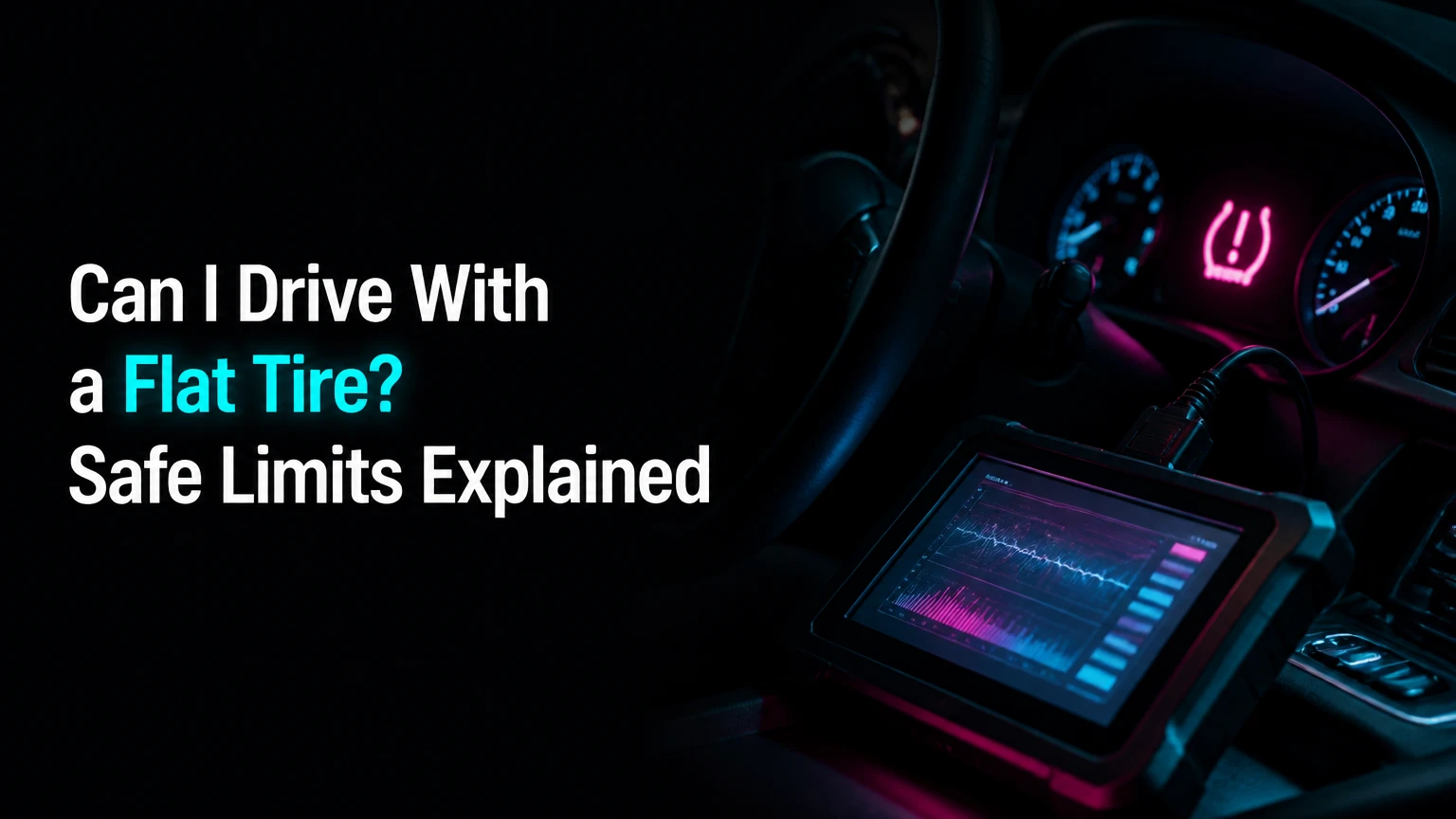
A steady TPMS light usually indicates that one or more tires are significantly below the recommended pressure. A flashing light followed by a steady light often indicates a TPMS system fault, although the exact pattern depends on the vehicle.
Check pressure with a gauge when the tires are cool, then inflate to the pressure on the driver-door placard, not the maximum pressure molded into the tire sidewall. If the light returns, the tire may have a leak or the sensor system may need diagnosis.
Temperature changes can alter pressure readings. A cold morning can trigger a warning without creating a puncture, but the driver must measure pressure before deciding that temperature caused the warning.
What Should You Avoid After a Flat Tire?
Avoid hard braking, normal-speed travel, improvised sidewall repairs, and driving several miles to a preferred service station. Avoid using aerosol sealant when the tire has a torn sidewall, a separated tread, a damaged valve, or a wheel that no longer holds the bead.
Common failure modes include:
- Driving to the next highway exit: Stop at the first protected location instead. A three-mile drive can destroy the casing and rim.
- Trusting the TPMS light alone: Measure all four tires with a gauge because the warning does not show the exact pressure or damage location.
- Using a plug on the sidewall: Replace the tire because sidewall flex prevents a safe structural repair.
- Installing an uninflated spare: Check the spare before fitting it, since years in the trunk can reduce pressure below its required level.
- Changing a tire beside fast traffic: Call roadside assistance when the shoulder is narrow, visibility is poor, or the vehicle cannot be stabilized.
- Replacing only one AWD tire without checking tread depth: Confirm the drivetrain requirement before buying a single replacement.
One counterintuitive rule matters: adding air does not make every damaged tire safe. Inflation restores shape, but it cannot reverse heat damage, broken cords, or a cut sidewall.
How Do You Prevent a Flat-Tire Emergency?
Preventive maintenance reduces the chance of a sudden failure and makes recovery faster when a puncture occurs. Check cold pressure monthly and before long trips, inspect tread and sidewalls, verify spare pressure, and keep a working gauge, inflator, flashlight, and gloves in the vehicle.
Use the vehicle door placard for pressure targets. Rotate tires according to the vehicle manufacturer’s schedule, replace tires at the legal or manufacturer tread limit, and investigate repeated pressure loss rather than repeatedly adding air.
A practical emergency kit includes:
- Digital tire-pressure gauge
- 12-volt compressor rated for the vehicle’s tire size
- Reflective vest and warning triangle
- Flashlight with spare batteries
- Wheel wrench and correctly sized jack
- Gloves and kneeling mat
- Roadside-assistance contact information
- Tire sealant only when compatible with the vehicle and tire
Check whether the vehicle has a spare, tire mobility kit, run-flat equipment, or no emergency inflation option. Electric vehicles and vehicles with large brake assemblies frequently have different recovery requirements.
Frequently Asked Questions
Can I drive a flat tire one mile?
Driving one mile on a standard flat tire is unsafe and may destroy the tire, wheel, or both. If stopping immediately creates a direct traffic hazard, move only to the nearest protected location at very low speed, then stop. Do not treat one mile as a safe allowance.
Can I drive with a nail in my tire?
You may drive only a short distance to a safe place if the tire still holds pressure and the vehicle handles normally. Do not remove the nail before reaching a repair location because removal can accelerate air loss. Measure pressure first and use a spare or tow if pressure is low.
Can I drive on a flat tire to avoid being stranded?
Avoid driving on a flat tire to avoid inconvenience. A roadside call, spare installation, or tow is usually less expensive than replacing a tire and alloy wheel, and the safety risk from impaired steering and braking is more serious than the delay.
Is a flat tire covered by roadside assistance?
Many roadside-assistance plans cover a tire change, inflation, or towing, but coverage depends on the insurer, automobile club, vehicle warranty, and location. Confirm whether the plan supplies a spare, handles vehicles without spares, and limits towing distance before an emergency occurs.
Should I replace all four tires after one flat?
You do not always need four replacement tires after one flat. Replace one tire when its tread matches the axle and the vehicle manufacturer permits it; replace two or four when tread-depth differences could affect AWD systems, traction control, or handling.
Can I use Fix-a-Flat on any puncture?
Fix-a-Flat and similar sealants are intended for limited temporary use on qualifying tread punctures, not sidewall cuts, bead leaks, large holes, or tire separations. Check the product instructions and vehicle manual, then have the tire professionally inspected as soon as possible.
The Bottom Line
Can I drive with a flat tire? Only far enough to escape an immediate danger, and never as a planned trip to a tire shop or highway exit. Stop safely, identify whether the tire is standard, run-flat, or self-sealing, then use a properly inflated spare, a compatible temporary repair, or a tow. A short roadside delay is safer and usually cheaper than converting a puncture into a destroyed tire, bent wheel, or loss of vehicle control.