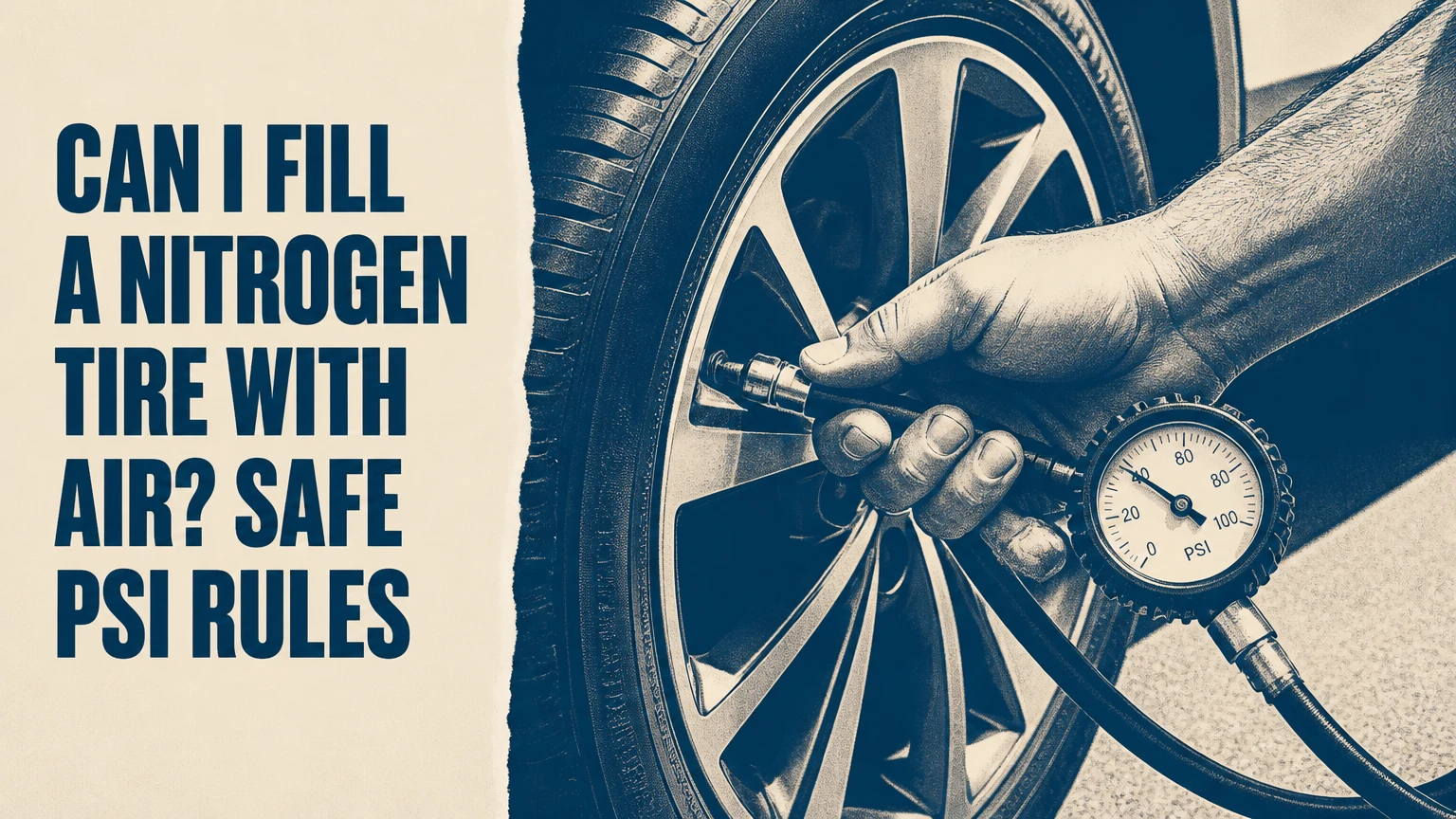
Yes, you can safely fill a nitrogen-inflated tire with ordinary compressed air. Air and nitrogen do not create a dangerous chemical reaction or damage the tire when mixed, because automotive tire inflation gases are nonflammable under normal conditions. Inflate the tire to the vehicle manufacturer’s recommended cold pressure, even if that dilutes the nitrogen.
Key Facts at a Glance
- Regular dry air contains approximately 78% nitrogen and 21% oxygen by volume.
- Adding compressed air to a nitrogen tire changes gas composition, not the tire’s required PSI.
- Correct tire pressure matters more for safety, handling, tread wear, and fuel economy than nitrogen purity.
- A door-jamb placard, not the tire sidewall’s maximum pressure, provides the normal inflation target.
- A nitrogen refill is optional after an air top-off unless a manufacturer, fleet policy, or specialist application requires it.
- Green valve caps identify a nitrogen service history in many shops, but they do not make a tire safer or seal gas inside.
Can I Fill a Nitrogen Tire With Air?
You can fill a nitrogen tire with air whenever the tire needs pressure, including during an emergency, at home, or during routine maintenance. The recommended action is simple: measure the pressure when the tire is cold and add ordinary compressed air until it reaches the vehicle manufacturer’s specified PSI.
The air does not separate into dangerous layers inside the casing. Nitrogen and oxygen mix as gases, and the tire, wheel, bead, valve, and TPMS components are designed to contain pressurized gas rather than a particular inflation gas. The only meaningful change is that the tire no longer contains the same high nitrogen concentration.
A low tire is a safety problem regardless of the gas inside. Driving several miles to find a nitrogen machine can create more risk than using a nearby air pump, especially when pressure is substantially below specification.
Is Mixing Nitrogen and Air Dangerous?
Mixing nitrogen and air is not dangerous under normal automotive conditions. Nitrogen is inert, while the oxygen in ordinary air can support oxidation in the presence of moisture, but the mixture does not explode, ignite, or chemically attack tire rubber.
Use the same precautions as with any tire inflation: keep your hands and face away from damaged components, do not exceed the placard pressure, and stop if the tire has a bulge, exposed cords, a separated tread, or a damaged wheel. A tire with structural damage needs inspection, not another gas refill.
What Gas Is Inside a Nitrogen Tire?
A nitrogen-filled tire normally contains nitrogen produced by a membrane or pressure-swing adsorption generator, not laboratory-grade nitrogen. Commercial tire systems commonly advertise approximately 93%-99% nitrogen, although final purity depends on the equipment, maintenance, hose contamination, and whether the tire was evacuated before filling.
| Inflation gas | Approximate nitrogen | Approximate oxygen | Moisture condition | Practical source |
|---|---|---|---|---|
| Dry atmospheric air | 78% | 21% | Very low | Laboratory or filtered reference gas |
| Ordinary ambient air | 78% | 21% | Variable | Air compressor intake |
| Shop compressed air | 78% | 21% | Variable to low | Service-station compressor |
| Commercial tire nitrogen | 93%-99% | 1%-7% | Usually low | Membrane or PSA generator |
Compressed air is not always 1% water vapor. Water content changes with temperature, humidity, compressor design, tank draining, and dryer performance. A well-maintained shop compressor can deliver relatively dry air, while a neglected system can introduce more moisture.
That distinction matters because nitrogen’s practical advantage usually comes from dryness and controlled service, not from a magical difference in how nitrogen behaves under pressure.
Why Does Adding Air Change Nitrogen Purity?
Adding air lowers the percentage of nitrogen because the new gas includes oxygen, argon, carbon dioxide, and variable water vapor. The tire’s pressure does not fall merely because the gas mixture changes; pressure depends primarily on the amount of gas, temperature, and tire volume.
For example, a tire containing 95% nitrogen receives enough air to increase its gas quantity by 10%. The new nitrogen fraction is approximately 93.6%, assuming the added air contains 78% nitrogen. That is a modest dilution, not a failure of the tire system.
The calculation is:
New nitrogen fraction = [(old gas quantity × old nitrogen fraction) + (added air quantity × 0.78)] ÷ total gas quantity
A complete deflation and refill can dilute nitrogen far more than a small top-off. Even then, the tire remains safe if the pressure, tire condition, and wheel condition are correct.
Does Nitrogen Have More Stable Pressure Than Air?
Dry nitrogen and dry air respond almost identically to temperature changes at the same pressure and volume. The ideal gas law, expressed as P = nRT/V, shows that pressure changes with absolute temperature, gas quantity, and volume; it does not give nitrogen a special immunity to temperature.
Nitrogen service can reduce pressure variability when it removes moisture. Water vapor can condense inside a tire and later vaporize as temperature rises, adding a variable component to pressure. However, claims that ordinary air changes by exactly 1 PSI for every 10°F, while nitrogen barely changes, are oversimplifications.
The U.S. Department of Energy and tire manufacturers consistently emphasize checking pressure cold because all inflation gases change pressure with temperature. A practical rule is to check tires monthly and before long trips, preferably after the vehicle has been parked for at least three hours.
How Should You Inflate a Nitrogen Tire With Air?
Inflate a nitrogen tire with air by checking the cold pressure, inspecting the tire, and adding air in short bursts until the door-jamb target is reached. The task typically takes 3-10 minutes per vehicle and requires a pressure gauge, an air compressor, and the manufacturer’s PSI specification.
Before You Start
| Item | Typical requirement | Why it matters | Replacement option |
|---|---|---|---|
| Cold tire pressure | Door-jamb PSI, often 30-36 PSI | Establishes the correct target | Owner’s manual |
| Pressure gauge | Accuracy within about 1 PSI | Prevents over- or underinflation | Calibrated digital gauge |
| Compressor | 12-volt, shop, or service-station unit | Supplies compressed air | Portable inflator |
| Inspection time | 2-5 minutes | Finds visible damage or a flat | Tire professional |
| Service cost | $0-$5 typical | Covers access to an air pump | Free home compressor |
Step 1: Find the Correct PSI
Read the placard on the driver’s door frame, door edge, fuel-door area, or owner’s manual. The placard may specify different front and rear pressures or a separate loaded-vehicle setting.
Do not use the maximum PSI molded into the tire sidewall as the normal target. That figure describes the tire’s permitted load and pressure limit, not the vehicle’s recommended operating pressure.
Step 2: Check the Tire Cold
Measure pressure before driving, or after the vehicle has been parked for roughly three hours. If the TPMS warning is active and the tire looks visibly low, inspect it before driving to an air source.
A tire that has been driven while underinflated can read higher because its casing has heated. Do not bleed a warm tire to the cold placard value.
Step 3: Inspect for a Leak or Damage
Look for nails, screws, sidewall cuts, bulges, cracked rubber, a bent rim, or a valve stem that moves excessively. A pressure loss of more than about 1-2 PSI per month deserves investigation, although the exact rate varies with temperature and tire condition.
A punctured tire may accept air temporarily while still losing pressure rapidly. Air restores pressure; it does not repair the puncture.
Step 4: Add Ordinary Air
Remove the valve cap, press the compressor chuck squarely onto the valve stem, and add air in 5-10 second bursts. Recheck the pressure after each burst because small passenger tires can gain several PSI quickly with a high-output compressor.
Stop at the placard pressure. The result is correct when the gauge matches the specified cold PSI and the tire has no visible damage.
Step 5: Recheck the Warning System
Replace the valve cap and check all four tires, plus the spare if it has a pressure sensor. TPMS systems may clear after several minutes of driving, but reset behavior depends on the vehicle, sensor type, and manufacturer procedure.
A warning that remains on after correct inflation can indicate a puncture, sensor fault, dead sensor battery, or required manual relearn. It does not prove that air damaged the nitrogen system.
Can a Gas-Station Compressor Top Off Nitrogen?
A gas-station compressor can safely top off a nitrogen-filled tire when the machine supplies clean compressed air and the nozzle fits the valve. Compressor quality affects moisture and gauge accuracy, but ordinary service-station air does not create a tire safety issue.
| Situation | Immediate action | Driving limit | Follow-up |
|---|---|---|---|
| 2-4 PSI low, no visible damage | Add air to placard PSI | Normal after correction | Recheck within 1 week |
| 5-10 PSI low, no visible damage | Add air and inspect closely | Drive only to service if stable | Leak test promptly |
| Tire visibly flat | Do not drive on it | 0 miles recommended | Use spare or roadside service |
| TPMS warning with nail visible | Add air only if necessary | Direct trip to repair shop | Repair according to tire policy |
| Pressure repeatedly falls | Inflate for temporary mobility | Short, cautious trip only | Inspect valve, bead, tread |
Use a separate personal gauge when possible. Public pump displays can be inaccurate, and some automatic inflators stop at a programmed pressure that differs from the vehicle placard.
Is Nitrogen Better Than Air in Passenger Tires?
Nitrogen can offer a modest maintenance advantage when a tire service provides dry gas conveniently, but properly maintained air-filled tires are suitable for most passenger vehicles. The strongest benefit is moisture control and consistent service, not dramatic fuel savings or permanent pressure retention.
The National Highway Traffic Safety Administration recommends maintaining the vehicle’s specified tire pressure and checking it regularly. Consumer Reports has also concluded that nitrogen may slow pressure loss but does not eliminate the need for routine checks, and the cost-benefit case is weak for many drivers.
| Decision factor | Ordinary air | Nitrogen service | Mixed inflation |
|---|---|---|---|
| Typical availability | Every compressor | Tire shop or dealer | Every compressor |
| Typical top-off price | $0-$2 | $0-$10 per tire | $0-$2 |
| Target pressure | Door-jamb PSI | Door-jamb PSI | Door-jamb PSI |
| Moisture control | Depends on compressor | Usually better controlled | Depends on added air |
| Passenger-car advantage | Adequate with checks | Modest in normal use | Intermediate and variable |
| Emergency suitability | Immediate choice | Only if available | Safe temporary or permanent state |
Nitrogen is not good for correcting a poor maintenance routine. A driver who checks nitrogen tires twice yearly may have less safe tires than a driver who checks air-filled tires monthly.
Does Nitrogen Improve Fuel Economy?
Correct inflation pressure improves fuel economy; nitrogen purity alone produces a smaller and less predictable effect. The U.S. Department of Energy states that properly inflated tires can improve fuel economy compared with significantly underinflated tires, while the exact result depends on vehicle, tire, load, speed, and pressure loss.
A claimed 1%-3% fuel-economy gain from nitrogen should not be treated as a universal passenger-car result. Any saving generally comes from maintaining pressure more consistently, and the same outcome can often be achieved with monthly air-pressure checks.
How Much Does Nitrogen Tire Service Cost?
Nitrogen top-offs commonly cost $0-$10 per tire, while a full four-tire conversion often costs about $20-$40 at independent shops, dealers, or tire retailers. Prices vary by region, membership program, vehicle access, and whether the service includes inspection, balancing, or a tire purchase warranty.
| Service type | Typical price | Typical time | Best use |
|---|---|---|---|
| Public air top-off | $0-$2 | 3-10 minutes | Emergency or routine pressure correction |
| Nitrogen top-off | $0-$10 per tire | 5-15 minutes | Existing nitrogen program |
| Four-tire nitrogen refill | $20-$40 | 15-30 minutes | Optional restoration |
| Tire inspection and leak test | $0-$30 | 10-30 minutes | Repeated pressure loss |
| Portable inflator purchase | $25-$100 | 5-15 minutes | Home and travel backup |
A shop may provide free nitrogen top-offs after selling the tires or as part of a dealer maintenance package. Confirm the policy before paying for a purge.
How Do You Restore Nitrogen After an Air Top-Off?
A tire shop can restore a high nitrogen concentration by removing and replacing the inflation gas, but one purge cycle cannot guarantee laboratory-grade purity. The practical process usually involves deflation, nitrogen inflation, another controlled purge, and final adjustment to the placard pressure.
A typical shop procedure is:
- Remove the valve-core restriction or use the shop’s nitrogen service equipment.
- Deflate the tire in a controlled area.
- Fill with generated nitrogen to a pressure above the target.
- Deflate again to displace part of the residual air.
- Refill to the vehicle’s cold specification.
- Check the valve core, cap, bead area, and TPMS seal for leaks.
The tire does not need to be removed from the wheel for a routine gas exchange, although a shop may remove it when inspecting a puncture, bead leak, bent rim, or internal damage. Purging is worthwhile mainly when the service is free, the vehicle has a specialist requirement, or the operator wants consistent gas conditions across a fleet.
Can You Completely Remove Air From a Tire?
You cannot completely remove air from a mounted tire through ordinary deflation and refill. Residual gas remains in the casing, valve passage, hose, and microscopic spaces, so each purge reduces contamination rather than guaranteeing 100% nitrogen.
Commercial nitrogen generators typically produce a controlled purity at the outlet, but final tire purity also depends on the fill method. Asking a shop for “99% nitrogen” does not mean the tire’s final internal mixture measures 99% after a single top-off.
What Causes a Low Nitrogen Tire?
A nitrogen tire loses pressure for the same primary reasons as an air-filled tire: punctures, valve-core leaks, bead sealing problems, wheel damage, temperature changes, and normal gas permeation through rubber. Nitrogen does not prevent flats, seal nails, or compensate for a damaged valve stem.
| Symptom | Likely cause | Useful check | Correct response |
|---|---|---|---|
| One tire loses pressure quickly | Nail or screw | Tread inspection and water test | Professional puncture repair |
| Valve area bubbles | Valve core or stem leak | Soap solution | Replace core or stem |
| All tires drop similarly in cold weather | Ambient temperature change | Cold gauge reading | Inflate to placard PSI |
| Slow loss at rim edge | Bead leak or corrosion | Submerged leak test | Dismount and inspect wheel |
| TPMS light returns after inflation | Ongoing leak or sensor fault | Manual gauge comparison | Diagnose before continued driving |
| Sidewall bulge appears | Casing impact damage | Visual inspection | Replace tire, do not repair |
The most important practitioner rule is to compare pressure loss by tire, not by gas type. One tire that loses 6 PSI in a week has a mechanical problem until proven otherwise.
Will Air Affect TPMS?
Ordinary air does not affect TPMS operation because tire-pressure monitoring systems measure pressure, temperature, or wheel rotation rather than nitrogen concentration. Correcting the pressure can turn off the warning after the vehicle drives, but some vehicles require a reset or sensor relearn.
Check the owner’s manual for the exact reset process. On direct TPMS vehicles, the sensor transmits pressure data from inside each wheel; on indirect systems, the vehicle infers a pressure difference from wheel-speed changes.
Do not ignore a flashing TPMS light. A steady light often indicates low pressure, while a flashing light at startup commonly indicates a system fault, although indicator behavior varies by manufacturer.
When Is Nitrogen Worth Using?
Nitrogen is most defensible for vehicles exposed to long storage, severe duty cycles, specialist tire-temperature management, or a free and convenient service program. Regular air is the sensible choice for most commuters and travelers when the alternative is delaying inflation.
Daily Commuter
Use ordinary air and check pressure monthly. A commuter gains more from an accurate gauge and prompt correction than from paying for a high-purity refill.
Frequent Traveler
Use the nearest safe compressor when a tire is low before a highway trip. Correct pressure reduces heat buildup and handling risk; preserving nitrogen purity can wait until the destination.
Track or Competition Vehicle
Follow the tire manufacturer’s and racing organization’s setup guidance. Dry nitrogen can make pressure changes more repeatable when teams control hot pressures, ambient conditions, tire temperatures, and bleed procedures, but the setup depends on data rather than the label on the valve cap.
Fleet or Heavy Truck
Nitrogen may be practical when a fleet has centralized service, maintenance records, and a defined pressure-control program. Fleet savings generally arise from disciplined pressure management, casing protection, and reduced downtime, not from gas purity alone.
Motorcycle
Top off with available air if needed, then check pressure with a reliable gauge. Motorcycle tires have smaller air volumes and can show noticeable PSI changes from small additions, so use the motorcycle manufacturer’s cold-pressure specification.
Common Mistakes With Nitrogen Tires
Waiting for nitrogen while driving underinflated
Underinflation increases casing flex and heat. Add air promptly, then arrange nitrogen service later if you still want it.
Using the sidewall maximum as the target
The sidewall number is not the normal vehicle setting. Use the door placard, which accounts for the vehicle’s axle loads, suspension, and tire fitment.
Checking only the tire that triggered TPMS
Temperature can lower all four tires, while a puncture may affect one. Measure every tire and compare the readings with the placard.
Assuming green caps contain nitrogen
Green caps communicate a service convention. They do not identify purity electronically, improve sealing, or require a special inflation procedure.
Bleeding a hot tire to cold pressure
Heat raises measured pressure after driving. Let the tire cool before setting final pressure, unless a tire professional gives a situation-specific racing instruction.
FAQ
Can I mix nitrogen and air in a tire with TPMS?
Yes. Nitrogen and compressed air are compatible with direct and indirect TPMS systems. Inflate to the vehicle placard pressure, replace the valve cap, and follow the owner’s manual if the warning remains. A persistent warning indicates low pressure, a leak, or a sensor issue, not an unsafe gas mixture.
Should I refill all four tires with nitrogen after adding air to one?
No, not for ordinary road use. A single air top-off does not make the vehicle unsafe or require immediate conversion. Refill all four tires with nitrogen only if a free service program, fleet policy, or specialist operating procedure makes consistent gas composition worthwhile.
How long does nitrogen stay in a tire?
Nitrogen gradually escapes through rubber and any imperfect seal, so no fixed interval applies. Check pressure monthly, regardless of gas type. A tire losing more than roughly 1-2 PSI per month under stable conditions should be tested for a puncture, valve leak, bead leak, or wheel damage.
Can I use a portable air compressor on a nitrogen tire?
Yes. A 12-volt or battery-powered inflator supplies ordinary compressed air and can safely correct a nitrogen tire. Verify the reading with a separate gauge when possible, because small portable compressors may have pressure displays that differ from the actual tire pressure.
Does nitrogen prevent tire blowouts?
Nitrogen does not prevent blowouts caused by underinflation, impact damage, overloading, worn casings, or manufacturing defects. Maintaining the correct cold PSI, respecting the tire load rating, inspecting for damage, and replacing aged or compromised tires provide the meaningful safety controls.
Is nitrogen required for a new tire?
No, ordinary passenger-vehicle tires do not generally require nitrogen. Tire manufacturers specify tire size, load rating, speed rating, and pressure, but standard road tires can operate safely with air when inflated and maintained correctly.
The Bottom Line
Can I fill a nitrogen tire with air? Yes. Use ordinary compressed air immediately when the tire is low, set the cold pressure from the door-jamb placard, and inspect for leaks or damage. Mixing air with nitrogen is safe, but it reduces the mixture’s nitrogen concentration and may add moisture. For most drivers, correct pressure and monthly checks matter far more than restoring 95% or higher nitrogen purity.