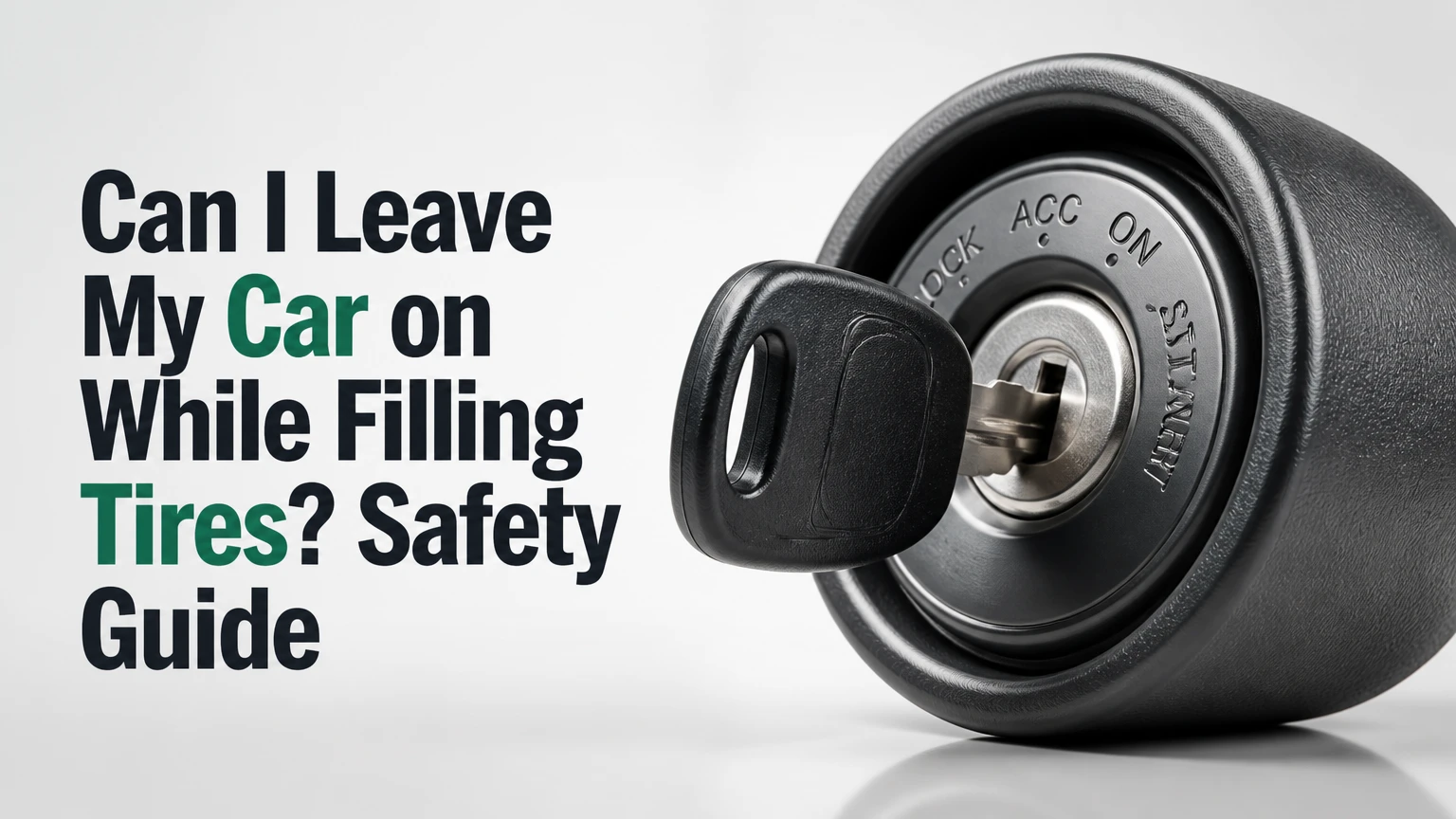
No, you should normally turn your car engine off while filling tires, especially at a gas station. The air pump does not need power from the vehicle, and switching off the engine removes unnecessary movement, exhaust, and electrical risks. A portable 12V compressor is different: follow its manual, and use the engine only when required in an open outdoor area.
Key Facts at a Glance
- A gas-station tire pump uses its own electrical supply, so your vehicle engine should be off.
- The correct tire pressure is printed on the driver-door jamb or vehicle placard, not usually on the tire sidewall.
- A 12V compressor can draw approximately 10-15 amps, with startup demand sometimes higher.
- Accessory mode can drain a weak battery because the alternator does not charge the battery when the engine is off.
- Never run an engine or gasoline-powered equipment in a garage, carport, or other poorly ventilated space because carbon monoxide can accumulate rapidly.
- A tire that repeatedly loses pressure may have a puncture, valve leak, wheel problem, or tire damage that inflation alone will not fix.
Can I Leave My Car on While Filling Tires?
You can physically leave the engine running, but you should not do so when using a gas-station air pump. Turn the ignition off, select Park, apply the parking brake, and keep the vehicle stationary while you connect the hose. The engine provides no useful power to a grid-powered station compressor.
Leaving the engine on creates avoidable hazards. A vehicle can move if the selector is not fully in Park, a manual-transmission car can roll if it is left in neutral, and an unattended running vehicle presents a theft risk. Exhaust is also dangerous near buildings, walls, overhangs, or enclosed service bays.
The answer changes for a portable compressor. Some 12V units are designed for short operation from the accessory socket with the engine off; others recommend running the engine because the compressor draws substantial current. The vehicle owner’s manual and compressor instructions control that decision. Engine operation is not a universal requirement.
A running engine does not normally make a tire more likely to explode. Tire failure is associated with conditions such as severe underinflation, overinflation, impact damage, age, overloading, or a damaged casing. The practical rule is simple: turn the engine off for a station pump, and follow the equipment manual for a portable unit.
Why Does the Pump Type Change the Answer?
The pump’s power source determines whether the vehicle engine has any electrical or mechanical role. A station compressor receives power from the business’s electrical system, while a 12V inflator uses the vehicle battery and possibly alternator output.
How does a tire valve accept air?
Most passenger vehicles use a Schrader valve with a spring-loaded valve core. The compressor chuck presses the core inward, opens the air passage, and seals around the valve stem so pressurized air enters the tire instead of escaping around the connection.
A crooked chuck can produce a loud hiss and inflate the tire slowly or not at all. A small puff when connecting or removing the chuck is normal; continuous hissing is not. Remove the chuck, check that the valve stem is straight and undamaged, then reconnect it squarely.
The valve cap is not the primary air seal on a healthy Schrader valve. The valve core performs that function, while the cap helps keep dirt, water, and road debris away from the core. A missing cap does not explain every leak, but replacing it is inexpensive protection.
What powers each inflation system?
| Inflation system | Electrical source | Typical current or energy demand | Normal engine position |
|---|---|---|---|
| Gas-station compressor | Site AC electrical supply | Vehicle draw: 0 amps | Engine off |
| 12V plug-in compressor | Vehicle battery and accessory circuit | Typically 10-15 amps | Off or running, per manual |
| Cordless inflator | Internal lithium-ion battery | Battery-specific, commonly 150-300 watt-hours | Engine off |
| Heavy-duty clamp compressor | Battery through direct cables | Commonly 30-80 amps | Often running, per manual |
A compressor connected to the battery does not automatically need the engine running. The reason some manufacturers recommend idling is battery protection and voltage stability, particularly with large compressors, long inflation cycles, or oversized all-terrain tires.
Where Do You Find the Correct Tire Pressure?
Use the cold inflation pressure on the driver-door placard, fuel-filler flap, glove-box label, or owner’s manual. Do not use the maximum pressure molded into the tire sidewall as the vehicle’s routine target, because that figure describes the tire’s limit under specified conditions rather than the vehicle manufacturer’s recommended setting.
“Cold” generally means the car has been parked for at least three hours or has driven less than about one mile at low speed. Driving heats the air and raises the measured pressure, so checking immediately after a long highway trip can produce a misleadingly high reading.
| Pressure reference | Example value | Correct use | Common mistake |
|---|---|---|---|
| Door-jamb placard, front axle | 35 PSI | Normal front-tire target | Ignoring front and rear differences |
| Door-jamb placard, rear axle | 33 PSI | Normal rear-tire target | Using front pressure on every tire |
| Temporary spare label | 60 PSI | Spare-tire inflation target | Treating it like a standard tire |
| Tire sidewall maximum | 51 PSI | Maximum marked tire pressure | Using it as the daily target |
The National Highway Traffic Safety Administration states, “The only way to know if your tires are properly inflated is to check the pressure with a tire pressure gauge.” That guidance matters because TPMS is a warning system, not a precision inflation instrument.
How Do You Inflate Tires Safely at a Gas Station?
Inflate tires at a gas station with the engine off, the transmission in Park or first gear, and the parking brake engaged. The process typically takes 5-10 minutes for four tires, depending on hose reach, payment controls, and how much pressure each tire needs.
Step 1: Park close enough for the hose
Position the vehicle so the hose reaches every valve without crossing a traffic lane. Keep the car on a reasonably level surface, away from moving vehicles, and leave enough space to walk around the tires.
For an automatic transmission, select Park. For a manual transmission, select first gear or reverse according to the parking direction, apply the parking brake, and switch off the engine. Do not rely on the transmission alone.
Step 2: Check the cold pressure
Remove each valve cap and measure pressure with a reliable gauge before adding air. Record the reading so you know whether one tire differs substantially from the others.
A 2-3 PSI difference can result from temperature, gauge variation, or a slow leak. A difference of 5 PSI or more deserves closer inspection, particularly if it returns after inflation.
Step 3: Set the station pump
Enter the placard pressure if the machine allows a target setting. If the pump has no automatic shutoff, use a separate gauge and inflate in short bursts, checking pressure between bursts.
Do not assume the station gauge is perfectly calibrated. Commercial pumps are convenient, but a dedicated digital or high-quality pencil gauge provides a useful second measurement.
Step 4: Attach the chuck straight
Press the chuck firmly onto the valve stem. Lock the lever if the chuck has one, then listen for the compressor to deliver air rather than leak around the connection.
You will know the connection is working when the pressure reading rises or the machine’s display changes. A sharp, uninterrupted hiss indicates poor alignment, a damaged valve, or a faulty chuck seal.
Step 5: Recheck and replace the caps
Measure every tire again after inflation, including the spare if it is accessible. Replace the caps tightly by hand, then drive slowly for a short distance and confirm that no valve cap or hose fitting was left behind.
If the TPMS warning remains on, the sensors may need several minutes of driving to update. Some vehicles require a TPMS reset procedure, while others relearn automatically.
Does a Portable Compressor Need the Engine Running?
A portable compressor needs the engine running only when its manufacturer requires alternator support or when the vehicle battery cannot safely supply the compressor for the intended runtime. A small cordless inflator usually operates with the engine off, while a high-current clamp compressor commonly uses a running engine outdoors.
Is accessory mode safe for a 12V inflator?
Accessory mode may power the 12V outlet without starting the engine, but it does not charge the battery. Some vehicles disable accessory sockets when the ignition is off, and many sockets have a 10-15 amp fuse that a compressor can approach or exceed.
Check the outlet rating and compressor label before use. A device rated at 15 amps on a 10-amp circuit can blow the fuse, especially during startup. Do not replace a fuse with a higher-rated fuse, because the wiring may overheat before the fuse opens.
A practical rule is to use ACC only for a short inflation session when the battery is healthy, the outlet rating is adequate, and the compressor manual permits it. Stop if interior lights dim, the compressor cycles abnormally, or the outlet or plug becomes hot.
How do you use a direct-battery compressor?
Park outdoors, apply the parking brake, keep the compressor on a stable surface, and connect the red clamp to positive and the black clamp to negative or the manufacturer’s specified ground point. Keep cables away from belts, fans, exhaust components, and hot engine surfaces.
If the manual requires the engine to run, start it before switching on the compressor. Large compressors can draw enough current to discharge a battery quickly when the engine is off, particularly in cold weather or with an older battery.
Never place a gasoline engine vehicle inside a closed garage for this procedure. The Centers for Disease Control and Prevention warns that carbon monoxide is an odorless, colorless gas that can kill without warning, so ventilation through a partly open garage door is not a reliable safety control.
Will a Tire Inflator Drain the Battery?
A tire inflator can drain a vehicle battery, but the outcome depends on compressor current, inflation time, battery condition, ambient temperature, and whether the battery is already near its starting limit. A short session on one tire may be harmless; repeated long sessions can leave insufficient power to start the engine.
| Compressor situation | Typical runtime | Battery risk with engine off | Recommended response |
|---|---|---|---|
| One tire, 3 PSI low | 1-3 minutes | Low with a healthy battery | Use a gauge and monitor the plug |
| Four passenger tires, 5 PSI low | 10-20 minutes | Moderate | Use a cordless unit or run per manual |
| One large SUV tire, 15 PSI low | 8-15 minutes | Moderate to high | Follow duty-cycle instructions |
| Four LT or off-road tires | 20-60 minutes | High | Use a heavy-duty compressor and alternator support |
These are typical practitioner ranges, not guarantees. Compressor output varies widely, and “minutes per tire” claims often assume a small tire starting only a few PSI below target.
Turn off headlights, climate control, audio equipment, and seat heaters during engine-off inflation. If the battery is old, the weather is below freezing, or the compressor is slow, use a cordless inflator, roadside service, or an engine-running setup permitted by the manual.
How Long Can a Compressor Run?
A portable compressor should run only for the duty cycle stated in its manual, commonly 5-10 minutes followed by a 5-15 minute cooling period for inexpensive 12V units. High-output models may support longer cycles, but the hose, motor housing, plug, and wiring still require monitoring.
| Tire and compressor combination | Typical fill time per tire | Typical total for four tires | Main limitation |
|---|---|---|---|
| Compact car, 12V unit | 2-5 minutes | 8-20 minutes | Motor heat |
| Crossover, 12V unit | 4-8 minutes | 16-32 minutes | Outlet current and duty cycle |
| Pickup, cordless inflator | 3-7 minutes | 12-28 minutes | Battery capacity |
| Large off-road tire, clamp compressor | 5-12 minutes | 20-48 minutes | Heat and air volume |
Stop the compressor if the casing becomes too hot to touch comfortably, the power plug softens, the fuse opens, or the motor changes sound. A thermal cutoff protects some devices, but waiting for an automatic shutdown is poor operating practice.
A compressor that takes unusually long may have a loose chuck, a leaking hose, an undersized power cable, a failing valve core, or a tire bead problem. More runtime is not always the solution.
Can You Inflate Tires in a Garage?
You may inflate a tire with a manual pump or cordless electric inflator in a garage, but you must not run a gasoline or diesel engine there for the compressor. A closed or partly enclosed garage can accumulate carbon monoxide from the vehicle, even when the door is open.
Move the vehicle completely outdoors before starting the engine. Do not treat a carport, covered driveway, loading bay, or garage with a partly open door as equivalent to open air, because walls and roof structures can trap exhaust.
A manual foot pump and a cordless inflator avoid engine exhaust, but neither fixes a structurally damaged tire. If the tire is visibly shredded, separated, bulged, cut through the sidewall, or off the wheel bead, do not inflate it. Install the spare or call roadside assistance.
Which Inflation Method Fits Your Situation?
The best method depends on access to electricity, the amount of air needed, tire size, and the condition of the vehicle battery. A gas-station pump is usually the simplest choice for routine maintenance, while a cordless or direct-battery compressor is more useful when a low tire occurs away from services.
| Situation | Preferred equipment | Engine state | Typical cost | Reason |
|---|---|---|---|---|
| Monthly pressure check | Gas-station pump and gauge | Off | $0-$3 per visit | Fast access to high-volume air |
| Highway warning on one tire | Cordless inflator and gauge | Off | $40-$100 purchase | Avoids electrical connection |
| Remote camping with large tires | Heavy-duty clamp compressor | Running if manual requires | $100-$300 purchase | Higher airflow and sustained output |
| Apartment resident with no outlet | Compact 12V compressor | Per manual | $25-$80 purchase | Stores in the vehicle |
| Tire nearly flat near home | Roadside service or tire shop | Off | $0-$150 typical service | Damage inspection matters more than air |
A plug-in 12V compressor is not automatically better than a cordless model. It can run longer if the vehicle supplies stable power, but the cable may be too short, the socket may be under-rated, and the engine-off session can consume starting capacity.
What Should You Do If Air Escapes?
If air escapes continuously while filling a tire, stop the compressor, remove the chuck, and reconnect it squarely to the valve stem. Persistent leakage after reseating the chuck indicates a damaged valve core, cracked valve stem, leaking hose connection, or wheel and tire problem.
Use these diagnostic steps:
- Listen for the leak with the compressor off.
- Apply soapy water to the valve core and bead area.
- Watch for growing bubbles.
- Compare pressure before and after a 10-minute rest.
- Arrange a tire inspection if pressure falls again.
Do not hold a leaking chuck against the valve for several minutes while assuming the tire is filling. The compressor may be adding air more slowly than the connection is losing it.
A puncture in the tread may be repairable, depending on its location, size, and tire condition. A puncture in the sidewall or shoulder generally requires tire replacement rather than a plug or patch.
Why Has the TPMS Light Not Turned Off?
The TPMS light may remain illuminated because the pressure is still below the vehicle’s threshold, the sensor has not updated, the tire temperature changed, or the system detected a sensor fault. Many vehicles need several minutes of driving after inflation before the pressure reading refreshes.
Check all four road tires with a gauge, then verify the placard targets. If the light flashes for roughly a minute before staying on, the vehicle may be reporting a TPMS malfunction rather than simple low pressure.
Do not add air solely until the warning disappears. A sensor can be inaccurate, and a tire can have a slow leak even when its current reading appears acceptable. If one tire loses 2 PSI or more over days, request a puncture and valve inspection.
Common Mistakes and Their Fixes
| Mistake | Consequence | Corrective action | Prevention |
|---|---|---|---|
| Using sidewall maximum PSI | Overinflated daily setting | Deflate to placard pressure when cold | Photograph the door label |
| Checking after highway driving | Pressure appears higher than cold value | Recheck after cooling | Check before driving |
| Running a station pump with engine on | Unnecessary movement and exhaust risk | Switch off and secure the car | Use Park and parking brake |
| Exceeding a 12V outlet rating | Blown fuse or hot connector | Stop and inspect the fuse and plug | Match compressor amps to outlet rating |
| Ignoring compressor duty cycle | Motor overheating | Power down and cool completely | Use timed intervals |
| Driving on a visibly damaged tire | Wheel and casing damage | Stop and call a tire professional | Inspect before inflation |
An expert rule of thumb is to measure before adding air, not after deciding that a tire “looks low.” Radial tires can appear normal while significantly underinflated, and visual inspection cannot establish PSI.
Another counterintuitive point is that a tire can lose pressure without a visible nail. Valve cores, bead seats, wheel corrosion, and temperature changes all create pressure differences. Repeated topping-up is a symptom, not a repair.
Finally, a gas-station pump is useful for pressure correction but not for diagnosing a dangerous tire. Inflation should stop when the tire has a bulge, exposed cord, severe cut, bead separation, or damage caused by driving while flat.
FAQ
Can I leave the radio on while filling tires?
You can leave the radio on briefly, but switching off unnecessary accessories is better when using a portable compressor with the engine off. The radio adds a small electrical load, while headlights, climate control, heated seats, and rear defoggers can consume substantially more battery power during inflation.
Should I inflate tires before or after driving?
Inflate tires before driving whenever possible, because the recommended pressure applies to cold tires. If a tire is dangerously low, add enough air to reach a safe location first, then perform the final pressure check after the tires cool.
Can I drive with the engine off while using a tire pump?
The vehicle must remain stationary while the pump is connected. Select Park or a suitable gear, apply the parking brake, and switch the engine off. Never leave the vehicle in neutral on a slope while walking around it to fill the tires.
Is a tire safe after it has been driven flat?
A tire driven flat is not automatically safe after adding air. Internal sidewall damage may be invisible from outside, so a qualified tire technician should inspect it before normal driving, especially if the tire traveled more than a short distance.
How often should tire pressure be checked?
Check tire pressure at least once each month and before long trips, using a gauge when the tires are cold. Seasonal temperature changes, punctures, valve leaks, heavy loads, and towing can require more frequent checks.
The Bottom Line
For the target question, can i leave my car on while filling tires, the safe routine answer is no: turn the engine off at a gas-station pump, secure the vehicle, and use the PSI on the door placard. A portable compressor may justify engine operation only when its manual requires alternator support, and that setup belongs outdoors with the vehicle stationary and the compressor’s duty cycle observed.