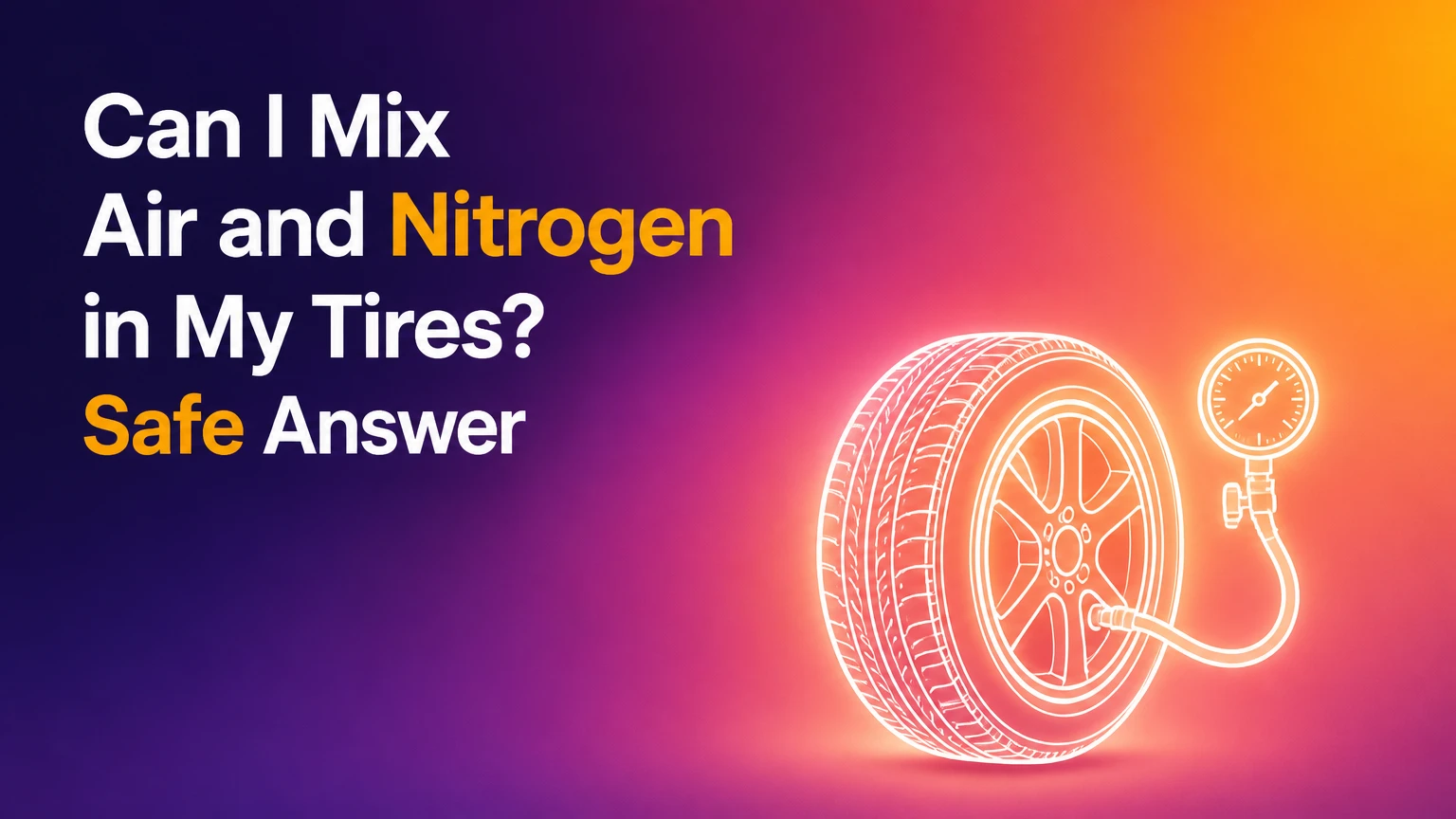
Yes, you can safely mix air and nitrogen in your tires. Regular compressed air is already about 78% nitrogen, so adding air to a nitrogen-filled tire creates a mixture rather than a dangerous reaction. Inflate the tire to the vehicle manufacturer’s recommended cold pressure immediately; preserving nitrogen purity is less important than correcting underinflation.
Key Facts at a Glance
Mixing compressed air and nitrogen does not cause an explosion, chemical reaction, or tire failure.
Regular air contains approximately 78% nitrogen, 21% oxygen, and about 1% argon, carbon dioxide, and other gases.
The driver’s-door placard, not the tire sidewall maximum, specifies the correct cold inflation pressure.
Nitrogen does not eliminate pressure checks, punctures, valve leaks, temperature effects, or TPMS warnings.
A nitrogen tire can be topped off with ordinary air in about 2-5 minutes at a service station.
A nitrogen purge is optional for most passenger cars and becomes more relevant when controlled gas purity matters.
What Happens When Air and Nitrogen Mix?
Air and nitrogen mix physically and safely inside a tire because both are gases at ordinary tire pressures and temperatures. The resulting pressure depends on the total number of gas molecules and temperature, not on whether the molecules came from one filling source.
Regular air is mostly nitrogen already. A tire filled with commercial nitrogen is usually not chemically different from an air-filled tire; the meaningful differences are lower oxygen and moisture content, not a new kind of pressure.
| Inflation gas | Approximate composition | Typical moisture condition | Main practical effect |
|---|---|---|---|
| Ambient air | 78% nitrogen, 21% oxygen | Variable | Widely available and suitable for road vehicles |
| Dry compressed air | 78% nitrogen, 21% oxygen | Low to moderate | Similar pressure behavior with less water vapor |
| Commercial nitrogen | Often 93%-99.9% nitrogen | Usually very low | Slower gas permeation and more repeatable conditions |
| Mixed inflation gas | Depends on fill history | Depends on air source | Safe, but less pure than the original nitrogen fill |
The exact composition varies by supplier, compressor, altitude, and moisture control. A green valve cap identifies a service practice, not a separate tire category.
Does mixing create a safety hazard?
No. Nitrogen is inert under normal tire-service conditions, and the oxygen in ordinary air does not react with nitrogen inside a tire. The immediate safety issue is the tire’s pressure: a tire that is 8 PSI below specification is more concerning than a tire containing a mixed gas.
Nitrogen is not flammable, and compressed air is not an explosive contaminant. Tire damage can still occur if a technician overinflates the tire, if a wheel is damaged, or if an underinflated tire has already overheated during driving.
Does Adding Air Reduce Nitrogen’s Benefits?
Adding air reduces the nitrogen concentration, but the practical impact depends on the original pressure, the amount added, and the tire’s condition. A small air top-off may change gas purity without producing a noticeable change in everyday performance.
Suppose a tire contains 30 PSI and receives 2 PSI of ordinary air. If the original fill was 95% nitrogen, the final mixture remains mostly nitrogen, although its purity falls. A complete replacement with air produces a much larger dilution, but it remains safe.
The commonly repeated claim that nitrogen-filled tires always hold pressure three or four times longer is too broad. Permeation is affected by tire construction, temperature, valve cores, wheel porosity, bead sealing, punctures, and measurement error. Nitrogen can reduce pressure loss under controlled conditions, but it does not repair a leak.
How quickly does air escape compared with nitrogen?
Oxygen and nitrogen permeate rubber at different rates, but real-world pressure loss cannot be predicted from molecule size alone. Oxygen generally permeates tire rubber faster than nitrogen, while water vapor can alter the behavior of compressed air, yet a valve leak or puncture usually dominates the result.
For a healthy passenger tire, a typical maintenance loss may be approximately 1 PSI per month, although vehicle manufacturers and tire organizations emphasize regular checks rather than a universal loss schedule. A sudden loss of 2 PSI overnight indicates a possible puncture, valve problem, bead leak, or wheel damage.
| Pressure-loss pattern | Likely interpretation | Recommended response | Typical urgency |
|---|---|---|---|
| 0.5-1 PSI over several weeks | Normal permeation or temperature change | Check cold pressure | Monthly |
| 1-2 PSI after a cold-weather change | Temperature effect | Restore placard pressure | Same day |
| 2 PSI overnight | Puncture, valve, bead, or wheel leak | Inspect with soapy water or visit a tire shop | Immediate |
| Repeated loss from one tire | Localized leak | Repair according to tire industry rules | Within 24 hours |
| All four tires lose similar pressure | Seasonal temperature change or gauge issue | Verify with a reliable gauge | At next cold check |
Expert insight: equal pressure loss in all four tires often points toward weather rather than four simultaneous punctures. One tire that repeatedly loses pressure deserves a leak inspection even if the vehicle has nitrogen.
What Pressure Should You Use After Topping Off?
Use the cold tire pressure printed on the vehicle certification label or tire-information placard, usually located on the driver’s door jamb, door edge, glovebox, or fuel door. Do not use the maximum pressure molded into the tire sidewall as the normal operating target.
Pressure changes with temperature. The familiar rule of approximately 1 PSI for every 10°F change is a useful field estimate, not a universal constant, because tire volume, construction, starting pressure, and measurement conditions affect the result. Nitrogen follows the same basic gas law as air, so it does not eliminate seasonal pressure changes.
How do you top off a nitrogen tire with regular air?
- Park safely and identify the placard pressure. Let the tires cool for at least three hours, or check them before driving more than a short distance.
- Measure every tire, including the spare. Use one reliable gauge because different gauges can vary by 1 PSI or more.
- Add air to the placard value. Inflate the tire to the specified cold pressure, not to a green-cap convention or the sidewall maximum.
- Inspect the tire while filling. Look for nails, bulges, cuts, exposed cords, and unusual tread wear.
- Replace the valve cap and drive normally. The tire now contains a safe air-nitrogen mixture.
- Monitor the pressure later. Recheck the tire when cold within a few days if it was substantially low.
You will know the immediate correction worked when the tire reaches the specified pressure, the TPMS warning clears after driving if the vehicle requires sensor recalibration, and the tire shows no visible damage. A warning that returns indicates a separate fault.
Can you add air to only one nitrogen-filled tire?
Yes. Adding air to one low tire is safer than driving with that tire underinflated. The four tires do not need identical gas purity, although they should meet the vehicle’s specified pressures and load requirements.
A difference in inflation gas is not a handling problem at normal road speeds. A difference in pressure, tire size, tread condition, or axle loading can affect handling significantly, so correct pressure remains the priority.
Air Versus Nitrogen: What Is the Practical Difference?
Air is the sensible default for most passenger vehicles because it is available everywhere, costs little, and already contains mostly nitrogen. Nitrogen offers the most defensible advantages when operators need low moisture, reduced permeation, or repeatable pressure behavior and are willing to maintain the system properly.
| Decision factor | Regular compressed air | Commercial nitrogen | Mixed air and nitrogen |
|---|---|---|---|
| Availability | Gas stations, shops, portable pumps | Tire retailers and fleet facilities | Available wherever air is available |
| Typical passenger-car cost | Free to about $2 per fill | About $5-$10 per tire for conversion, often less for refill | Usually free to about $2 |
| Moisture content | Depends on compressor maintenance | Usually low | Depends on the air added |
| Pressure behavior | Normal permeation and temperature response | Potentially slower permeation | Between the two, but not predictable from purity alone |
| Emergency suitability | Immediate and practical | Not always available | Immediate and practical |
| Required maintenance | Monthly checks | Monthly checks still required | Monthly checks still required |
| Best use case | Daily road driving | Fleets, motorsport, controlled storage | Any vehicle needing a convenient top-off |
Does nitrogen improve fuel economy?
Nitrogen does not directly create a meaningful fuel-economy boost. Any fuel savings come mainly from maintaining correct pressure, because underinflated tires increase rolling resistance; a driver can obtain the same primary benefit by checking air pressure regularly.
The U.S. Department of Energy’s fueleconomy.gov explains that proper inflation improves rolling resistance and fuel economy, while the U.S. National Highway Traffic Safety Administration identifies underinflation as a safety and maintenance concern. Neither organization recommends nitrogen as a substitute for pressure maintenance.
A small nitrogen advantage may matter in a commercial fleet with thousands of tires and tightly managed service intervals. For a private car traveling ordinary annual mileage, the price and inconvenience commonly outweigh a measurable return.
Does nitrogen prevent corrosion or tire aging?
Dry nitrogen can reduce the moisture introduced during inflation, which may lower internal corrosion risk in some wheels and reduce moisture-related pressure variation. Nitrogen does not prevent external corrosion, bead-seat corrosion caused by road salt, valve damage, punctures, or rubber aging caused by sunlight and ozone.
Wheel material also matters. Steel wheels, aluminum alloy wheels, chrome-plated wheels, and multi-piece racing wheels do not face identical corrosion risks. A poorly maintained compressor can add moisture, but a leaking bead or damaged valve can cause pressure loss regardless of the gas used.
Is Nitrogen Better for Winter, Track Days, or Storage?
Nitrogen is most useful when controlled moisture and repeatable pressure behavior matter more than convenience. Ordinary air remains appropriate for winter commuting, provided the driver checks cold pressure as temperatures change.
Winter driving
Cold weather lowers tire pressure whether the tire contains air, nitrogen, or a mixture. Check pressure at least monthly and whenever temperatures change sharply; restore the placard value before driving at highway speed.
A TPMS warning often appears after a cold front because the sensor detects pressure, not gas purity. Adding air clears the immediate condition. Do not delay inflation while searching for a nitrogen source.
Track days and racing
Motorsport teams often use dry nitrogen because it offers consistent starting conditions and reduces water-vapor variability during repeated heat cycles. Racing tires operate at temperatures and loads far beyond ordinary street use, so predictable pressure growth can affect setup and handling.
A street tire on a public road does not experience the same operating envelope. Track users should follow the tire manufacturer’s hot-pressure guidance, use a calibrated gauge, and never assume nitrogen compensates for an unsuitable tire, excessive heat, or poor alignment.
Long-term vehicle storage
Nitrogen can be reasonable for a stored classic car, trailer, aircraft tire, or specialty vehicle when the owner already has access to dry gas and wants to limit internal moisture. Storage still requires cleaning, stable temperature, protection from ultraviolet light, and periodic inspection.
Nitrogen does not stop dry rot. Rubber aging depends on time, ozone, ultraviolet exposure, temperature, and storage conditions. A vehicle stored for six months with ordinary air is not automatically damaged.
| Situation | Recommended inflation choice | Pressure-check interval | Main reason |
|---|---|---|---|
| Daily commuter | Air | Monthly | Availability and low cost |
| Seasonal winter vehicle | Air or nitrogen | Monthly and after cold fronts | Temperature changes affect both gases |
| Commercial fleet | Dry nitrogen where systems exist | Every service cycle and monthly audit | Repeatability across many tires |
| Track vehicle | Dry nitrogen or controlled dry air | Before each session | Reduced moisture variability |
| Classic car in storage | Dry nitrogen is optional | Monthly visual inspection | Lower moisture during long storage |
| Emergency low tire | Any available air | Immediately, then reinspect | Correct pressure outranks purity |
When Should a Nitrogen Tire Be Purged?
A nitrogen purge is justified when the operator needs a controlled gas composition, not merely because a tire received one air top-off. Most passenger-car owners can continue driving after adding air and can refill with nitrogen at the next convenient service.
A shop typically performs a purge by removing the tire’s existing inflation, filling it with nitrogen, bleeding it down, and repeating the cycle before the final fill. The exact purity achieved depends on the equipment, hose purge practices, tire volume, and number of cycles.
What does a purge usually cost and take?
Typical passenger-vehicle nitrogen conversion costs range from $20-$40 for four tires, or about $5-$10 per tire, although some tire retailers include lifetime nitrogen service with a tire purchase. A basic top-off takes about 2-5 minutes; a full purge commonly takes 15-30 minutes.
| Service | Typical duration | Typical cost | When it makes sense |
|---|---|---|---|
| Air pressure check | 2-5 minutes | Free-$5 | Every month |
| Air top-off | 2-5 minutes | Free-$2 | Any low tire |
| Nitrogen top-off | 2-10 minutes | Free-$10 | Existing nitrogen service plan |
| Four-tire nitrogen conversion | 15-30 minutes | $20-$40 | Fleet, specialty, or customer preference |
| Leak diagnosis | 15-45 minutes | $0-$40 | Repeated or sudden pressure loss |
| Tire repair | 30-60 minutes | $20-$40 typical | Repairable tread puncture |
Expert insight: repeated purging is not a cure for pressure loss. If a tire drops from 35 PSI to 28 PSI in a week, a purity change cannot explain the entire loss; the technician should test the valve, bead, wheel, and tread.
What Problems Can a Mixed Tire Reveal?
A mixed tire is usually not the problem. The reason it needed air is more important than the gas mixture.
Sudden pressure loss
Do not attribute a rapid pressure drop to nitrogen dilution. Check for a tread puncture, leaking valve core, damaged valve stem, cracked wheel, corrosion at the bead seat, or a tire that was previously driven underinflated.
Spray soapy water around the valve, tread puncture, and bead area if the tire remains safely inflated. Bubbles identify a leak, but a tire with a sidewall bulge or structural damage should not be reinflated for continued driving.
TPMS remains illuminated
A tire-pressure monitoring system may need the vehicle driven several minutes after pressure correction, or it may require a manual reset according to the owner’s manual. TPMS does not detect nitrogen purity.
If the light flashes before remaining illuminated, the vehicle may have a sensor, receiver, or battery fault rather than a simple low-pressure condition. Check all four tires and the spare where applicable.
Green valve cap confusion
Green caps are often used to indicate nitrogen service, but they are not a safety lock or manufacturer requirement. Replace a missing cap to keep dirt and water away from the valve core, yet use ordinary air when necessary.
Never leave a tire underinflated to preserve a color-coded service label. Underinflation increases flexing, heat, tread-edge wear, and the risk of internal damage.
Uneven tire wear
Center tread wear usually suggests excessive pressure, while wear on both shoulders often suggests insufficient pressure. One-sided wear can indicate alignment problems, and cupping may involve suspension or balance issues.
Gas purity does not correct these mechanical conditions. Measure pressure with a known gauge, inspect tread depth, and ask a tire professional to assess alignment when wear is uneven.
Which Inflation Gas Should You Choose?
Choose regular air for most cars, SUVs, and light trucks used on public roads. Choose nitrogen when a fleet, racing program, specialty vehicle, or storage plan can maintain dry-gas service consistently and the operator values controlled conditions enough to justify the cost.
Daily commuter
Use air and check all tires monthly. A reliable gauge, a functioning TPMS, and prompt correction of low pressure provide more practical benefit than paying for a high-purity fill.
Fleet manager
Consider nitrogen if the fleet has centralized equipment, documented pressure audits, long routes, high tire counts, or operating conditions where downtime is expensive. The business case depends on measured tire life, fuel use, service labor, and gas costs rather than the label alone.
Track-day driver
Use the tire manufacturer’s recommended setup procedure and a consistent dry inflation gas. Record cold and hot pressures for each session because nitrogen cannot replace temperature management, tire selection, alignment, or driver feedback.
Classic-car owner
Nitrogen is optional for storage. Control humidity, block ultraviolet exposure, prevent flat-spotting according to the tire manufacturer’s guidance, and inspect the tires before returning the vehicle to the road.
The Bottom Line
Can I mix air and nitrogen in my tires? Yes, safely. Add ordinary compressed air whenever a tire is below the vehicle’s recommended cold pressure, even if the valve cap is green. The mixture remains safe to drive on, although its nitrogen purity decreases.
For most passenger vehicles, regular air is the practical choice because pressure accuracy matters more than gas purity. Check pressure monthly, investigate sudden losses, and use a professional nitrogen purge only when controlled moisture or gas composition has a specific operational value.
Frequently Asked Questions
Can I put nitrogen in a tire that already has air?
Yes. A tire can receive nitrogen after an air fill without damage, and the gases will mix safely. The new fill will not be 100% nitrogen unless the shop removes the existing gas and performs one or more purge cycles. Set the pressure using the vehicle placard, then monitor the tire for leaks.
Is nitrogen better than air for car tires?
Nitrogen can reduce moisture and may slow gas permeation, but regular air is adequate for most road cars. Nitrogen does not prevent punctures, eliminate temperature-related pressure changes, or replace monthly checks. The practical winner for a daily driver is usually air because it is inexpensive and available immediately.
Can I use a home air compressor on nitrogen-filled tires?
Yes, provided the compressor produces clean, dry air and the hose connection is suitable. Drain compressor moisture, use an accurate pressure gauge, and avoid contaminating the valve with dirt. A home compressor adds ordinary air, so the tire becomes a safe mixture rather than remaining high-purity nitrogen.
Does nitrogen make tires last longer?
Nitrogen may help in controlled applications by limiting moisture and reducing some permeation, but tire life depends more strongly on correct pressure, alignment, rotation, load, heat, road damage, and age. Nitrogen cannot extend the life of a tire with exposed cords, severe cracking, a damaged sidewall, or irregular wear.
How often should nitrogen-filled tires be checked?
Check nitrogen-filled tires at least once a month and before long trips, just as you would check air-filled tires. Measure them cold, compare the readings with the door-jamb placard, and inspect for tread damage. A nitrogen fill does not make a vehicle maintenance-free.
Can mixed air and nitrogen affect handling?
A mixed gas does not normally affect handling when all tires have the correct pressure and matching tire specifications. Handling can change when one tire is underinflated, overloaded, damaged, or substantially different in tread and construction. Correct pressure and tire condition matter more than whether the gas is pure nitrogen.