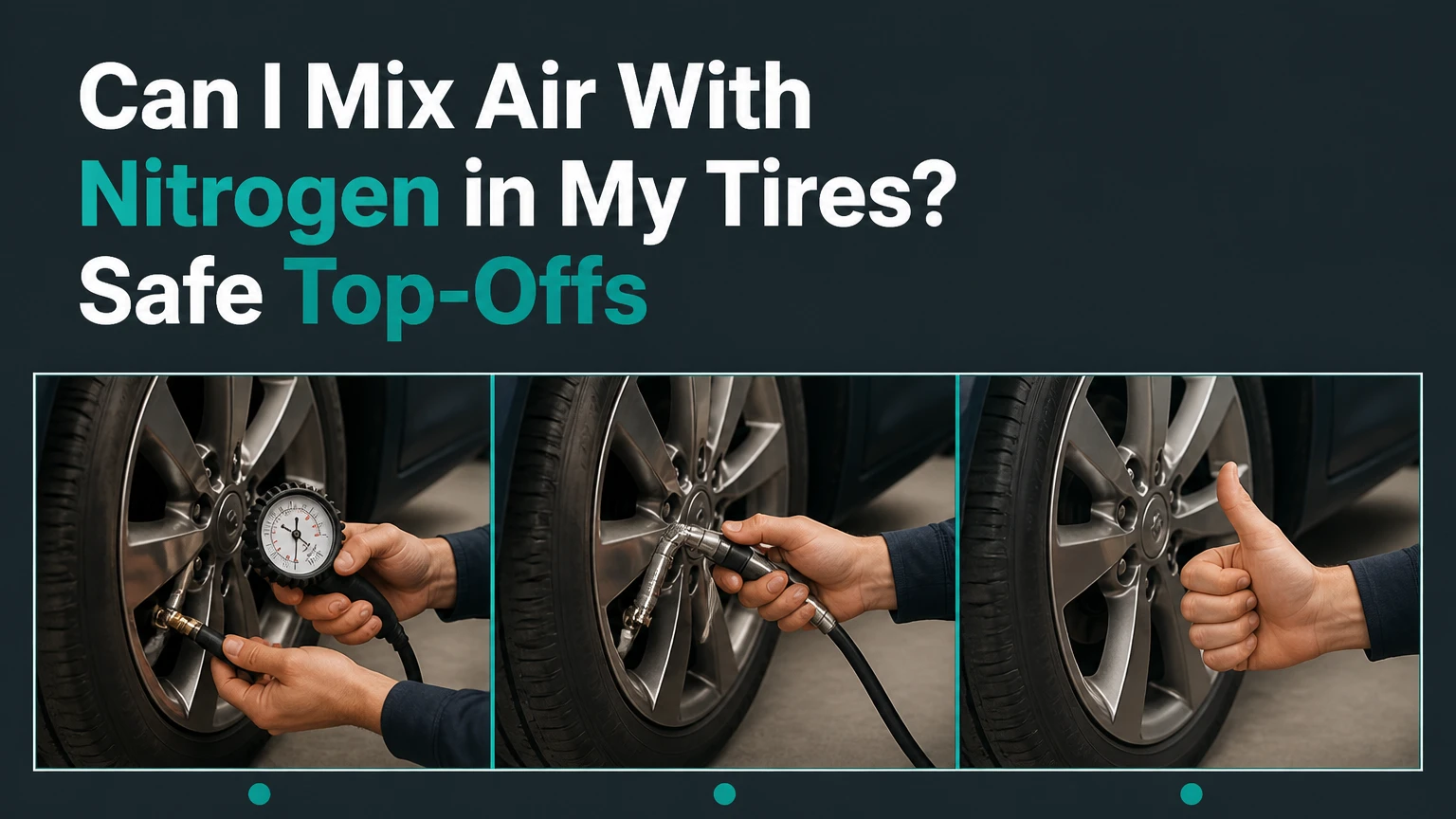
Yes, you can safely mix compressed air with nitrogen in your tires. Regular air already contains about 78% nitrogen, so adding air to a nitrogen-filled tire changes the gas mixture without creating a chemical reaction, damaging the rubber, or making the tire unsafe. Inflate the tire to the vehicle manufacturer’s specified cold pressure.
Key Facts at a Glance
Compressed air and nitrogen mix uniformly inside a tire and do not form a hazardous compound.
Ordinary atmospheric air contains approximately 78% nitrogen, 21% oxygen, about 0.93% argon, and variable water vapor.
A low tire filled with ordinary air is safer than a nitrogen-filled tire left underinflated while you search for a nitrogen source.
The correct inflation target is the cold PSI on the driver’s door placard, not the maximum PSI molded into the sidewall.
Nitrogen may slow pressure changes caused by gas permeation and moisture, but it does not eliminate leaks or routine pressure checks.
A tire does not need a special TPMS reset because air was added to nitrogen.
Can I Mix Air With Nitrogen in My Tires?
You can mix air and nitrogen in any normal passenger-car, SUV, trailer, or light-truck tire without causing a chemical or structural problem. The practical result is a tire containing less-pure nitrogen, not a dangerous gas combination.
A tire filled to the recommended pressure performs according to its pressure, temperature, load, speed, and condition. Gas identity matters less than inflation pressure for ordinary road use. If a tire has fallen from 35 psi to 27 psi, restoring it to 35 psi with compressed air addresses the immediate safety problem.
The common concern comes from the idea that “pure” nitrogen and air must remain separate. They do not. Molecular motion distributes both gases throughout the tire, and nitrogen does not react with oxygen under normal tire temperatures and pressures. The valve stem, wheel, bead, liner, and tread do not require nitrogen-only service.
Is mixing air and nitrogen dangerous?
Mixing air and nitrogen is not dangerous under normal vehicle operating conditions. The main risk is driving with incorrect pressure, a damaged tire, or an unresolved leak, regardless of whether the tire contains air, nitrogen, or a mixture.
A green valve cap can indicate that a shop originally used nitrogen, but cap color does not change the inflation procedure. Remove the cap, check the pressure with a reliable gauge, add available compressed air, and replace the cap securely.
The exception involves specialized operating procedures, not chemical incompatibility. Aircraft, military vehicles, mining equipment, and certain racing programs may specify dry nitrogen for fire-risk control, temperature management, or operating consistency. Those requirements should be followed when the equipment manufacturer or competition rules demand them.
What Happens Inside a Mixed Tire?
A mixed tire contains nitrogen, oxygen, argon, and variable water vapor at a total pressure determined by the amount of gas and the tire’s temperature. Air and nitrogen do not separate into layers, and the mixture does not damage the inner liner or wheel.
At sea level, the approximate composition of dry atmospheric air is:
| Component | Approximate share of dry air | Role in a tire |
|---|---|---|
| Nitrogen, N₂ | 78.08% | Main inert gas in both air and nitrogen fills |
| Oxygen, O₂ | 20.95% | Small component added with ordinary air |
| Argon, Ar | 0.93% | Chemically inactive trace gas |
| Carbon dioxide, CO₂ | 0.04% | Trace atmospheric component |
| Water vapor | 0%-4% | Variable moisture from the air system |
Commercial tire nitrogen is not normally 100% nitrogen. A shop generator may deliver roughly 93%-99% nitrogen, depending on its membrane or pressure-swing system, maintenance, purge procedure, and operating specification.
The final purity depends on how much gas was already in the tire and how much air was added. For example, topping a 35-psi tire that contains 95% nitrogen with a small amount of air does not suddenly turn it into ordinary air. A complete deflation followed by an air refill produces a much larger change.
How does dilution work?
Gas composition changes according to the quantity of each gas added, not according to the label on the valve cap. A small 3-psi air top-off adds less air than a complete refill after the tire has been emptied, so the resulting nitrogen percentage differs substantially.
A simplified example assumes a tire starts at 35 psi gauge, contains 95% nitrogen, and receives enough air to reach 37 psi gauge. The added air is only a small fraction of the tire’s total gas inventory, so the final nitrogen concentration remains much closer to 95% than to 78%.
The calculation is not normally useful to a driver because tire pressure gauges report gauge pressure, temperature changes affect the reading, and residual gas remains after service. The important operational instruction is simpler: use any clean, suitable air source to restore the specified pressure.
How Should You Top Off a Nitrogen-Filled Tire?
Top off a nitrogen-filled tire with compressed air whenever the pressure is below the vehicle manufacturer’s specification. The process takes about 5-10 minutes at a service station and requires a pressure gauge, an air hose, and the cold-pressure value from the door placard.
- Check the tire when cold. Measure before driving, or after the vehicle has been parked for at least three hours. Sunlight can warm one side and create misleadingly different readings.
- Read the correct specification. Use the placard on the driver’s doorjamb or the owner’s manual. A common passenger vehicle may specify 32-36 psi, but the correct value belongs to that vehicle and axle.
- Remove the valve cap. Keep the cap clean because dirt can interfere with the valve core. Green plastic is an identifier, not a pressure-control component.
- Add air in short bursts. Check the gauge after each burst, especially with a small portable compressor that can overshoot the target.
- Set all four tires and the spare if applicable. Front and rear specifications may differ, and a full-size spare can lose pressure unnoticed.
- Replace the cap and check for leakage. A brief soapy-water test around the valve stem can reveal bubbling from a loose core or damaged valve.
You will know the top-off worked when the cold reading matches the placard, the TPMS warning clears after driving if the system requires motion, and the tire does not lose pressure again. Do not bleed a warm tire merely because its pressure is higher than the cold specification.
Which pressure should you use?
Use the vehicle’s recommended cold inflation pressure, commonly printed as a value such as 35 psi, rather than the tire sidewall’s maximum pressure. The sidewall number identifies a limit associated with the tire, while the door placard accounts for the vehicle’s load, suspension, handling, and original tire size.
| Location or marking | Example value | Correct use |
|---|---|---|
| Driver-door placard, front axle | 35 psi cold | Normal front-tire target |
| Driver-door placard, rear axle | 33 psi cold | Normal rear-tire target |
| Tire sidewall maximum | 51 psi | Never use as the default vehicle setting |
| TPMS warning threshold | Often 25% below target | Warning trigger, not inflation specification |
| Full-size spare placard | 60 psi cold on some vehicles | Verify separately before storage |
The 25% figure is a common regulatory design point for passenger-vehicle TPMS warning behavior, but actual thresholds vary by vehicle. A TPMS light is not a nitrogen-purity warning.
Does Mixing Reduce Nitrogen’s Benefits?
Mixing air with nitrogen reduces the purity-related advantages of a nitrogen fill, but the practical effect for most road vehicles is small. Correct pressure, regular inspections, and a sound tire usually affect safety and service life more than whether the gas contains 80% or 95% nitrogen.
Nitrogen has two commonly cited advantages. Dry nitrogen introduces less moisture than poorly maintained shop air, and nitrogen molecules may permeate through rubber slightly more slowly than a mixture containing oxygen. Neither advantage prevents a nail puncture, bead leak, valve leak, or temperature-related pressure change.
Why does pressure change with temperature?
Tire pressure changes with absolute temperature because gas pressure rises when the gas warms in a substantially fixed volume. A rough road rule is that pressure changes by about 1 psi for each 10 degrees Fahrenheit change in tire temperature, although the result varies with starting pressure, construction, and measurement conditions.
A tire exposed to a cold overnight temperature can show a lower morning reading even when no gas escaped. A hot tire can read several PSI higher after highway driving. Nitrogen follows the same basic gas law as air, so nitrogen does not make a tire immune to weather.
The moisture distinction matters most when comparing dry nitrogen with wet compressed air. Water vapor can condense inside a tire and later vaporize as temperature changes, adding another source of pressure variation. Modern, properly maintained shop compressors often remove much of that moisture, so the difference between dry shop air and nitrogen can be narrower than advertising suggests.
How much pressure does a tire lose each month?
A healthy tire may lose roughly 1 psi per month as a practical maintenance estimate, but no universal air-versus-nitrogen loss rate applies to every tire. Temperature, tire age, wheel corrosion, valve condition, punctures, permeability, and measurement error can produce far larger differences.
Claims that ordinary air always loses 1-2 psi monthly while nitrogen always loses only 0.3-0.5 psi are too precise without specifying tire design, test conditions, temperature, pressure, and time. A tire losing 2 psi in a few weeks deserves inspection, whether it contains nitrogen or air.
Is Nitrogen Better Than Air for Ordinary Driving?
Regular compressed air is the better default for most daily drivers because it is available, inexpensive, and fully adequate when pressure is checked monthly. Nitrogen becomes more defensible when a fleet, race team, or specialized operator values dry gas and consistent service more than convenience and cost.
The U.S. Department of Energy’s fueleconomy.gov guidance emphasizes maintaining proper tire pressure for efficiency and safety; it does not require nitrogen for ordinary vehicles. Consumer Reports has also reported that nitrogen’s road-car benefit is modest when drivers check pressure regularly.
Michelin’s consumer guidance summarizes the practical limitation directly: “Nitrogen does not eliminate the need to check tire pressure.” That statement matters more than the color of a valve cap because underinflation remains the dominant everyday problem.
| Inflation choice | Typical purity or condition | Typical access cost | Best fit | Main limitation |
|---|---|---|---|---|
| Public compressed air | About 78% nitrogen, variable moisture | $0-$2 per visit | Daily cars and emergency top-offs | Moisture and more oxygen than dry nitrogen |
| Shop compressed air | About 78% nitrogen, often filtered | $0-$10 service fee | Tire installation and repairs | Quality depends on compressor maintenance |
| Generated nitrogen | About 93%-99% nitrogen | $30-$100 initial service | Fleets, specialty vehicles, convenience programs | Requires a nitrogen source for future fills |
| Bottled nitrogen | Usually supplier-specified purity | $5-$10 per tire top-off | Remote or specialized service | Cylinder logistics and recurring cost |
| Mixed inflation | Commonly about 80%-95% nitrogen | $0-$10 | Emergency or normal maintenance | Lower purity without a meaningful safety penalty |
Which drivers benefit most from nitrogen?
Nitrogen can make more sense for performance vehicles, heavy fleets, and equipment that experiences repeated heat cycles or long idle periods. Even in those cases, the benefit comes from controlled, dry, repeatable inflation procedures, not from a magical difference between two incompatible gases.
For a track vehicle, teams may use dry nitrogen to reduce moisture-related pressure variability and simplify setup between sessions. A track driver should follow the tire manufacturer’s hot-pressure targets and measure pressures immediately after a session. Road-air topping is still safer than running below the intended pressure during transit.
For a delivery fleet or recreational vehicle, nitrogen can reduce service interruptions when a provider supplies scheduled pressure checks. The economic benefit comes from the maintenance program. Nitrogen alone does not compensate for neglected inspections.
How Much Does Nitrogen Tire Service Cost?
A typical initial nitrogen conversion costs about $30-$100 for four tires, while routine nitrogen top-offs commonly cost $5-$10 per tire where charged. Compressed-air top-offs usually cost $0-$2, so nitrogen is rarely a direct money-saving choice for a private passenger vehicle.
Prices vary by region, retailer, vehicle size, and whether the shop removes the tire, replaces valve hardware, or performs multiple purge cycles. Some dealers include nitrogen as a sales package, while some tire stores provide it free during tire service.
| Service event | Typical quantity | Typical time | Typical price |
|---|---|---|---|
| Compressed-air top-off | 1-4 tires | 5-10 minutes | $0-$2 total |
| Nitrogen top-off | 1-4 tires | 5-15 minutes | $5-$10 per tire |
| Initial nitrogen conversion | 4 tires | 20-30 minutes | $30-$100 total |
| Tire repair with pressure reset | 1 tire | 20-45 minutes | $20-$50 repair service |
| Nitrogen refill after tire installation | 1-4 tires | 10-20 minutes | Often included, otherwise $5-$10 per tire |
Paying for nitrogen does not create a maintenance exemption. A driver who checks pressure monthly with free air may achieve better real-world tire performance than a driver who pays for nitrogen but ignores the placard and TPMS alerts.
Can a Tire Be Converted Back to Nitrogen?
A mixed tire can be converted back to high-purity nitrogen by deflating it and performing one or more purge-and-fill cycles. A simple top-off with nitrogen does not restore high purity because ordinary air remains inside the casing.
A professional conversion usually follows this sequence:
- Measure and record the existing pressure.
- Remove the tire from service if the shop’s equipment requires it.
- Deflate the tire safely through the valve core.
- Use a nitrogen machine to purge residual gas.
- Refill to the specified cold pressure.
- Repeat the purge cycle when the equipment procedure calls for higher purity.
- Inspect the valve core, bead, tread, and wheel before returning the tire to service.
A two-cycle process can improve purity more than a single drain-and-fill, but the actual result depends on how completely the tire is evacuated and how the machine operates. Drivers do not need to convert a tire after an emergency air top-off. The expense usually provides no measurable everyday advantage.
What If a Mixed Tire Keeps Losing Pressure?
A mixed tire that loses more than about 2 psi over a few weeks should be inspected for a puncture, leaking valve core, damaged valve stem, corroded wheel, or bead-seal problem. Gas composition does not explain rapid pressure loss.
Ask a tire technician to test the entire assembly, including the inner sidewall and wheel flange. A nail may remain embedded in the tread and leak only when the tire flexes. Aluminum-wheel corrosion can create a slow bead leak that becomes worse after winter road salt exposure.
| Symptom | Likely cause | Recommended check | Safe response |
|---|---|---|---|
| 1 psi lower after a cold night | Temperature change | Recheck at the same temperature | Inflate to cold placard pressure |
| One tire loses 2 psi in two weeks | Puncture or valve leak | Soapy water and immersion test | Repair or replace the leaking component |
| TPMS light remains on | Pressure below threshold or sensor fault | Manual gauge plus scan tool | Set pressure, then diagnose sensor |
| All tires read low in winter | Seasonal temperature drop | Compare with placard value | Inflate all tires when cold |
| Bead area bubbles during test | Wheel corrosion or bead damage | Tire removed for inspection | Repair wheel or replace tire |
| Pressure drops after new installation | Valve or bead seating issue | Recheck torque and leak points | Return to installer promptly |
Never use nitrogen purity as a reason to postpone a puncture inspection. A slow leak can become a rapid loss at highway speed.
Why Is the TPMS Light Still On?
The TPMS light can remain illuminated after air is added if the tire is still below the vehicle’s warning threshold, the vehicle has not completed its relearn drive cycle, or a sensor has a fault. The TPMS system measures pressure or pressure-related wheel speed, not nitrogen percentage.
Set every tire with a calibrated gauge, including the spare if the vehicle monitors it. Then drive according to the owner’s manual, since some direct TPMS systems update after several minutes above a specified speed while others require a manual reset or relearn tool.
A flashing TPMS light followed by a steady warning often indicates a system fault rather than simple low pressure. The repair may involve a dead sensor battery, damaged valve-mounted sensor, incorrect sensor registration, or a receiver problem.
What Are the Most Common Mistakes?
The most expensive mistake is preserving nitrogen purity while accepting underinflation. Correct pressure has priority because low pressure increases heat buildup, steering changes, tread wear, and fuel consumption.
Avoid these service errors:
- Waiting for a nitrogen station: Add suitable compressed air immediately when the tire is low.
- Using the sidewall maximum: Set the placard value, not the tire’s maximum allowable pressure.
- Checking only the visibly low tire: Slow leaks can affect any wheel, and seasonal changes affect all four.
- Bleeding a hot tire: Wait for the tires to cool before comparing readings with the cold specification.
- Assuming a green cap proves a nitrogen fill: Cap color does not verify purity or seal quality.
- Paying for an unnecessary purge: A normal road tire does not need re-conversion after an air top-off.
- Ignoring compressor moisture entirely: Dry equipment matters for racing and specialized service, but ordinary clean shop air remains suitable for road tires.
A practical technician’s rule is simple: pressure first, leak second, gas composition third. That order prevents a harmless dilution from receiving more attention than an unsafe tire.
When Does Nitrogen Make More Sense?
Nitrogen makes more sense when dry-gas control, repeatability, or scheduled fleet service has a measurable operational value. Nitrogen is usually unnecessary for a commuter who has easy access to a gauge and free compressed air.
| Driver or equipment type | Recommended inflation approach | Reason | Re-conversion priority |
|---|---|---|---|
| Daily commuter sedan | Regular air with monthly checks | Lowest cost and broadest access | Very low |
| Highway family SUV | Air or nitrogen with scheduled checks | Pressure accuracy matters more than purity | Low |
| Track-day car | Dry nitrogen when available | More consistent heat-cycle setup | Medium to high |
| Commercial delivery fleet | Nitrogen within a managed program | Centralized service can reduce downtime | Medium |
| RV or heavy trailer | Air or nitrogen with frequent inspections | Load and storage pressure matter | Low after air top-off |
| Motorcycle | Correct pressure with available clean gas | Small volume magnifies pressure changes | Low |
| Winter-stored vehicle | Air or nitrogen, checked before use | Temperature and storage leaks dominate | Low |
Nitrogen is not a substitute for a tire gauge, a tread inspection, a repairable puncture assessment, or correct load ratings. Its value is operational and situational rather than universal.
Frequently Asked Questions
Can I fill one nitrogen tire with air and leave the other three alone?
Yes. One tire can contain a mixed gas while the others contain a higher-purity nitrogen fill, and the vehicle remains safe if all tires have the correct cold pressures. Gas composition does not need to match across axles for normal road driving. Inspect the single tire if its pressure falls again.
Does adding air cancel nitrogen completely?
No. Adding air reduces nitrogen purity in proportion to the amount added, but it does not cancel nitrogen instantly or turn the tire into a hazardous mixture. A small top-off leaves much of the original gas inventory in place. Only a complete air refill produces a composition close to ordinary compressed air.
Can I use a portable compressor on nitrogen-filled tires?
Yes. A portable 12-volt or battery compressor can safely inflate a nitrogen-filled tire. Confirm that the compressor’s hose and chuck fit the valve, allow the unit to cool according to its instructions, and verify the final pressure with a separate gauge if the compressor display is not calibrated.
Should I use nitrogen in winter?
Nitrogen is optional in winter, while correct pressure is mandatory. Cold temperatures lower tire pressure regardless of gas type, so check tires when cold and adjust them to the door-placard specification. Snow, ice, potholes, and corrosion can also create leaks that nitrogen cannot prevent.
Does nitrogen improve fuel economy?
Nitrogen may support fuel economy only indirectly if it helps a tire retain pressure slightly longer, but properly inflated air-filled tires provide the main benefit. Underinflation increases rolling resistance, so monthly pressure checks and prompt leak repair generally matter more than paying for a nitrogen refill.
Should I remove all the air before adding nitrogen?
Remove existing air only when a high-purity nitrogen process is specifically required. A professional shop may perform repeated purge cycles for racing, fleet, or specialized equipment, but ordinary passenger tires do not need this step after a routine air top-off. Correct pressure and tire condition remain the priorities.
The Bottom Line
You can mix air and nitrogen in your tires safely, and you should use compressed air immediately when nitrogen is unavailable and pressure is low. The mixture will contain less-pure nitrogen, but it will not react, separate, damage the tire, or confuse the TPMS sensor. For most road vehicles, maintaining the manufacturer’s cold PSI matters more than maintaining nitrogen purity. If a tire loses pressure repeatedly, diagnose the leak rather than paying for another nitrogen fill.


